**Part 1**
The General studied him for a second, then returned his attention to me.
“I see.”
He closed the medal case.
Dad cleared his throat.
“Well.”
His voice sounded strangely thin.
“I suppose this is all very dramatic.”
Nobody laughed.
He tried again.
“You know Lauren. Always private. Never tells us anything.”
Mike turned his head toward him so slowly that even my father seemed to realize he had made a mistake.
“Private?”
Mike whispered.
Dad lifted both hands.
“I’m saying if she’d told us she actually did something like this, maybe—”
“Maybe what?”
My voice cut through the room.
Dad stopped.
I stood.
My chair scraped across the floor.
For thirty years, I had imagined confronting him.
In some versions, I screamed.
In others, I listed every insult he had ever thrown at me.
Every birthday dinner where he introduced my brother first.
Every Christmas where he asked when I was going to get a “real career.”
Every phone call where he referred to the Air Force as my “little government adventure.”
Every time I came home after months away and he asked my brother about court cases while barely asking me where I had been.
But standing there now, with a General holding my medal and Mike looking like a ghost had walked into the room, I didn’t feel angry.
I felt tired.
“You want to know why I never told you?” I asked.
Dad’s jaw tightened.
“Lauren—”
“No.”
One word.
That was all it took.
The room went silent again.
“You asked.”
I stepped away from the table.
“So listen.”
The General remained beside me but said nothing.
I looked directly at my father.
“When I was twelve, I told you I wanted to fly.”
Dad looked down.
“You laughed.”
His friends shifted uncomfortably.
“You told everyone at dinner that girls my size didn’t become fighter pilots. You said I’d probably quit the first time somebody yelled at me.”
Dad’s eyes flicked toward his friends.
“That was a joke.”
“No.”
My voice stayed calm.
“That was Tuesday.”
His face tightened.
“At sixteen, when I got accepted into a summer aviation program, you refused to drive me to the airport because you said I needed to learn that fantasies had consequences.”
My brother looked up sharply.
He remembered that one.
Mom had still been alive then.
She drove me.
She packed sandwiches in a plastic bag.
She hugged me outside the terminal and whispered, “Go prove him wrong.”
She died three years later.
Dad never changed.
“At twenty-two,” I continued, “when I earned my commission, you skipped the ceremony because Daniel had a law school dinner.”
My brother flinched.
Dad glanced at him.
Daniel finally spoke.
“Dad.”
“Not now.”
“Yes. Now.”
That surprised me.
It surprised everyone.
Daniel set his drink down.
“You told me her ceremony was just paperwork.”
Dad stared at him.
Daniel swallowed.
“You said she wasn’t doing anything important.”
My father’s mouth opened.
Then closed.
I continued.
“When I earned my wings, I mailed you a photograph.”
My throat tightened despite myself.
“You sent it back.”
The General’s eyes moved toward Dad.
Mike looked stunned.
Dad’s expression hardened.
“I didn’t send it back.”
“Yes, you did.”
“That’s not true.”
“I still have the envelope.”
For the first time all evening, my father looked genuinely confused.
I reached into the inside pocket of my uniform jacket.
Not because I had planned this.
I hadn’t.
But earlier that afternoon, while changing at the hotel, I had found the old photograph tucked behind my military ID holder.
I carried it sometimes.
A reminder.
Maybe a wound.
Maybe both.
I removed it and placed it on the table.
The photograph was creased at the corners.
Twenty-four-year-old me stood in my flight suit beneath the wing of a training aircraft, smiling so hard my cheeks hurt.
Across the front, in my handwriting, were three words.
FOR YOU, DAD.
The envelope it had come back in was still wrapped around it.
RETURN TO SENDER.
Dad stared.
“I never saw that.”
I almost laughed.
“Of course.”
“I’m serious.”
His voice changed.
“Lauren, I never saw that picture.”
Daniel stepped closer.
“Dad, stop.”
“I’m not lying.”
“You’ve been insulting her career for thirty years.”
“I know what I’ve done!”
Dad shouted it.
The sudden volume made several people jump.
He looked around the room.
Then his shoulders dropped.
“I know.”
Nobody moved.
Richard Hayes had spent his entire adult life filling every space he entered.
Courtrooms.
Restaurants.
Family gatherings.
He could turn a compliment into a speech and an argument into a performance.
But suddenly he looked old.
Not seventy.
Older.
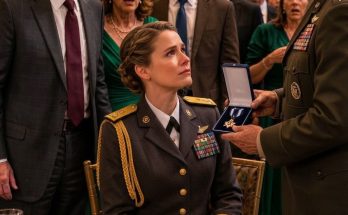
The General opened the medal case again.
“Captain.”
I faced him.
He held out the Distinguished Flying Cross.
“I came here tonight because Colonel Bennett believed you would refuse another ceremony.”
Despite everything, I almost smiled.
“He knows me well.”
A few people laughed nervously.
The General didn’t.
“He also believed your family should know what happened.”
My stomach tightened.
“Sir.”
There was a warning in my voice.
He heard it.
So did Mike.
The General looked at me for a long second.
Then nodded.
“Your choice.”
Dad looked between us.
“What happened?”
I stared at the medal.
My medal.
One I had refused to collect in front of cameras.
I hated ceremonies.
I hated applause for the worst day of my life.
Because medals make people imagine victory.
Alhadar had never felt like one.
Nine men came home.
Three aircraft did not.
A pararescueman named Evan Cole lost his left leg.
A twenty-three-year-old SEAL named Tyler Grant never woke up after the medevac landed.
And my wingman—
Major Hannah Price—
died eleven days later.
People saw ribbons.
I saw faces.
Mike’s voice came quietly from beside me.
“Tell him.”
I looked at him.
He wasn’t commanding me.
He was asking.
Dad swallowed.
“What happened to you?”
For the first time in my life, my father asked the question without sarcasm.
That almost made it harder.
I looked toward the windows.
Denver glittered below us.
Cars moved along the streets.
People walked beneath restaurant lights.
Normal life.
The kind of life you don’t appreciate until you have watched men fight for seconds of it.
“Mike’s team wasn’t supposed to be there,” I began.
Mike nodded.
“Classified reconnaissance operation.”
“The weather collapsed faster than forecast,” I continued. “Their extraction helicopter couldn’t get through. Ground support was hours away.”
Dad listened.
No interruptions.
“The first distress call came at 0217.”
I remembered it perfectly.
I always would.
“Mike’s team was trapped between two ridgelines. Enemy fighters were moving downhill. They had one functioning radio and almost no visibility.”
Mike closed his eyes.
“We requested close air support.”
I swallowed.
“We were denied.”
Dad frowned.
“Why?”
“Because the canyon was almost impossible to navigate safely in those conditions.”
Mike gave a humorless laugh.
“Almost?”
I looked at him.
“Impossible.”
A faint smile touched his mouth.
Then disappeared.
“The order came to hold outside the valley,” I said. “Command expected the weather to clear.”
“But we didn’t have that long,” Mike said.
“No.”
I could hear the radio again.
Shadow Watch, Reaper Six.
We have wounded.
Repeat.
Multiple wounded.
A voice behind static.
Another explosion.
Someone screaming.
Mike had sounded different then.
Younger.
Scared.
Nobody ever admits that part afterward.
But everyone is afraid.
Courage is what happens next.
“I asked for permission to enter the valley.”
The General spoke.
“You were denied three times.”
Dad looked at me.
I nodded.
“So I entered anyway.”
Several of Dad’s friends stared at me.
One whispered, “Jesus.”
Dad didn’t move.
“My wingman, Hannah Price, followed me.”
My voice almost broke at her name.
Almost.
“We descended below the cloud layer and followed the ravine by terrain mapping. We couldn’t see more than a few hundred feet ahead.”
Mike’s hands clenched.
“We heard the engines before we saw them.”
I remembered the tracer fire.
Orange lines climbing through snow.
Too beautiful.
That was the horrible part.
War could be beautiful for half a second.
Then something exploded.
“We took fire immediately,” I said.
“Lauren.”
Dad’s voice was quiet.
I ignored him.
“Hannah drew the first battery away. I went lower.”
The General’s expression stayed unreadable.
He knew the report.
He knew what came next.
“I made two attack runs.”
Mike shook his head.
“Four.”
I looked at him.
“Two effective runs.”
“Four.”
“Mike.”
“You came through four times.”
His eyes were wet again.
“The first pass destroyed the machine-gun position above us. The second hit the vehicles coming through the south entrance. The third—”
He stopped.
His jaw trembled.
“The third time, your aircraft was already smoking.”
Dad sat down.
Not gracefully.
He simply seemed to lose strength in his legs.
His chair caught him.
Mike pointed toward me.
“She had every reason to leave.”
Nobody looked at Dad anymore.
Everyone looked at Mike.
“She didn’t.”
My skin felt cold.
“Mike.”
“No.”
His voice cracked.
“You don’t get to minimize it tonight.”
He turned toward the room.
“Her right hydraulic system was failing. Part of her control surface was damaged. Her wingman was hit.”
Dad whispered, “Hannah?”
I looked at him.
He had never heard that name before tonight.
“Yes.”
“What happened to her?”
Silence.
The answer sat between us.
Dad’s face collapsed.
“Oh.”
I looked away.
Mike continued.
“Shadow Watch stayed.”
The call sign sounded strange in his voice.
Sacred somehow.
“She stayed because the medevac helicopter finally got a narrow approach window.”
I could see it.
Snow whipping sideways.
The helicopter appearing between the cliffs.
Tiny.
Vulnerable.
Enemy fire turning toward it.
“So I climbed.”
Dad frowned.
“What does that mean?”
“I made myself visible.”
Mike answered for me.
“She became the target.”
My father stopped breathing.
“At least three enemy positions shifted fire toward her aircraft,” Mike said. “That gave the helicopter enough time to reach us.”
Dad looked at me.
“You let them shoot at you?”
“It wasn’t quite that simple.”
“Yes, it was,” Mike said.
I gave him a look.
He ignored it.
“She pulled fire away from eight men she had never met.”
“Nine,” I corrected.
Mike stared at me.
“What?”
“There were nine.”
His lips parted.
“You knew?”
“I counted the thermal signatures.”
He rubbed both hands over his face.
“There were nine of us at the beginning.”
The room changed.
Something in his words.
I noticed.
So did the General.
“At the beginning?” Dad asked.
Mike didn’t answer.
I did.
“One man died before extraction.”
Mike looked at the floor.
“Tyler.”
I nodded.
His voice was almost inaudible.
“He was twenty-three.”
Nobody moved.
Mike lifted his head.
“But eight of us reached that helicopter.”
He turned toward me.
“Because of her.”
Then something unexpected happened.
My father started crying.
Not dramatically.
No sobbing.
No speech.
Just tears.
Silent.
He wiped one away angrily.
Then another came.
I had never seen my father cry.
Not even when Mom died.
At her funeral, he shook hands.
He thanked people.
He organized the reception.
He stood beside her coffin looking like a lawyer preparing to cross-examine grief.
But now the tears kept falling.
And somehow I hated them.
Because a part of me had wanted this moment for years.
I had imagined him finally understanding.
Finally regretting it.
Finally looking at me the way he looked at Daniel.
But seeing him broken didn’t heal anything.
It only made me realize how much time we had wasted.
Dad looked at the old flight-school photograph on the table.
“I never saw it.”
I closed my eyes.
“Stop saying that.”
“I didn’t.”
“Dad.”
“Lauren, listen to me.”
He reached toward the photograph.
His fingers shook.
“Your mother handled the mail then.”
That hit me so hard I actually stepped backward.
Daniel frowned.
“Mom?”
Dad looked at him.
“She was scared.”
I felt anger rise immediately.
“Don’t do that.”
“I’m not blaming her.”
“You don’t get to use Mom now.”
“I’m not.”
His voice broke.
“She begged me to stop you.”
The room disappeared.
All I could see was my father.
“What?”
“After your first aviation summer program.”
He stared down at the photograph.
“Your mother was terrified.”
“That’s a lie.”
“She knew I could be cruel about it.”
“You were cruel about everything.”
“Yes.”
No defense.
No excuse.
Just yes.
The simplicity stopped me.
Dad continued.
“But she was afraid because her brother died flying.”
My mind went blank.
“My uncle Robert?”
Dad nodded.
“You were told it was a car accident.”
I stared at him.
Dad took a trembling breath.
“He was training civilian aerobatics. Engine failure. Your mother was seventeen.”
Daniel whispered, “Why didn’t we know?”
“Because she never wanted to talk about it.”
Dad looked at me.
“When you became obsessed with flying, it terrified her. She begged me to discourage you.”
My chest felt tight.
“So you humiliated me for thirty years because Mom was afraid?”
“No.”
His answer came immediately.
“No. I did that because I was a coward.”
Nobody made a sound.
Dad looked around at his friends.
All the people he had performed for.
All the people whose approval he had valued.
Then he looked back at me.
“Your mother was afraid for a few years.”
He swallowed.
“I kept going long after she changed her mind.”
I couldn’t speak.
“Before she died,” he continued, “she told me she regretted asking me to push you away from flying.”
My throat tightened.
“She said you were happiest in the air.”
I remembered Mom driving me to the airport.
The sandwiches.
Go prove him wrong.
Maybe that had been her apology.
“She made me promise I would come to your commissioning.”
I laughed once.
A bitter sound.
“You didn’t.”
“No.”
“Because Daniel had dinner.”
“No.”
Daniel’s head snapped up.
Dad stared at me.
“I was in the parking lot.”
My heart seemed to stop.
“What?”
“I drove there.”
No.
“I sat in my car for almost two hours.”
No.
“I watched families walking inside.”
No.
“I had flowers on the passenger seat.”
“Stop.”
Dad’s eyes closed.
“I couldn’t go in.”
“Stop.”
“Because I had spent so many years telling you that you couldn’t do it—”
“STOP.”
My voice cracked across the room.
The General moved slightly but didn’t interfere.
I stepped toward my father.
“You do not get to turn cowardice into some tragic love story.”
Dad nodded.
“You’re right.”
“You were there?”
“Yes.”
“You were outside?”
“Yes.”
“And you let me stand inside looking at the door every five minutes?”
His face crumpled.
“Yes.”
My eyes burned.
I hated that more than if he had stayed home.
Because staying home meant he didn’t care.
Sitting outside meant he cared and chose himself anyway.
Daniel walked toward Dad.
“You told me you forgot.”
“I lied.”
“You lied to both of us.”
“Yes.”
Daniel laughed bitterly.
“All these years, you made me the golden child.”
Dad lowered his eyes.
“And you made Lauren think she was nothing.”
“Yes.”
“And what was I supposed to be?”
Dad looked at him.
“My proof.”
Daniel froze.
Dad’s voice dropped.
“My proof that I had raised at least one child who chose the life I understood.”
The words hit Daniel differently.
I saw it.
For years, I had envied my brother.
His law degree.
Dad’s praise.
The photographs in Dad’s office.
What I had never considered was what it felt like to be trapped inside the role Dad approved of.
Daniel pulled out a chair.
Sat.
Covered his face.