**Part 1**
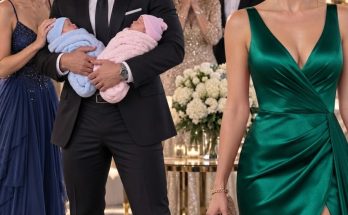
My husband had twins with my best friend and told me, “At last, I have the family you could never give me.”
THE FAMILY HE SAID I COULD NEVER GIVE HIM—AND THE QUIET TRUTH HIDDEN IN THE TWINS’ RESEMBLANCE
For the next four days, I heard nothing from Evelyn Lawson.
That was unusual.
Evelyn had never been a woman who allowed silence to occupy a room for long.
She filled empty spaces with questions, opinions, observations about other people’s table manners, and stories about ancestors nobody else remembered.
Yet after sending me those seven words—
You have no idea what you just confirmed.
—she disappeared.
I sent no follow-up.
There had been a time when I would have called immediately.
I would have asked what she meant, demanded an explanation, tried to organize the mystery the way I organized balance sheets.
But the divorce had taught me something uncomfortable.
Not every uncertainty had to be solved the moment it appeared.
Sometimes the truth came more clearly when you stopped chasing it.
So I went back to work.
Vextor Dynamics had become the one remaining thread connecting Christopher and me, and even that thread was fraying.
For nearly twelve years, I had been the person behind most of the financial discipline at the company.
Christopher had founded it with two engineers and a prototype.
I had helped turn it into something investors trusted.
He was brilliant at making people believe in possibilities.
I was good at making sure those possibilities could survive contact with a bank statement.
For a long time, we had made an effective team.
The mistake I had made was believing that effectiveness and intimacy were the same thing.
On Wednesday morning, I was reviewing vendor expenses when I came across Sonoran Strategy Partners again.
I had noticed the company before.
Three payments.
Then two more.
Then a sixth.
All approved personally by Christopher.
The invoices described “regional market research,” “technical consulting,” and “specialized advisory services.”
Except Vextor had no active clients in southern Arizona.
I printed every invoice and spread them across my dining table.
The mailing address belonged to a private mailbox in Tucson.
One of the attached expense reports contained a reimbursement for a hotel two blocks from Desert Bloom Reproductive Medicine.
The same fertility clinic Evelyn had asked me about.
I sat very still.
There were reasonable explanations.
Consultants traveled.
Executives stayed in hotels.
Tucson contained more than one medical building.
I had spent enough years examining financial irregularities to know the danger of finding the conclusion you wanted and forcing the evidence to fit it.
So I closed the folder.
At 6:18 that evening, Evelyn finally called.
“Are you home?”
“Yes.”
“Alone?”
I almost smiled.
“Evelyn, Christopher moved out months ago.
Who exactly are you expecting to be here?”
“That wasn’t what I meant.”
Her voice sounded different.
Not frightened.
Not dramatic.
Simply tired.
“What happened?” I asked.
She was quiet for several seconds.
“They came today.”
I knew exactly who she meant.
Christopher.
Michelle.
The twins.
I walked over to the windows.
San Diego was turning gold beneath a late afternoon sky.
Traffic moved far below my apartment, orderly and indifferent.
“How are the babies?”
It was the first question that came to me.
Evelyn softened.
“Beautiful.
Both of them.
The little girl slept through almost everything.
The boy spent most of the afternoon looking offended by the existence of ceiling fans.”
A laugh escaped me before I could stop it.
That sounded like Christopher as a baby, according to stories Evelyn had told hundreds of times.
Then she said, “Victoria, I need to tell you what happened.”
I pulled out a chair.
“Go ahead.”
Christopher had arrived at the Lawson family home shortly before noon.
Evelyn’s younger sister Diane was there.
So were two cousins and Christopher’s uncle Martin, who had driven in from Scottsdale.
Nothing formal had been planned.
Evelyn had made lunch.
Michelle brought lemon cake.
Christopher carried the little boy in one arm as if he had been practicing for weeks.
According to Evelyn, he looked genuinely happy.
That detail mattered to me.
Even then, after everything, it mattered.
I did not want him miserable.
I simply no longer wanted his happiness to require my humiliation.
Evelyn had taken the baby from him and walked toward the large front windows.
The little boy opened his eyes.
He had Michelle’s dark hair.
But the shape of his brow, the slight curve at the corner of his mouth, and one particular expression stopped Evelyn so abruptly that Diane asked if she felt faint.
“I knew that face,” Evelyn told me.
“Christopher’s?”
“No.”
She paused.
“Owen’s.”
I frowned.
“Owen Lawson?”
Christopher’s cousin lived in Tucson.
I had met him perhaps eight times in twelve years.
He was an architect, quiet and dryly funny, married to a woman named Claire.
They had two daughters in middle school and a son in college.
I remembered him mostly because he was one of the few Lawsons who never seemed interested in discussing the Lawson name.
At Thanksgiving one year, Evelyn had given a speech about the family’s hundred-year history in Arizona.
Owen had leaned toward me and whispered, “Technically, half of us came from Ohio in 1978.”
I had nearly choked on my wine.
“What do you mean, Owen’s?” I asked.
“I mean Owen at that age.
Exactly.
Not generally.
Not one of those vague family resemblances people invent because babies have the same nose.”
Evelyn inhaled.
“I have photographs.”
“What did you say?”
Another pause.
Then she told me.
She had been standing near the window holding the baby when Michelle joined her.
Evelyn looked from the little boy to Michelle.
Then to Christopher.
Apparently Christopher recognized the change in his mother’s expression immediately.
Before he could say anything, Evelyn asked Michelle quietly, “He never told you about that resemblance?”
Michelle had gone pale.
Not Christopher.
Michelle.
Christopher had crossed the room and said, “Mother, this isn’t necessary.”
And that sentence had told Evelyn nearly everything she needed to know.
“What happened next?” I asked.
“Nothing dramatic.”
That sounded like a correction directed as much at herself as at me.
“I handed the baby back to Michelle.
Diane took the little girl into the garden.
Martin suddenly became fascinated by the coffee machine.”
Despite everything, I smiled.
“That sounds like Uncle Martin.”
“He attempted to make six cups of coffee for five people.”
Then Evelyn’s voice became quiet again.
“I asked Christopher whether Owen was the donor.”
The word landed softly.
Donor.
For several moments, I simply looked at the table in front of me.
All those months of Christopher talking about his son.
His daughter.
His blood.
His legacy.
The family I could never give him.
“Victoria?”
“I’m here.”
“He said yes.”
I closed my eyes.
There were many things I might have felt.
Satisfaction would have been understandable.
Anger would have been justified.
Instead, what came first was exhaustion.
Not because Owen was the biological father.
That part, in itself, meant almost nothing.
Families were made in dozens of ways.
What exhausted me was the unnecessary lie built around it.
Christopher had taken two innocent babies, a private fertility decision, and the end of our marriage and arranged them into a story where he had won something over me.
“Did Michelle know?” I asked.
“Yes.”
That hurt differently.
“How long?”
“I don’t know everything yet.”
“Evelyn.”
“I truly don’t.”
I heard movement at her end of the call.
A door closing.
Then her voice lowered.
“Claire called me six weeks ago.”
“Owen’s wife?”
“Yes.”
“She knows?”
“She has always known.”
That stopped me.
Evelyn explained.
According to Claire, Christopher had contacted Owen more than a year earlier.
He and Michelle had already been undergoing fertility treatment in Tucson.
Michelle was thirty-eight, and her doctor had told her that waiting indefinitely might reduce her chances of carrying a pregnancy using her own eggs.
Christopher’s fertility tests had shown unexpectedly poor results.
Not impossibility.
Not sterility.
But enough uncertainty that their doctor had discussed several options.
One was IVF using Christopher’s sperm.
Another was donor sperm.
Christopher had rejected an anonymous donor.
He wanted someone genetically related to him.
He wanted, as he apparently told Owen, “the children to still be Lawsons.”
I almost laughed when Evelyn repeated that.
Not because it was funny.
Because sometimes hypocrisy became so precise that it approached absurdity.
“So Owen agreed?”
“Eventually.”
“Why?”
“Because Christopher told him your marriage was over.”
My fingers tightened around the phone.
Evelyn continued carefully.
“He said you had been living separate lives for a long time.
He said the legal paperwork was delayed because of the company.”
I stared out at the lights appearing along the waterfront.
“That wasn’t true.”
“I know.”
“When did Christopher contact Owen?”
“Claire thinks it was last summer.”
Last summer.
In July, Christopher and I had spent a week in Carmel.
We had walked along the beach every morning.
We had discussed renovating the kitchen.
One evening, he had held my hand across a restaurant table and told me that the strain between us was temporary.
In August, he suggested we stop fertility treatments for a while.
He said they were making us treat our marriage like a project.
I had believed him.
I had even been grateful.
“We weren’t separated,” I said.
“I know.”
“Not emotionally.
Not legally.
Not physically.”
“I know.”
The anger arrived then.
Not explosive.
Cold.
Exact.
The kind that clarified things.
“What did Claire want from you?”
“She wanted to know whether you knew.”
“Knew what?”
“That Owen had been the donor.”
I stood.
“No.
Obviously I didn’t.”
“I told her that.”
“And?”
“She became very quiet.”
Something in Evelyn’s tone made me turn away from the window.
“What else?”
“Claire believed Christopher had already told the immediate family.”
“Why would she believe that?”
“Because Owen insisted on it.”
I sat again.
Evelyn explained that Owen had never been comfortable with secrecy.
He was not interested in being a parent to the twins.
The agreements at the clinic were explicit.
Christopher would be their intended and legal father.
But Owen believed the adults in the family should know enough to prevent confusion later.
Especially because the children might resemble him.
Especially because medical history mattered.
Especially because children eventually asked questions.
Christopher had apparently assured him that everyone important knew.
“He lied to Owen too,” I said.
“It appears so.”
“And Michelle?”
“I don’t know what Christopher told her about what the rest of us knew.”
I thought about my best friend of eighteen years.
There had been a point, months earlier, when I was still capable of inventing excuses for her.
Loneliness.
Confusion.
Christopher’s charm.
A friendship that had become emotionally blurred.
But whatever story Michelle had told herself, she had known he was married.
She had known me.
That fact remained.
Still, the more I learned, the less simple everyone became.
“What happened at the house after you asked about Owen?”
Evelyn sighed.
“Christopher said the children were his regardless of genetics.”
“He’s right.”
“I told him so.”
That surprised me.
“I said fatherhood was not a laboratory result.
If he loved those children, protected them, raised them, and showed up for them every day, then he was their father.”
I swallowed.
“Then what was the problem?”
“My problem,” Evelyn said, “was that he spent months using biology to punish you while privately knowing biology was not what made him their father.”
That silenced me.
There are moments when someone says the sentence you have been avoiding because hearing it aloud would make it too real.
That was one of them.
“He told me I was twisting things.”
“Were you?”
“No.”
For once, Evelyn sounded entirely certain.
“I asked him why he had needed to say those things about you.
Why he had turned the babies into proof that something was wrong with you.”
I lowered my eyes.
“What did he say?”
“Nothing useful.”
I could imagine him.
The tightened jaw.
The defensive silence.
Christopher had always been eloquent when he was selling an idea and nearly mute when someone found the flaw in it.
“What did Michelle say?”
“Very little.”
Evelyn paused.
“But before they left, she asked whether she could speak to me alone.”
I waited.
“She said she thought you knew.”
I actually laughed.
It was one short, humorless sound.
“She thought I knew she was having children with my husband?”
“No.
She meant the donor.”
“That distinction is not helping her as much as she probably thinks.”
“I agree.”
“What else?”
“She said Christopher told her you had stopped wanting children.”
The room seemed to narrow.
I remembered every appointment.
Every injection.
Every laboratory waiting room.
Every month I had opened an app and watched another hopeful date become another ordinary day.
I remembered sitting beside Christopher in a fertility specialist’s office while a doctor explained that sometimes there was no clean answer.
Unexplained infertility.
Two words that sounded almost gentle until you lived inside them.
“I never said that.”
“I know.”
“He knew I never said that.”
“I know that too.”
I rose and walked into the kitchen.
My glass of water had gone warm.
“I need to go, Evelyn.”
“There is one more thing.”
Of course there was.
“What?”
“I asked Christopher whether he used company money to pay the clinic.”
Every thought in my head stopped.
“How do you know about that?”
“I didn’t.”
“You guessed?”
“I knew Christopher was worried about money last year.
Fertility treatment is expensive.
He once told me Vextor covered executive health benefits that were ‘more flexible than people realized.’”
I looked toward the folder on my dining table.
Sonoran Strategy Partners.
Six invoices.
A Tucson hotel.
“What did he say?”
“He told me to stay out of his business.”
That was not an answer.
Unfortunately, in my experience, it was often the answer before the answer.