**Part 1**
The first time I saw my father in sixteen years, I wasn’t allowed anywhere near his coffin.
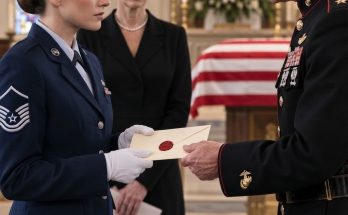
I stood in the back of a crowded church wearing my Army dress blues while my stepbrother blocked the aisle like a bodyguard and told me I wasn’t family anymore.
What none of them realized was that my father had spent sixteen years hiding something powerful enough to destroy every lie they built against me.
Rain hammered the stained-glass windows of the cathedral the morning we buried Richard Carter.
It came down hard enough to blur the parking lot beyond the doors and turn every person entering the church into a dark shape under an umbrella. By the time I stepped inside, the shoulders of my dress blues were dotted with rain, and my polished shoes carried a thin shine of water from the stone steps.
I had imagined seeing my father again more times than I could count.
None of those versions looked like this.
The pews were crowded with people who knew Richard Carter as a respected man. Business owners. Church members. Old friends. Men who shook his hand after services. Women who probably brought casseroles when Patricia told them he was sick.
They knew the version of my father Patricia had carefully preserved.
They knew the version of our family she wanted people to see.
They didn’t know me.
Or maybe some of them remembered me and had decided not to show it.
Major Emily Carter. Thirty-four years old. A decorated Army officer who had spent years learning how to enter hostile places without letting fear show on her face.
And there I was, standing in the last pew of my own father’s funeral like I had wandered into the wrong church.
Six rows ahead, my father rested inside a polished walnut casket surrounded by white lilies.
From where I stood, I could barely see him.
Just the line of his forehead. The angle of his cheek. The silver in his hair beneath the chapel lights.
The silver was what nearly broke me.
In my memories, his hair was still dark.
He was still the man who used to stand in the kitchen with a coffee mug in one hand while my mother teased him about leaving cabinet doors open. He was still the father who taught me to ride a bike and ran behind me longer than he needed to because I was convinced I would fall the second he let go.
Sixteen years had passed without me seeing what time had done to him.
Now time was the only thing I could see.
I took one step toward the center aisle.
Ryan moved in front of me.
My former stepbrother wore an expensive black suit that fit him perfectly. His hair was neat, his shoes polished, his expression controlled. He carried himself with the same confidence he had developed as a teenager, back when he learned that Patricia’s rules would always become everyone else’s reality if she repeated them calmly enough.
“Back row, Emily,” he said.
He didn’t raise his voice.
He didn’t have to.
I looked past him toward the front.
Patricia sat in the first pew wearing a black veil. Her hands rested neatly in her lap, and her posture was so composed she could have been posing for the version of grief she wanted everyone to remember.
She never turned around.
She didn’t need to.
Ryan had always been good at carrying out instructions Patricia never seemed to give in public.
For years, that had been her greatest talent.
She never had to shout.
She could ruin someone with a soft voice, a sympathetic smile, and a story repeated just carefully enough that everyone else began telling it for her.
She was the woman people described as gracious.
Patient.
Devoted.
The woman who stepped in after tragedy and helped a grieving widower rebuild his life.
That was the story.
The part people didn’t talk about was how quickly rebuilding my father’s life required dismantling mine.
“I came to say goodbye to my father,” I told Ryan.
His eyes traveled over my uniform for a second before returning to my face.
Then he smiled.
“The front rows are for family.”
I had survived combat zones.
I had stood in places where every instinct told me to move faster, speak louder, make a decision before hesitation became dangerous. I had led soldiers through moments that demanded clarity when fear would have been easier.
I had written letters to families who lost sons and daughters far too young.
I had watched strong people receive news that permanently divided their lives into before and after.
But two words from Ryan reached past every piece of armor I had built.
Family only.
For one moment, I wasn’t thirty-four.
I was fourteen again, sitting beside my mother’s hospital bed.
Helen Carter had been thin by then. Cancer had taken weight from her face and strength from her hands, but it had not taken the way she looked at me when she wanted me to remember something.
She curled her fingers around mine and whispered, “Don’t let them erase us.”
At fourteen, I didn’t understand what she meant.
I thought she was afraid I would forget her voice, or the smell of her hand lotion, or the way she hummed while making dinner.
I promised I wouldn’t.
I didn’t know she was warning me about something larger than memory.
After Mom died, Patricia did not arrive all at once.
That would have been easier to recognize.
At first, there were coffee visits.
Then church events.
Then small favors for my father, offered with the kind of concern nobody could reasonably object to.
She brought things by. She stayed longer. She spoke to me gently whenever other people were around.
Ryan started coming with her.
At first, he was just another kid sitting in our living room.
Then his shoes began appearing by the front door often enough that they stopped looking temporary.
Before long, Patricia was helping decide what groceries came into our kitchen, where things belonged, what schedules made sense, and what my father supposedly needed in order to move forward.
Then she moved in.
My mother’s bedroom became Patricia’s room.
The change happened so quickly that I remember standing in the doorway one afternoon and staring at unfamiliar clothes where my mother’s things had been.
Nobody had asked me whether I was ready.
Nobody even used the word ready.
The house simply changed around me.
Then my bedroom became Ryan’s.
Patricia explained that he needed the space more than I did.
My father stood nearby while she said it.
I waited for him to correct her.
He didn’t.
I was sent to the basement.
There was no dramatic family meeting. No screaming fight that neighbors could hear. No single moment I could point to later and say, That was when I stopped belonging.
It happened through ordinary decisions.
A room reassigned.
A photograph moved.
A question answered for me before I could speak.
A holiday plan made without asking what I wanted.
A hundred small changes that taught me the same lesson long before anyone was cruel enough to say it out loud.
There was less and less room for Helen’s daughter in the family Patricia was building.
The town saw something different.
They saw Patricia standing beside my father at church.
They saw her smiling when people asked how we were doing.
They saw her speaking kindly about how difficult grief could be for a teenager.
And eventually, they saw me exactly the way she described me.
Angry.
Difficult.
Ungrateful.
A girl who refused to accept that her father deserved happiness after losing his wife.
What they didn’t see was the basement.
They didn’t see the way decisions had already been made before I entered the room.
They didn’t see how often my father looked away when he should have spoken.
They didn’t see me learning that silence from someone you love can hurt as much as cruelty from someone who never loved you at all.
By eighteen, I understood that staying would not make anyone choose me.
So I packed one suitcase.
I left a note behind.
I can’t live where I’m unwanted.
That was all I wrote.
No accusation.
No long explanation.
No list of everything Patricia had done or everything my father had failed to stop.
I walked out believing that if my father wanted me back badly enough, he would come after me.
He didn’t.
The Army gave me something I desperately needed then: a place where expectations were clear.
Do your job.
Keep your word.
Take responsibility for the people depending on you.
None of it was easy, but it was understandable.
Over the years, I became good at living without expecting anything from the house I had left behind.
Promotions came.
Assignments changed.
People began calling me Major Carter.
I learned how to stand in front of others with confidence even when I was exhausted. I learned how to make difficult decisions and live with them. I learned that leadership was not about being the loudest person in a room. It was about being willing to carry responsibility when everyone else wanted somewhere to put it down.
But there were parts of me the uniform never touched.
Every so often, I would wonder whether my father still kept anything of my mother’s.
Whether he ever walked past the basement and thought of me.
Whether he had read my note once or a hundred times.
Whether Patricia had told him I hated him.
Whether he believed her.
Whether he preferred believing her because the alternative required admitting what he had allowed.
I never got answers.
And then the call came that Richard Carter was dead.