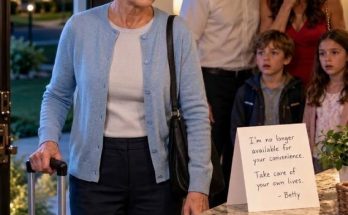
Part 1: The Decision and the Porch
I bought the house in 2011.
I want to say this at the beginning because it is a fact, and facts are the things this story eventually turned on, and I am a person who believes in the orderly presentation of facts before interpretation.
I bought the house in 2011, two years before I met Mark, with a down payment I had saved over six years working as a supply chain analyst for a regional distribution company, a job I had taken at twenty-four because it paid well and because I was good at it and because I had grown up in a
house where the lesson about money, stated and restated until it was bone-deep, was that the person who owned the building had a fundamentally different experience of life than the person who lived in it.
My father owned a small hardware store for thirty-one years and lost it in the recession, and in the years after losing it he paid rent to a landlord who could raise it whenever he chose, and the watching of this had produced in me a specific and thorough understanding of what I wanted,
which was to own the thing I lived in and to own it in my name and to have the mortgage and the tax statements and the homeowner’s insurance all addressed to Claire Bennett, because Claire Bennett was the person paying them.
The house on Alderwood Drive was a four-bedroom colonial with a yard and a study and a kitchen that had been updated in the nineties and needed another update but had good bones and good light, and I had been in the house for two years when I met Mark at a work event, a vendor
dinner that I had almost skipped because I was tired and had a report due.
Mark was in commercial real estate, which seemed ironic later and perhaps should have told me something from the beginning, though I do not think it tells you anything about a person that they work in real estate, only that they understand the general principle of property value.
We dated for a year and got married in 2014.
I want to describe the marriage accurately, because accuracy is what I owe it. The marriage was good in many of the ways that matter. Mark was present, mostly. He was funny in the specific way of men who have good timing rather than good material. He was generous with the people he
loved and he loved me in his way, which was a way that expressed itself through action rather than language, through the appearing and the doing rather than the saying.
The marriage was also, in ways I had learned to navigate around rather than through, organized around a set of assumptions that I had never fully examined because examining them would have required a confrontation I was not ready to have.
The assumptions had to do with what was his and what was mine and what was ours, and where the lines between those categories fell, and who got to draw them.
Mark had never been on the mortgage. This was not a deliberate exclusion at the time of the marriage. It was a fact of the timeline: the house was already mine when he arrived, the mortgage was already in my name and half paid, and the question of adding him to the title had come up
once, briefly, in the first year of the marriage, when Mark had mentioned it in a general way, and I had said something about refinancing being complicated and we had moved on and not returned to it.
I had not returned to it because I had, somewhere in the examining of that conversation, recognized that I did not want to, and had allowed myself not to want to without explaining to myself precisely why.
Diane, Mark’s mother, was a woman of seventy-four who had the specific quality of women who have been formidable their entire lives and who approach age as an insult rather than an inevitability. She was sharp and she was funny and she was, in the specific way of certain mothers with
only sons, completely organized around Mark’s wellbeing as the central project of her existence.
She had been warm to me, mostly. The warmth had always had a texture to it that I had attributed to personality and had eventually come to understand as conditionality, that she was warm to me in the specific way of someone who is warm to the satellite orbiting the thing they actually
love.
She made comments. Not the pointed comments of a woman who has decided to be difficult, but the softer comments of a woman who has a worldview and is simply sharing it without considering that the sharing is itself a statement about what she believed.
How lucky I was that Mark provided so well.
How nice it must be not to worry about money.
How proud she was that he’d done so well for himself.
I had heard these comments for nine years and had understood them as evidence of an old-fashioned sensibility, the worldview of a woman who had been raised to understand that a man providing for his family was the natural order. The comments had not previously required me to
correct them.
This was the second error. The first was not having the direct conversation, at any point in nine years, about what it meant that the house was mine.
The text arrived at 4:17.
Mom’s moving in. It’s already decided.
I read it twice. Then I called him. He answered on the fourth ring.
I said: “What does already decided mean?”
He said his mother needed somewhere to stay.
I said: “When were you planning to ask me?”
He said: “She’s my mother.”
I said: “I know who she is.”
He told me about the rent increase, the apartment she hated, and how Lisa’s spare room was unavailable because Lisa worked from home selling commercial insurance—meaning my office was apparently available for public housing.
I said: “You already picked my office.”
He said: “I’m trying to make this work.”
I said: “You already made it work. I’m just finding out what my part is.”
We went around it for another few minutes, and when I asked directly whether his mother was already on her way, he hung up. Callbacks went straight to voicemail.
At 5:11, I heard tires in the driveway.
Diane got out first, wearing white capri pants, a navy blouse, and large sunglasses. Then Lisa got out of the passenger side. Lisa was carrying a storage bin. The back of the SUV held three rolling suitcases, two bins, a garment bag, a canvas tote, and a peace lily.
The doorbell rang. I opened the door.
Diane smiled. “Which room did Mark clear out?”
“He didn’t,” I said.
The smile went. “What do you mean?”
“He didn’t clear out a room.”
Lisa shifted the bin on her hip. “Oh Claire, don’t start.”
“I haven’t started anything. You’re the ones standing on my porch with luggage.”
Diane insisted Mark had said she could stay.
I stayed where I was. “Diane, you’re welcome to come in and sit down. You’re not moving in today.”
Lisa pulled out her phone and pointed it at me. Diane tried calling Mark, who didn’t answer.
Diane snapped, “My son owns this house.”
The words were right there to correct her, but I stopped myself. Saying it to Diane would be correcting a misunderstanding Mark should have never allowed to exist. Diane knew the narrative Mark had permitted, and I wanted Mark to be the one to revise it.
Diane dialed another number. Lisa said, “Mom, don’t.”
“Who are you calling?” I asked.
She said: “911.”
When the dispatcher answered, Diane announced at full volume that her daughter-in-law had locked her out of her son’s house. I stood in the doorway and waited for Mark.
Part 2: The Police and The Awkward Question
At 5:34, Mark’s car turned into the driveway. At almost the same moment, Officer Ruiz’s cruiser came around the corner.
Mark saw his mother, Lisa, the suitcases, and the flashing lights. For the first time all afternoon, he looked like a man who understood exactly how badly he had miscalculated. He looked like a man trying to figure out which side of a thing would cost him less, calculating the cost of the truth
about his own house.
Officer Ruiz got out with the methodical quality of someone used to clearing up domestic misunderstandings.
Diane rushed to him immediately. “Officer, thank goodness!” She explained that her daughter-in-law was refusing to let her into her son’s house.
Ruiz looked at me. “Ma’am?”
“My name is Claire Bennett. I live here.”
Ruiz asked Diane if she lived at this address or received mail here. She said no, but her son had told her she could stay.
Officer Ruiz turned to Mark and asked the question that changed everything:
“Sir, do you own the property?”
The silence that followed was the kind of silence that has its own weight. Mark looked at me, then at his mother, then at Officer Ruiz.
Mark said: “Claire, can we please stop embarrassing everybody?”
Not we handled this badly. Not I handled this badly. Just can we please stop embarrassing everybody—directed at me, meaning: stop making this uncomfortable by insisting on the truth.
Officer Ruiz waited. “Sir, I still need an answer.”
Mark said: “It’s complicated.”
“It isn’t,” I said.
Everyone looked at me.
“The house is in my name. I purchased it in 2011, two years before Mark and I met. My name is the only name on the deed and the mortgage. Mark has never been on the title.”
The silence was a different kind now. Diane’s expression shifted from indignant to recalculating. Lisa lowered the storage bin. Mark looked down at the driveway.
Officer Ruiz nodded. “So you’re the homeowner.”
“Yes.”
“And you were not consulted about Mrs. Bennett moving in?”
“My husband informed me by text at four-seventeen this afternoon that his mother was moving in. I was told it was already decided. I called to discuss it, he ended the call, and forty-five minutes later his mother arrived with luggage.”
“And you declined to let her in?”
“I told her she was welcome to come inside as a guest, but the luggage would need to stay outside until my husband and I had spoken. She called the police.”
Officer Ruiz turned to Diane. “Ma’am, the homeowner has the right to determine who does and does not move into the property. Your son making that commitment without her knowledge doesn’t create a legal right to occupy the home.”
Diane protested, “She’s my son’s wife.”
“Yes ma’am. That doesn’t change property law.”
He advised Mark to have a conversation with his wife about how to handle things going forward, confirmed there were no safety issues, and drove away.
Left standing in the driveway, Lisa put the storage bin down on the concrete. Diane took off her sunglasses and looked at Mark with an exposed expression I had never seen before.
“You told me this was your house,” Diane said.
Mark said: “I never said that.”
Diane replied: “You never said it wasn’t.”
I broke the heavy silence. “Diane, would you like to come inside? Lisa too. We should all talk.”
Part 3: The Truth and The Pruning
We went inside. I put the kettle on.
Diane sat at the kitchen table, Lisa beside her, and Mark across from them. I set down the cups and sat down.
“Mark,” I said, “this house has been mine for twelve years. You have known this for the entire nine years we have been together. And at no point, in nine years of comments from your mother about how lucky I was that you provided so well, did you correct her.”
Mark tried to interrupt, but I continued. “I don’t know why you didn’t correct her. Maybe you thought it was harmless, or maybe it felt easier to be thought of as the provider in a traditional sense. But the version of our marriage your mother and sister believe in is not the marriage we have.”
Diane turned to Mark, her face pale. “Is this true?”
Mark mumbled: “The house is Claire’s. I’ve always known that.”
“You never told me!”
“It didn’t come up.”
Diane’s voice rose. “I made comments for nine years about this woman’s house being your house! You let me!”
Diane then turned to me. “I owe you an apology. For nine years of comments. I didn’t know what I was saying. I thought I was talking about my son’s success. I didn’t understand I was erasing yours.”
Lisa apologized as well for pulling out her phone and trying to force the situation.
I looked at Mark. “When Officer Ruiz asked whose house it was, you said it was complicated. You chose to protect yourself from the awkwardness of admitting the truth rather than tell it. You left me standing in my own driveway without the most basic acknowledgment of what is true.”
Mark put his hands on the table. “I’ve been calculating a lot of things wrong.”
Diane looked down. “I should look at the senior community in Lanexa again. I came here with my expectations without asking Claire, assuming because Mark said it was fine. I treated this house like it was mine to make decisions about. It’s not true here.”
“The offer stands,” I told Diane. “If you need somewhere to stay while you sort out a better arrangement, you can stay here for three weeks. As a guest. In the guest room, which I choose.”
“Why?” she asked.
“Because you’re seventy-four, your rent went up, and despite everything today, you’re family. The way today went was not entirely your fault; you were given a wrong version of reality. That’s on Mark.”
We spent the next hour working through the logistics. Diane would stay in the guest room for three weeks while she, Mark, and Lisa thoroughly researched the Lanexa community and other options.
The next day, Diane moved into the back bedroom. She brought her peace lily, which we placed on the windowsill.
Standing by the window looking out at the yard, Diane said softly, “I asked Mark, years ago, why the house was in your name. He told me it was a tax thing. I didn’t ask again… I chose to accept his explanation because it was convenient.”
“We all accept convenient explanations sometimes,” I said.
“You built this,” she said. “And he should have told me: Mom, Claire built this, and I’m the lucky one.“
“Yes,” I said. “He should have said that.”
Later, I went into the kitchen to find Mark. He looked at me, genuinely remorseful.
“I should have told her years ago,” Mark said. “I liked the version where I was the provider. The not-correcting was comfortable… I’m sorry.”
“Is sorry enough?” I asked.
“What comes after it is that I fix the narrative,” Mark said. “With my mother, with Lisa, with everyone else. And whenever decisions involve this house, I ask you first.”
“We can start from there,” I agreed.
He looked out the window toward the yard. “I heard what Mom said earlier about the roses. That you’ve been cutting them too short.”
“So do you,” I said. “Apparently we’ve been doing it wrong together. We can learn to do it right together.”
He gave a slight, genuine smile. “Go check on your mother,” I told him.
After he left the room, I stood in the kitchen looking out over the house I had owned for twelve years. The distinction between what was mine and what was ours had finally been drawn. The work ahead of us was going to be difficult, but for the first time, it was built on what was real.
I put the cups in the dishwasher and started dinner.
THE END