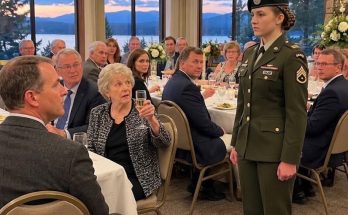
I said nothing. Seven days later, she stormed into my house and screamed, “Who do you think you are, abandoning your own family?” But she never imagined I had quietly prepared something that would leave her completely speechless the moment she saw it…
I brought my daughter into this world in the sterile silence of a military hospital. My husband was stationed a thousand miles away, bound by federal orders he couldn’t break. So, I labored alone.
After fourteen agonizing hours, when the nurses finally laid Iris’s slick, warm body against my bare chest, the brutal marathon faded. My mind, usually a chaotic battlefield of anxieties and obligations, was blissfully empty. But that fragile peace lasted exactly ten minutes—until I reached for my phone.
There was no inquiry about my survival. No acknowledgment of the harrowing labor. No mention of her new granddaughter. Just a single text message from my mother, Diane:
“Rachel’s kids are begging for new gaming consoles for their birthdays. I need you to wire me $3,000 tonight before the holiday sale ends.”
I stared at the glowing screen. For a decade, my military salary had been quietly treated as the official slush fund to cover my older sister Rachel’s chaotic, irresponsible life. I used to naively believe I was being a dutiful daughter, holding the roof up. But lying there, trembling, exhausted, and stitched up from childbirth, a profound shift occurred within me. The fog of obligation burned off.
I wasn’t their savior. I was a hostage funding my own captivity. For the first time in my thirty-two years of life, I turned the phone facedown on the plastic tray. I did not reply.
My absolute silence triggered a war.
Exactly one week later, I was pacing the worn living room rug, desperately bouncing a colicky Iris against my shoulder. I was running on four hours of sleep. My phone was vibrating endlessly. Rachel had shifted from pleading to weaponized guilt: “Don’t punish innocent children just because you are feeling stressed out by your new life. After everything mom and I have sacrificed for you, is this really the cold, arrogant person you’ve become?”
After everything they had sacrificed for me? What was that, exactly? Allowing me to pay off Rachel’s maxed-out credit cards? I shoved the bitter thoughts away, focusing on Iris. She was finally drifting to sleep.
Suddenly, without a single knock.
The heavy front door was violently thrown open, slamming against the drywall with a noise like a gunshot. My stomach dropped into my knees. My mother stomped across the threshold, not bothering to remove her wet shoes. She looked like a ruthless CEO preparing to fire a subordinate, not a grandmother meeting her newborn grandchild for the first time.
She didn’t glance at the tiny blanket swaddled against my chest. Instead, she pointed a manicured finger directly at the bridge of my nose.
“What on God’s green earth is wrong with you, Elena?” she bellowed, her harsh voice echoing off the vaulted ceiling.
Iris violently jerked against my collarbone. Her tiny face crumpled, and she unleashed a piercing, terrified shriek.
And right there, standing on the faded living room rug, the absolute final frayed thread holding my obedience together for thirty-two years… snapped.
Part 2
The rupture inside me wasn’t an explosive, screaming meltdown. It was the exact opposite. It was a sudden, terrifying drop in temperature.
I didn’t yell back. That clearly threw her off balance. I stood perfectly straight, ignoring the agonizing pull in my lower abdomen. I cradled my wailing daughter closer to my chest, shielding her ears, and locked my eyes directly onto my mother’s.
“You need to lower your voice right this second,” I stated. My voice was a dead, flat monotone. “Or you will leave my house immediately.”
Diane blinked. Her mouth opened, but no sound came out. She stared at me as though I had just spoken to her in dead Latin. She had genuinely believed that my boundaries were mythical constructs, easily trampled with enough volume.
“I am your mother, and I will speak in whatever tone I damn well please,” she finally hissed, attempting to reclaim her high ground. “Do you have any idea how much grief you are causing Rachel? She is drowning. Those children deserve better. You are the one with the stable government paycheck. It is your fundamental duty to keep this family afloat!”
She was screaming these mandates at a woman who was still physically bleeding from childbirth. She viewed my postpartum vulnerability not as a state requiring care, but as a temporary inconvenience to her financial extraction plan.
“I am not sending you a single cent,” I replied, the words dropping like heavy stones onto the floorboards between us. “Not today. Not tomorrow. Never again.”
Part 3
Diane stood frozen, her manicured finger hovering in the air like a broken compass. For three decades, her rage had been an invincible force, a tidal wave that consistently flattened every boundary I attempted to erect. She had conditioned me to believe that her anger was a fatal storm, and that my only survival strategy was absolute compliance. But watching her face contort—not with genuine concern for my well-being or her crying newborn granddaughter, but with the raw, ugly fury of an entitled landlord losing a passive income stream—the illusion completely disintegrated.
“Never again?” Diane echoed, her voice dropping into a dangerous, weaponized octave. “Do you hear yourself, Elena? You are standing there talking to your mother like I am some stranger off the street! After thirty-two years of raising you, feeding you, and putting up with your endless coldness, this is how you repay me? Because you had a baby? Women have babies every single day! You are not special!”
Iris continued to scream against my chest, her tiny fists balling into tight knots, her face flushed dark red. The sheer volume of Diane’s shouting vibrated through my ribs, but strangely, my heart rate began to slow down. The frantic adrenaline that usually accompanied her outbursts dissipated, replaced by a crystalline, icy clarity.
“I am giving you five seconds to walk out that door,” I said, my voice dangerously calm. “If you take one more step toward me or raise your voice again, I will dial security.”
“Security?” Diane sneered, taking a deliberate step forward, her heavy boot coming down hard on my clean rug. “This is base housing, Elena! What are you going to tell the military police? That your poor, heartbroken mother came to see her grandchild and you had her dragged off? Go ahead! Call them! Let everyone know what an ungrateful, malicious monster you really are!”
She stepped closer, her perfume—thick, floral, and suffocating—filling my lungs. She leaned in, her eyes narrowed into slit-like daggers, targeting the exact insecurity she had spent my entire childhood constructing. “Penny is your sister. Her children are your flesh and blood. You sit here in your warm house with your officer husband’s military benefits, holding back money that could give those innocent kids a decent birthday. You think you’re better than us now? You think because you wear that uniform you’re above this family?”
“I am above being robbed,” I replied.
Diane gasped, a dramatic, performative gasp that lacked any real weight. “Robbed? We are a family! Family shares! Family supports each other!”
“Family doesn’t text a woman ten minutes after she almost bleeds out on an operating table asking for three thousand dollars for gaming consoles,” I said, every word delivered like a precise, surgical cut. “Family doesn’t burst into a home without knocking, screaming at a seven-day-old infant, because their monthly stipend was cut off. You didn’t come here to see Iris. You didn’t even bring a blanket, or ask if I was breathing. You came here to collect a tax.”
Diane’s face paled, then turned a mottled, furious purple. She looked around the modest living room as if searching for an audience, for someone to validate her indignation. But there was no one—just me, my wailing child, and the dead silence of a boundary finally held tight.
“You’ve changed,” Diane spat out, her tone souring into pure contempt. “Ever since you married Marcus, you’ve acted like you’re too good for the people who made you. He turned you against us. He told you to do this, didn’t he?”
“Marcus didn’t turn me against you, Mom,” I said softly, calling her ‘Mom’ for what I knew would be the last time. “You did that all by yourself. Marcus just showed me what actual love looks like. It doesn’t come with an invoice.”
“Fine!” Diane snapped, clapping her hands together with a sharp, violent sound that made Iris flinch again. “Fine! Keep your precious money! See if I care! But don’t you dare come crawling back to us when Marcus is deployed and you’re stranded all alone with a child you clearly can’t handle! Don’t call me when you realize what a cold, lonely life you’ve built for yourself!”
She spun around on her heel, her heavy coat whipping through the air, and marched toward the door. She didn’t offer a single glance at Iris. She didn’t drop a blessing, a touch, or a word of affection. She paused at the threshold, her hand gripping the brass knob, looking back over her shoulder with an expression of pure malice.
“Rachel was right about you,” Diane hissed. “You don’t have a heart, Elena. You have an iceberg where your soul should be.”
She slammed the front door so hard the framed photographs along the hallway rattled on their hooks.
The silence that followed was heavy, almost physical. Iris’s cries gradually tapered off into breathless, hitching sobs, her tiny nose buried against the warm skin of my neck. I stood completely still in the middle of the room for a long moment, waiting for the wave of guilt, shame, or regret to wash over me. I waited for the familiar, painful knot in my stomach to tighten, telling me to chase after her, to apologize, to wire the money just to keep the peace.
It never came.
Instead, a profound, deep breath filled my chest—the first full, unobstructed breath I felt like I had taken in years. The air in the room felt lighter, cleaner. The oppressive weight that had rested on my shoulders since I was a teenager—the burden of managing adults who refused to grow up—simply evaporated.
I walked slowly over to the front door, pushed it shut, and engaged the heavy deadbolt with a firm, decisive click.
I walked back to the nursery, sat down in the gliding armchair, and began to gently rock my daughter. I rocked her until her frantic breathing synchronized with mine, until her tight little fists uncurled and rested softly against my collarbone.
“I’ve got you,” I whispered into the soft fuzz of her head. “Nobody is ever going to use you. Nobody is ever going to make you feel like you owe them your life.”
My phone, resting on the coffee table in the living room, began to vibrate again. I could hear it buzzing against the wood—a continuous, desperate rhythm. I knew what it was. Rachel calling to enforce the damage control, followed by texts from aunts, cousins, and distant relatives who had been mobilized into Diane’s flying monkey brigade.
I didn’t rush to answer it. I didn’t feel a single prick of panic.
Once Iris was sound asleep in her crib, I walked back to the living room, picked up the phone, and unlocked the screen. There were twelve missed calls from Rachel, four from Diane, and a essay-length text message accusing me of treason against my own blood.
I opened the contact settings. Methodically, deliberately, I pressed Block Contact on Diane’s number.
Then I went to Rachel’s contact. Block Contact.
I opened my banking app, pulled up the recurring monthly transfers I had set up five years ago to cover Rachel’s car insurance and my mother’s rent subsidies, and canceled every single one of them. The total savings flashed on the screen: $1,850 a month. Money earned through long deployments, dangerous training exercises, and sleepless shifts—money that would now build my daughter’s future instead of enabling my family’s paralysis.
Finally, I drafted a single group email to the remaining family members who might be dragged into the crossfire.
To everyone,
Effective immediately, I am cutting off all financial support to Diane and Rachel. Do not contact me regarding their expenses, their debts, or their personal conflicts. I am focusing entirely on my health, my career, and my daughter. Any attempts to harass me on their behalf will result in an immediate block. I wish you all the best.
Elena.
I hit send. Then I logged into my social media accounts, deactivated my profiles, and set my phone to Do Not Disturb.
Final: The Horizon
Six months later.
The early morning sun broke over the horizon, painting the coastal waters near the base in brilliant shades of amber and rose. A cool, crisp breeze rustled the palm trees along the waterfront path.
I sat on a wooden bench overlooking the bay, a thermos of hot coffee resting beside me. In front of me, sitting happily in her stroller, Iris was babbling cheerfully at a flock of seagulls gathering on the grass. She was thriving—chubby-cheeked, bright-eyed, and entirely unburdened by the generational trauma that had haunted my own youth.
The crunch of gravel announced someone approaching behind me. I turned to see Marcus walking down the path, wearing his crisp dress whites, his uniform immaculate, his face lit up with a smile that reached all the way to his eyes. His long deployment had finally ended forty-eight hours ago, and the relief of having him home was a warm, steady anchor in my soul.
“Hey,” he said softly, stepping over to lean down and kiss the top of my head before scooping Iris into his arms. She let out a squeal of pure delight, her tiny hands immediately grabbing at his brass buttons. “How are my girls doing?”
“We’re perfect,” I said, handing him the thermos. “Just enjoying the quiet.”
Marcus sat down beside me, wrapping one arm around my shoulder, holding Iris securely in his lap. He looked at me carefully, his dark eyes searching my face with the deep, quiet intuition that made him such an incredible husband.
“Did they try to reach out again?” he asked gently.
Two weeks ago, a letter had arrived in the mail—a handwritten plea from Rachel, sent through an unblocked mutual acquaintance, claiming that she was facing eviction and that Diane was heartbroken over missing Iris’s first milestones. It had contained all the classic triggers: guilt, nostalgia, performative sorrow, and subtle threats of public shame.
Six months ago, that letter would have plunged me into a spiral of anxiety, leaving me tossing and turning for nights on end.
“They tried,” I replied calmly, watching the sunlight dance across the water. “I threw it in the trash without finishing it.”
Marcus smiled, squeezing my shoulder tightly. “No regrets?”
“Not a single one,” I said, taking a sip of coffee. “In fact, I’ve never felt lighter.”
It was the absolute truth. In the six months since I locked that door and blocked their numbers, my life had completely transformed. The physical healing from Iris’s birth had accelerated once the toxic stress was gone. My postpartum checkups were flawless. My sleep, though still fragmented by a infant’s schedule, was deep and restorative because my mind was finally at peace.
Without the constant drain on my finances, Marcus and I had officially started Iris’s college fund and put a down payment on a piece of land where we planned to build our dream home once his active duty service concluded.
More than that, I had discovered a fundamental truth about family: blood is merely a biological fact, but family is a choice. Family is built on respect, mutual care, and unconditional love—not leverage, extortion, and emotional servitude.
“She has your eyes, you know,” Marcus said softly, holding Iris up so she could catch the morning breeze. “That same sharp, unstoppable look.”
“I hope she keeps it,” I said, standing up and brushing off my jeans. “I hope she never lets anyone make her feel small.”
“With a mother like you?” Marcus laughed gently, bringing Iris down to kiss her soft cheek. “She doesn’t stand a chance of being anything less than fierce.”
I looked at my husband, then down at my daughter, whose laughter echoed bright and clear over the quiet sound of the waves. The battlefield of my past was behind me, buried under six months of silence and unshakeable boundaries. The road ahead was wide open, quiet, and entirely ours.
I took Marcus’s hand, took hold of the stroller handle with the other, and together, we walked into the morning sun.
THE END