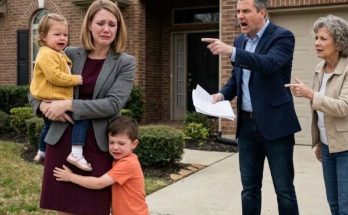
I told my daughter I couldn’t babysit over Memorial Day because I had cataract surgery scheduled, and she texted, “You’re choosing yourself over your grandkids.”
I didn’t argue, didn’t beg, just let the kettle whistle until the house went quiet.
A week later, her husband was pounding on my porch at seven in the morning, after the bank called about a $19,400 debt.
The first text had arrived at 4:47 on a Thursday afternoon while my old silver kettle rattled on the stove.
The kitchen smelled like lemon dish soap and the damp May air drifting through the cracked window above the sink.
Caroline’s name lit up my phone.
“You’re choosing yourself over your own grandchildren, and that’s a hill you want to die on. Fine.”
Behind me, the kettle started screaming.
I let it.
I was sixty-eight years old, and I had spent forty-one years working for the post office.
I raised Caroline on overtime shifts, macaroni dinners, and gas-station coffee that went cold while I waited in school pickup lines.
Her father, Royce, worked maintenance until his knees gave out, and between the two of us, we made sure Caroline never knew exactly how close we sometimes came to missing the electric bill.
All I had said no to was Memorial Day weekend.
Three days.
Caroline and her husband, Wade, wanted to go to Hilton Head with another couple from his firm.
They wanted me to keep four-year-old Hudson and eight-month-old May, who was still waking for bottles through the night.
I loved those children more than I knew how to put into words.
But my cataract surgery was scheduled for Tuesday, and my pre-op appointment was Saturday at seven in the morning.
The clinic had been clear that I needed to rest my eyes, avoid strain, and not spend the weekend lifting a baby and chasing a preschooler.
I asked Caroline to call Wade’s mother or move the trip one week.
She did not ask whether I was nervous about the surgery.
She did not ask who would drive me home.
She sent that text.
An hour later, Wade sent a screenshot with no explanation.
The $800 I had transferred two weeks earlier for Hudson’s preschool tuition had been reversed.
That was when I understood they had discussed how to punish me.
The next morning, I drove to their house anyway.
Their Subaru and Wade’s truck were both in the driveway, and Hudson’s red tricycle lay tipped into the grass.
I rang the bell.
Inside, I heard PBS Kids and Hudson talking in his singsong play voice.
Then Caroline said something low, and he went silent.
They knew I was standing there.
They waited for me to leave.
When I got home, a manila envelope leaned against my storm door.
Inside was a typed letter saying they needed space from my “transactional relationship with money” so they could build “healthier patterns” as a “family unit.”
Caroline did not say family unit.
Caroline said y’all.
Wade had written it, or taught her how to write it, and my daughter had signed beneath his name anyway.
I sat on the church-pew bench my late husband built in 1998 and laughed because my body could not find another sound.
Then I pulled the green accordion file from the spare-room closet.
Royce had labeled it C&W after we co-signed Caroline’s first car loan and she let it go to collections without telling us.
“We’re not keeping this to use against her,” he had told me. “We’re keeping it so we remember the truth if we ever start forgetting.”
Inside were thirteen years of yes.
There was the apartment deposit, Hudson’s NICU bill, preschool help, the house down payment, the truck repair, IVF money, funeral expenses for Wade’s father, and every emergency that became invisible once it was solved.
I added the receipts.
The total was $73,420.
That did not include gas cards, grocery runs, school pickups, overnight bottles, birthday cash, or all the rescues too small to earn a thank-you and too regular to be remembered.
For one hard minute, I wanted to call Caroline and read every amount aloud.
I did not.
I closed the file and called Royce’s old lawyer, Otis Beaman.
“Otis,” I said, “I need to talk about my will, my power of attorney, and a few other things.”
He gave me an appointment for Tuesday afternoon.
When I walked into his office carrying receipts, bank printouts, tuition screenshots, hospital statements, and the typed letter, he reached for a yellow legal pad.
“Start at money,” he said.
So I did.
I started with the $800 reversal, then the preschool tuition, the car loan, the down payment, and the financial power of attorney I had signed after Royce died because Caroline said it would make emergencies easier.
Otis stopped writing.
He asked who had copies.
I told him Caroline did, and Wade handled most of their paperwork.
He circled something twice, then asked his assistant to prepare a revocation before I left.
I signed it with my glasses sliding down my nose and my hands steadier than I expected.
Otis sent notice to the bank and told me to change my passwords, freeze access to every account I could, and call him immediately if anyone contacted me about unfamiliar transactions.
Then I went home and prepared for surgery.
One week later, at seven in the morning, I stood in my hallway with one eye still blurry and a paper shield taped over the other when the bank called.
The woman on the line said my name carefully.
Then she said an amount that made the floor feel uneven beneath my slippers.
$19,400.
She described it as a debt attached to an account opened using my financial information and documents connected to the old power of attorney.
Before I could ask what the debt had to do with me, someone struck my front door hard enough to rattle the storm glass.
Once.
Twice.
Then Wade’s voice came through the porch.
“Margaret, open the door.”
I looked from the phone in my hand to the green accordion file on the hall table.
Through the narrow glass, I saw my son-in-law raise his fist again.
“Please hold,” I told the woman at the bank.
I set the phone on speaker, slid the chain into place, and opened the wooden door three inches.
Wade stood on the porch in wrinkled work pants and an untucked blue shirt.
His truck was parked crooked at the curb, one tire pressed against the grass.
“What did you do?” he demanded.
His eyes went directly to the paper shield over mine, but he did not ask about the surgery.
“I answered my phone,” I said.
“You called the bank.”
“The bank called me.”
“You revoked the power of attorney.”
It was not a question.
Behind me, the bank representative asked whether I was safe.
Wade heard her voice through the speaker and lowered his own.
“This is a misunderstanding,” he said. “Let me come in and explain it before you make it worse.”
The old version of me would have opened the door.
She would have worried about the neighbors seeing him on the porch.
She would have made coffee, cleared a place at the kitchen table, and listened while he turned his emergency into her obligation.
I kept the chain fastened.
“Explain it from there.”
His jaw tightened.
He said the money had been needed for household expenses, preschool, credit cards, and repairs that could not wait.
He said Caroline knew they were struggling but did not understand the details.
He said they had intended to pay everything back after his quarterly bonus.
Then he made the mistake that changed the entire conversation.
“You’ve always helped us,” he said. “I didn’t think this would be different.”
The woman from the bank asked him to identify himself.
Wade stared at the phone on my hall table.
He took one step backward.
“I’m her son-in-law.”
“Are you associated with the account in question?” she asked.
Wade looked at me instead of answering.
“Margaret, hang up.”
“No.”
“This is family business.”
“It became bank business when my name appeared on a debt I didn’t authorize.”
His face hardened in a way I had seen before, usually when a waiter brought the wrong order or a mechanic disagreed with him.
“You signed the power of attorney.”
“For emergencies involving me.”
“You gave Caroline authority.”
“I did not give you permission to borrow money in my name.”
He pushed his fingers through his hair and glanced toward the street.
Then he changed direction.
He told me Caroline had completed the forms.
He said it had been her idea.
He said she was embarrassed and afraid to tell me how badly they needed the money.
For years, Wade and Caroline had presented themselves as a single wall whenever they wanted something from me.
Now that the wall had cracked, he stepped aside and placed my daughter directly in the opening.
I asked the bank representative what she needed from me.
She said the account would be restricted while the authorization was reviewed, and she instructed me not to discuss account details with anyone at the door.
I told Wade to leave.
He planted one hand against the storm door.
“You’re going to ruin us over paperwork?”
“No,” I said. “I’m going to find out what you did.”
His voice rose again.
“What about Hudson and May?”
There it was.
Not an apology.
Not an explanation.
The children placed between us like a barricade.
I felt the familiar pull in my chest, the reflex that had sent money whenever Caroline sounded frightened and driven me across town whenever one of the children had a fever.
Then I remembered Hudson going silent behind their front door because his mother had told him not to answer me.
“You brought their names to my porch,” I said. “I didn’t.”
Wade removed his hand from the glass.
Before he walked away, he pointed at me through the narrow opening.
“Caroline will never forgive you for this.”
I closed the door without answering.
My hand shook only after the lock clicked.
I called Otis, then followed the bank representative’s instructions line by line.
By nine that morning, the disputed account was frozen, my remaining accounts had new passwords, and every copy of the revocation had been resent.
Otis told me not to delete texts, emails, screenshots, or voice messages.
I placed the phone beside the green file and sat on Royce’s bench until the dizziness passed.
At 10:16, Caroline called.
At 10:18, she called again.
At 10:20, she left a voicemail accusing me of humiliating Wade in front of bank employees and threatening the financial stability of her children.
At 10:31, she sent a text that said, “You could have asked us before making accusations.”
I read it twice.
Then I replied with one sentence.
“Did you authorize a $19,400 debt in my name?”
She did not answer for four hours.
When she finally arrived, she brought Hudson and May with her.
Hudson jumped out of the Subaru holding a plastic dinosaur and started running toward me before Caroline called him back.
I stood inside the doorway with the chain still fastened.
Caroline looked exhausted.
May was fussing in her car seat, and Hudson kept asking why Grandma had a pirate patch.
“Can we come in?” Caroline asked.
“Not until you answer my question.”
Her eyes dropped to the porch boards.
She said Wade had told her it was a temporary line they could use because I had helped them before.
She admitted signing forms he placed in front of her.
She insisted she believed I had agreed.
“Did you call me?” I asked.
“No.”
“Did you see a message from me saying yes?”
“No.”
“Did you wonder why I would lend you nearly twenty thousand dollars one week after you stopped speaking to me over babysitting?”
Her mouth opened, then closed.
Hudson pressed his dinosaur against the storm glass and made it roar.
Caroline flinched at the sound.
She said Wade had told her the paperwork had started earlier.
She said he claimed I had discussed it with him after helping with preschool.
Then she looked at the paper shield over my eye as though noticing it for the first time.
“How did the surgery go?” she asked.
The question came too late, but it still hurt.
“It went as expected.”
“Who drove you?”
“My neighbor.”
Caroline’s face changed.
She had assumed I would solve that problem too, quietly and without requiring anything from her.
I asked whether she had written the letter about my transactional relationship with money.
She admitted Wade drafted it.
She had signed because she was angry and because he said they needed to establish boundaries.
“You reversed Hudson’s tuition payment,” I said.
Her eyebrows pulled together.
“What reversal?”
I opened the door only far enough to slide the screenshot through the gap.
Caroline stared at it.
She said she had not known Wade sent it, and she believed the preschool payment had already gone through.
For the first time, her confusion looked larger than her anger.
She pulled out her phone and checked their account.
Then she walked toward the Subaru without speaking.
I watched her scroll, stop, and scroll again.
When she returned, she was holding the phone so tightly her knuckles had gone pale.
There were transfers she did not recognize.
One was for the Hilton Head rental deposit.
Another had gone toward a credit card she thought Wade had paid off months earlier.
The rest had been broken into smaller amounts that looked ordinary until they were placed beside the $19,400 total.
Wade had not borrowed the money to save their house from an immediate disaster.
He had used part of it to keep their life looking unchanged.
Caroline sat down on the porch step with May’s carrier beside her.
Hudson crouched near the flower bed and drove his dinosaur through the mulch.
“I signed it,” she whispered.
“Yes.”
“I believed him.”
“Yes.”
She looked up at me, waiting for the sentence that had rescued her so many times.
We’ll fix it.
I could not say it.
“I will tell the bank the truth,” she said.
“You need to tell them your whole part, not only his.”
Her eyes filled, but I did not open the door wider.
That boundary hurt both of us, which was how I knew it was real.
Over the next several days, Caroline provided the bank with the messages Wade had sent her, the forms she had signed, and the account history she could access.
Otis helped me submit a written dispute and copies of the revocation, my signature records, and the timeline showing that I had never agreed to the debt.
No single document solved everything immediately.
There were interviews, verification calls, and long periods when nobody could promise what the final decision would be.
Wade continued insisting that the power of attorney made the transaction legitimate.
He also insisted Caroline had understood exactly what she was signing.
Caroline admitted she had signed without asking enough questions, but she refused to say I had given permission.
That refusal was the first time I saw her choose the truth when the truth could cost her something.
She and the children stayed with Wade’s mother while their finances were reviewed.
She did not ask to stay with me.
I was grateful for that.
An apology does not automatically restore access, and regret does not erase a pattern simply because the person crying has finally noticed it.
Two weeks later, the bank confirmed that I would not be held responsible for the disputed balance while the matter was resolved with the people who had actually completed and benefited from the transaction.
The account was removed from my online profile, and additional restrictions were placed on any future attempt to use my information.
Otis updated my will, replaced my emergency documents, and helped me name a neutral professional contact instead of a family member for financial matters.
I also changed the way I helped Caroline.
I would not transfer cash into a shared account.
I would not co-sign another loan.
I would not cover unexplained shortages.
When I chose to help with Hudson’s preschool, I paid the school directly.
When I bought diapers for May, I carried them to the house myself.
Help would be a gift I freely decided to give, not a standing resource someone else controlled.
Caroline did not like every boundary.
That was another sign the boundaries were working.
She apologized for the text about choosing myself over my grandchildren.
She apologized for signing Wade’s letter and for letting Hudson hear her tell me to leave.
She did not ask me to forgive her in the same conversation.
Instead, she began doing small things that required effort without guaranteeing a reward.
She drove me to my follow-up appointment.
She sat in the waiting room without spending the entire time on her phone.
She brought groceries but kept the receipt because she knew I would insist on paying for my own food.
She arranged childcare before asking whether I was available.
When I said no, she answered, “Okay, Mom,” and made another plan.
Wade never apologized to me.
Through Caroline, I heard that he still described the situation as a family misunderstanding that had been exaggerated by lawyers and bank employees.
I did not argue with a story he was telling in rooms I no longer entered.
Caroline eventually moved into a small apartment with the children while she decided what her marriage would become.
I did not push her toward divorce or reconciliation.
For most of her life, I had rushed ahead of her consequences and cleared the path before she had to choose where to step.
This time, I let the path remain hers.
Nearly three months after Wade pounded on my door, Caroline brought Hudson and May over on a Saturday morning.
She had asked four days in advance.
She packed bottles, diapers, snacks, emergency numbers, and the stuffed rabbit May needed for naps.
She told me she would return at noon.
At 11:52, her Subaru turned into the driveway.
Hudson was at the kitchen table coloring a dinosaur green, and May was asleep in the portable crib beside the couch.
Caroline came in quietly and set her keys on the counter.
Then she saw the old silver kettle beginning to tremble on the stove.
She reached over and turned off the burner before it screamed.
For a moment, neither of us spoke.
She poured hot water into two mugs and placed one in front of me.
There was no speech about family units, healthy patterns, sacrifice, or forgiveness.
She simply sat across from me while Hudson colored and May slept.
The green accordion file remained in the spare-room closet.
I no longer needed it on the table to remind me what had happened.
I remembered the truth.
More importantly, Caroline was finally learning to remember it too.
THE END