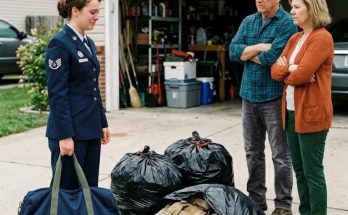
I had not seen Ava in eight months.
That is the part I kept coming back to later, when everyone asked me how I missed it.
Eight months sounds short to people who live under the same roof as their children.
It is not short when your daughter is twelve.
It is not short when her voice changes between video calls, when her face gets sharper, when she learns how to say “I’m fine” in that careful way children use when adults have trained them not to be inconvenient.
The last time I held her before Diane’s wedding, she was crying into the front of my uniform because our old dog had died.
She kept asking if he knew he was loved.
I told her yes.
I told her that love was not erased just because somebody left the room.
At the time, I thought I was talking about a dog.
Later, I realized I had been making a promise I had no idea I would be forced to keep.
The call came at 2:16 a.m. in Germany.
My commanding officer did not waste words.
“There has been an incident involving your daughter,” he said.
I sat up before I understood the sentence.
The barracks room was cold, the kind of cold that gets into metal bed frames and floor tiles.
My phone lit the wall in a blue rectangle.
“What kind of incident?” I asked.
There was a pause.
I heard papers moving on his end.
“Wedding reception. Adult male transported for emergency treatment. Your daughter is being described as the aggressor.”
For a few seconds, I could not connect those words to Ava.
Adult male.
Transported.
Aggressor.
My daughter still slept with the stuffed yellow dog she had won at a county fair when she was seven.
My daughter apologized to shopping carts when she bumped them in grocery stores.
My daughter once cried because a school janitor threw away a nest of baby birds after a storm.
Then my commanding officer said the sentence that turned the room sideways.
“The family is discussing criminal charges.”
By 6:40 a.m., I had signed emergency leave paperwork.
By noon, I had one duffel bag, a printed travel confirmation, and a copy of the bare incident summary that told me almost nothing.
Minor female.
Wedding reception.
Adult male injured.
Possible assault charge pending.
Facts can be cruel, but they can also be cowards.
They sit on paper pretending to be neutral while leaving out the part that matters.
The flight home felt longer than any deployment movement I had ever made.
I kept opening old photos of Ava.
Ava at nine, missing a front tooth, holding a paper plate of barbecue in our old backyard.
Ava at ten, standing in the school pickup line with her backpack hanging off one shoulder.
Ava at eleven, sitting on the front porch with our dog’s head in her lap, whispering secrets into one floppy ear.
Then the last photo Diane had sent me.
Ava standing beside Tommy.
Tommy was Wade’s son.
He was seven years old, small for his age, with a cautious smile and hair that always looked like somebody had tried to fix it with wet fingers in a hurry.
Diane had written, “They’re finally getting along.”
I had believed her.
That is the kind of guilt that stays with you.
Not because you meant harm.
Because you trusted the wrong adult to tell you when harm was happening.
Diane and I had been divorced for three years.
It was not the kind of divorce people make movies about.
No plates thrown.
No screaming in the driveway.
No one big betrayal we could point to later and say, There, that is where everything broke.
It was smaller and sadder than that.
Missed calls.
Long separations.
A marriage built around calendars and apology texts until eventually there was nothing left but custody schedules and polite distance.
When Diane met Wade, she sounded relieved.
He had a steady job.
He owned his truck.
He fixed the loose railing on her porch without being asked.
He took Tommy to barber appointments and said yes when Diane asked him to pick up Ava from school if she was running late.
I wanted to hate him because he was standing in a place I used to stand.
Instead, I tried to be fair.
Fairness is a noble word until it becomes an excuse for distance.
I gave Diane space.
I gave Wade the benefit of the doubt.
I gave my daughter short calls from the other side of the world and told myself she would speak up if something was wrong.
Children do speak up.
Adults just call it attitude when the truth makes them uncomfortable.
By the time I reached Diane’s house, the wedding flowers were still tied to the porch rail.
White ribbon snapped in the wind.
A small American flag hung above the mailbox, bright and ordinary in the morning light.
There was a rusty stain in the gravel near the front steps.
I stood there for half a breath, staring at it.
Not because I had never seen blood before.
Because I had never seen blood at the entrance to the house where my child slept.
Diane opened the door before I knocked.
Her eyes were swollen.
Her hair was still pinned in pieces from the wedding.
She was wearing a robe over what looked like a white slip dress, and her face had that hard look people get when guilt is trying to disguise itself as anger.
“We’re pressing charges,” she said.
I looked past her into the living room.
“I’m not taking anyone’s side until I hear both.”
That made her flinch.
Not much.
Enough.
The living room felt like a courtroom where the verdict had been decided before the hearing started.
Diane’s parents sat on the couch.
Her father had both hands on his knees.
Her mother had a tissue folded into a perfect square in her lap, as if neatness could make the morning respectable.
Russ, Diane’s brother, stood by the fireplace with his jaw set.
Fen, her sister, hovered in the corner, hugging herself like she was cold.
Wade’s parents stood behind the sofa.
Patricia had one hand on Wade’s shoulder.
Wade’s father kept his arms folded, but his fingers tapped against his sleeve too fast.
And Wade sat in the middle.
His jaw was wired.
Both eyes were swollen dark.
White bandages wrapped around his head.
He looked terrible.
I will not pretend otherwise.
But even through the bandages, even through the groans he made every few seconds, his eyes kept cutting toward my daughter.
Ava sat on a wooden chair near the window.
Her pale-blue dress was wrinkled from the wedding.
Her hair had half fallen out of its pins.
Her sneakers were dusty.
Her split knuckles were wrapped in a paper towel that had already bled through in two small places.
She looked too still.
That was what hit me first.
Not the injuries.
Not the adults.
The stillness.
Children who have just exploded usually shake afterward.
They sob.
They ramble.
They beg someone to understand.
Ava sat like a child who had already learned nobody was coming until it was too late.
“Look what she did to him,” Diane said.
Wade pressed an ice pack to his face.
“She’s dangerous,” he mumbled.
Patricia snapped, “They should charge her as an adult.”
I let the words hang there.
Then I looked at Ava.
“Tell me your side.”
Her chin shook.
It was the first childlike thing I had seen in her since I walked in.
Then she looked around the room.
She looked at her mother.
At her grandparents.
At Russ.
At Fen.
At Wade’s parents.
At Wade.
“He’s been hurting Tommy for six months,” she said.
The words were quiet.
They landed like a dropped glass.
“Locking him in rooms,” she said. “Calling it discipline.”
The room erupted.
Diane said, “No.”
Russ cursed.
Fen started crying instantly, which told me some part of her had already known what Ava was about to say.
Diane’s father said, “A firm hand never ruined a child.”
Diane’s mother whispered, “Kids need rules.”
Wade groaned loudly enough to pull attention back to himself.
It almost worked.
Almost.
But his eyes slid sideways toward his father.
Ava saw it.
So did I.
She lifted her phone with her swollen hand.
Her fingers trembled over the screen.
“He bolts the door from the outside,” she said.
Diane shook her head.
“Ava, stop.”
“No,” I said.
The word came out sharper than I meant it to.
Diane turned to me.
I did not look at her.
I kept my eyes on my daughter.
Ava opened a hidden folder.
The first photo showed a metal hasp screwed onto the outside of a child’s bedroom door.
Not a childproof lock.
Not a latch to keep a toddler from wandering.
A metal hasp.
The kind you use on a shed.
The second photo showed bruises around a small wrist.
The third showed marks across the back of a little boy’s legs.
Ava did not describe them.
She did not need to.
The living room went silent in a way I will remember for the rest of my life.
Not peaceful silence.
Not shocked silence.
The silence of adults calculating how much they had ignored.
Diane stared at the screen.
“Kids bruise,” she whispered.
But her voice had no weight in it.
Wade lifted one bandaged hand.
“That’s out of context,” he said. “The boy is clumsy.”
Every face changed.
Because he had just admitted he knew Tommy was hurt.
His father closed his eyes.
Only for one second.
But I saw it.
Ava stood.
The paper towel slipped loose from her knuckles.
Her voice broke, but it did not get smaller.
“Mom, I told you three months ago.”
Diane opened her mouth.
Nothing came out.
“Grandpa, you laughed.”
Diane’s father went gray around the lips.
“Aunt Fen, you said I was being dramatic.”
Fen covered her mouth and looked at the wall.
“Uncle Russ, you said I should be grateful a man cared enough to set boundaries.”
Russ lowered his head into both hands.
Then Ava looked at Diane’s mother.
“You said kids need discipline.”
The tissue in Diane’s mother’s lap unfolded under her fingers.
She did not speak.
That was when Wade’s parents began whispering.
At first, I could not catch the words.
Then Wade’s father grabbed Patricia’s arm.
“Not again, Patricia,” he hissed.
Two words can open a locked room.
Not again.
Patricia’s face changed so fast it was almost violent.
She looked at him like he had slapped her.
Ava heard it too.
She wiped her face with the back of her hand.
Then she looked at every adult in the room.
“We’re children,” she said, “and every adult in this room chose him over us.”
Nobody argued.
Then she turned to me.
“But that’s not why I hit him.”
I felt the blood leave my hands.
“What do you mean?”
Ava looked toward the stairs.
“Because Tommy is still up there.”
For one second, the sentence did not move.
It stayed in the air above all of us.
Then something knocked once from upstairs.
Small.
Weak.
Real.
Diane made a sound and grabbed the stair rail.
Wade said, “Don’t.”
That was the wrong word.
It moved through me like a trigger.
I stepped toward him before I decided to.
For one ugly heartbeat, I pictured my hand around the front of his shirt.
I pictured dragging him out of that chair.
I pictured making him afraid in a room full of people who would finally have to watch.
Then Ava touched my sleeve.
Not hard.
Just enough.
“Dad,” she whispered.
So I walked past Wade.
I went up the stairs.
Diane followed two steps behind me, crying so hard she could barely breathe.
Fen came after her.
Russ stayed at the bottom, one hand on the banister, frozen like the floor had turned to water under him.
At the top of the stairs, the hallway smelled like old carpet and wedding hairspray drifting up from below.
There was a child’s bedroom door at the end.
A metal hasp was fixed to the outside.
A cheap padlock hung through it.
Diane stopped making sound.
That was worse than the crying.
The lock was not closed all the way.
It had been forced loose.
Later, Ava told me that was why she hit Wade.
During the reception, she had gone upstairs because Tommy was not in the pictures.
She heard him crying.
She found Wade outside the door.
She told him to open it.
He laughed at her.
Then he reached for her phone.
Ava said she did not remember every punch.
I believe her.
Children remember the reason more clearly than the motion.
I pulled the hasp open.
The door stuck against something inside.
“Tommy,” I said.
No answer.
I pushed again.
A small laundry basket scraped across the carpet.
Then I saw him.
He was sitting in the corner between the bed and the wall, knees pulled to his chest, wearing a white dress shirt that was too big in the sleeves.
His bow tie hung loose.
His face was blotchy from crying.
He looked at Diane first.
Then at Ava behind her.
Then at me.
“Is the wedding done?” he asked.
Diane folded.
Not fainted.
Folded.
She dropped to the carpet with both hands over her mouth, and the sound she made did not sound like a bride or a mother or a woman trying to defend her choices.
It sounded like somebody finally hearing the truth too late.
I picked Tommy up.
He was lighter than I expected.
That is not a line people understand until they carry a frightened child.
He held on to my shirt with both hands.
Ava stood in the hallway with blood on her knuckles and guilt all over her face.
“I tried to tell them,” she said.
“I know,” I told her.
And I meant it.
For the first time since I walked through the door, Ava started to cry.
Downstairs, Wade was shouting through his wired jaw.
His words were thick and broken, but the meaning was clear enough.
He wanted his father.
He wanted his mother.
He wanted everyone to stop looking upstairs.
No one did.
I called 911 from the hallway at 9:27 a.m.
I gave the address.
I told the dispatcher there was a child who needed medical evaluation and a locked bedroom door with evidence attached.
I used that word on purpose.
Evidence.
Because the room was not just a room anymore.
It was a record.
The responding officers arrived before the ambulance.
They separated everyone.
They photographed the door, the metal hasp, the marks on the frame, the paper towel around Ava’s hand, the photo folder on her phone.
One officer asked Ava when she had taken the pictures.
She gave him dates.
Not guesses.
Dates.
She had saved them in a folder named “Tommy.”
Some were from three months earlier.
Some were from the week before the wedding.
One was from that day, timestamped 5:48 p.m., while Diane had been outside smiling for portraits under white ribbon.
Diane heard that and bent over like she might be sick.
At the hospital intake desk, Tommy would not let go of Ava’s sleeve.
Not Diane’s hand.
Not mine.
Ava’s sleeve.
A nurse with tired eyes and a calm voice wrote everything down.
She asked Tommy if he felt safe going home.
He looked at Diane.
Then he looked at the floor.
“No,” he said.
That one word did more damage than all of Wade’s bandages.
Diane turned away and cried into her hands.
Ava sat beside Tommy with an ice pack on her knuckles.
Her dress was still wrinkled.
There was dried blood at the edge of the paper towel.
She looked exhausted in a way no twelve-year-old should ever look.
A social worker came.
Then a detective.
Then more paperwork.
Police report.
Hospital intake form.
Photo log.
Temporary safety plan.
Ava answered every question she could.
When she did not know, she said she did not know.
That mattered.
Truth is not always dramatic.
Sometimes it is a child saying, “I only saw that part,” when lying would have made the story easier.
By evening, the family had stopped calling Ava dangerous.
They had other words now.
Brave.
Scared.
Angry.
Traumatized.
I did not care which word they picked.
I cared that they had waited until proof was glowing on a phone screen before they believed her.
Wade’s father came to the hospital just before dark.
He looked smaller without the living room behind him.
Patricia was not with him.
He asked to speak to me.
I said no.
Then he asked to speak to Diane.
She stood in the hallway, arms wrapped around herself, and listened while he said the phrase again.
“Not again,” he told her, meant exactly what we feared it meant.
There had been complaints before.
Different home.
Different woman.
Different child.
Nothing that had stuck.
Nothing he had wanted to believe.
He said Wade had always been “strict.”
He said Patricia had always made excuses.
He said he thought marriage would settle him down.
Diane stared at him for a long time.
Then she said, “You handed him to my children.”
He did not answer.
Because there was no answer clean enough to stand in that hallway.
Ava heard part of it from the plastic chair outside Tommy’s room.
She looked at me.
“I’m in trouble, aren’t I?” she asked.
I sat beside her.
The chair was too small.
The hallway smelled like disinfectant and coffee from a vending machine.
“You told the truth,” I said.
“I hit him.”
“Yes.”
“Hard.”
“Yes.”
Her mouth trembled.
“I didn’t know what else to do.”
That was when I finally understood the whole shape of it.
Not one violent moment.
Not a child losing control at a wedding.
A child reaching the end of every safe road adults had blocked.
I put my arm around her carefully, because her knuckles hurt.
“You should never have been the only one doing something,” I said.
She leaned into me then.
Not like a soldier.
Not like a witness.
Like my little girl.
The investigation did not become simple after that.
Nothing involving children ever does.
There were interviews.
There were temporary orders.
There were family court hearings where adults used calm voices to describe things children had survived without calm.
There were questions about Wade’s injuries and whether Ava had used more force than necessary.
The photos mattered.
The timestamp mattered.
The lock mattered.
Tommy’s statement mattered most.
In the end, the adults who wanted Ava charged had to sit with the fact that the police report did not read like a story about a dangerous child.
It read like a story about a child who had been ignored until she became the emergency alarm.
Wade did not come home.
Diane removed the flowers from the porch herself.
She took down every wedding card from the mantel.
She returned the gifts she could return and boxed the rest for evidence when asked.
Then she stood in that upstairs hallway with a screwdriver and took the metal hasp off Tommy’s door.
She could barely hold the tool.
Russ helped her remove the screws.
Fen sat on the stairs and cried.
Ava watched from the landing.
Tommy watched from behind her.
When the last screw came free, Diane turned around.
She looked at both children.
“I’m sorry,” she said.
It was not enough.
She knew it.
Ava knew it.
Tommy knew it.
But sometimes the first honest sentence is not a cure.
It is only the first brick in a road back.
For months, Ava carried guilt like a second backpack.
She worried about Wade’s face.
She worried about court.
She worried Tommy would hate her for making everything public.
Tommy did not hate her.
He followed her around like a shadow whenever they were together.
One afternoon, when I was home on leave again, I found them on the porch steps.
The small American flag above the mailbox kept clicking softly in the breeze.
Ava was teaching Tommy how to throw a tennis ball for a neighbor’s dog.
He missed every time.
She laughed once.
A real laugh.
The kind I had not heard from her in nearly a year.
Tommy looked at her and said, “You came upstairs.”
Ava stopped smiling.
Then she nodded.
“Yeah,” she said. “I did.”
He threw the ball again.
It bounced into the driveway.
The dog chased it anyway.
Later that night, Ava asked me if our old dog really knew he was loved.
I told her yes.
Then I told her something else.
I told her Tommy knew too.
Not because adults said the right words after everything broke.
Because when the door was locked, she came upstairs.
Because when everyone called her dangerous, she still told the truth.
Because when every adult in that room chose comfort, she chose a child.
And that is what I remember most now.
Not the wedding flowers.
Not Wade’s bandages.
Not the living room full of people pretending shock was the same thing as innocence.
I remember my twelve-year-old daughter standing with blood on her knuckles and a phone in her hand, forcing a room full of grown people to look at what they had refused to see.
They called her dangerous.
But dangerous was never the child who finally fought back.
Dangerous was the silence that made her think she had to.
THE END