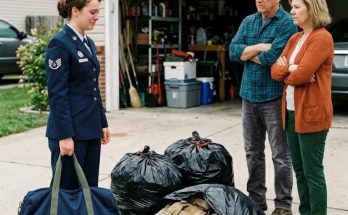
“I’ll sn@p your arm,” my brother-in-law sneered, throwing a pair of MMA gloves at my feet and threatening to send me to the hospital in front of my terrified little girl.
He thought he was facing a helpless mother with no way to defend herself.
What he didn’t know was that I was a combat veteran.
And he had just awakened a Special Operations major.
Part 1: The Threat on the Lawn
“Put the gloves on, mighty sister-in-law,” Marcus Caldwell shouted, throwing a pair of black fighting gloves at my boots.
“Or should I break your arm and send you to the hospital in front of your daughter?”
The gloves landed in the grass with a dull thud.
Behind him, his father, Warren, laughed loudly while several neighbors turned away in disgust.
“Teach that pathetic desk soldier a lesson,” Warren called.
“Show her who runs this neighborhood.”
Nearly forty people stood around the end of our suburban street with paper plates, plastic cups, and half-eaten burgers.
Smoke drifted from the grill, and a sprinkler hissed across the lawn.
No one laughed with Warren.
At the edge of the crowd, my eleven-year-old daughter, Lily, stood frozen.
Her hands twisted the hem of her T-shirt, and her face had gone pale.
She was looking at me.
Waiting to see if I could keep her safe.
Marcus rolled his shoulders beneath his sleeveless shirt.
He was large, muscular, and used to being feared.
Four men from his gym stood behind him, smirking as if they had come to watch me fall.
They thought I was harmless.
My sister thought so too.
Rachel stood beside Warren in an expensive summer dress, arms folded, looking not frightened—but entertained.
That hurt more than the gloves at my feet.
Everyone in the neighborhood believed I worked in records management for a federal agency.
Rachel believed I sat in a windowless office filing supply forms for a modest salary.
I let them believe it.
I drove an old SUV, bought secondhand curtains, and kept my military decorations locked in a fireproof case beneath winter blankets.
My official civilian profile called me an administrative support specialist.
That was not exactly false.
It was simply the smallest part of the truth.
The rest required clearances Warren Caldwell’s money could never buy.
I slowly removed my jacket and placed it on the picnic bench.
Marcus grinned.
The crowd drew in a breath.
I gave Lily one steady nod, then stepped toward the gloves without picking them up.
“One rule,” I told Marcus.
He raised his fists.
“When you want to quit, stay flat on the ground.”
He smiled wider because he still thought I was bluffing.
He had no idea the woman he wanted to hospitalize had spent most of her adult life entering places other soldiers were ordered to avoid.
He had just forced me to stop pretending.
How the Caldwells Began
The Caldwell family had not become dangerous all at once.
At first, they were only loud.
Marcus trained beside the fence every afternoon, hitting his punching bag so hard my kitchen windows shook.
Warren drove past my house slowly, staring at my old SUV and peeling porch rail as if he wanted me to feel ashamed.
I noticed everything.
I simply did not react.
In my former work, I learned that people reveal more when they believe no one is watching.
Marcus targeted anyone unlikely to fight back.
He pushed elderly delivery drivers into wet grass, shouted at children, and broke things that did not belong to him.
Warren encouraged him.
Rachel excused him.
“He’s intense,” she once told me.
“Successful men usually are.”
“Breaking a seventy-year-old man’s garden nozzle isn’t success,” I said.
She rolled her eyes.
“You always make everything dramatic.”
The first time Marcus frightened Lily directly, she was washing my SUV in the driveway.
Music played softly through the open window while soap ran down the doors.
Marcus crossed the property line, reached into the car, and twisted the radio knob until it cracked.
Then he dropped the broken piece beside Lily’s wet sneakers.
“Garbage music,” he snapped.
“Turn it down next time.”
Lily backed against the car.
I walked outside.
“You crossed a line,” I said.
“You will not touch my property or threaten my daughter again.”
Marcus smirked.
“What are you going to do? File paperwork at me?”
“My response depends on what you do next.”
He stared at me, searching for fear.
When he did not find any, he called me a washed-up military clerk and walked away.
That night, I installed hidden security cameras covering the driveway and backyard.
I did not tell the Caldwells.
I only started documenting.
Part 2: The Evidence They Never Saw
I only started documenting.
At first, the recordings seemed almost ordinary.
Marcus kicking a soccer ball away from a group of children because it rolled near his driveway.
Warren threatening to have a disabled veteran’s car towed from a legal parking space.
Rachel standing nearby while both men laughed.
A delivery driver apologizing after Marcus deliberately knocked a package from his hands.
A widow named Mrs. Alvarez crying beside her crushed flower bed while Warren explained that “accidents happened” to people who complained too much.
Individually, each incident looked petty.
Together, they formed a pattern.
The Caldwells did not simply enjoy intimidation. They used it with purpose.
Within six months, four families on our street had put their homes up for sale. Three accepted offers from the same property company, Harbor Ridge Development.
The company’s public address led to a mailbox in Delaware.
Its local representative was Warren Caldwell.
I discovered that detail on a rainy Tuesday night while Lily slept upstairs.
I sat at my kitchen table with tax records, property transfers, and screenshots spread across my laptop. The deeper I searched, the clearer the strategy became.
Warren wanted the entire eastern side of our street.
He already owned two vacant properties through shell companies. Marcus frightened the remaining residents until they became desperate to leave. Then Harbor Ridge appeared with fast cash and promises of an easy closing.
My house stood in the middle of the block.
Without it, the properties could not be joined into a continuous commercial parcel.
That explained Warren’s slow drives past my porch.
It explained Marcus’s broken radio.
It explained why they cared so much about a modest house with peeling paint and secondhand curtains.
They had mistaken simplicity for financial weakness.
The truth was that I could have repaired the porch ten times over.
I left it imperfect because Lily had painted a tiny blue star beneath the railing when she was six. Replacing the wood would have erased it.
Warren saw neglect.
I saw home.
Three weeks after the radio incident, an envelope appeared beneath my windshield wiper.
There was no stamp and no name.
Inside was a photocopy of a Harbor Ridge purchase map.
My property had been circled in red.
Across the bottom, someone had written four words.
They need your signature.
I studied the handwriting for several minutes.
The letters were intentionally uneven. Whoever wrote it had tried to disguise the way they normally formed words.
I scanned the page, sealed the original in an evidence sleeve, and checked every camera angle.
At 2:13 that morning, a hooded figure had approached from the blind side of the street, stayed beyond the infrared range, and slid the envelope beneath the wiper.
The person knew where my cameras were.
That meant either Marcus had discovered them—
or someone had been watching Marcus closely enough to learn what he knew.
I added the envelope to the file.
Then I waited.
Waiting was something my former profession had taught me well.
Most people believed action meant movement.
Sometimes action meant allowing an opponent to believe his plan remained hidden.
Sometimes it meant making coffee, driving Lily to school, and waving politely while the man trying to steal your home watered his lawn.
Warren increased the pressure.
A complaint was filed with the homeowners’ association about my SUV.
Another claimed my porch created a safety hazard.
Someone reported that Lily’s bicycle had blocked the sidewalk, though the photograph submitted with the complaint showed a different child’s bicycle.
Each report arrived through the same anonymous online account.
Each was dismissed.
Marcus became less careful.
One evening, he stopped me beside the mailbox.
“You should consider moving,” he said.
“I like it here.”
“Neighborhood’s changing.”
“Neighborhoods do that.”
His smile tightened.
“Some people recognize when they don’t belong.”
I looked toward his house.
Rachel stood behind the upstairs window.
The curtain moved, then became still.
“Are you threatening me?” I asked.
Marcus stepped closer.
He smelled of protein powder, expensive cologne, and beer.
“I’m giving you advice.”
“No,” I said quietly. “Advice benefits the person receiving it. What you’re doing benefits you.”
For one second, his expression changed.
There it was.
Not anger.
Concern.
He had not expected me to understand.
Then Warren called from his porch, and Marcus walked away.
That same night, another envelope appeared.
This one was placed inside Lily’s school backpack.
My blood went cold when she handed it to me.
“Mom, is this yours?”
The envelope contained a key and a storage-unit number.
Nothing else.
I asked Lily who had touched her bag.
She remembered leaving it outside the music room during lunch. Dozens of students had passed through the hallway.
I called the school, requested security footage, and contacted someone I had not spoken to in almost a year.
Colonel James Voss answered on the second ring.
“Elena.”
“I need a favor.”
“You never ask for favors.”
“I need a storage unit checked without alerting the people watching my family.”
There was a brief silence.
Then his voice changed from that of an old friend to the tone he had used inside operational briefings.
“Send me everything.”
By sunrise, a federal team had quietly examined the unit.
It contained copies of property deeds, financial ledgers, photographs of frightened homeowners, and invoices from Caldwell Strategic Solutions, Warren’s private security company.
There were also military shipping manifests.
That changed everything.
Caldwell Strategic Solutions had received federal contracts to transport communications equipment between training installations. According to the manifests, several shipments had arrived intact.
According to military inventory reports, they had not.
Encrypted radios, thermal optics, and restricted navigation systems had disappeared in transit.
The missing equipment was worth millions.
Some of it could be sold overseas.
Some of it could get soldiers killed.
My quiet neighborhood dispute had become part of something much larger.
Voss called me from a secure line.
“You were right to contact us.”
“Who rented the unit?”
“False identity. Cash payments.”
“Fingerprints?”
“Partial. Nothing conclusive.”
“Whoever provided the key had access to Warren’s records.”
“Yes.”
I looked through my kitchen window.
Across the street, Rachel was loading grocery bags into her car.
Marcus stood behind her, speaking sharply.
She flinched when he grabbed her elbow.
The movement was small.
Most people would have missed it.
I did not.
“James,” I said, “I think I know where the source is.”
“You think your sister is involved?”
“I think she’s afraid.”
“Those are not the same thing.”
“No,” I said. “But they can look identical from a distance.”
Part 3: The Sister I Thought I Had Lost
Rachel and I had not always been strangers.
When we were children, she followed me everywhere.
She was five years younger and terrified of thunderstorms. During summer storms, she crawled into my bed and pressed her hands over her ears while I counted the seconds between lightning and thunder.
When I enlisted, she wrote every week.
When I deployed, she sent photographs of ordinary things—our mother’s garden, the first snow, a burned pie she had attempted to bake.
Then I came home different.
I slept lightly. I sat facing exits. Sudden noises made my shoulders tighten before my mind understood why.
Rachel tried to ask what had happened.
I told her I was fine.
That lie created the first distance between us.
Marcus created the rest.
He entered her life after our mother died. He was confident, attentive, and almost aggressively helpful. He arranged repairs, handled bills, and spoke about protecting Rachel from people who wanted to take advantage of her.
At first, I was grateful.
Then his protection became permission.
He decided which friends she saw.
He criticized her clothes.
He persuaded her to leave a job she loved because her male supervisor “looked at her too much.”
By the time I challenged him, Rachel had already learned to defend him.
“You don’t understand marriage,” she told me.
“You don’t look happy.”
“Not everyone needs to be in control all the time, Elena.”
“I’m not trying to control you.”
She laughed bitterly.
“You walk into a room and assess everyone like they’re a threat.”
“Marcus is a threat.”
“To you, maybe, because you can’t intimidate him.”
The accusation stayed with me for years.
Rachel thought I wanted power over her.
I thought she had chosen Marcus over me.
Neither of us understood how much fear had been standing between us.
After the storage unit was discovered, I began watching Rachel differently.
The expensive dresses were always selected by Marcus.
The jewelry she wore belonged to Warren’s late wife and could not be sold.
Rachel’s folded arms were not confidence.
They concealed bruises near her wrists.
Her eye rolls appeared whenever Marcus watched her.
When he turned away, her face emptied.
I wanted to confront her.
Voss warned me not to.
“If she’s our source, approaching her could expose her.”
“If she isn’t, Lily remains at risk.”
“We’ll place surveillance nearby.”
“Surveillance reacts after danger appears.”
“And you’re too emotionally involved.”
He was right.
I hated him for being right.
So I waited again.
The neighborhood cookout was announced two weeks later.
Warren claimed it was intended to “restore community spirit.”
The invitation was placed in every mailbox.
Mine had a handwritten message across the bottom.
Bring Lily. Let’s settle our differences.
I knew it was bait.
What I did not know was who had prepared the trap.
Before the cookout, I sent Lily to stay with Voss’s wife.
She refused.
“I’m not leaving you alone.”
“You won’t be leaving me alone.”
“They’re mean because everyone walks away.”
She stood in the hallway with her backpack against one shoulder, trying not to cry.
Lily had inherited my stubbornness without the years of discipline that made it manageable.
“I need you somewhere safe,” I said.
“You always say safe doesn’t mean scared.”
The words struck harder than I expected.
I had said them after Marcus broke the radio.
“Safety also means choosing the right position.”
“Then my position is with you.”
I knelt in front of her.
“You stay beside Mrs. Alvarez. You do not move toward me, whatever happens. If I say ‘bluebird,’ you go inside her house and lock the door.”
“Bluebird,” she repeated.
It had been our emergency word since she was five.
“Good.”
“Are you going to fight Uncle Marcus?”
“I’m going to stop him from hurting anyone.”
“That isn’t the same answer.”
“No,” I said. “It isn’t.”
She studied my face, then nodded.
At the cookout, Warren behaved like a man hosting a campaign event.
He shook hands, praised the neighborhood, and promised that Harbor Ridge’s redevelopment would increase property values.
Several families looked uncomfortable.
Mrs. Alvarez stood beside me.
“My husband planted those trees,” she whispered, pointing toward the vacant lots. “Warren says they’ll cut everything down.”
“He doesn’t own enough property yet.”
“He says he will.”
“No,” I told her. “He won’t.”
Across the lawn, Rachel watched me.
She wore a pale green dress and a thin silver necklace.
When Marcus approached, she touched the necklace twice.
A nervous habit, I thought.
Then I noticed the pendant.
It was not jewelry.
It was a miniature audio recorder disguised inside a silver casing.
Rachel saw me recognize it.
Her eyes flickered toward the garage.
Then Marcus called my name.
The confrontation began exactly as Warren wanted.
Or perhaps exactly as Rachel did.
Marcus accused me of spreading lies about Harbor Ridge. I denied nothing. Warren produced printed copies of complaints residents had made against his company and demanded to know whether I had encouraged them.
“I encouraged people to tell the truth,” I said.
Marcus stepped into my space.
“You’ve been acting tough for months.”
“I’ve been asking you to stay off my property.”
“You think that old uniform makes you special?”
“I have never discussed my service with you.”
“Because there’s nothing to discuss. Rachel told us you filed paperwork.”
Rachel’s face did not change.
But her hand closed around the pendant.
Marcus gestured toward his gym friends.
“They think you need a lesson.”
One of the men shifted uncomfortably.
Another stared at the ground.
They had expected a demonstration.
They had not expected a threat against a woman in front of a child.
Warren raised his cup.
“Settle it like adults.”
Then Marcus threw the gloves.
“I’ll break your arm,” he said.
And the lawn went silent.
Part 4: The Fight He Had Already Lost
The memory of that silence stayed with me longer than the sound of his voice.
A sprinkler clicked.
Smoke rolled from the grill.
Somewhere behind the houses, a dog barked.
Marcus lifted his fists.
I did not pick up the gloves.
“You invited witnesses,” I said.
He laughed.
“I invited an audience.”
“No. Your father invited homeowners he has threatened. You brought men from your gym. You made a specific threat in front of forty people.”
Warren’s smile faded slightly.
Marcus took another step.
“Put them on.”
“No.”
“What happened to your rule?”
“The rule was for you.”
His jaw tightened.
Behind him, Rachel’s fingers trembled against the pendant.
I looked at Lily.
She stood beside Mrs. Alvarez, pale but steady.
I gave her the smallest nod.
Marcus mistook it for fear.
He lunged.
His right hand reached for my shoulder while his left prepared to strike.
He was strong.
He was also angry, overconfident, and accustomed to opponents who followed gym rules.
I stepped outside his reach, redirected his wrist, and turned my hips.
His momentum did the rest.
Marcus hit the grass hard enough to lose his breath.
The crowd gasped.
Before he could recover, I released him and stepped back.
“Stay down,” I said.
He rolled onto one knee.
His face had changed.
Humiliation burned hotter than pain.
“You got lucky.”
“No. You announced your movement with your shoulders.”
He charged again.
This time he tried to wrap both arms around my waist.
I lowered my center of gravity, trapped one arm, and pivoted.
He went over my hip and landed flat on his back.
The impact knocked the rage out of him for half a second.
I could have dislocated his elbow.
I could have broken his wrist.
I did neither.
I placed one boot beside his hand and looked down at him.
“This is your opportunity to stop.”
Warren shouted, “Get up!”
That was the moment I understood something important.
Warren did not care whether his son was injured.
He cared whether his son appeared weak.
Marcus heard it too.
His father’s command dragged him back to his feet.
His gym friends no longer smirked.
One moved forward.
I looked directly at him.
“Do you intend to participate in an assault?”
He stopped.
“No, ma’am.”
The word escaped before he could correct himself.
Marcus turned toward him.
“You coward.”
Then he swung at me.
It was not a controlled strike.
It was a desperate one.
I caught his arm, stepped behind him, and brought him face down into the grass. My knee settled between his shoulder blades. His wrist rotated upward just far enough for him to understand what would happen if he resisted.
He groaned.
“Get off me.”
“You threatened to break my arm in front of my daughter.”
“I was joking.”
“No one laughed.”
“I didn’t mean it.”
“Your body language disagreed.”
Warren moved toward us.
Three neighbors stepped into his path.
The first was the delivery driver Marcus had pushed.
The second was Mrs. Alvarez’s adult son.
The third was a quiet accountant named Mr. Brooks, whose mailbox Marcus had destroyed.
Warren stopped.
For the first time since moving into the neighborhood, he looked around and realized fear had changed sides.
Not because the neighbors wanted revenge.
Because they were no longer isolated.
Rachel walked forward.
Marcus twisted beneath me.
“Rachel, tell her to stop!”
She did not look at him.
She looked at me.
Her face was calm, but tears had gathered along her lower lashes.
“Bluebird,” she said.
For one terrible second, I thought she was warning Lily.
Then the garage door opened.
Federal agents in plain clothes entered the yard from both sides of the house.
Local officers followed.
Voss stepped through the center.
“Major Ward,” he said, “you can release him.”
Every face turned toward me.
Marcus became completely still.
Warren’s cup slipped from his hand and spilled into the grass.
Rachel removed the silver pendant from her neck.
“They heard everything,” she whispered.
Two agents helped Marcus to his feet and placed him in restraints.
He stared at my face as though it had changed.
“Major?”
I stood slowly.
Grass clung to one knee of my jeans.
“My administrative assignment is real,” I told him. “It simply isn’t all I do.”
Voss faced the crowd.
“Major Elena Ward is a decorated combat veteran currently assigned as a Special Operations planning officer. Her public employment profile is deliberately limited for security reasons.”
Warren’s face drained of color.
Marcus looked toward Rachel.
“You knew?”
She shook her head.
“Not until three weeks ago.”
“That’s a lie.”
“No,” Rachel said. “The lie was pretending I still believed you were untouchable.”
Part 5: Rachel’s War
The arrests did not end on the lawn.
Agents entered the Caldwell house with warrants. Others searched Warren’s office and the warehouse behind his security company.
They recovered restricted military optics hidden inside commercial air-conditioning units.
They found altered shipping logs, offshore payment records, and contracts used to purchase neighborhood properties with stolen federal funds.
The redevelopment project had never been only about profit.
Warren needed the eastern block because the properties bordered an old service road leading to his warehouse. If he controlled the entire parcel, he could expand the building, remove municipal access, and move stolen equipment without curious neighbors seeing the trucks.
My house stood directly across from the service-road entrance.
Mrs. Alvarez’s upstairs window overlooked the loading area.
Marcus’s intimidation had been operational security disguised as neighborhood cruelty.
The broken radios, damaged mailboxes, and threats were not random.
They were designed to remove witnesses.
The anonymous complaints against me were intended to build a legal record portraying me as unstable and irresponsible. If I refused to sell, Warren planned to challenge my property maintenance, bury me in legal fees, and pressure the homeowners’ association to condemn portions of the house.
He had underestimated my finances.
He had underestimated my training.
Most dangerously, he had underestimated his daughter-in-law.
Rachel sat in my kitchen after midnight while agents continued working across the street.
She had changed out of the green dress and wrapped herself in one of my old sweatshirts.
Lily slept upstairs.
For several minutes, neither of us spoke.
The kitchen clock sounded unnaturally loud.
Finally, I placed two mugs of tea on the table.
Rachel stared into hers.
“You’re angry.”
“Yes.”
“I understand.”
“No,” I said. “You don’t.”
She flinched.
I hated that she expected anger to be followed by pain.
I lowered my voice.
“I’m angry because you entered Lily’s school.”
Her head snapped up.
“I didn’t.”
“The storage key was placed in her backpack.”
Rachel’s eyes widened.
“That wasn’t me.”
The room went cold.
“Who else knew about the unit?”
“Warren’s accountant. A man named Peter Vale.”
Mr. Brooks.
The quiet neighbor whose mailbox Marcus had destroyed.
The man who had stepped between Warren and me on the lawn.
I reached for my phone.
Before I could call Voss, someone knocked at the back door.
Three precise taps.
A pause.
Two more.
A recognition pattern.
I opened the door with one hand near the knife block.
Voss stood outside with Mr. Brooks.
The accountant looked exhausted.
“I owe you an explanation,” he said.
He entered slowly and placed both hands on the table where I could see them.
His real name was Peter Vale.
For nine years, he had managed Warren’s shell companies.
He had also helped create them.
Peter was not an innocent employee.
He had laundered money, falsified invoices, and ignored evidence that military equipment was being diverted.
Then his younger brother, a communications specialist stationed overseas, was killed during an operation after his unit’s replacement navigation system failed to arrive.
The missing shipment had passed through Caldwell Strategic Solutions.
Peter began copying records.
He rented the storage unit.
He delivered the first map to my SUV.
When Rachel secretly contacted him, they began exchanging evidence.
“Why involve my daughter?” I asked.
His face tightened.
“I didn’t know it was her backpack. I paid a student courier to place the envelope in a blue bag outside the music room. I was told the bag belonged to a staff member.”
“You used a child.”
“I made a terrible decision.”
“You made several.”
“Yes.”
There was no defensiveness in his voice.
Only shame.
Voss folded his arms.
“Mr. Vale surrendered tonight. His cooperation led us to two additional warehouses.”
“That doesn’t erase what he did.”
“No,” Peter said. “It shouldn’t.”
Rachel looked at him.
“You said you would leave Lily out of it.”
“I believed I had.”
I wanted to hate him cleanly.
It would have been easier.
But grief had hollowed his face. His hands shook when he spoke about his brother.
He had helped build Warren’s machine.
Then he had sacrificed his freedom to stop it.
The source had never been one person.
It had been Rachel and Peter, each trapped by different forms of guilt.
One had been afraid to leave.
The other believed he no longer deserved to.
“What happens to him?” Rachel asked.
Voss answered carefully.
“He will be charged. Cooperation will be considered, but there will be consequences.”
Peter nodded.
“There should be.”
He looked at me.
“I’m sorry about Lily.”
I held his gaze.
“Apologize to her when she is old enough to decide whether she wants to hear it.”
“I will.”
Voss escorted him outside.
When the door closed, Rachel began crying.
Not loudly.
Her shoulders folded inward, and she covered her mouth with both hands as though even grief needed permission.
I moved around the table.
For a moment, I did not know whether she wanted me near her.
Then she reached for my sleeve.
I held her.
She pressed her face against my shoulder, and twenty years of anger became something heavier.
“I tried to leave twice,” she whispered.
“Why didn’t you call me?”
“Marcus said you would take control. He said you’d treat me like a failed mission.”
I closed my eyes.
“Did I ever make you feel that way?”
“Not intentionally.”
The answer hurt because it was honest.
Rachel pulled back.
“When you came home from deployment, you stopped telling me anything. Every question felt like an intrusion. Every mistake I made felt small beside whatever you had survived.”
“I thought silence protected you.”
“It made me believe you didn’t trust me.”
“I trusted you with my life.”
“You never said that.”
“No,” I admitted. “I didn’t.”
She wiped her face.
“Marcus knew how much I missed you. He used it. He said you thought I was weak.”
“I never thought that.”
“I know now.”
“How?”
A sad smile touched her mouth.
“Because when you realized the pendant was a recorder, you didn’t expose me. You understood.”
I sat beside her.
“The envelopes?”
“The first one was Peter. The second was Peter too. I gave him the documents. I didn’t know he would use Lily’s school.”
“And the cookout?”
“That was me.”
I stared at her.
“Warren planned a private meeting with you. He wanted Marcus to frighten you into signing an agreement.”
“So you suggested a community cookout.”
“I told Warren public humiliation would make you easier to control. I told Marcus he needed an audience.”
Her voice broke.
“I knew he would threaten you. I knew the pendant would record it. Voss’s team needed an immediate criminal act connected to the property scheme so they could move before Warren transferred the equipment.”
“You placed Lily in danger.”
“I tried to convince you not to bring her.”
“The invitation specifically said to bring Lily.”
“Warren added that after I printed it.”
Rachel looked sick.
“When I saw her arrive, I almost stopped everything. But Marcus was watching me. Warren had already said Peter was leaking information. If I warned you openly, they would know.”
“So you stood beside them.”
“Yes.”
“Looking entertained.”
“I was terrified.”
The image returned to me.
Rachel in the expensive dress.
Arms folded.
Face unreadable.
I had believed her expression meant cruelty.
It had been armor.
She had not been waiting to watch me fall.
She had been waiting for the moment she could finally help bring them down.
Part 6: What Strength Looked Like Afterward
Marcus was charged with assault, coercion, conspiracy, and offenses connected to the stolen equipment.
Warren faced federal charges that would likely keep him imprisoned for the rest of his working life.
Harbor Ridge Development was seized.
The fraudulent property sales were reviewed one by one.
Two families who had been pressured into leaving received their homes back. A third chose financial restitution instead because returning carried too many painful memories.
Mrs. Alvarez kept her trees.
The warehouse was shut down.
The old service road remained public.
Peter accepted a plea agreement requiring prison time, repayment, and testimony against Warren’s network.
Rachel filed for divorce.
That process was not triumphant.
There were hearings, statements, and long nights when she woke from dreams convinced Marcus was standing outside.
She moved into my spare room.
For the first month, she apologized for everything.
For using too much hot water.
For leaving a cup in the sink.
For asking whether she could change the television channel.
Each apology revealed another small place where Marcus had trained her to disappear.
Lily responded with the fierce practicality of a child.
“Aunt Rachel,” she said one morning, “you don’t need permission to eat cereal.”
Rachel laughed.
Then she cried.
We learned not to pretend recovery was graceful.
Some days Rachel wanted to talk.
Other days she sat on the porch and watched cars pass.
I attended counseling with her twice.
During the second session, the therapist asked why I had kept my military life hidden from my family.
“Security,” I answered.
“That explains the operational details,” the therapist said. “It does not explain the emotional ones.”
I looked at Rachel.
She waited.
“Because I was afraid,” I said.
Rachel blinked.
I had faced gunfire with a steadier voice.
“Afraid of what?” she asked.
“That if I told you what I had done, or what I had seen, you would look at me differently.”
“You came home and looked at yourself differently.”
“Yes.”
“You didn’t give me the chance.”
“No.”
The admission opened something between us.
Not forgiveness all at once.
Something smaller and more useful.
Honesty.
The neighborhood changed too.
People who had once closed their curtains began standing together on sidewalks.
Mr. Brooks’s damaged mailbox remained bent for months. No one repaired it immediately. His house stood empty while the government determined what would happen to his assets.
One Saturday, Mrs. Alvarez brought paint.
The delivery driver brought tools.
Several children arrived with stickers.
They repaired the mailbox together.
Lily painted a small bluebird on the side.
When I asked why, she shrugged.
“It means you go somewhere safe.”
I looked at Rachel.
She was holding the paint tray.
Her eyes filled, but she smiled.
Three months after the cookout, the Army held a recognition ceremony at a nearby installation.
I had avoided such events for years.
This one honored the task force that recovered the stolen equipment and identified vulnerabilities in military transport contracts.
Voss asked me to attend in uniform.
I almost refused.
Lily found the garment bag in my closet.
“You’re going,” she said.
“That sounded like an order.”
“I learned from a major.”
On the morning of the ceremony, I put on my dress uniform for the first time in front of her.
Lily stood in the doorway.
Her mouth opened slightly when she saw the ribbons, badges, and gold oak leaf on my shoulder.
“You really are a major.”
“I told you I served.”
“You said you did paperwork.”
“I do a remarkable amount of paperwork.”
Rachel appeared behind her.
For a long moment, she stared at me.
Then she stepped forward and adjusted one of my ribbons by less than a fraction of an inch.
“You always hated crooked things,” she said.
“You remember?”
“I remember everything.”
At the ceremony, my name was called.
I walked across the platform while Lily and Rachel sat in the front row.
The citation mentioned operational planning, interagency coordination, and the recovery of restricted equipment.
It did not mention Marcus on the lawn.
It did not mention Rachel’s pendant.
It did not mention Peter’s brother or Mrs. Alvarez’s trees.
Official language rarely carried the true weight of events.
Afterward, a senior officer approached Lily.
“Your mother is one of the finest officers I’ve worked with.”
Lily looked at me.
“I know.”
Her answer mattered more than the medal.
Part 7: The Blue Star
By autumn, Rachel found a small apartment two streets away.
She did not move because she wanted distance.
She moved because choosing her own home was important.
The apartment was modest. The kitchen cabinets were outdated, and one bedroom window stuck during humid weather.
Rachel loved it.
She chose the curtains herself.
On moving day, Lily carried a box labeled BOOKS, though it contained only pillows.
Rachel pretended not to notice.
I repaired the window while she arranged photographs on a shelf.
One picture showed us as children beneath a blanket during a thunderstorm.
Another showed Lily missing her two front teeth.
Rachel placed a third photograph beside them.
It had been taken after the recognition ceremony.
I stood in uniform between her and Lily.
None of us looked polished.
Rachel’s eyes were red from crying.
Lily’s hair was blowing across her face.
I was laughing at something outside the frame.
It was the most honest photograph we owned.
That evening, we returned to my house for dinner.
The porch had finally been repaired.
I replaced every damaged board except one.
Beneath the railing, partially protected by old paint, Lily’s tiny blue star remained.
Warren had seen decay when he looked at that porch.
Marcus had seen weakness when he looked at me.
I had seen betrayal when I looked at Rachel.
We had all mistaken surfaces for truth.
After dinner, Lily brought the black MMA gloves from a closet.
The police had returned them after the case no longer required them as evidence.
“Why did you keep these?” Rachel asked.
“I didn’t,” I said. “Lily did.”
Lily placed them on the table.
“I want to learn.”
Rachel stiffened.
“Learn what?”
“How to put someone on the ground.”
“No,” I said.
Lily frowned.
“But you did.”
“I put Marcus down because there was no safer option left.”
“What if someone threatens me?”
“Then your first skill is recognizing exits. Your second is using your voice. Your third is getting help. Fighting comes much later.”
She considered that.
“Can you teach me the first three?”
“Yes.”
Rachel touched one glove.
“Can you teach me too?”
I looked at her.
She was not asking how to hurt Marcus.
She was asking how to trust her own instincts again.
“Yes,” I said. “We start tomorrow.”
The following morning, we stood in the backyard before sunrise.
No gloves.
No audience.
No threats.
I showed them how to balance their weight, how to breathe, and how to keep their eyes up when fear encouraged them to look down.
Rachel struggled at first.
Every time I moved quickly, her shoulders tightened.
So I slowed down.
Lily became impatient.
So I slowed her down too.
Strength was not speed.
It was not volume.
It was not the ability to frighten a neighborhood or throw someone into the grass.
Strength was knowing when to move.
Strength was knowing when to wait.
Sometimes, strength was surviving long enough to tell the truth.
When the sun rose above the roofs, Rachel managed the movement correctly.
She stepped away from my grip, turned, and created distance.
I nodded.
“Again.”
She repeated it.
This time she did not flinch.
Lily clapped.
Rachel laughed, breathless and surprised.
For a few seconds, we stood together in the pale morning light.
The street was quiet.
Mrs. Alvarez’s trees moved gently in the wind.
The Caldwell house remained dark and empty across the road, no longer a fortress, only a building waiting for a new family.
Lily slipped her hand into mine.
Rachel took the other.
No one spoke.
We did not need to.
Above the repaired porch, beneath the railing no one else would notice, the little blue star was still there.
And for the first time in years, all three of us were home.
They Laughed at the Smallest Guard Until Her Badge Exposed the King of C-Block…..004
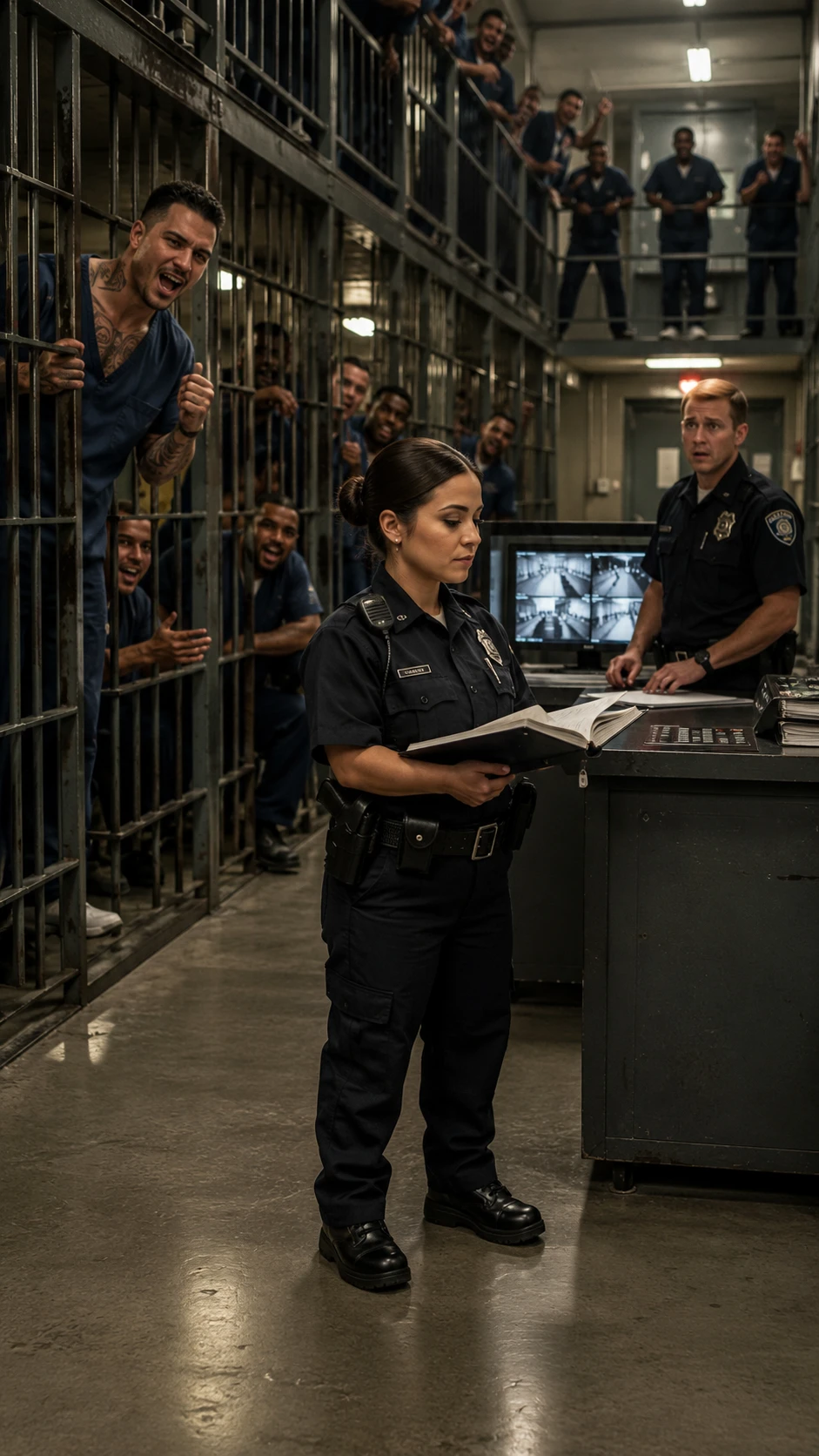
They laughed at the smallest guard until her hidden badge exposed the man who owned C-Block.
“Get her out before somebody steps on her,” an inmate yelled from behind Cell 12.
The steel door thundered shut behind Olivia Reed, and C-Block erupted like a packed courtroom hearing a cruel verdict.
She did not turn around.
She did not lower her eyes.
She crossed the yellow line painted on the concrete floor and walked straight into the noise.
Men slammed palms against bars.
Metal rattled along both tiers.
A voice from above whistled like she was walking onto a stage.
“Tell me that ain’t our new guard.”
Another inmate leaned through his door and laughed.
“Nah, man, that is Bring Your Daughter to Work Day.”
The corridor exploded again.
Olivia kept moving.
Her black uniform was freshly pressed, with no loose thread and no careless wrinkle.
The radio on her shoulder crackled once, then went silent.
Her duty belt sat firm around her waist.
Her boots struck the floor with measured sound.
They were polished, but not pretty.
Nothing about her was decorative.
Still, the men ignored the uniform.
They ignored the radio.
They ignored the belt.
They saw only that Olivia Reed stood four feet five inches tall.
Her rare genetic condition had shaped her body before strangers ever learned her name.
It had also trained strangers to underestimate her without asking permission.
That morning, every prisoner in C-Block made the same decision.
They decided she was harmless.
They decided she was funny.
They decided she had walked into their house by mistake.
A tall prisoner near Cell 12 slapped both hands against the bars.
“Yo, they sent us a substitute teacher.”
A man on the upper tier shouted back.
“Substitute teacher? She looks like she needs a hall pass.”
The men howled.
Boots dragged over concrete.
Fists pounded doors.
Faces appeared between steel bars like spectators at a street fight.
Olivia reached the guard station without looking at anyone.
Behind the desk, Officer Ryan Bell rose halfway from his chair.
He looked young, tired, and badly outnumbered.
His blond hair was cut too short.
His eyes carried the strained alertness of a man who slept with one ear open.
“Officer Reed,” he said quietly.
His voice nearly disappeared beneath the laughter.
Olivia held out one hand.
“Logbook.”
Bell blinked.
“Yes, ma’am.”
He pushed a thick clipboard across the desk.
His fingers hesitated before he released it.
Olivia took it calmly.
The inmates kept laughing.
Their words came fast, rough, and eager.
They were trying to bruise her before she spoke.
She turned the first page.
Then the second.
She read incident reports, meal counts, medical notes, and shift warnings.
Her eyes moved quickly.
Her face stayed still.
Someone cupped his hands beside his mouth.
“Hey, short stack, you need a ladder for that desk?”
Fresh laughter rolled through the block.
Bell looked at Olivia with open embarrassment.
He seemed ready to apologize for every man behind every door.
She did not allow it.
“Camera view, upper tier two,” Olivia said.
Bell frowned.
“Sorry?”
“Upper tier two,” she repeated.
Bell glanced toward the wall of monitors.
They were old screens, mounted above the desk in uneven rows.
Each screen showed grainy angles of concrete, steel, stairs, and barred doors.
C-Block appeared in gray fragments.
A stairwell camera flickered.
A corridor camera wavered with static.
One screen showed the upper walkway near Cell 12.
Bell switched the feed.
Olivia leaned forward slightly.
She studied the image like someone comparing it to a map she already knew.
An inmate in Cell 8 crouched near his bars.
He bent until his eyes were level with hers.
“Look at that,” he said. “Now we are the same height.”
The block roared again.
Olivia closed the logbook.
She placed the pen across the clipboard with quiet care.
Then she turned toward the cells.
“Stand for inspection.”
Her voice was not loud.
It crossed the concrete anyway.
The laughter broke unevenly.
Some men kept grinning.
Others looked around, waiting for the next joke.
Olivia did not give them one.
“Cell inspection begins in five minutes.”
A man near Cell 3 whistled.
“You cannot even see the top bunk.”
Olivia looked at the clock above the security door.
“Four minutes and fifty seconds.”
Bell stared at her.
So did several inmates nearest the desk.
She did not puff herself up.
She did not sharpen her voice.
She did not perform anger for an audience.
That irritated them more.
A gray-stubbled prisoner leaned against his door.
“You hear that, fellas?”
He grinned at the upper tier.
“Tiny wants to search the block.”
Olivia turned her head.
For the first time, she looked directly at the tall inmate by Cell 12.
His nameplate read Darius Kane.
He was broad, muscular, and still in the way dangerous men often were.
His prison blues hung loose around his shoulders.
His face carried the calm confidence of someone who expected obedience.
The others watched him before they watched staff.
Even Bell’s eyes moved toward Kane too often.
Olivia saw that.
She saw the timing.
She saw the silence that followed Kane’s smallest gestures.
She saw that C-Block did not laugh randomly.
It laughed when Kane allowed it.
“Mr. Kane,” Olivia said.
His smile spread slowly.
“Oh, she knows my name.”
“I know every name assigned to this unit.”
“Then you know mine carries weight here.”
Olivia lifted the clipboard again.
“No. I know your name appears repeatedly.”
A few inmates made low sounds.
Kane’s smile thinned.
Bell shifted behind the desk.
Olivia turned one page.
“Three altercations outside your cell within fourteen days.”
She turned another page.
“Two missing meal trays.”
Another page.
“One damaged cover on the camera near stairwell B.”
Kane’s eyes cooled.
Olivia continued.
“One officer requested transfer after a night shift on this tier.”
The block lost another layer of noise.
Kane tapped the bars once.
The sound was deliberate.
“You read a lot for somebody who just got here.”
Olivia glanced at the monitor showing upper tier two.
“I read what matters.”
Bell cleared his throat.
“Officer Reed, we may need to wait for additional staff.”
She did not turn from the screen.
“Additional staff is already involved.”
Bell’s mouth closed.
Kane heard it.
His head tilted slightly.
“What is that supposed to mean?”
“It means you have three minutes and forty seconds to stand for inspection.”
A younger inmate near Cell 8 muttered under his breath.
Kane snapped his fingers once.
The younger man stopped instantly.
Olivia watched the movement.
Bell watched it too.
The fluorescent lights hummed overhead.
For the first time since Olivia entered, the block seemed to listen.
Kane leaned closer to his bars.
“Do you really think this place answers to you?”
“No,” Olivia said. “I think this place records more than people remember.”
Something shifted behind Kane’s eyes.
It lasted less than a second.
His gaze moved toward the upper-tier camera.
Then toward the stairwell.
Then toward Bell.
Olivia caught all of it.
Bell looked down at the control panel.
His right hand trembled near the switches.
Olivia stepped closer to the station.
“Officer Bell.”
“Yes, ma’am?”
“Release inspection hatch one.”
Bell froze.
The reaction inside the block was immediate.
Several inmates began shouting.
One cursed.
Another kicked the lower edge of his door.
Kane’s voice cut through all of them.
“Bell, do not touch that panel.”
Bell’s face drained of color.
Olivia looked at him fully.
There it was.
Not disrespect.
Not laziness.
Fear.
Bell was not embarrassed because she was small.
He was terrified because Kane was watching.
Olivia lowered her voice.
“Officer Bell, look at me.”
He did.
“You submitted a request for outside review three weeks ago.”
The words struck C-Block like a chair thrown across a room.
Kane went still.
Bell’s eyes widened.
Olivia continued.
“You reported contraband movement, missing property, and pressure from inmate leadership.”
Bell swallowed hard.
His lips parted, but nothing came out.
“You were told to stop asking questions,” Olivia said.
Bell closed his eyes briefly.
Kane gripped the bars.
“You do not know anything.”
Olivia turned back toward him.
“I know you made a young officer afraid to do his job.”
Kane smiled again.
This time, it looked like a mask.
“You came here because Bell wrote some scared little complaint?”
“No,” Olivia said. “I came because that complaint disappeared.”
The silence that followed was different.
It did not belong to the guards.
It did not belong to Kane.
It belonged to the truth entering a room that had avoided it.
Bell stared at the floor.
His shame showed plainly.
“I sent it,” he whispered.
“I know.”
He lifted his eyes.
“I did send it.”
“I know you did,” Olivia said.
Kane laughed once.
It sounded flat.
“You think paperwork protects people in here?”
“No,” Olivia said. “Evidence does.”
She pointed toward the monitor wall.
“Upper tier two.”
Bell turned slowly.
His fingers moved across the control panel.
The camera angle changed.
The upper walkway appeared on the central monitor.
It showed a narrow path outside Cell 12 and the stairwell beyond it.
At first, nothing seemed unusual.
Concrete.
Bars.
A blind corner near the broken camera cover.
Olivia leaned closer.
“Rewind to 6:14 a.m.”
Bell stared at her.
He did not ask why she knew the time.
He pressed the control.
The footage jumped backward in short, ugly frames.
Men shifted behind their bars.
Nobody laughed now.
A uniformed officer appeared on the screen.
It was not Bell.
The man had heavy shoulders and gray at his temples.
He walked with the confident boredom of someone trusted too long.
Bell whispered the name before he could stop himself.
“Captain Harlan.”
On the screen, Captain Harlan approached Cell 12.
Kane’s hand slipped through the bars.
Something small passed from Kane’s palm into Harlan’s hand.
The image was grainy.
The exchange was not.
Bell stopped breathing for a moment.
Olivia spoke without looking at him.
“Continue.”
Bell pressed play.
Harlan moved toward stairwell B.
He glanced once toward the damaged camera cover.
Then he tucked the object inside his vest.
A prisoner on the upper tier whispered a curse.
Kane’s face tightened.
“That proves nothing.”
Olivia nodded once.
“By itself, no.”
She reached inside her breast pocket.
Bell watched her hand.
Kane watched it too.
Olivia removed a folded document.
The paper had been opened many times.
At the top, the state seal showed under the fluorescent lights.
Bell’s breath caught.
Olivia unfolded it with care.
“This is my assignment authorization.”
Kane stared at the document.
Bell stared harder.
“Effective today,” Olivia read, “Special Investigator Olivia Reed is authorized to conduct internal review of C-Block operations at Redstone State Correctional Facility.”
The word traveled before she finished.
“Investigator?”
Someone said it from the upper tier.
Another inmate repeated it below.
Investigator.
The word crossed the block faster than any insult had.
Olivia folded the paper.
“I am not the new guard.”
Her voice stayed level.
“I am the investigator sent after Officer Bell’s report vanished.”
Kane’s smile disappeared completely.
Bell gripped the edge of the desk.
“You did not tell me.”
“You were safer that way.”
Bell looked wounded for half a second.
Then understanding replaced it.
Kane slammed his palm against the bars.
The sound cracked through the corridor.
Several inmates flinched.
Olivia did not.
“You cannot walk into my block and act like you own it,” Kane said.
Olivia stepped closer to Cell 12.
She stopped outside his reach.
“I do not own C-Block.”
She looked along both tiers.
“And neither do you.”
A few inmates looked away from Kane.
It was a small movement.
Inside prison walls, small movements carried enormous meaning.
Bell straightened behind the desk.
Olivia noticed without turning.
“Release inspection hatch one,” she said again.
This time, Bell obeyed.
The hatch buzzed open with a metallic snap.
Kane watched him do it.
His control cracked in front of everyone.
The humiliation changed direction.
It no longer belonged to Olivia.
It settled on the man who had mistaken her calm for weakness.
Olivia pulled nitrile gloves from a dispenser.
She snapped them over her hands.
Then she took an angled inspection mirror from the rack.
The handle was short.
The mirror tilted upward.
A man in Cell 3 stared at it.
“Guess she can see the top bunk after all,” he muttered.
Nobody laughed.
Olivia approached Cell 12 first.
Kane stood near the back wall.
His body filled much of the cell.
His jaw worked once.
Olivia did not enter.
She did not need to.
She checked the floor seam.
Then the sink.
Then the bedding.
She slid the mirror under the lower bunk.
The mirror reflected the underside of the frame.
Then she angled it toward the upper rail.
A taped packet sat behind the metal support.
Bell saw it on the mirror.
His face went white.
Olivia held out one hand.
“Evidence bag.”
Bell moved quickly.
He passed the bag through the hatch.
Olivia removed the packet with careful precision.
Inside were folded notes, small pills, and torn strips of uniform cloth.
The corridor stayed silent.
Olivia sealed the bag.
She wrote the time across the label.
Then she looked at Kane.
“Your reach was longer than your arms.”
Kane’s nostrils flared.
“You planted that.”
Olivia shook her head.
“The camera says otherwise.”
She turned back to Bell.
“Archive thirty days of footage from upper tier two and stairwell B.”
Bell nodded.
“Yes, ma’am.”
His voice sounded stronger.
Kane noticed immediately.
His eyes narrowed at the young officer.
“You think she protects you now, Bell?”
Bell looked at him.
For the first time, he did not look away.
“No,” Bell said. “The truth does.”
A low murmur moved through the block.
Olivia watched Bell for one brief moment.
Something softened in her expression.
It was not pride.
It was recognition.
She had seen that moment before.
The moment a frightened person remembered his own spine.
Then the far security door opened.
Captain Marcus Harlan entered with two officers behind him.
He was tall, thick through the shoulders, and comfortable with authority.
His gray hair was trimmed neatly.
His uniform looked broken in, not sloppy.
His eyes found Olivia at once.
“Who authorized this inspection?” Harlan demanded.
Olivia turned.
“I did.”
Harlan looked her up and down.
He tried to hide his reaction.
He failed.
The inmates saw it.
Kane saw it most clearly.
For one hungry second, C-Block waited for Harlan to crush her.
Harlan stepped closer.
“Officer Reed, you are new here.”
“No, Captain.”
He frowned.
Olivia raised a badge case.
Gold flashed beneath the light.
“Special Investigator Reed, Ohio Department of Rehabilitation and Correction.”
Harlan stopped.
The two officers behind him exchanged glances.
Kane’s expression changed again.
He had expected Harlan to rescue him.
Instead, Harlan looked like a man hearing a lock close.
Olivia opened the badge case fully.
“Captain Harlan, surrender your keys and radio.”
The words seemed to remove all oxygen from the block.
Harlan forced a laugh.
“That is ridiculous.”
Olivia tilted her head.
“Is it?”
She nodded toward Bell.
“Play 6:14 again.”
Bell pressed the control.
The monitor showed Harlan walking past Cell 12.
It showed Kane’s hand.
It showed Harlan taking the object.
It showed him hiding it inside his vest near stairwell B.
Harlan’s color changed.
“That is not what it looks like.”
“Then you can explain the difference to internal affairs.”
One officer behind Harlan stepped back.
He looked at Olivia.
Then he looked at Bell.
Then he removed Harlan’s radio himself.
Harlan spun toward him.
“What do you think you are doing?”
The officer did not answer.
He took Harlan’s keys next.
Kane backed away from his bars.
The king of C-Block watched his bridge collapse.
Olivia turned to the unit.
“Every inmate remains at his door.”
No one laughed.
No one slapped the bars.
No one called her a child.
Olivia’s body had not changed.
Their understanding had.
Bell stepped beside the desk.
His shoulders were not fully relaxed.
But he no longer looked alone.
Kane leaned toward the bars again.
His voice dropped low.
“You made a mistake.”
Olivia met his eyes.
“No,” she said. “You did.”
She looked toward the officers.
“Move inmate Kane to holding for separation.”
The cell door buzzed.
Kane did not move.
For years, his silence had made others hesitate.
This time, his silence did nothing.
The officers opened the door.
They cuffed him without force.
They did not need drama.
Kane kept his head high.
His eyes burned as he passed Olivia.
“You think they will thank you?”
Olivia looked up at him.
“No.”
The answer seemed to unsettle him.
“I did not come here for thanks.”
Kane had nothing ready for that.
The door shut behind him.
Its sound was heavy and final.
After Kane left, C-Block did not become safe.
It did not become kind.
The concrete still held old anger.
The air still smelled of bleach, sweat, and metal.
But it became different.
It became honest enough to breathe.
Bell stared at the sealed evidence bag on the desk.
“I thought I ended my career,” he said softly.
Olivia peeled off her gloves.
“You came closer to saving this place.”
He looked at her.
“Closer?”
She handed him the logbook.
“You stopped being afraid today.”
Bell swallowed.
“That matters too.”
“It matters most.”
His eyes drifted toward the folded assignment order in her hand.
“You knew about my report before you arrived?”
“Yes.”
“And you let them laugh?”
Olivia looked down the corridor.
“The insults were useful.”
Bell stared at her.
“Useful?”
“They showed who followed Kane.”
Her eyes moved to Cell 8.
“They also showed who laughed because they were scared.”
The young inmate who had crouched to mock her looked at the floor.
His face reddened.
Olivia did not shame him further.
She had never needed to.
That was the difference.
Minutes later, the warden arrived with state officers.
The unit filled with controlled movement.
Radios crackled.
Boots crossed concrete.
Doors remained closed.
Harlan was escorted through the same door Olivia had entered.
He did not look left or right.
Bell watched him go.
His hands no longer shook.
The warden approached Olivia near the desk.
“Investigator Reed,” he said, “I was told this would be discreet.”
Olivia looked at the silent tiers.
“It was.”
The warden followed her gaze.
Then he understood.
Discreet did not mean quiet.
It meant precise.
It meant waiting until the truth could not be dodged.
Olivia handed him the sealed evidence.
“Cell 12’s network had staff protection.”
The warden’s jaw tightened.
“We will handle it.”
“You will,” Olivia said.
“And this review will not disappear.”
He nodded once.
There was no argument left in him.
Hours later, C-Block looked nearly unchanged.
The lights still hummed.
The bars still stood.
The security doors still groaned when opened.
But the sound of the place had shifted.
When Olivia walked toward the exit, no one laughed.
No one slapped steel.
No one bent down to meet her eyes.
Near Cell 3, the gray-stubbled inmate cleared his throat.
“Officer Reed.”
She stopped.
He hesitated.
Then he corrected himself.
“Investigator Reed.”
Olivia turned her head.
He looked uncomfortable.
“I was out of line.”
The apology was rough.
It carried no polish.
Still, it was real.
Olivia studied him briefly.
Then she nodded once.
“Stay that way tomorrow.”
He looked down.
“Yes, ma’am.”
Bell walked her to the exit door.
He pressed the release button.
The lock buzzed open.
Before she stepped through, he spoke again.
“Why this job?”
Olivia paused.
For the first time that day, her expression changed.
Only slightly.
Enough to show the question had reached something old.
“Because people spent my whole life deciding what I could not do.”
She looked back toward C-Block.
“Places like this are built from that same mistake.”
Bell said nothing.
Olivia stepped into the outer corridor.
Then she turned back.
“File a new report before your shift ends.”
Bell nodded.
“Yes, ma’am.”
“And sign your name.”
His throat moved once.
This time, there was no fear in his answer.
“I will.”
The steel door closed between them.
Inside C-Block, the men remained quiet.
Outside, Olivia Reed walked alone down the long corridor.
Her boots struck the floor steadily.
Not loudly.
Not theatrically.
Just steadily.
At the end of the hall, late Ohio sunlight crossed a narrow window.
It fell across her uniform, her badge, and the folded order in her hand.
For a moment, she stood inside that thin square of light.
Then she kept walking.
Behind her, Redstone had started changing.
Not perfectly.
Not painlessly.
But truth had entered through the smallest door in the building.
And nobody in C-Block was laughing anymore.
THE END