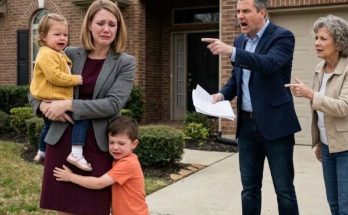
My water broke beneath a crystal chandelier while nearly three hundred guests applauded my sister-in-law’s first dance.
For one confused second, I thought someone had spilled a drink behind me.
Then warmth spread down the inside of my legs and pooled across the polished marble beneath my shoes.
The ballroom lights caught the liquid, turning it silver.
I stared down.
My champagne flute slipped from my hand and struck the table without breaking.
The baby was not due for six more weeks.
A pressure tightened across my abdomen.
It began low in my back and moved forward, hardening everything until I could not stand straight.
I grabbed my husband’s sleeve.
“Caleb.”
He kept watching the dance floor.
His sister, Sophia Bellamy, was turning beneath her husband’s raised hand while a string quartet played a slow arrangement of their favorite song. Her wedding dress had a long pearl-covered train, and every movement seemed designed for the three camera crews surrounding her.
“Caleb,” I said again.
He looked at me at last.
“What?”
“My water broke.”
His eyes dropped toward the floor.
The color left his face.
Another contraction began.
I bent forward and gripped the edge of the table.
“Call an ambulance.”
Caleb glanced toward the dance floor.
Not toward the nearest exit.
Not toward the waiters.
Not toward the hotel medic whose station had been identified during the rehearsal.
He looked toward the cameras.
“Can you walk?” he asked quietly.
“What?”
“The photographer is facing this way.”
Pain tightened through me.
“I’m thirty-four weeks pregnant. Call an ambulance.”
Several guests at the neighboring table began noticing us.
A woman in a gold dress looked down at the wet floor.
Her mouth opened.
Before she could speak, my mother-in-law appeared.
Helena Bellamy moved through crowds the way a ship moved through shallow water. People stepped aside before she asked.
She wore a silver evening gown with a narrow train and a diamond necklace that had belonged to her husband’s grandmother. Her gray-blonde hair remained perfectly arranged despite the heat rising from the ballroom.
She looked at the floor.
Then at me.
Her expression did not show concern.
Only calculation.
“Not here,” she said.
She gripped my upper arm.
Her fingers dug into the fabric of my sleeve.
“I need a hospital.”
“Lower your voice.”
“My water broke.”
“I can see that.”
“Then call someone.”
Helena smiled at two guests who were looking toward us.
“Just a little spill,” she told them.
Then she pulled me away from the table.
I stumbled.
“Stop.”
Caleb followed behind us, still glancing toward the dance floor.
The guests applauded as Sophia finished the first dance.
No one heard me over the music.
Helena led me through a side door and into a service corridor lined with stacked chairs, folded tablecloths, and carts of untouched champagne glasses.
“Please,” I said. “The baby is early.”
“Then walk faster.”
A sharper contraction struck.
My knees weakened.
I caught the wall.
Helena tightened her grip and nearly dragged me forward.
“Mother, slow down,” Caleb said.
He did not tell her to stop.
He did not call for help.
He only asked her to make the cruelty less visible.
We reached a bathroom near the bridal suite.
Helena pushed the door open.
The room was larger than the kitchen in my first apartment. White marble counters ran along one wall. Fresh roses stood beside gold-framed mirrors. A velvet chair occupied one corner beneath a decorative lamp.
I pulled away from her.
“I am not staying here.”
“Yes, you are.”
She pushed me across the threshold.
I turned toward Caleb.
“Call emergency services.”
He rubbed one hand over his mouth.
“Maybe we should wait a few minutes and see whether the contractions stop.”
“My water broke.”
“You could be mistaken.”
I stared at him.
The fluid was still running down my legs.
“How could I be mistaken?”
Helena reached for the door.
“This child has already taken enough attention from Sophia.”
I thought I had misunderstood her.
“What?”
“She has planned this day for eighteen months. You will not ruin the reception because you enjoy making emergencies.”
“I am in labor.”
“You have complained through the entire pregnancy.”
“I had hyperemesis for five months.”
“You made every family dinner about nausea.”
“I was hospitalized twice.”
“And everyone heard about it.”
Another contraction folded me forward.
I grabbed the counter.
Pain moved through my pelvis with frightening force.
“Caleb.”
He stood in the doorway.
His face looked pale.
For one moment, I believed he would finally choose correctly.
Instead, he said, “Just ten minutes.”
I stopped breathing.
“What?”
“Let the first dance finish. Then we’ll leave quietly.”
“The first dance already finished.”
“The speeches are next.”
“Your son could be in danger.”
“We don’t know it’s a boy,” Helena said coldly.
We did.
I had told them.
They simply did not care enough to remember.
Helena stepped out.
I tried to follow.
She pulled the door shut.
The lock clicked from the outside.
I stared at the handle.
“Open the door.”
No answer.
I struck it with my palm.
“Caleb?”
His shadow paused beneath the narrow gap.
“Please don’t make this worse,” he said.
Then his footsteps disappeared.
For several seconds, I stood completely still.
The music from the ballroom reached the bathroom through the walls as a distant vibration.
A man began giving a speech.
Guests laughed.
My hands shook.
I tried the handle again.
Locked.
There was no window.
No emergency button.
My regular phone was inside my purse, which Helena had pushed onto the chair before leaving.
I pulled it out.
The screen showed one bar of reception.
I called emergency services.
The call failed before connecting.
I tried again.
Nothing.
The vineyard sat in a valley surrounded by hills. Mobile service was inconsistent, and the estate’s guest network required a code I had never received.
Another contraction began.
I dropped to one knee.
The pressure was stronger now.
Too close together.
Too fast.
At thirty-four weeks, every minute mattered.
I had spent enough time around medical reports to understand the risks without imagining the worst.
Premature labor.
Infection after membrane rupture.
Fetal distress.
Cord complications.
Hemorrhage.
Words I had read professionally now felt like threats written inside my body.
I opened my purse wider.
Beneath a small makeup bag, a wallet, and the folded wedding program lay a black phone no larger than my palm.
It was not connected to my personal mobile account.
No social applications.
No family contacts.
No photographs.
The phone had been issued by the state attorney general’s organized fraud unit for field operations.
One number was programmed into the emergency directory.
Special Agent Naomi Reyes.
My supervisor.
My closest professional ally.
The woman who had warned me not to attend the wedding at all.
I pressed the call button.
She answered before the second ring.
“Claire?”
My professional name was Claire Monroe.
The Bellamys still called me Claire Bellamy when they wanted to remind me I belonged to them.
“I need medical assistance.”
Naomi’s voice changed immediately.
“Location.”
“East bridal bathroom, Bellamy Vineyard. I’ve been locked inside.”
“Medical condition?”
“My water broke. Thirty-four weeks. Contractions are close.”
“Any bleeding?”
“Not yet.”
“Can you unlock the door?”
“No.”
“Who locked it?”
I looked toward the handle.
The next contraction forced me to grip the counter.
“The same people named in the sealed warrant.”
There was a pause.
Not shock.
Confirmation.
Naomi said, “Stay on the line. Tactical and medical teams are twelve minutes away.”
“Twelve?”
“The warrant team staged nearby after the rehearsal dinner.”
I closed my eyes.
I had known agents would execute the sealed warrants sometime that weekend.
I had not known they were already waiting.
“Why didn’t you tell me?”
“You were not operational on this phase.”
“I provided half the evidence.”
“You are also married to one of the subjects.”
“My husband signed the transfers.”
“Yes.”
The word was careful.
I sat on the floor with my back against the vanity cabinet.
“Is Caleb named?”
“Claire.”
“Tell me.”
“Yes.”
The room seemed to tilt even though I already knew.
Two weeks earlier, I had found his electronic approval on every major transfer.
At first, I hoped his signature had been copied.
Then I found access records from his office computer.
Time stamps.
Device verification.
Messages between him and the vineyard controller.
He was not merely aware.
He had participated.
Still, some foolish part of me had held onto the possibility that he had been pressured.
That he might confess.
That the husband who rested his hand on my stomach at night could be separate from the man whose credentials moved stolen money.
Now he had left me locked in a bathroom during premature labor.
The separation between those men disappeared.
Naomi continued.
“Paramedics will reach you first if they can access the east corridor. Can you make noise?”
“I can hit the door.”
“Do it only between contractions. Conserve energy.”
“I’m not delivering here.”
“You are not making that decision alone. Listen carefully. Is there pressure to push?”
“Not yet.”
“Any urge to use the bathroom?”
“No.”
“Baby moving?”
I placed one hand on my abdomen.
For several frightening seconds, I felt nothing.
Then a small movement pressed beneath my palm.
“Yes.”
“Good. Stay on your left side if possible.”
The bathroom floor felt cold through my gown.
I lowered myself carefully.
My dress was pale blue, loose around the waist, and chosen because Helena said maternity clothes looked undisciplined in photographs. I had spent the evening pulling the fabric away from my body whenever the baby kicked.
Now the skirt clung wetly to my legs.
“Naomi.”
“I’m here.”
“If the warrant team enters during the speeches, there will be hundreds of guests.”
“That is not our priority.”
“They’ll panic.”
“Security teams are managing exits.”
“Children are present.”
“We know.”
I heard movement on her end.
A radio.
A door closing.
Then a man’s voice giving coordinates.
Naomi said, “Medical team is entering through the service gate.”
Another contraction began.
I breathed through my teeth.
“Talk to me,” she said.
“I hate when people say that during pain.”
“Then insult me.”
“You should have stopped me from coming.”
“I tried.”
“You should have tried harder.”
“Fair.”
The contraction peaked.
I pressed my head against the cabinet.
When it eased, I opened my eyes.
“I thought if I attended, Caleb might believe I still trusted him.”
“You were gathering information.”
“I was pretending it was strategy.”
“What was it?”
“Hope.”
Naomi remained quiet.
I continued.
“I wanted him to be innocent.”
“I know.”
“You knew before I did.”
“I suspected.”
“You removed me from direct review.”
“Because conflict rules required it.”
“Because you thought I would protect him.”
“No.”
“What, then?”
“I thought you would punish yourself trying not to.”
The words landed harder than I expected.
For nine months, I had examined Bellamy Vineyard’s finances.
The investigation began with a payroll complaint from a seasonal worker named Arturo Medina.
He claimed the vineyard issued wages under his dead father’s identity, then demanded part of the money back in cash.
At first, the complaint looked like tax fraud.
Then we found dozens of payroll accounts tied to dead relatives, former employees, and people who had never worked at the property.
Money entered those accounts.
Within days, it moved into vendor companies.
The vendors appeared to provide irrigation repairs, bottle labeling, soil consulting, event security, and transport services.
Most had no employees.
Several shared mailing addresses with Bellamy family properties.
One belonged to Sophia’s husband.
Another belonged to Helena’s personal attorney.
The money trail moved outward.
State tourism grants.
Agricultural subsidies.
Pandemic relief funds.
Charitable donations.
Private investor money.
More than twenty-eight million dollars had passed through the network over five years.
My job was to follow transactions without falling in love with explanations.
That was easy when the people involved were strangers.
It became harder when Caleb’s name appeared.
At first, he said he signed whatever his mother placed in front of him.
Then he said the vineyard controller used his electronic authorization for routine payments.
Then he stopped answering questions and accused me of bringing work into our marriage.
I did not tell him the investigation was official.
I said only that the accounting looked irregular.
He kissed my forehead and told me pregnancy had made me anxious.
That night, I copied his explanation into my evidence log.
I cried while typing it.
Naomi’s voice sharpened.
“Claire, officers are outside the bathroom corridor.”
I heard shouting beyond the door.
A man ordered someone to move away.
Another voice answered angrily.
Helena.
“You cannot enter during my daughter’s reception!”
The handle shook.
Then someone struck the door near the lock.
Wood splintered.
The door opened inward.
Two uniformed officers entered first.
Behind them came a paramedic team with a stretcher and medical bags.
Naomi’s voice remained in my ear.
“They have you.”
I began crying.
Not because the danger had ended.
Because someone had opened the door when I asked.
A paramedic knelt beside me.
“My name is Daniel. How far along?”
“Thirty-four weeks.”
“First baby?”
“Yes.”
“Any bleeding?”
“No.”
“Contractions how close?”
“I don’t know. Three or four minutes.”
His partner placed a monitor against my abdomen.
The baby’s heartbeat appeared quickly.
Fast.
Uneven.
Daniel’s expression became focused.
“We’re transporting now.”
They helped me onto the stretcher.
As they rolled me into the corridor, I saw Helena standing against the wall between two officers.
Her face was red.
“Do not take her through the ballroom,” she demanded. “There are service exits.”
The paramedic ignored her.
Caleb stood several feet away.
He had removed his suit jacket.
His bow tie hung loose.
For one second, he looked relieved to see me alive.
Then he saw the black operational phone in my hand.
His expression changed.
Not concern.
Fear.
“You called them,” he said.
I stared at him from the stretcher.
“I called someone who answered.”
He moved toward me.
An officer blocked him.
“That’s my wife.”
“You need to remain here, sir.”
“I’m going to the hospital.”
The officer said, “You are being detained pending execution of a search warrant.”
Guests had begun gathering at the end of the service corridor.
Sophia stood among them in her wedding gown.
Her husband held her arm.
“What is happening?” she cried.
Helena turned toward the agents entering through the ballroom doors.
“This is Claire’s fault.”
I watched Caleb.
He did not deny it.
He did not defend me.
He looked only at the phone.
“What did you tell them?” he asked.
“The truth.”
His face emptied.
The stretcher moved away.
The ballroom doors were open.
The first dance decorations still glowed beneath the chandeliers. Guests stood between tables while agents directed them toward marked exits.
Several officers carried document boxes toward the vineyard offices.
Others guarded stairways.
Sophia’s wedding cake remained untouched beneath a wall of flowers.
As the paramedics rolled me through the room, hundreds of people turned.
I expected humiliation.
Instead, I felt strangely detached.
The scene belonged to them now.
Their whispers.
Their cameras.
Their questions.
My concern had narrowed to the monitor near my shoulder.
The baby’s heartbeat.
Daniel leaned toward me.
“Stay with us.”
“I’m conscious.”
“Keep it that way.”
Outside, evening air struck my face.
An ambulance waited beneath strings of garden lights.
The vineyard’s stone buildings glowed gold against the dark hills.
For months, those buildings had appeared in financial statements as event spaces, offices, warehouses, and charitable training centers.
Now every doorway held officers.
They loaded me into the ambulance.
Before the doors closed, I saw Caleb being led from the service corridor in handcuffs.
Helena shouted at an agent.
Sophia stood frozen in her wedding dress.
Her perfect day had not been stolen by my baby.
It had been destroyed by the truth her family believed they could postpone.
The ambulance began moving.
Daniel started an IV while his partner contacted the hospital.
The monitor showed contractions coming quickly.
I held the black phone against my chest.
Naomi remained on the call.
“I’m following behind,” she said.
“You should be at the search.”
“I delegated.”
“You never delegate.”
“I do when my auditor is trying to deliver six weeks early.”
“I’m not your auditor tonight.”
“No.”
“What am I?”
“A patient.”
The word gave me permission to stop thinking.
For several minutes, I listened to the siren.
The baby’s heartbeat dipped during another contraction.
Daniel adjusted my position.
“Left side.”
I turned as much as the straps allowed.
“Is he okay?”
“He’s showing stress. The hospital is ready.”
My throat tightened.
“What happens if he needs to be delivered now?”
“They handle it.”
“That isn’t an answer.”
“It’s the honest one.”
At the hospital, the doors opened before the ambulance fully stopped.
A neonatal team waited inside.
They moved me into an examination room where nurses cut away my wet clothing and replaced it with a hospital gown.
An obstetrician introduced herself as Dr. Elaine Ford.
She performed an ultrasound, checked dilation, and studied the monitor.
“You’re six centimeters,” she said.
My stomach dropped.
“Can labor be stopped?”
“Not safely after this degree of membrane rupture and progression. The baby’s heart rate is showing repeated decelerations.”
“What does that mean?”
“He may not be tolerating labor well.”
“Will I need surgery?”
“Possibly. We’re monitoring minute by minute.”
“Can my sister come?”
“Is she your approved support person?”
“Yes.”
I had not thought about the hospital forms until that moment.
Six weeks earlier, after finding Caleb’s authorization on the suspicious transfers, I had changed my emergency contacts.
My older sister, Rachel, became the primary.
Naomi had told me to prepare medical privacy forms even though I resisted.
“You are not predicting disaster,” she said. “You are preventing someone else from controlling information while you cannot.”
Now a nurse called Rachel.
She arrived twenty-five minutes later wearing jeans, a sweatshirt, and two different shoes.
“I dressed in the car,” she said.
Then she saw my face and stopped joking.
“What happened?”
“Helena locked me in a bathroom.”
Rachel’s expression became blank.
“She did what?”
“Later.”
“Where is Caleb?”
“Detained.”
“For the bathroom?”
“For fraud.”
She stared at me.
“What kind of wedding did you attend?”
“A Bellamy wedding.”
Another contraction came.
Rachel stood beside the bed and pressed her hand into mine.
“You should have called me before going.”
“I know.”
“You always know after.”
“I’m busy.”
“You are in labor. You are allowed to stop arguing.”
She stayed close while the medical team worked.
Around midnight, the baby’s heart rate dropped and did not recover quickly.
Dr. Ford looked at the monitor.
“We need to move to surgery.”
My fear became clean and immediate.
“Is he dying?”
“He needs help now.”
Consent forms appeared.
Rachel read the important parts aloud because my hands shook too much to hold them.
Emergency cesarean.
Possible general anesthesia.
Blood products if needed.
Neonatal intensive care.
I signed.
The operating room was bright and cold.
An anesthesiologist placed medication through the IV.
Rachel could not enter until they confirmed I would remain awake.
I stared at the ceiling.
A nurse stood beside my head.
“Your name?”
“Claire Monroe.”
“Baby’s gestational age?”
“Thirty-four weeks.”
“Who may receive updates?”
“My sister Rachel. Naomi Reyes.”
“No spouse?”
I swallowed.
“No.”
The spinal anesthesia took effect.
Pressure replaced pain.
Rachel entered wearing surgical clothing and sat beside me.
“You look ridiculous,” I whispered.
“So do you.”
“That helps.”
“I’m talented.”
The surgery began.
I felt pulling.
Movement.
Voices exchanged in controlled tones.
Then a small cry entered the room.
Weak.
Brief.
Nothing like the loud newborn cry I had imagined.
My chest tightened.
“Is he okay?”
The neonatal team moved quickly around a warming table.
Dr. Ford said, “You have a son.”
“Why isn’t he crying?”
“He is breathing, but he needs support.”
I turned my head as far as I could.
For one second, I saw him.
Tiny.
Red.
A mask over his face.
One nurse lifted him close enough for me to see before moving him toward the neonatal unit.
“His name is Lucas,” I said.
Rachel squeezed my hand.
“Lucas James.”
The doors closed behind the team.
I began crying silently.
The surgery continued.
I asked for updates every thirty seconds.
The anesthesiologist answered when she could.
Breathing support.
Stable heart rate.
Premature but responsive.
No major bleeding for me.
Placenta delivered.
Incision closing.
By the time I reached recovery, exhaustion had replaced fear with a heavy fog.
Rachel sat beside me.
Naomi entered after changing into clean clothes.
Her hair had escaped its usual tight bun. She looked as tired as I felt.
“How is the baby?” she asked.
“NICU.”
“Stable?”
“They say yes.”
She pulled a chair close.
For several minutes, none of us spoke.
Then I asked, “What happened at the vineyard?”
Rachel looked at Naomi.
“Do we need this now?”
“Yes.”
Naomi answered carefully.
“Search teams secured the administrative offices, family residence, wine-storage building, event office, and financial servers.”
“Records?”
“Extensive.”
“Accounts?”
“Emergency restraint requests filed.”
“Caleb?”
“Arrested on initial counts involving conspiracy, wire fraud, falsified payroll filings, and obstruction.”
The words sounded professional.
Distant.
Caleb had eaten cereal beside me that morning.
He had tied my shoes two days earlier because I could not bend comfortably.
He had also signed fraudulent transfers and left me locked in a bathroom while our son entered premature labor.
Both versions were real.
“Helena?”
“Arrested for unlawful confinement, obstruction, evidence destruction, and financial charges.”
“Sophia?”
“Not arrested tonight.”
“Her husband?”
“Detained, later released pending review.”
“The guests?”
“Removed safely. Some gave statements.”
I closed my eyes.
“What about the wedding?”
Rachel said, “Claire.”
“I’m asking.”
“The reception ended,” Naomi replied.
“Of course.”
“You are not responsible for that.”
“I know.”
“Do you?”
“No.”
Naomi leaned closer.
“Helena locked a premature woman in a bathroom to protect a wedding schedule. Caleb assisted by leaving you there. Agents executed warrants based on months of evidence. None of those decisions were yours alone.”
“I brought the investigation into the family.”
“The crimes brought the investigation.”
“I stayed married while collecting evidence.”
“You attempted to resolve the conflict legally and ethically.”
“I hoped he would confess.”
“Yes.”
“That was stupid.”
“It was human.”
Rachel said, “I dislike when professionals use that word after something terrible.”
“What would you prefer?” Naomi asked.
“Say it was stupid and understandable.”
Naomi nodded.
“Fine. It was stupid and understandable.”
I laughed despite the pain.
Then I cried again.
The next morning, a nurse wheeled me to the neonatal intensive care unit.
Lucas lay inside an incubator beneath soft blue lights.
Wires ran from his chest.
A thin tube rested near his mouth.
A small knitted cap covered his head.
He weighed four pounds and twelve ounces.
The nurse opened one side of the incubator and helped me place my hand against his back.
His body was warm.
Fragile.
Real.
“Can I hold him?”
“Later today if his breathing remains stable.”
I watched his chest rise.
Nothing else mattered for several minutes.
Then a hospital administrator approached.
“A man identifying himself as your husband has requested medical information through his attorney.”
My hand remained inside the incubator.
“What did you tell them?”
“That your chart is private and only approved contacts receive updates.”
“Good.”
“He also requested visitation.”
“No.”
“The hospital will follow your instructions while you are the patient and Lucas remains under intensive care. Longer-term parental access may require legal review.”
“Naomi has my attorney’s information.”
“We have it.”
The administrator left.
Rachel stood behind my chair.
“He sent a lawyer before calling you.”
“He can’t call directly from custody.”
“He could ask through counsel whether Lucas is alive before demanding visitation.”
I looked at my son.
“Maybe he did.”
“Do you want to know?”
“No.”
That answer changed later.
At the time, I needed distance more than explanation.
The sealed case became public within forty-eight hours.
News trucks gathered outside Bellamy Vineyard.
Photographs from the wedding spread online.
One showed me being wheeled through the ballroom while guests stared.
Another showed Helena arguing with agents.
Another showed Caleb in handcuffs near the service entrance.
Commentators reduced everything into simple language.
Pregnant Auditor Exposes Vineyard Dynasty During Wedding.
Mother-in-Law Locks Woman in Bathroom as Police Raid Reception.
Bellamy Family Fraud Empire Collapses at Lavish Ceremony.
The truth was slower.
Messier.
Less satisfying.
The fraud case involved thousands of transactions, dozens of witnesses, layered corporate entities, and years of deliberate concealment.
The confinement case was easier.
Hotel corridor cameras showed Helena pulling me toward the bathroom.
Audio from the service hallway captured me asking for an ambulance.
The electronic lock record showed the door secured from outside.
Caleb’s voice could be heard saying, “Just ten minutes.”
Those four words became public.
He later claimed he believed I was experiencing false labor and that he intended to return immediately.
The timeline showed twenty-three minutes passed before agents entered.
He never called emergency services.
He returned to the ballroom long enough to stand beside Sophia during the first speech.
A photographer captured him smiling.
I saw the image while recovering.
I closed the article and did not open another for weeks.
Lucas remained in the NICU for twenty-six days.
He needed breathing support for four days and a feeding tube for nearly three weeks.
Every morning, I sat beside him.
Every afternoon, I held him against my chest for skin-to-skin care.
Rachel helped me shower, change dressings, and understand discharge instructions.
Naomi visited only when she could avoid discussing work.
My mother flew in from Oregon and stayed at Rachel’s apartment.
She cried the first time she saw Lucas.
Then she became practical.
She washed baby clothes.
Prepared meals.
Created a notebook for feeding and medication schedules.
She had never trusted the Bellamys, but she did not say she had warned me.
That restraint was a gift.
Caleb’s attorney sent a letter one week after the birth.
He requested photographs and basic medical updates.
My family attorney, Jennifer Cole, advised me to provide limited factual information through a secure channel.
“Why?” I asked.
“Because he is Lucas’s legal father unless that status changes.”
“He left us.”
“Yes.”
“He participated in locking me inside.”
“Yes.”
“He’s charged with fraud.”
“Yes.”
“Then why does he get anything?”
“Parental rights and criminal accusations are separate until a court orders otherwise.”
I hated the answer.
I also understood it.
We sent one photograph.
Lucas asleep beneath a knitted blanket.
No location details.
No medical charts.
A brief note stated that he was stable and receiving premature-infant care.
Caleb replied through counsel.
Thank you. I am sorry.
Two words.
Too small.
Too late.
Still, I read them more than once.
My separation petition was filed from the hospital.
It requested temporary exclusive use of our home, preservation of marital assets, restricted communication, and supervised contact after medical clearance.
Caleb opposed the exclusive-home request, then withdrew after prosecutors introduced evidence that financial records were stored there.
The property became part of the search.
I did not return.
Rachel arranged a furnished apartment near the hospital for me and Lucas.
My mother packed essential belongings under agent supervision.
She brought the hospital bag.
The nursery remained untouched for months.
Caleb’s criminal case moved slowly.
He remained in custody briefly, then obtained conditional release with electronic monitoring.
He was prohibited from contacting witnesses, including me, except through attorneys.
Helena remained detained longer because prosecutors argued she had attempted to destroy records after the raid began.
Agents found shredded documents in the vineyard incinerator and a suitcase containing cash, passports, and encrypted drives.
Sophia publicly defended her mother at first.
She gave an interview outside the courthouse.
“My family is being targeted by a vindictive government employee who used her marriage to spy on us.”
I watched the clip once.
She wore black sunglasses and held her husband’s hand.
The reporter asked about the bathroom footage.
Sophia said, “My mother was trying to protect a premature woman from public embarrassment.”
I turned off the television.
Naomi later asked whether I wanted witness-intimidation concerns documented.
“No.”
“She accused you publicly.”
“She is frightened.”
“Fear does not excuse retaliation.”
“No, but I don’t want every cruel sentence prosecuted.”
“That is not how prosecution works.”
“Then why ask me?”
“To understand impact.”
“The impact is that I feel tired.”
Naomi wrote that down.
The first time Caleb and I spoke after the wedding was four months later during a court-approved mediation connected to temporary parenting.
Lucas was home by then.
He had gained weight but remained small for his age.
The mediator sat between us at a long table.
Caleb looked thinner.
He wore a plain gray suit instead of the tailored clothes his family preferred.
An ankle monitor showed beneath his trouser cuff.
For several seconds, we only looked at each other.
Then he said, “How is he?”
“Growing.”
“Does he have complications?”
“Mild reflux. Follow-up respiratory monitoring. Developmental assessments.”
“Can I see him?”
“You’ve seen photographs.”
“That is not the same.”
“No.”
The mediator interrupted.
“We are here to discuss conditions for potential supervised contact, not the criminal allegations.”
Caleb looked at me.
“I didn’t know labor had started.”
“I told you.”
“I thought you were panicking.”
“My water was on the floor.”
“I didn’t understand how serious it was.”
“I asked for an ambulance.”
“My mother said moving you through the crowd could create panic.”
“And you believed her.”
“I was trying to manage everything.”
“You managed the wedding.”
His face tightened.
“I made the worst decision of my life.”
“Which one?”
He looked down.
There were too many options.
The fraudulent transfers.
The confinement.
The silence.
The choice to follow Helena instead of protecting me.
Finally, he said, “Leaving you in that room.”
“Why?”
“What?”
“Why did you do it?”
“I thought ten minutes would not matter.”
“Why?”
“Because my mother said it wouldn’t.”
“You were thirty-six years old.”
“I know.”
“You had attended prenatal classes.”
“One.”
“You knew thirty-four weeks was early.”
“Yes.”
“You heard me say the baby might be in danger.”
“Yes.”
“Then why did her opinion outweigh mine?”
His eyes filled.
“Because it always had.”
That was the first honest answer.
The mediator allowed silence.
Caleb continued.
“She taught us that every family event depended on keeping her calm. If she became angry, everyone paid. Dad withdrew. Sophia cried. Staff got fired. I learned to agree quickly and apologize privately.”
“You apologized privately to me for years.”
“I know.”
“You thought that erased what happened publicly.”
“Yes.”
“It didn’t.”
“I know.”
The words no longer gave me satisfaction.
“Why did you sign the transfers?” I asked.
His attorney shifted.
The mediator said criminal matters were outside scope.
Caleb answered anyway.
“Mother said the accounts were temporary.”
“You had financial training.”
“I avoided looking.”
“That is not ignorance.”
“No.”
“Did you know the vendors were fake?”
“Some.”
“How many?”
“I don’t know.”
“You signed every transfer.”
“I know.”
“You told me your credentials had been copied.”
“I lied.”
“Yes.”
He covered his face briefly.
“I was afraid if I refused, she would expose Dad’s debts and collapse the vineyard.”
“The vineyard was already collapsing.”
“I know now.”
“You knew enough then.”
He lowered his hands.
“Yes.”
The mediator asked whether I would consider professionally supervised visits.
I looked at Caleb.
“Why do you want contact?”
“He’s my son.”
“That is a legal answer.”
“I want to know him.”
“Why?”
His expression changed.
“Because I failed him before he was born. I cannot undo that. I want the chance not to fail every time afterward.”
I agreed to begin with one-hour supervised visits after Caleb completed parenting education and a psychological assessment.
Not forgiveness.
Not reconciliation.
A structured chance.
The first visit occurred when Lucas was six months old.
Caleb sat in a family-services room beneath fluorescent lights.
He had never held our son.
The supervisor placed Lucas in his arms after showing him how to support the baby’s neck and back.
Caleb began crying immediately.
Lucas stared at him.
Then grabbed his tie.
Caleb laughed through tears.
“He’s strong.”
“He spent a month proving it,” I said.
Caleb looked at me.
“I should have been there.”
“Yes.”
The visit lasted one hour.
Caleb learned how to prepare a bottle and check Lucas’s breathing.
When the baby spit up across his shirt, he did not complain.
That small fact mattered more than the tears.
The criminal trial began nearly eighteen months after the wedding.
By then, the fraud investigation had identified thirty-six shell companies and more than forty-two million dollars in misused funds.
Some money had been spent on the vineyard.
Much had supported the family’s private lifestyle.
Luxury travel.
Jewelry.
Political donations.
Wedding expenses.
Sophia’s reception alone cost more than eight hundred thousand dollars.
Foundation accounts paid for floral installations and entertainment through false “community relations” invoices.
Sophia claimed she did not know.
Evidence showed she approved some event payments but not the larger fraud structure.
She accepted a civil settlement and repaid funds from the sale of personal property.
Her husband was charged separately with tax violations.
Helena went to trial.
Caleb accepted a plea agreement before proceedings began.
He pleaded guilty to conspiracy, wire fraud, falsifying payroll records, and obstruction.
His cooperation helped recover assets and identify other participants.
The confinement charge proceeded separately.
He entered a guilty plea to unlawful restraint and reckless endangerment.
During sentencing, he spoke directly to me.
“I told myself I was avoiding a scene,” he said. “The truth is that I was protecting comfort while my wife and son were in danger. I followed the person I feared instead of helping the person who trusted me.”
I believed he meant it.
That did not prevent the sentence.
He received prison time.
Less than Helena.
More than he expected.
The judge considered his cooperation, lack of prior record, and participation in the fraud.
She also considered the bathroom footage.
“The request for ten minutes,” she said, “reveals how easily inconvenience became more important than human safety.”
Helena received a much longer sentence after conviction on financial crimes, obstruction, unlawful confinement, and evidence destruction.
She never apologized to me.
In court, she said I had manipulated the entire family from the moment I entered it.
The judge asked whether I had made her lock a pregnant woman in a bathroom.
Helena did not answer.
Bellamy Vineyard entered receivership.
The property was sold to repay public programs, employees, lenders, and investors.
A cooperative group of former workers purchased part of the agricultural land.
Arturo Medina, whose complaint began the investigation, became operations manager.
The wedding ballroom was converted into an events center under new ownership.
The east bridal bathroom remained.
I learned that from a newspaper article.
I never returned.
My divorce from Caleb became final while he was incarcerated.
We divided what remained of our lawful assets.
Much of the family wealth was subject to forfeiture.
I kept my retirement account, my salary savings, and the small condo I purchased after Lucas left the NICU.
Caleb retained little.
His relationship with Lucas continued through monitored video calls and occasional prison visits when approved.
I resisted bringing a toddler into a correctional facility.
Our child therapist advised honest, age-appropriate contact rather than disappearance.
So I took Lucas twice a year.
The first visit was difficult.
Caleb wore prison clothing.
Lucas was three and asked why his father could not come home.
Caleb answered, “I broke important rules and hurt people. I have to stay here while I take responsibility.”
“Did you hurt Mommy?”
“Yes.”
Lucas looked at me.
“Are you okay?”
“I am now.”
He accepted that answer for the moment.
As he grew, the questions became harder.
I never told him his father was a monster.
Caleb was not one simple thing.
He had committed crimes.
He had endangered us.
He also learned to parent through restrictions, letters, and patience.
He remembered birthdays.
Read books over video calls.
Completed counseling programs.
Sent no excuses disguised as apologies.
Whether that work changed him permanently was not mine to declare.
I could only judge behavior over time.
Naomi remained in our lives.
She became Lucas’s godmother, though she said the title sounded suspiciously religious for someone who distrusted ceremonies.
Rachel attended every birthday.
My mother moved closer when Lucas started school.
Our family became smaller than the Bellamys’ gatherings and safer than any room they had controlled.
Years after the raid, people still recognized me occasionally.
A documentary about the fraud case used my testimony and the bathroom audio.
I refused dramatized reenactments.
The real recording was enough.
My voice said:
Please. The baby is early.
Helena answered:
You will stay quiet until the cake is cut.
Then the lock clicked.
I listened to that recording only once.
The sound I remembered most was not Helena’s voice.
It was Caleb’s footsteps leaving.
For a long time, that sound represented abandonment.
Later, another sound replaced it.
The bathroom door breaking open.
Paramedics entering.
A stranger asking how far along I was.
Naomi saying, “They have you.”
Help did not arrive because someone loved me privately.
It arrived because I reached for the phone and told the truth clearly.
When Lucas was eight, he asked about the wedding photograph displayed in a museum exhibition on public corruption.
The image showed officers entering the vineyard while guests stood beneath chandeliers.
I had taken him because Arturo invited us to the cooperative’s anniversary event.
“Is that where I was born?” Lucas asked.
“Not exactly.”
“Was I there?”
“You were inside me.”
He studied the photograph.
“Why were the police at a wedding?”
“Some people had stolen money and hidden it through businesses.”
“Did Dad steal?”
“Yes.”
He looked at me carefully.
“Did Grandma Helena lock you up?”
“Yes.”
“Because of me?”
“No.”
“But you were having me.”
“She locked the door because she believed appearances mattered more than our safety. That was her choice. You did nothing wrong.”
He nodded slowly.
“Did I ruin the wedding?”
“No.”
The answer came immediately.
“The crimes ruined the family long before the wedding. Your birth only happened at the moment they could no longer hide.”
He seemed satisfied.
Children often need truth without decoration.
Adults are the ones who demand comfortable versions.
Caleb was released when Lucas was ten.
He moved into supervised transitional housing and found work with a bookkeeping service that knew his conviction history.
He asked to meet me alone.
I agreed in a public café with our attorneys aware.
He looked older.
His hair had begun graying near the temples.
For several minutes, we spoke about Lucas.
School.
Soccer.
Asthma monitoring.
Reading habits.
Then Caleb said, “I don’t expect forgiveness.”
“That is good.”
“I’m sorry.”
“You have said that.”
“I know.”
“What is different now?”
He looked toward the window.
“I used to think sorry meant I understood that you were hurt. Now I understand it also means I have no right to decide when the consequences end.”
That was the most honest thing he ever said to me.
“I believe you,” I replied.
“Do you hate me?”
“No.”
His eyes filled.
“That might be worse.”
“It isn’t about you.”
“What is it, then?”
“I stopped organizing my life around what I felt toward you.”
He nodded.
We established a gradual parenting plan.
Supervised visits became unsupervised afternoons.
Then occasional weekends after Lucas requested them and professionals approved.
Caleb never regained equal custody immediately.
Trust was built slowly.
He did not argue with the pace.
That mattered.
Sophia contacted me only once after her mother’s conviction.
She sent a handwritten letter.
I blamed you because admitting the truth meant admitting my family funded my wedding with stolen money. I also knew Mother treated you badly and called it personality. I am sorry I joined her.
I did not answer for six months.
Then I wrote:
I accept that you understand more now. I am not ready for a relationship.
She replied only:
Understood.
We did not become friends.
Not every apology creates closeness.
Sometimes it creates distance without hostility.
Lucas grew into a thoughtful boy who disliked loud celebrations.
For his twelfth birthday, he asked for pizza, a small cake, and four friends.
I smiled at the simplicity.
“No vineyard?” Rachel joked.
“No chandeliers,” he said.
“Excellent rule.”
After the guests left, Lucas helped wash dishes.
He asked whether I regretted marrying his father.
I took time before answering.
“No.”
He looked surprised.
“Why?”
“Because regretting the marriage would feel too close to regretting you.”
“You can regret Dad and still like me.”
“I don’t regret a person. I regret choices. I regret ignoring signs. I regret staying silent when I should have spoken. But the life after those choices includes you.”
He dried a plate.
“Would you marry him again?”
“No.”
“That makes sense.”
I laughed.
“You are very practical.”
“Naomi says feelings need evidence.”
“That is not exactly what she means.”
“It sounds like her.”
Years later, the black emergency phone remained in a locked drawer in my office.
The state replaced it after the investigation, but Naomi arranged for the original device to be released once the case closed.
It no longer connected to the network.
The battery had been removed.
Still, I kept it.
Not as a symbol of revenge.
As proof that I had reached for help.
The Bellamys believed my calmness meant obedience.
They believed a government salary made me small.
They believed my briefcase contained ordinary accounting reports.
They believed family loyalty would prevent me from following numbers into their private accounts.
Most of all, they believed I would protect the appearance of marriage after Caleb stopped protecting me.
They were wrong.
But the truth did not make me fearless.
I was terrified in that bathroom.
I wanted my husband to return.
I wanted Helena to unlock the door and apologize.
I wanted the wedding to continue, the investigation to disappear, and my son to remain safely inside me for six more weeks.
None of those things happened.
Instead, I called Naomi.
I gave my location.
I described my condition.
I named the people responsible.
Then I waited through pain while strangers came to open the door.
People later said I destroyed the Bellamy family.
That was never true.
I documented what they were already doing.
Their company records carried their signatures.
Their cameras captured their choices.
Their own words remained on audio.
The family collapsed because it had been held together by stolen money, fear, and silence.
My emergency call did not create the cracks.
It simply brought people who were willing to look through them.
The night began beneath a chandelier while Sophia danced for cameras.
It ended under hospital lights while Lucas fought to breathe.
For years, I thought those two rooms belonged to different worlds.
One built for appearance.
One built for survival.
Now I understand they were connected by a locked door.
On one side stood people who wanted me quiet until the celebration ended.
On the other stood the life I needed to protect.
I chose the phone.
I chose the truth.
And when the door finally broke open, I stopped asking their perfect family to make room for me.
THE END