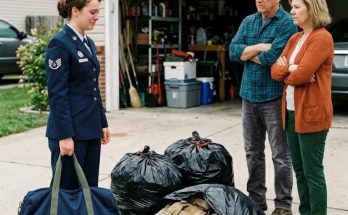
When I finally pulled into the driveway of my childhood home in Fairhaven, Virginia, the winter wind was howling through the bare oaks like a wounded animal. I carried a bakery box containing a vanilla buttercream cake in my left hand, and my standard-issue service weapon holstered at my hip, hidden beneath my civilian jacket.
I had spent the last five years as a Special Agent for the Department of Veterans Affairs Office of Inspector General (VA OIG), specializing in financial exploitation and federal pension fraud. Before that, I was an Army combat medic. I had stitched up shrapnel wounds in the dust of Kandahar and interrogated contractors who thought they could siphon federal funds meant for broken soldiers. But walking up the cracked concrete path to the house built by my father, Colonel Arthur Marlowe, my heart hammered against my ribs with an entirely different kind of dread.
I had imagined my mother, Judith Marlowe, opening the oak door with that fragile, surprised smile of hers. I had imagined the smell of cinnamon tea, the hum of the old grandfather clock, and maybe a gentle scolding about how my job kept me away from home for too long.
Instead, the door was yanked open by my sister-in-law, Kendra Marlowe. She stood there in a pristine cream cashmere sweater and fitted black trousers, blocking the threshold like a bouncer at an exclusive, sterile club. Her expression was polished, cold, and entirely unwelcoming.
“Tessa. You should have called.”
“It’s Mom’s seventy-ninth birthday,” I replied, forcing my voice to remain perfectly level. “I wanted to surprise her.”
Kendra didn’t move an inch. Her eyes flicked down to the cake box, then back to my face. “Her routine is very important now. Unexpected visitors trigger her anxiety. She’s… she’s declining, Tessa.”
I studied her face. Over the past eight months, every phone call to my mother had ended before it began. It was always Kendra or my older brother, Bryce Marlowe, answering the landline. They would smoothly assure me that Judith was sleeping, confused, emotionally exhausted, or simply unwilling to speak. I had swallowed those excuses because I was pulling eighty-hour weeks in D.C., dismantling a tri-state embezzlement ring. I had told myself Bryce, despite his history of failures and his simmering resentment of our father’s military shadow, was stepping up.
Now, standing on the freezing porch, my professional instincts flared into life. A barrier to entry. Controlled communication. Deflection. These were textbook indicators of isolation.
“I’m already here,” I said, stepping forward so she had to either yield or physically push me back. “Where is she?”
Kendra’s jaw tightened, but she stepped aside.
The house felt entirely wrong. The heavy thermal curtains were drawn tight against the afternoon sun, plunging the living room into a suffocating twilight. The mahogany display cases that used to hold my father’s Marine Corps commendations and antique sabers were empty. The warm, chaotic tapestry of Judith’s life—her vibrant quilts, the ceramic birds she painted, the framed photos of our family—had been surgically removed. The space felt like a corporate waiting room.
I found my mother sitting perfectly still in the dim den.
She looked terrifyingly small. Her cheekbones jutted sharply beneath pale, papery skin, and her silver hair hung limp. But the detail that made my breath catch in my throat wasn’t her frailty. It was what she was wearing.
Buttoned all the way up to her fragile neck, swallowing her thin frame, was Colonel Marlowe’s heavy, navy-blue wool military peacoat.
The house was kept at a comfortable temperature, certainly not cold enough to warrant a dense winter trench coat meant for freezing maritime gales.
I set the cake down on a glass table and knelt slowly beside her chair, keeping my movements predictable and unthreatening. “Happy birthday, Mom.”
Judith blinked, her eyes tracking the movement. For a fraction of a second, the fog parted. A spark of pure, desperate recognition illuminated her pale blue eyes.
“Tessa?”
“It’s me, Mom. I’m here.”
I reached out to gently embrace her shoulders. The moment my fingers brushed the rough wool of the coat, she violently flinched, pulling away with a sudden, breathless panic that froze my blood.
“Mom, what’s wrong?”
Her eyes darted frantically toward the hallway. “Please,” she whispered, her voice trembling like dry leaves. “Don’t touch the coat.”
“You must be boiling in this,” I said softly, keeping my tone soothing. “Let me help you take it off. Just for a minute.”
As my hand moved toward the heavy brass button at her collar, her frail, bony fingers clamped around my wrist. The grip was weak, but the sheer terror in her grip was absolute.
“No,” she begged, a tear spilling over her lashes. “Please. Bryce will know. He’ll know.”
Before I could process the chilling implication of those words, the heavy thud of leather dress shoes echoed from the hardwood of the hallway.
“Well, look who finally found Fairhaven on a map.”
Bryce stood in the doorway, carrying a sleek leather briefcase. He wore a charcoal suit that cost more than my first car, his posture radiating the smug, unearned confidence of a man who believed he held all the cards. I looked at the dark, bruised circles under my mother’s eyes, then at the arrogant smirk on my brother’s face, and a cold, clinical fury settled deep into my bones. Something was terribly wrong here, and I was going to tear this house apart to find out what.
Dinner was a meticulously orchestrated hostage situation.
Bryce and Kendra controlled every micro-interaction at the dining table. They dictated what Judith ate, how much water she was permitted to sip, and sharply corrected her if she attempted to speak out of turn. When my mother reached for a salt shaker with a trembling hand, Kendra intercepted it smoothly, placing it out of reach with a condescending smile.
“We don’t need any spills, Judith,” Kendra said, her voice dripping with artificial sweetness. “Remember what happened yesterday.”
My mother withdrew her hand instantly, shrinking deeper into the collar of the massive wool coat. She’s conditioned, I realized, my stomach twisting. They’ve trained her through fear.
After the plates were cleared, Bryce gestured for me to follow him into our late father’s study. He poured himself two fingers of an expensive bourbon, sinking into the Colonel’s leather chair as if he had earned the right to sit there.
“I know Mom’s decline is shocking to see,” Bryce began, his tone practiced, almost rehearsed. “Dementia is a cruel thief, Tessa. She’s become deeply paranoid. She hallucinates. Sometimes, she completely loses her grip on reality.”
I stood by the bookshelf, keeping my expression entirely neutral. “Is that why she’s wearing Dad’s coat indoors?”
Bryce sighed, pinching the bridge of his nose in a show of exhaustion. “She’s obsessed with it. If we try to take it off to wash it, she becomes hysterical. The doctor said to just let her have her security blanket.” He slid a thick, black leather folder across the mahogany desk. “Kendra and I have sacrificed everything to keep her out of a facility. We manage her care, her diet, her finances. You have your… administrative job in Richmond. You don’t see the daily grind.”
Bryce still thought I pushed papers at a generic state desk. I had never corrected him. In my line of work, being underestimated was a tactical advantage. I opened the folder.
Inside was a stack of legal documents. Durable power of attorney. Medical proxies. Transfer of property deeds. Bank statements showing massive, systematic liquidations of mutual funds. And, most damningly, a newly drafted mandate granting Bryce total control over the Colonel’s federal survivor benefits and military pension.
My eyes scanned the signature on the deed transfer. The ink was slightly staggered, a poor imitation of my mother’s fluid cursive. A forgery. A sloppy one.
“She accuses us of the most insane things,” Kendra chimed in, leaning against the doorframe with a glass of Pinot Noir. “Last week, she told the mailman we were stealing her jewelry. She thinks there are spies in the walls. When we try to bathe her, she fights us like a wild animal.”
I closed the folder, deliberately letting my shoulders slump. I needed them to believe I was overwhelmed, guilt-ridden, and compliant. I channeled every ounce of my interrogation training to project defeat.
“I had no idea,” I whispered, looking away. “I’m so sorry, Bryce. I’ve been a terrible sister, leaving this all on you.”
Bryce’s chest puffed out slightly. The arrogant glow of victory washed over his face. “We’re family, Tessa. We do what we have to do. I just need you to sign off on a few secondary witness lines tomorrow so we can finalize her medical trust.”
“Of course,” I nodded meekly. “Let me do something tonight, at least. Let me take her upstairs, get her washed up, and put her to bed. You and Kendra take the rest of the night off.”
Kendra scoffed, swirling her wine. “Good luck. She won’t let you near that coat.”
“I’ll be patient,” I said softly.
Thirty minutes later, I excused myself to use the downstairs restroom. Instead, I slipped silently into the study. Moving with practiced speed, I reached beneath the lip of the heavy mahogany desk, right where my brother’s knees would rest, and pressed a magnetic, voice-activated micro-transmitter into the dark wood.
As I crept back into the hallway, the floorboards creaked above me. I froze. From the master bedroom upstairs, I heard Bryce’s muffled voice speaking on his cell phone.
“…the buyer in Alexandria confirmed for the medals and the antique Colt. Yes, fifty grand cash. The old bat won’t even know they’re gone. Just get the transport ready for tomorrow morning. Once she’s locked in the ward, the VA pension is fully ours.”
My blood ran ice cold. It wasn’t just elder abuse. It was a calculated federal heist, and they were going to commit her to a psychiatric ward to silence her forever. And tomorrow morning, the trap was springing shut.
I gently guided Judith up the stairs and into the master bathroom adjoining her bedroom. As soon as we crossed the threshold, I shut the heavy wooden door and locked it. I reached into the shower stall and turned the hot water on full blast. The roar of the water echoing off the tile would mask any conversation from the listening ears outside.
Judith stood rigidly by the marble sink, still drowning in the heavy navy wool of my father’s coat. The steam began to rise, curling around her frail shoulders.
“Mom,” I whispered, stepping close so she could hear me over the water. “They can’t hear us now. We are safe.”
She shook her head violently, her eyes wide with terror. “You have to leave, Tessa. If Bryce catches you asking questions, he… he gets so angry. He says you don’t care about me. He says no one is coming.”
“He lied,” I said, my voice thick with emotion but hard as steel. “I am here. And I am not leaving you.”
I held both of my hands up, palms open, showing her I was unarmed and peaceful. “Mom, I need you to trust me. I know you aren’t crazy. I know what they are trying to do with Dad’s pension. But I need to see what you are hiding. I need to see why you won’t take off the coat.”
Judith stared at me, her chest heaving. A solitary tear cut a path down her hollow cheek. The fight slowly drained out of her, replaced by a profound, agonizing exhaustion. Her trembling fingers moved to the large brass buttons of the peacoat.
She unfastened the top button. Then the next.
As the heavy wool parted, the breath was knocked entirely out of my lungs.
Beneath the coat, my mother wore a thin, faded cotton nightgown. Her collarbones and upper arms were painted in a horrifying mosaic of dark, mottled bruises—some a yellowish-green of older injuries, others a fresh, angry purple. Around her thin wrists were the undeniable, chafed red rings of zip-ties or heavy ropes.
My brother did this. The realization hit me like a physical blow. The combat medic in me instantly cataloged the blunt force trauma, the signs of severe malnutrition, the defensive wounds.
But it was what was pinned to the inside lining of the coat that made the tears finally break through my composure.
Dozens of heavy brass safety pins pierced the dark silk lining of the jacket. Attached to them were Colonel Arthur Marlowe’s most sacred possessions. The Silver Star. The Purple Heart. The Bronze Star with Valor. Gleaming in the dim bathroom light, they hung heavily against my mother’s frail chest.
Tucked into a hand-sewn, makeshift pocket on the inner lapel was a stack of tightly folded papers.
“He tore apart the display cases,” Judith whispered, her voice breaking. “He said they were just metal. He said he owed money to bad men. He made me sign things, Tessa. When I refused, he… he locked me in the basement. He tied me to the chair.”
I reached out, my fingers trembling, and gently touched the Silver Star.
“I couldn’t let him take your father’s honor,” she wept, clutching the lapels of the coat. “I took the real will. The real deed to the house. I pinned them here. It’s the only thing that kept me safe. When he tried to rip the coat off me, I screamed until the neighbors knocked. He’s been waiting to get me out of the house to take it.”
She had turned her own body into a vault. She had endured torture, starvation, and psychological torment, using her fragile frame to guard my father’s legacy and the truth.
“Mom,” I choked out, pulling her gently into my arms, mindful of her bruised ribs. The rough wool of the coat scratched against my cheek. “You are the bravest soldier I have ever known.”
Suddenly, a heavy fist hammered against the bathroom door, shaking the frame.
“Tessa!” Bryce’s voice barked, muffled but sharp with suspicion. “What’s taking so long? Turn that water off, you’re wasting it!”
Judith gasped, violently shoving me away and clutching the coat tight against her chest. “He has a key,” she panicked. “Tessa, he has a key to this door!”
I heard the distinct, metallic scrape of a key sliding into the lock from the outside. The knob began to turn.
“Hold your horses, Bryce!” I yelled, injecting a pitch-perfect tone of exasperated, overwhelmed sibling annoyance into my voice. I swiftly grabbed a towel and threw it over my own shoulder, splashing some water onto my face and shirt.
I yanked the door open just as the lock clicked.
Bryce stood there, his face flushed with anger, holding a small brass key. He peered past me, his eyes zeroing in on Judith, who was huddled by the sink, still fully buttoned into the coat.
“What is going on in here?” he demanded.
“What does it look like?” I sighed, rolling my eyes and wiping my wet forehead. “I tried to get her to at least wash her face, and she knocked the soap into the tub. You weren’t kidding, Bryce. She’s completely uncooperative. I can’t get that damn coat off her.”
Bryce’s rigid posture relaxed slightly. A smug, knowing smile crept onto his face. “I told you. It requires a firm hand. You don’t have the stomach for this, Tessa.”
“You’re right,” I admitted, letting my shoulders slump in defeat. “I’m exhausted. I’ll sign whatever proxy forms you need in the morning. If there’s a facility that can handle this, maybe it’s for the best.”
Bryce clapped a heavy hand on my shoulder, squeezing it with patronizing affection. “Don’t worry, little sister. I’ve already arranged everything. A private transport team is coming at 8:00 AM. They specialize in… difficult relocations. You just sign the papers, and Kendra and I will handle the heavy lifting.”
“Thank you, Bryce,” I whispered.
I escorted my mother to her bed. I sat beside her in the dark until her breathing slowed. Then, I pulled out my secure government phone. I bypassed the standard channels and called the direct line of my supervising agent in D.C., Special Agent Vance.
“Marlowe,” Vance’s gravelly voice came through the encrypted line. “You’re supposed to be on leave.”
“Leave is canceled, Boss,” I said softly, staring out the window into the pitch-black Virginia night. “I need an emergency warrant for wiretap authorization, retroactively justified under the Exigent Circumstances clause. I’ve got felony elder abuse, kidnapping conspiracy, and federal pension fraud. Subject is Bryce Marlowe.”
“Your brother?” Vance paused. “Tessa, you know the protocols on familial conflicts of interest—”
“He’s selling a decorated Marine’s stolen medals on the black market tomorrow morning,” I cut in, my voice cold. “And he’s committing the widow to a psych ward to drain a federal pension. I have audio of him confessing to the sale.” I tapped a few buttons, forwarding the audio file I had extracted from the study bug.
There was a long silence on the line as Vance listened. When he spoke again, the bureaucratic hesitation was gone.
“I’m mobilizing the Richmond Field Office,” Vance said. “We’ll coordinate with local PD for the perimeter. What’s your play?”
“Hold the cavalry a mile out,” I instructed. “He’s hired a private transport crew for 8:00 AM. If he sees cruisers, he’ll bunker down and destroy the documents. I need him to think he’s won. I need him to spring the trap.”
“Copy that. We breach on your signal.”
I sat in the dark bedroom, my hand resting gently over my mother’s sleeping, bruised form. The heavy wool of the Colonel’s coat rose and fell with her shallow breaths. You held the line, Mom, I thought. Now it’s my turn.
Morning broke with a pale, gray light. At exactly 7:55 AM, the crunch of heavy tires sounded on the gravel driveway. I peered through the blinds. A white, unmarked transport van idled near the porch. Two large men in sterile white uniforms stepped out, carrying heavy leather restraints. This wasn’t an ambulance. It was an extraction team.
Downstairs, I heard Bryce’s voice, sharp and commanding. “Upstairs. She’s probably going to fight. Just get her in the cuffs and get her in the van.”
The heavy footsteps began to pound up the wooden stairs. The moment of truth had arrived.
I stood at the top of the landing, blocking the narrow hallway.
The heavy wool of the peacoat settled over my shoulders, smelling faintly of old cedar and my father’s favorite drugstore aftershave. It was incredibly heavy, a literal armor of fabric and history. Underneath it, my heart beat a steady, rhythmic drum against my ribs, but on the outside, I was stone. I had spent years staring down hardened embezzlers and corrupt contractors; I wasn’t going to flinch at my own brother.
Bryce led the two transport men up the stairs, his heavy leather shoes thudding against the wood. Kendra trailed behind him, clutching the black leather folder tight to her chest like a shield. When Bryce crested the final step and saw me standing there, his fake, brotherly smile vanished entirely, replaced by a deep, ugly scowl of irritation.
“Tessa, move aside,” he snapped, waving a hand dismissively. “Let the professionals handle this. You don’t need to see it.”
I didn’t move an inch. I kept my eyes locked on his. Slowly, deliberately, I reached down and unzipped my civilian jacket, letting it slide off my shoulders and fall in a crumpled heap to the hardwood floor.
Beneath it, I was wearing the heavy, navy-blue wool of Colonel Marlowe’s peacoat.
Bryce stopped dead in his tracks. His eyes widened, darting frantically from the brass buttons of the coat to the closed door of the master bedroom behind me. A sickening pale color washed over his face as his brain struggled to process the visual.
“What are you doing?” he demanded, his voice dropping an octave. “Where did you get that?”
“She didn’t need it anymore,” I said, my voice echoing coldly in the tight, shadowed hallway. “She surrendered it to me.”
Bryce’s face contorted into a mask of pure, unfiltered rage. The polished, wealthy facade melted away, revealing the desperate, greedy little boy beneath. He lunged forward, grabbing the lapels of the coat with both hands, his knuckles turning white.
“Take it off!” he spat, a spray of saliva hitting my cheek. “You stupid bitch, take it off right now! Give it to me!”
He tried to violently yank me forward, intending to throw me to the ground and strip the coat from my back. But I didn’t budge. I planted my feet, rooted in my training, and let him pull the wool. I let him expose the inner silk lining to the morning light.
The heavy brass safety pins gleamed. The Silver Star. The Purple Heart. The Bronze Star with Valor. And tucked securely beneath them, the folded stack of original deeds and my father’s true will.
Bryce’s breath hitched in his throat. He froze, staring at the medals, his mind frantically trying to calculate the catastrophic failure of his master plan. The buyer in Alexandria was waiting. The transport van was idling. And the loot was pinned to the chest of a sister he had spent his entire life underestimating.
“You didn’t really think I just pushed papers for the state, did you, Bryce?” I asked quietly, my voice deadly calm.
Before he could even register the question, muscle memory took over. I executed a flawless, brutal wrist-lock. I seized his right forearm, twisted it sharply against the joint, and drove my knee hard into his abdomen. The air rushed out of his lungs in a wet gasp, and he collapsed heavily to his knees on the hardwood floor, clutching his wrist in agony.
“What the hell is going on?!” Kendra screamed, dropping the leather folder. The fake proxy papers scattered across the floor like dead leaves.
The two massive transport men stepped forward, their faces darkening as they reached into the pockets of their sterile white uniforms.
“Federal Agent!” I roared, drawing my Glock 19 in a fluid, practiced motion and leveling the barrel squarely at the center mass of the lead man. “Hands where I can see them! Right now!”
The men froze instantly, staring down the dark barrel of a federal service weapon. They slowly, carefully raised their hands, backing away from the stairs.
“Tessa, you’re crazy!” Bryce wheezed from the floor, his face pressed against the wood, spit trailing from his lips. “You have no jurisdiction here! I have medical power of attorney! I own this house!”
“Not anymore,” I said. I didn’t take my eyes off the transport men. I simply reached up to my collar and pressed the tactical microphone clipped to my shirt. “Vance. Execute.”
For three agonizing seconds, there was absolute silence in the house. Only the sound of Bryce’s ragged breathing and Kendra’s panicked whimpering filled the air.
Then, the heavy oak front door of the house didn’t just open; it exploded inward in a deafening shower of splintered wood and twisted metal.
“FBI! Federal Agents! Show your hands! Get down, get down!”
The chaotic, beautiful roar of a tactical breach shook the foundation of the house. A dozen heavily armed agents in Kevlar flooded the downstairs, swarming up the staircase in perfect, disciplined formation. Within seconds, the transport men were violently thrown against the hallway wall, their legs kicked apart, and heavy zip-ties ratcheted around their wrists.
Special Agent Vance, wearing a tactical vest over his dress shirt, stepped onto the landing. He barely looked at me, keeping his professional demeanor as he looked down at my brother, who was now weeping on the floor.
“Bryce Marlowe,” Vance read from a folded warrant, his voice booming with the weight of the federal government. “You are under arrest for conspiracy to commit federal fraud, theft of government property, wire fraud, and felony elder abuse.”
Kendra began to sob hysterically, her perfect posture crumbling as an agent firmly secured her wrists behind her back. Bryce stared up at me, his face pale, his arrogance completely and utterly shattered. The realization of his ten-year mandatory minimum sentence was visibly crushing him.
“Tessa,” he pleaded, his voice cracking into a pathetic whine. “Tessa, please. We’re family. Don’t let them do this.”
I looked down at him. I searched my heart for a shred of pity, a fragment of sisterly love. I found absolutely nothing but cold, clinical contempt.
“You disgraced this family,” I said, turning my back on him. “Take him out of my house.”
As they dragged Bryce and Kendra down the stairs, their protests fading into the crisp morning air, I holstered my weapon and slowly opened the bedroom door.
Judith was sitting on the very edge of the bed. She looked terrified by the shouting, the splintering wood, and the heavy boots pounding through her home. But when she looked up and saw me standing there, still wearing the coat, a profound, overwhelming peace washed over her hollow face. The terror in her eyes dissolved.
I knelt beside her, the stiff wool bunching around my knees. Gently, I reached into the lining and unpinned the Silver Star, placing the cool metal into her trembling palm.
“It’s over, Mom,” I whispered, my own tears finally breaking free. “The men who hurt you are gone. The house is yours. The legacy is safe. You don’t have to wear the armor anymore.”
She closed her eyes, clutching the medal tightly to her chest, and let out a long, shuddering breath. For the first time in nearly a year, my mother truly smiled.
It took months to untangle the bureaucratic and financial nightmare Bryce had created. Facing overwhelming evidence and the wiretap recordings, he and Kendra pleaded out to avoid a lengthy federal trial, earning themselves a decade each in a federal penitentiary. The black-market dealer in Alexandria was raided by the ATF two days after the arrest, and the antique Colt was recovered.
I took an extended, six-month leave of absence from the OIG and moved back into the Fairhaven house. We hired contractors to repaint the sterile gray walls, threw open the heavy curtains, and let the warm Virginia sunlight pour back into the rooms. The mahogany display cases were painstakingly rebuilt, and the Colonel’s medals were returned to their rightful place of honor, shining brightly behind tempered glass.
But my father’s old, heavy wool peacoat didn’t go back into the dark cedar closet. I had it professionally dry-cleaned, carefully patched where the safety pins had torn the delicate inner silk, and draped it permanently over the back of my mother’s favorite reading chair in the den.
It was no longer a desperate shield against terror. It was a monument to the strongest, most resilient woman I had ever known.
Sometimes, on cold winter nights when the wind howls through the oaks, I’ll find her sitting in that chair, reading a book, absentmindedly running her frail hands over the thick navy wool. She is at peace. The war was over, but the victory—hard-fought, bloody, and deeply personal—would echo in the halls of this house forever.
THE END