“No One Cares About Your Navy Career,” My Dad Texted—Then 300 SEALs Stood Up the Moment I Walked In
My name is Rebecca Hale, and I was thirty-four years old when my father sent the message that finally ended our relationship.
Make sure you don’t wear your uniform today. Nobody cares about your Navy career. The groom’s family expects high society, not government workers.
I read it three times beneath the flickering arrivals board at Norfolk International Airport.
Around me, suitcase wheels rattled over tile. A toddler cried beside the baggage carousel. The terminal smelled of burnt coffee, floor polish, and the damp pine carried in whenever the automatic doors opened.
I had been back in the United States for seventeen minutes.
For the previous eight months, I had been deployed with a Naval Special Warfare task force in a place I was not allowed to name. My days had been measured in satellite windows, encrypted briefings, and the number of people who returned through the gate before sunrise. I had slept in two-hour stretches and learned to drink coffee that tasted like hot metal.
I was exhausted enough that my bones hurt.
Still, I had carried one thing onto the transport plane with more care than my classified equipment: a black garment bag containing my dress white uniform.
My younger sister, Madison, was getting married that afternoon.
Her fiancé, Grant Ellison, managed part of his family’s investment empire. My parents had spent two years talking about the wedding as if they were negotiating a merger between royal houses. The Ellisons owned office towers, hotels, and enough local property that people lowered their voices when mentioning their name.
My father, Douglas, worshiped wealth with the devotion other men reserved for religion.
My mother, Elaine, worshiped appearances.
I looked at the text again.
Government workers.
That was how my father described thirteen years of service.
He did not know where I had been. He did not know what my unit had done. He had never asked. Whenever someone mentioned my career, he told them I “worked with computers for the Navy,” usually with a laugh suggesting I repaired printers.
I could have turned around.
I could have booked a room, slept for twelve hours, and sent Madison a polite message saying my return had been delayed. No one in my family would have missed me for the right reasons.
But there had been a time when Madison and I were close.
When she was eight and I was eleven, we used to build forts beneath the maple tree behind our house. She would draw treasure maps in purple marker, and I would lead us across the yard pretending the neighbor’s sprinkler was enemy fire. Back then, she had laughed with her whole body.
I kept hoping some part of that little girl remained beneath the curated photographs and designer labels.
So I slid my phone into my pocket without answering.
Outside, rain had darkened the pavement. I loaded my duffel and garment bag into a rideshare and gave the driver the address of Bellmere Country Club.
During the drive, wet highways gave way to stone walls, iron gates, and broad lawns clipped so precisely they looked artificial. My reflection hovered in the window: hair pulled back, face pale from travel, a faint scar near my left eyebrow.
I looked older than thirty-four.
The driver glanced at the garment bag.
“Wedding?” he asked.
“My sister’s.”
“You excited?”
I watched a row of mansions pass behind the rain.
“I’m trying to be.”
Bellmere appeared beyond a pair of wrought-iron gates, a gray stone building with turrets, terraces, and a circular drive crowded with luxury cars. Valets in cream jackets hurried beneath umbrellas. Florists carried white roses through carved wooden doors.
I stepped from the car in jeans, boots, and a gray sweater.
A valet looked at my duffel, then toward the service entrance.
“The main entrance is this way,” I said before he could redirect me.
His face colored. “Of course, ma’am.”
Inside, crystal chandeliers reflected off polished marble. The air smelled of roses, furniture wax, and expensive perfume. A wedding coordinator rushed past with two phones pressed against her ear.
I followed a sign toward the bridal suite.
Laughter and the pop of a champagne cork came through the double doors. For a moment, I stood with my hand on the brass handle, listening to my sister’s friends celebrate a life from which I had always been kept at the edge.
Then I opened the door.
The room fell silent.
My mother turned first. Her eyes moved over my travel clothes, my boots, my duffel—and finally stopped on the garment bag.
She did not hug me.
She did not say she was glad I had returned safely.
Her lips tightened.
“You brought it,” she said.
Across the room, Madison met my eyes through the vanity mirror.
Her smile was small, bright, and cruel.
Before anyone said another word, she reached for a heavy crystal pitcher filled with orange liquid.
And I knew, from the steadiness of her hand, that whatever happened next would not be an accident.
### Part 2
Madison rose from the makeup chair in a white silk robe trimmed with feathers.
“Rebecca,” she said, drawing out my name as if I had arrived several days late instead of directly from deployment. “You actually came.”
“I told you I would.”
“I know. I just thought something important might happen.”
A few bridesmaids laughed uncertainly.
I ignored them and glanced toward the garment rack beside the windows. Five peach-colored dresses hung in a neat row. At the end was a sixth dress with my name written on a paper tag.
It was nothing like the others.
The other bridesmaids had elegant silk gowns. Mine had layers of stiff tulle, puffed sleeves, and a high ruffled neckline that looked designed for a Victorian scarecrow.
Madison noticed me looking.
“The designer had trouble finding a flattering cut for your build.”
I was five-foot-eight and athletic. Madison had been calling me bulky since high school, usually while asking me to carry her luggage.
“I’ll make it work,” I said.
That disappointed her.
She had wanted an argument.
I set my duffel near the door and walked toward the rack. Madison picked up the crystal pitcher and moved across the completely unobstructed floor.
She came within four feet of me.
Then she made a theatrical squeaking sound and threw both arms forward.
The contents of the pitcher sailed directly onto my dress.
Orange juice and champagne struck the bodice, soaked through the skirt, and dripped onto the marble. The sugary smell filled the room.
Madison remained perfectly balanced in her flat slippers.
“Oh no,” she said.
Nobody moved.
The photographer lowered her camera. One makeup artist stared at the puddle with her mouth slightly open.
Madison placed the empty pitcher on a table.
“My wedding nerves are terrible.”
“Your hands look steady,” I said.
Her smile sharpened.
“Well, maybe it’s for the best. The dress would have made your shoulders look enormous. You’ve probably been doing push-ups in some dusty parking lot for eight months.”
My mother crossed the room, but she did not go to the ruined gown.
She came straight to me.
“Look what you’ve done.”
I stared at her.
“I was standing still.”
“You brought tension into this room the moment you entered.”
“The pitcher was in Madison’s hands.”
Elaine waved that away. “Today is not about blame. It is about solving problems without upsetting the bride.”
She opened a closet and removed a wrinkled black shirt and matching trousers on a plastic hanger.
The fabric had the dull shine of cheap polyester.
“What is that?” I asked.
“A spare catering uniform.”
She pushed it toward my chest.
“You can change downstairs. Stand near the kitchen doors during the ceremony and help direct the staff. Nobody needs to know you were supposed to be in the bridal party.”
Behind her, Madison lifted a champagne glass and watched me over the rim.
My mother lowered her voice.
“The Ellisons have invited senators, executives, and international investors. We cannot have a stained bridesmaid wandering through the photographs.”
“I’m not wearing a catering uniform.”
“Then what do you intend to wear?”
I raised the garment bag.
“This.”
My mother’s face changed.
She reached for the zipper, but I moved the bag away from her hand and opened it myself.
White fabric appeared beneath the black vinyl. Gold buttons caught the light. The top of my ribbon rack was visible near the collar.
Madison groaned.
“You cannot be serious.”
“It is formal attire.”
“It is a costume,” she said. “And you know exactly what will happen. People will stare at you and ask questions. You’ll turn my wedding into another one of your military performances.”
I looked at her reflection in the mirror.
“When have you ever attended one of my military events?”
She opened her mouth and closed it.
My mother stepped closer.
“You will not wear that government uniform in the main ceremony hall.”
“I just returned from deployment. It’s the only formal clothing I brought.”
“You should have planned better.”
“I planned to wear the bridesmaid dress Madison just destroyed.”
Her eyes went hard.
“Then you can sit in the overflow area.”
“What overflow area?”
“A tent behind the western lawn. It’s for vendors, distant acquaintances, and additional guests. You will stay there, away from the Ellisons and away from the cameras.”
The cruelty was familiar, but something about hearing it after eight months away made it sound different.
Smaller.
I thought of men giving their last water to one another in brutal heat. I thought of officers sleeping on concrete beside their teams. I thought of forty-two voices answering a radio check in the dark.
Then I looked at my mother and sister surrounded by mirrors, flowers, and half-empty champagne bottles.
“I’ll wear my uniform,” I said. “And I’ll sit wherever you choose.”
Madison blinked. She had expected me to beg.
My mother pointed toward the door.
“Then get out.”
I picked up my bags.
As I turned, I noticed an older man standing in the hallway beyond the partially open door. He wore a simple charcoal suit and held a silver-topped cane.
Grant’s grandfather, Walter Ellison.
The billionaire everyone in my family was desperate to impress.
He looked at the ruined dress, then at the catering uniform in my mother’s hands.
His expression revealed nothing.
But when his eyes met mine, he gave one slow nod—the kind of acknowledgment I had seen only from people who understood exactly what a uniform cost.
Then he stepped away.
I left the bridal suite wondering how much he had heard.
I did not yet understand that Walter Ellison had already witnessed something far worse.
### Part 3
The employee locker room was hidden behind the kitchen, past stacks of folded linens and industrial carts loaded with silverware.
It smelled of detergent, stale coffee, and hot bread.
A young server entered while I was changing. She stopped when she saw the decorations on my uniform.
“Oh. Sorry, ma’am.”
“You’re fine.”
She hesitated at the door. “Are you with the wedding?”
“I’m the bride’s sister.”
Her eyes flicked toward the black catering uniform lying on the bench.
She seemed to understand more than I had said.
“I can find you a private room.”
“This works.”
After she left, I buttoned my jacket and adjusted my collar devices beneath the fluorescent lights. The dress whites were immaculate. I had pressed them before leaving the staging base, using a warped ironing board in a trailer while helicopters shook dust from the roof.
I attached my ribbon rack.
Each strip of color carried a memory my family had never asked about.
A nighttime evacuation in rough water.
A joint operation that lasted thirty-seven hours.
A sailor I had carried to a helicopter while blood soaked both our uniforms.
The public versions of those stories fit into dry award citations. The real versions lived in sounds: rotor blades, labored breathing, radio static, boots striking metal.
I fastened my cover beneath my arm and studied myself in the scratched mirror.
My father had called me a government worker.
My mother had called my uniform embarrassing.
Madison had called it a costume.
Yet looking at my reflection, I felt no shame.
Only fatigue.
My phone vibrated on the bench.
The message came through an encrypted application used by my command. I expected an administrative notice or travel confirmation.
Instead, it contained five words.
Maintain location. Do not depart.
The sender was Captain Marcus Reed, my immediate commanding officer.
I read it twice.
Then another message appeared.
Ceremonial party inbound. No action required.
I frowned.
There had been discussion of a formal recognition ceremony after our return, but it was supposed to happen on base the following week. I had objected to anything elaborate. The people who survived the operation deserved attention, not me.
I typed:
Sir, I’m at a private family event.
His response came almost immediately.
We are aware.
Before I could ask how, a third message appeared.
Hold your position, Commander.
Commander was not technically my rank, but senior officers often shortened lieutenant commander in conversation. Still, the wording felt deliberate.
I locked the phone.
Outside the locker room, kitchen workers moved around me carrying trays of canapés. A cook shouted about missing sauce. Somewhere beyond the service doors, a string quartet tested a scale.
I headed toward the western lawn.
The overflow tent stood beyond the main garden, partially hidden by hedges and delivery vans. White folding chairs sat on artificial turf. Cardboard boxes filled two tables near the rear. From most seats, the ceremony was invisible behind a wall of hydrangeas.
My parents had not exaggerated.
They truly meant to hide me.
A distant cousin named Linda sat near the aisle, fanning herself with a program.
“Rebecca?” she said. “I thought you were a bridesmaid.”
“Plans changed.”
She examined my uniform, then looked toward the main building.
“That sounds like Elaine.”
I sat in the last row.
The humid air clung to my neck. Mosquitoes drifted beneath the canvas roof. A catering worker pushed a cart past my chair without looking at me.
After ten minutes, my phone vibrated again.
No text this time.
Just a location pin showing a convoy less than fifteen miles away.
I stared at the screen.
A ceremonial party did not travel in a convoy.
Across the lawn, three black sport-utility vehicles turned through the country club gates. They did not stop at valet parking. They continued toward the rear service road.
A man in a dark suit stepped from the first vehicle and spoke to Bellmere’s head of security. The security chief’s posture changed immediately.
He straightened.
Then he raised a hand to his earpiece and began clearing the service entrance.
I stood.
Something larger than a medal presentation was unfolding.
Before I could move, Captain Reed called.
“Sir?”
“Where did they place you?”
I looked at the folding chairs, delivery boxes, and artificial turf.
“In an overflow tent behind the kitchens.”
There was a pause.
Not silence—control.
When he spoke again, his voice was flat.
“Remain where you are until instructed otherwise.”
“Captain, what is happening?”
“You spent eight months bringing our people home, Hale.”
In the background, I heard vehicle doors closing in rapid succession.
“Today,” he said, “we’re returning the favor.”
The call ended.
A shadow passed across the tent entrance.
Then another.
Outside, rows of white uniforms were moving behind the hedges.
### Part 4
I stepped to the edge of the tent and looked through a gap in the canvas.
At first, I saw only movement between the oak trees.
Then the formation became clear.
Men and women in Navy dress uniforms were assembling along the rear drive in disciplined rows. Some wore gold warfare insignia above dense blocks of ribbons. Others carried the posture of career chiefs—steady, watchful, impossible to rattle.
They had not come as wedding guests.
They had come as a unit.
My throat tightened.
Many of the faces belonged to people from my task force. Others I recognized from briefings, joint exercises, or casualty reports I had spent nights reading. There were operators from both platoons trapped during our final mission. Men whose voices I had heard through static while enemy fire closed around them.
I saw Senior Chief Daniel Voss near the front.
During the operation, his team had been cut off in a ravine with two wounded men and almost no communications. For nine hours, his voice had been the only link between the ground element and our command center.
Now he stood beneath a Virginia oak tree adjusting his white service cover.
Alive.
A lump formed behind my ribs.
Someone beside him pointed toward the building. The formation began moving out of sight.
I returned to my chair before they could see me watching.
My instructions were to hold my position.
That was something I knew how to do.
The quartet began playing inside the main hall. The music traveled faintly across the lawn, distorted by hedges and stone walls.
After several minutes, my father appeared at the tent entrance.
He spotted me in the last row and marched down the aisle. Sweat gleamed near his hairline despite the shade.
“What are you doing out here dressed like that?”
“You told me to sit here.”
“I told you to stay out of sight. People arriving through the service drive saw you.”
“I haven’t moved.”
His gaze settled on my ribbons.
“You enjoy this, don’t you?”
“Enjoy what?”
“Making us uncomfortable. Forcing everyone to acknowledge your little career.”
I looked at the empty chairs around us.
“You placed me behind a hedge beside catering boxes.”
“Because you refused to cooperate.”
A worker nearby slowed while arranging napkins.
Douglas noticed and lowered his voice.
“The Ellisons are asking questions. Grant’s father saw you in the lobby earlier and wanted to know why a naval officer was wandering around. I had to explain that you work in an administrative role.”
“You don’t know what role I have.”
“I know enough.”
“No,” I said. “You’ve never asked enough to know anything.”
His jaw tightened.
“Your sister is about to walk down the aisle. For once in your life, stop competing with her.”
“I came directly from deployment to attend her wedding.”
“In that ridiculous outfit.”
“It’s a uniform.”
“It’s an attention-seeking device.”
The napkin cart stopped moving.
My father glanced toward the worker.
“Go,” he snapped.
The young man pushed the cart out of the tent.
Douglas leaned over me.
“You will remain in this chair until every important guest has left. Then you may attend the reception in civilian clothing, provided you behave.”
I thought of Captain Reed’s message.
Maintain location.
“That may not be possible.”
My father’s eyes narrowed. “What does that mean?”
Before I could answer, my mother appeared outside.
She waved frantically.
“Douglas, we have a problem.”
He turned.
“What now?”
“There are military people near the service entrance.”
For the first time, uncertainty crossed his face.
“How many?”
“I don’t know. Dozens. Perhaps more. Bellmere security won’t tell me anything.”
Douglas looked at me.
“What did you do?”
“Nothing.”
“Did you invite them?”
“No.”
His voice sharpened. “This is Madison’s wedding, not one of your recruitment ceremonies.”
“I didn’t arrange anything.”
Elaine stepped into the tent.
Her perfume mixed with the smell of warm canvas.
“Make them leave.”
“I cannot order people away when I don’t know why they’re here.”
“You’re an officer, aren’t you?” she snapped. “Call whoever is in charge.”
“That isn’t how the Navy works.”
Douglas took out his phone. “I’ll call the police.”
“For uniformed service members standing on a service road?”
“For trespassers disrupting a private event.”
He began dialing.
My secure phone vibrated again.
Proceed to the main hall. Rear entrance. Stand by.
I rose.
My father blocked the aisle.
“You’re not going anywhere.”
The words would once have frightened me. At seventeen, I had learned to measure his moods by the sound of his footsteps. At twenty, I still apologized when he insulted me. At thirty-four, he was simply a man in an expensive tuxedo standing between me and a lawful instruction.
“Move,” I said.
He stared at me.
Something in my voice must have reached him, because he stepped aside.
I passed my parents and crossed the lawn toward the rear entrance.
Through the windows of the country club, I could see guests rising as the bridal procession began.
Behind me, my father hissed to my mother, “Whatever she planned, we’ll stop it.”
Ahead of me, the heavy oak doors to the ceremony hall were closing.
And just beyond the service corridor, hundreds of polished shoes struck the floor in perfect unison.
### Part 5
My mother caught up with me before I reached the doors.
She gripped my upper arm, her nails pressing through the fabric.
“You are not walking into that ceremony dressed like this.”
“Let go.”
“People are already staring.”
“They are staring because you’re dragging a naval officer through a hallway.”
Her hand dropped instantly.
A photographer stood twenty feet away.
Elaine forced a smile until he turned the corner. Then her face hardened again.
“There is a place behind the floral column in the main hall. You can stand there until we determine what is happening outside.”
“You said I had to remain in the tent.”
“The caterers need the space.”
The excuse was so weak that neither of us pretended to believe it.
She led me along the outer wall of the ceremony room, keeping us behind curtains and flower stands. The hall was enormous, with vaulted ceilings, crystal lights, and rows of gold chairs facing a raised altar.
White orchids covered nearly every surface.
My father waited near a structural column wrapped in hydrangeas. Behind it was a narrow dead space between the wall and a service door.
He pointed to the shadowed gap.
“Stand there.”
I looked through the leaves. From that position, I could see part of the aisle but not the altar.
“Nobody will notice you,” he added.
“That seems important to you.”
“Do not start.”
My mother adjusted her pearl necklace.
“The ceremony is beginning. Stay here, remain silent, and do not appear in any photographs.”
Douglas leaned closer.
“You have embarrassed us enough for one day.”
They left together.
I took my position behind the flowers.
The air was warmer there. The arrangement blocked the nearest vent, and the perfume of thousands of blossoms was almost suffocating.
Through a gap, I watched my parents take their seats in the front row.
My mother immediately produced a lace handkerchief and arranged her face into a tender expression for the camera. My father shook hands with Grant’s relatives as if nothing unusual had occurred.
The quartet changed melodies.
Guests rose.
Madison appeared at the far end of the aisle on my father’s arm. Her gown glittered beneath the chandeliers. She looked exactly as she had always wanted to look—untouchable, admired, and completely central to everyone else’s world.
Douglas walked beside her, beaming.
He had never looked that proud at my commissioning.
Not when I graduated.
Not when I earned my warfare qualification.
Not when I returned from my first deployment.
I waited for the familiar pain.
It came, but faintly.
Like an old injury aching before rain.
Madison passed within twenty feet of me and never glanced toward the floral column. Grant waited at the altar in a tailored tuxedo, smiling for the cameras.
The officiant began speaking about devotion, honesty, and the importance of family.
I almost laughed.
My phone vibrated once.
Two minutes.
I kept my hands at my sides.
A server passed near the column and noticed me.
He startled.
“Ma’am, are you supposed to be—”
“Yes.”
He nodded quickly and moved on.
The officiant described Madison as “Douglas and Elaine’s beloved daughter,” singular.
That omission had been planned.
I wondered how many conversations it had taken to remove me from the script.
One minute.
The quartet softened.
Grant began his vows. He spoke about ambition, partnership, and building a legacy. His language sounded like an investor presentation.
Then the rear doors moved.
A wedding coordinator hurried toward them and pressed both palms against the wood.
The handles turned from the other side.
She whispered urgently into her headset.
“No. The ceremony is in progress. Whoever they are, send them around.”
The doors continued opening.
The coordinator planted one heel against the marble and pushed with her entire weight. It made no difference. She slid backward as the heavy panels separated.
Cool air entered the hall.
Guests in the final row turned.
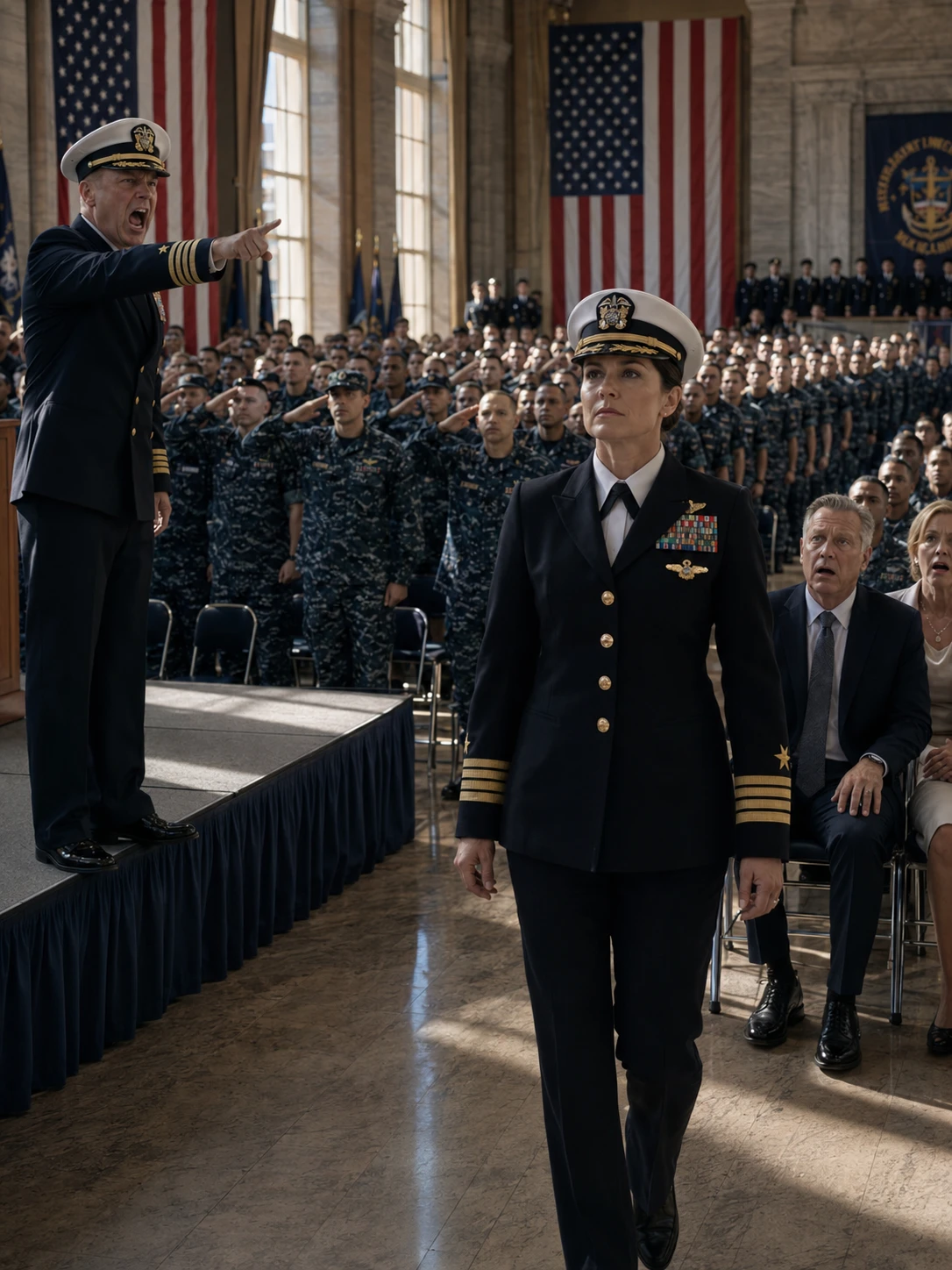
The first man through the doorway was Captain Reed.
He wore dress whites covered in ribbons, his expression controlled and severe. Behind him stood Senior Chief Voss and a formation that extended beyond the lobby.
The coordinator raised both hands.
“This is a closed event.”
Captain Reed showed her a document and spoke too quietly for me to hear.
Whatever she read changed her posture.
She stepped aside.
The operators entered without noise beyond the measured rhythm of their shoes.
They separated into two columns, moving along the side aisles. More followed them. Then more.
Guests stopped watching the altar.
Heads turned row by row as white uniforms filled the perimeter.
Madison noticed the shift.
Her smile faltered.
Grant stopped speaking in the middle of a sentence.
My father rose from his chair.
Through the flowers, I saw his face transform from confusion to fury.
He looked toward my hidden corner.
Our eyes met through the leaves.
He knew the military personnel were there because of me.
He just did not know why.
Neither did the guests.
And when three hundred members of Naval Special Warfare came to attention around the room, my father made the worst decision of his life.
He walked directly toward them.
### Part 6
Douglas moved down the aisle with Grant close behind him.
The videographers followed.
My father had spent his career intimidating contractors, junior executives, and restaurant managers. He believed volume was authority and money was power.
He stopped in front of Senior Chief Voss.
Voss was six-foot-four and built like a reinforced door. A pale scar cut through one eyebrow. His dress uniform carried more service ribbons than my father could count.
“Who authorized this?” Douglas demanded.
Voss remained at parade rest.
“This ceremony is private,” my father continued. “You are trespassing.”
No response.
Grant stepped beside him.
“My family owns the land beneath this club,” he said. “You have thirty seconds to leave before I call the chief of police.”
Several guests shifted uncomfortably.
A retired senator in the second row seemed to recognize Captain Reed’s insignia. He leaned toward the man beside him and whispered something that drained the color from both their faces.
Douglas pointed at Voss’s chest.
“I’m speaking to you.”
Voss’s eyes lowered to the finger, then returned to my father’s face.
“Sir,” he said calmly, “I recommend you lower your hand.”
Douglas did.
Grant tried a different approach.
“Was this arranged by Rebecca?”
Voss said nothing.
“She has a history of making events about herself,” Grant added, glancing toward the audience. “This is clearly some theatrical military stunt.”
Senior Chief Voss looked at him for the first time.
I had seen that expression directed at unreliable intelligence, structural damage, and unexploded ordnance.
Grant seemed to feel it.
He took half a step back.
Captain Reed moved forward.
“You misunderstand our presence.”
Douglas crossed his arms. “Then explain it.”
“We are not here for your ceremony.”
“Good. Then leave.”
“We are here to honor a member of our command.”
My mother had risen in the front row.
Madison stood at the altar with her bouquet held against her waist, forgotten by nearly everyone in the room.
Douglas looked toward the floral column.
His face tightened.
“She is not available.”
Voss’s jaw moved slightly.
Captain Reed’s voice dropped.
“Excuse me?”
“My daughter is attending a family wedding. Whatever administrative paperwork you have can wait.”
A murmur passed through the guests.
My father heard it and tried to regain control.
“She works in intelligence,” he said. “She isn’t one of your commandos. She sits behind a computer.”
Voss moved before anyone else did.
One moment he stood several feet away. The next, he was directly in front of Douglas.
He did not touch him.
He did not threaten him.
He simply occupied the space until my father’s confidence began collapsing under the weight of his presence.
“Your daughter,” Voss said, “spent forty-eight hours keeping my men alive while the rest of us were trapped behind a collapsed ridgeline.”
The room went still.
Douglas swallowed.
“That sounds exaggerated.”
A muscle flexed in Voss’s cheek.
Captain Reed placed one hand near the senior chief’s arm—not restraining him, only reminding him where they were.
Grant looked between them.
“Rebecca told you to say this?”
Voss turned his head slowly.
“Lieutenant Commander Hale did not know we were coming.”
My mother hurried down the aisle.
“This is a misunderstanding,” she said. “Rebecca has always been very dramatic about her job.”
Voss looked over her shoulder toward the floral column.
“Where is she?”
Elaine’s gaze flickered.
“She stepped outside.”
Captain Reed already knew that was a lie.
His eyes tracked the faint outline of my white sleeve through the flowers.
“Senior Chief,” he said.
Voss moved toward the arrangement.
My father stepped into his path.
“She was told to stay out of sight.”
The sentence escaped before Douglas understood what he had admitted.
Every camera in the room captured it.
Voss stopped.
“You hid her?”
“It is my daughter’s wedding.”
“Both of them are your daughters.”
Douglas’s mouth opened.
Nothing came out.
Voss looked at the hydrangeas, then back at my father.
“She saved forty-two members of this command, and you put her behind a flower wall?”
“She is trying to steal attention from the bride.”
That was when someone laughed.
Not loudly.
Just a single humorless sound from the front row.
Walter Ellison had risen from his seat.
He leaned on his silver-topped cane and stared at my father with open disgust.
“I heard you last night,” Walter said.
Douglas’s face changed.
My father had forgotten the dark corner of the steakhouse lounge.
I had not.
The memory returned with brutal clarity: polished mahogany, the smell of bourbon, Douglas telling me I should thank him for stealing my college fund because it had “forced me to become independent.”
Walter had been seated in the shadows through the entire argument.
Now he stepped into the aisle.
“You mocked her service,” he said. “You called her unambitious. Then you threatened her when she told the truth about the money you took.”
Grant stared at his grandfather.
“Granddad, this isn’t the time.”
Walter’s cane struck the marble.
“Character does not wait for a convenient time.”
Douglas looked desperately toward the guests.
“This is a private family disagreement.”
Captain Reed’s voice cut across the hall.
“No, sir. It is no longer private.”
He turned toward the entrance.
A new cadence approached through the lobby—slower than the previous formation, accompanied by the unmistakable movement of senior staff.
Every operator around the room straightened.
Captain Reed drew a breath.
“Attention on deck!”
Three hundred heels struck the floor at once.
The sound hit the hall like thunder.
And through the open doors walked the officer who had crossed an ocean to tell my family exactly who I was.
### Part 7
Vice Admiral Nathan Cole entered with two aides behind him.
He commanded the joint task force under which our unit had operated. I had seen him only four times in person, always in secure rooms where maps covered the walls and nobody wasted words.
His dress uniform carried four decades of service.
The wedding guests did not know his history, but they understood authority when it walked past them.
Every operator held rigid attention.
The admiral did not look at the altar.
He did not look at Madison’s gown, the chandeliers, or the wealthy men trying to decide whether to stand.
He looked directly at the floral column.
Captain Reed approached and saluted.
“Sir.”
“Where is she?”
Reed’s expression tightened.
“Behind the flowers, Admiral.”
Cole’s eyes moved toward my parents.
“Why?”
Nobody answered.
Senior Chief Voss stepped to the iron base of the largest arrangement.
“Permission?”
The admiral nodded.
Voss and another chief lifted the structure and carried it aside. White petals scattered across the marble. Light flooded the narrow space where I had been standing.
Suddenly, hundreds of faces were turned toward me.
I stepped forward and saluted.
“Admiral.”
Cole returned it.
For several seconds, nothing else existed.
Not my parents.
Not Madison.
Not the cameras.
Just the recognition between an officer and someone who had completed an almost impossible mission.
“At ease, Commander Hale.”
I lowered my hand.
His gaze briefly settled on the gap behind me.
“They placed you there?”
“Yes, sir.”
A dangerous silence entered his expression.
He faced the room.
“I apologize for interrupting the ceremony,” he began. “However, Lieutenant Commander Rebecca Hale returned to American soil only hours ago after an eight-month deployment. Her command had scheduled a private recognition for next week.”
My father seized on the word private.
“Exactly,” he said. “This could have waited.”
The admiral turned.
Douglas shrank without moving.
Cole continued.
“The recognition was moved because members of her task force learned she had been ordered to conceal her uniform and remain apart from this gathering.”
My mother’s hand flew to her necklace.
“We did not understand the importance of the occasion.”
“You understood she was your daughter.”
Elaine had no response.
The admiral looked around the hall.
“Most details of Commander Hale’s work remain classified. Specific portions have been cleared for disclosure to the individuals present today because inaccurate public statements have been made regarding her service.”
The phrase inaccurate public statements sounded mild.
The way he delivered it did not.
Grant’s father sat very still in the front row.
The admiral continued.
“Twenty-three days ago, two Naval Special Warfare elements were conducting a reconnaissance operation in hostile territory. Their location was compromised. Communications failed during an enemy attack, and both teams became isolated.”
I felt my breathing change.
The hall disappeared.
For an instant, I was back beneath red emergency lights in the operations center.
Radio static tearing through my headset.
A map covered in shifting symbols.
A voice saying, We have wounded. Route north is gone.
Cole’s words brought the memory into the ballroom.
“Lieutenant Commander Hale was the senior intelligence officer monitoring the mission. When primary systems failed, she established an alternative communications path through legacy equipment that had not been used operationally in years.”
The guests listened without movement.
“She identified an extraction corridor through terrain considered impassable. When satellite imaging became unavailable, she reconstructed enemy positions from fragmented radio traffic and aerial sensor data.”
Senior Chief Voss’s eyes remained forward.
His team had been the first into that corridor.
“She remained at her station for forty-eight consecutive hours,” Cole said. “She coordinated air support, casualty movement, and the evacuation of two separate ground forces while the command facility itself came under attack.”
My mother stared at me as though I were a stranger.
Perhaps I was.
She had never known enough about me to recognize the person standing before her.
The admiral paused.
“All forty-two isolated personnel returned.”
A sound moved through the operators—not applause, not yet. A collective breath from people who remembered waiting for the last aircraft.
Cole turned toward me.
“That number includes Senior Chief Voss.”
Voss stepped forward.
His voice was rougher than before.
“My team had nine minutes before we were overrun. Commander Hale found a route no one else could see.”
He looked toward my father.
“She stayed on the radio until the last man crossed the extraction line.”
Douglas stared at the floor.
The admiral addressed the guests again.
“You were told she performs an insignificant administrative job.”
No one needed to ask where he had heard that.
“You were told her decorations were meaningless.”
My father’s face had gone gray.
“You were told her uniform was inappropriate for this room.”
Madison’s bouquet trembled.
Admiral Cole’s voice hardened.
“The truth is that her service is the most honorable thing in this room.”
The words struck harder than shouting.
He gestured to an aide.
The officer carried forward a dark blue presentation case.
My pulse jumped.
I had known a decoration was under review.
I had not known which one.
The aide opened the case.
Inside rested a medal suspended from a blue ribbon.
The admiral removed it carefully.
“Lieutenant Commander Hale, front and center.”
I stepped forward.
As I did, my father reached toward me.
Not out of affection.
Out of panic.
“Rebecca,” he whispered, “before this goes any further, we should discuss what you’ve told them.”
Senior Chief Voss moved between us.
My father’s hand stopped in midair.
The admiral looked at Douglas with quiet disbelief.
Then he faced me again.
“Commander Hale, this recognition does not belong to anyone else in this building. It cannot be borrowed, managed, or used to repair another person’s reputation.”
My mother began crying.
I felt nothing.
Cole raised the medal.
Behind him, three hundred members of Naval Special Warfare prepared to salute.
And my family finally understood that they were no longer controlling the room.
### Part 8
The citation took several minutes to read.
I remember almost none of the words.
Extraordinary courage.
Exceptional judgment.
Disregard for personal safety.
Those phrases sounded too polished for the reality.
The reality had been sweat soaking the back of my shirt while generators failed one after another.
It had been Voss whispering coordinates because speaking louder might reveal his position.
It had been a young operator named Torres asking whether the helicopter would reach his wounded friend in time.
It had been my own fear pressed so deep beneath procedure that I did not feel it until everyone was safe.
Admiral Cole pinned the Navy Cross above my ribbons.
The metal touched the white fabric with surprising weight.
“On behalf of a grateful nation,” he said, “thank you.”
I saluted.
He returned it.
Then Captain Reed faced the formation.
“Present arms!”
Three hundred hands rose in perfect unison.
The sharp movement cracked through the hall.
Every operator looked toward me.
Some had been on the ground during the mission. Others had flown the aircraft, analyzed imagery, treated casualties, or maintained the fragile equipment through which I guided the teams.
They were saluting one person, but the moment belonged to all of us.
My vision blurred.
I blinked until the room became clear again.
I would not cry in front of my father.
Not because tears were weakness.
Because he had spent my childhood treating them as evidence that he had won.
The salute held for several seconds.
Then Reed called, “Order arms.”
Hands returned to sides.
The wedding hall remained silent.
Walter Ellison rose slowly in the front row.
He placed his cane against the chair, straightened as much as age allowed, and saluted me.
His hand trembled.
His posture did not.
Grant stared at him.
“Granddad, what are you doing?”
Walter ignored him.
I returned the salute.
When he lowered his hand, his eyes were wet.
“Marine infantry,” he said. “Vietnam.”
The admiral nodded toward him.
“Semper Fi.”
“Always.”
That small exchange carried more dignity than the entire wedding.
My mother seemed to recognize the shift in the room before my father did.
She forced her way past a bridesmaid and hurried toward me with both arms extended.
“My baby,” she cried. “We are so proud.”
Senior Chief Voss stepped into her path.
Elaine stopped inches from him.
“I’m her mother.”
“Yes, ma’am.”
“Then move.”
“No, ma’am.”
Her expression flickered between outrage and fear.
“You cannot prevent me from hugging my own daughter.”
Voss looked toward me.
The decision was mine.
Every eye in the room followed his.
For years, my mother had controlled physical affection like a reward. She hugged me in public when it improved her image. In private, she withheld warmth until I apologized for offenses I had not committed.
Now she wanted a photograph.
“No,” I said.
Her face collapsed.
“Rebecca—”
“You heard me.”
“We made a mistake.”
“You made a series of choices.”
My father approached more carefully.
“Let’s not create a scene.”
A strange laugh escaped me.
“You put me behind a wall of flowers, and I’m creating the scene?”
“Your mother is emotional.”
“My mother gave me a catering uniform.”
Whispers moved through the room.
Douglas’s eyes sharpened.
“This is not the time to air private grievances.”
“You aired them last night when you mocked me in front of Grant’s family.”
He glanced toward Walter.
“That was a joke.”
“You also joked about taking my college fund?”
Grant’s father turned in his chair.
“What college fund?”
Douglas froze.
My mother clasped her hands.
“Rebecca, please.”
The admiral remained beside me but did not intervene. He knew this was no longer a military matter.
It was mine.
“When I was seventeen,” I said, “my grandparents’ education account contained fifty-two thousand dollars. My father emptied it and gave the money to Madison.”
Madison finally moved from the altar.
“That money belonged to the family.”
“It was legally designated for my education.”
“You got a scholarship.”
“After he took it.”
Douglas raised his voice.
“I invested in the daughter who showed business potential.”
The sentence echoed through the hall.
Madison’s expression changed.
Not because he had insulted me.
Because he had confirmed the money existed.
Walter Ellison picked up his cane.
“What business?”
My father said nothing.
I answered.
“A skin-care company that lasted four months. Then an event-planning application that was never developed. Then an online boutique that closed before it shipped a single order.”
A few guests looked toward Madison.
She gripped the skirt of her gown.
“You’re jealous because people support me.”
“I’m finished being jealous of you.”
That was true.
Jealousy required believing she possessed something worth wanting.
I looked at my parents.
“You stole from me, mocked the life I built without you, and attempted to hide me today because my uniform did not impress the right people.”
My mother cried harder.
“We didn’t know about the medal.”
“That is the problem. You think the medal changes my value.”
The room grew still again.
“You should have treated me with dignity before you knew anyone important was watching.”
Walter’s cane struck the floor once.
“Exactly.”
Grant moved toward his grandfather.
“This has gone far enough.”
Walter turned to him.
“No,” he said. “It has gone on far too long.”
The groom’s face drained of color.
Because he recognized that tone.
It was not the voice of a grandfather offering advice.
It was the voice of a chairman preparing to end someone’s future.
### Part 9
Walter walked toward the altar with slow, deliberate steps.
Grant met him halfway.
“Granddad, please. Whatever her family did has nothing to do with us.”
Walter stopped.
“You stood beside them.”
“I didn’t know.”
“You knew enough.”
Grant glanced toward Madison.
“She told me Rebecca was unstable. That she exaggerated her military work for attention.”
Madison made a strangled sound.
“You believed me!”
Grant ignored her.
“I was misled.”
Walter studied his grandson.
“No. You heard a version of events that allowed you to feel superior, so you chose not to question it.”
The words landed with surgical accuracy.
Grant’s father rose.
“Walter, perhaps we should discuss this privately.”
“Privacy is where cowards hide their character.”
The older man faced the room.
“I built Ellison Capital after returning from Vietnam with six hundred dollars and a damaged leg. I built it beside people whose handshakes mattered more than contracts. Loyalty was not branding. It was survival.”
He pointed his cane toward Grant.
“My grandson has enjoyed every privilege that company created. Yet today, when a decorated officer was humiliated in front of him, he said nothing because he believed she lacked social value.”
Grant’s father stepped closer.
“He made an error.”
“He revealed himself.”
“Do not destroy his future over one afternoon.”
Walter’s expression hardened.
“A future handed to him without character is already destroyed.”
Grant began breathing quickly.
“What are you saying?”
“As of Monday morning, you will no longer hold an executive position at Ellison Capital.”
A gasp came from the front rows.
Grant stared at him.
“You can’t fire me at my wedding.”
“I can fire you wherever I discover you are unfit to lead.”
“You promised I would become managing partner.”
“I promised opportunity. You mistook it for entitlement.”
Madison dropped her bouquet.
The orchids struck the marble and scattered.
“What about the trust?” she asked.
Every face turned toward her.
Grant looked at his bride in disbelief.
Walter’s mouth twisted.
“That was your first question?”
Madison realized too late what she had revealed.
“I’m worried about our future.”
“No,” Walter said. “You are worried about access to money.”
Grant grabbed her wrist.
“Did you know this could happen?”
“How would I know your grandfather would lose his mind over Rebecca?”
Walter’s cane cracked against the floor.
“You will not speak of her that way again.”
Madison jerked her arm free.
“This is my wedding! She came here and ruined everything.”
I watched her from across the room.
She was not the little girl beneath the maple tree anymore.
Perhaps that girl had vanished years ago. Perhaps I had preserved the memory because admitting the truth hurt too much.
Madison pointed at me.
“You couldn’t let me have one day.”
I stepped forward.
“I stood in the tent.”
“You wore the uniform.”
“It was the only formal clothing I had.”
“You could have worn what Mom gave you.”
“The catering uniform?”
Several guests reacted aloud.
Madison’s face flushed.
“You always think you’re better than me.”
“No. I spent years thinking I was less than you because our parents told me so.”
My voice remained calm.
“But I don’t think either of those things anymore.”
She stared at me.
“I simply don’t want your life.”
That hurt her more than anger would have.
Grant turned toward her.
“You said the military people would never show up.”
Madison blinked. “What?”
“You told me your sister had no real influence. You said she processed paperwork.”
“My parents told me that.”
“And you intentionally destroyed her dress?”
Her eyes shifted.
The photographer near the bridal suite had apparently spoken to someone. A bridesmaid in the second row looked down.
Grant saw the answer.
“You threw the drink.”
“She was going to ruin the photographs.”
He laughed once, bitterly.
“My grandfather removed me from the company because your family couldn’t tolerate a uniform in a picture.”
“Our family?” Madison shouted. “You agreed she shouldn’t wear it!”
The room turned toward Grant.
His mouth closed.
Walter nodded slowly.
“There it is.”
Grant’s father looked at him with disgust.
“You knew?”
Grant pulled at his collar.
“I said it might be distracting. I did not tell them to hide her.”
“But you accepted it when they did,” Walter said.
Grant looked around for an ally and found none.
The senators avoided his eyes. Investors whispered to one another. His groomsmen stood frozen, unwilling to attach themselves to a man whose access to billions had disappeared.
He looked back at Madison.
Whatever affection had existed between them could not survive the pressure of mutual blame.
“You cost me everything,” he said.
Her face twisted.
“You were the one too weak to stand up to your grandfather.”
“I’m not marrying you.”
Madison went completely still.
My mother screamed, “Grant, don’t be ridiculous.”
He removed the ring from his finger and placed it on the altar.
“The wedding is over.”
Then he walked away.
Madison stared after him.
My father hurried toward Grant’s father, already trying to negotiate.
My mother ran to the bride.
Walter turned his back on all of them and looked toward me.
“Commander Hale,” he said, “I owe you an apology for what happened under my family’s name.”
“You do not owe me for their choices.”
“Perhaps not. But I can refuse to reward them.”
Behind him, Madison tore the veil from her hair.
The sound she made was raw, furious, and nothing like grief.
She was not mourning a man.
She was mourning the life his money had promised her.
And when she looked at me again, I knew she intended to make me pay for losing it.
### Part 10
Madison came down the altar steps so quickly that she nearly fell.
Her gown caught beneath one heel. She ripped the fabric free and kept moving.
“This is your fault.”
Senior Chief Voss shifted, but I raised one hand.
I wanted no one touching her unless necessary.
Madison stopped several feet away.
Mascara streaked beneath her eyes. A crystal pin hung loose from her hair.
“You planned this.”
“No.”
“You expect me to believe three hundred people just appeared?”
“I learned about it less than an hour ago.”
“You contacted them because Dad texted you.”
“I did not answer Dad’s text.”
She laughed wildly.
“You always do this. You act calm while you punish everyone.”
“What exactly did I do to punish you?”
“You showed up.”
The honesty silenced her.
I nodded.
“There it is.”
My mother reached us.
“She doesn’t mean that. She’s distraught.”
Madison spun toward her.
“You promised Rebecca would stay in the tent.”
Elaine glanced toward the cameras.
“Lower your voice.”
“You told me the photographers would never see her!”
My father arrived behind them.
“Both of you, stop talking.”
His attention was fixed on the guests now leaving through the side doors. Every departure represented a business relationship, a club invitation, or an opportunity he feared losing.
He caught the arm of an executive I recognized from the rehearsal dinner.
“Andrew, this family matter has nothing to do with our acquisition.”
The man removed Douglas’s hand from his sleeve.
“My board will contact you.”
“When?”
“After we review our relationship.”
Douglas’s face sagged.
Another investor walked past without acknowledging him.
My father looked at me with naked panic.
“Rebecca, you have to tell them this was exaggerated.”
“What was exaggerated?”
“That we abused you. That I stole from you.”
“You admitted taking the money.”
“It was a parental financial decision.”
“It came from an account established in my name by Grandma and Grandpa.”
“You still went to college.”
“Because I earned a military scholarship.”
His voice dropped.
“Do you want to destroy us?”
The question surprised me.
He truly believed my refusal to lie was an attack.
“No,” I said. “I don’t want anything from you.”
“Then fix this.”
“I cannot fix people seeing you clearly.”
My mother tried to take my hand.
I stepped back.
Her fingers closed around empty air.
“We’re sorry,” she whispered.
“For what?”
“For everything.”
“That isn’t an answer.”
She looked around helplessly.
“For the dress. The tent. The misunderstanding about your work.”
“What about the years before today?”
Her lips parted.
“What about missing my commissioning because Madison had a brand photo shoot?”
Tears gathered in her eyes.
“What about telling relatives I was overseas because I could not handle a real career?”
“Rebecca—”
“What about every birthday you forgot until social media reminded you?”
She lowered her head.
My father interrupted.
“This public humiliation is unnecessary.”
I turned to him.
“You are still worried about the audience.”
He looked toward the admiral and immediately softened his tone.
“We can rebuild as a family.”
“No.”
The word came easily.
My mother’s head snapped up.
“You don’t mean that.”
“I do.”
“We are your parents.”
“You are people who raised me. That is not the same thing as being safe, loyal, or loving.”
Madison wiped her face with the back of her hand.
“You’ll regret this when your little military friends leave.”
Senior Chief Voss gave a low, humorless chuckle.
Captain Reed looked toward her.
“My people,” I said, “have crossed oceans for one another. You could not cross a ballroom without trying to hurt me.”
Madison flinched.
I removed my phone from my pocket.
My father’s message still glowed on the screen.
Make sure you don’t wear your uniform today. Nobody cares about your Navy career.
I held it where they could see.
“This was your last message to me before I arrived.”
Douglas stared at it.
“You misunderstood my tone.”
“No. For the first time, I understood it perfectly.”
I blocked his number.
Then my mother’s.
Then Madison’s.
The small actions produced no dramatic sound, but they felt more final than the admiral’s command.
My mother began sobbing.
“You cannot cut off your family at your sister’s wedding.”
“It is no longer a wedding.”
Madison lunged.
The movement was sudden enough that Voss stepped between us before I could react. She collided with his arm and recoiled.
He did not grab her.
He simply looked down.
“Do not approach the commander again.”
Security officers from Bellmere finally entered, led by the same chief who had greeted the military convoy.
They moved toward Madison and my parents.
Douglas’s outrage returned.
“You cannot remove me from an event I paid for.”
Walter’s attorney stepped from the front row.
“According to the contract, Mr. Ellison’s family is the principal client. Mr. Ellison has instructed Bellmere to conclude the event.”
Grant’s father stared at Walter.
“You’re canceling the reception?”
“There is nothing to celebrate.”
My mother looked around the collapsing room.
Flowers lay broken on the floor. Guests were leaving. The groom was gone. Three hundred operators stood around the walls, silent witnesses to the destruction of the image she valued most.
She turned to me one final time.
“Please come home with us.”
“I am home,” I said.
Then I looked at the men and women who had crossed the country to stand beside me.
Captain Reed gave the order to form up.
The ranks shifted around me.
For the first time that day, I did not stand behind anyone.
I walked toward the doors at the head of the formation.
But before I crossed the threshold, Walter called my name.
When I turned, he held an old photograph in his hand.
And the man standing beside him in the faded image was someone I recognized from my own family history.
### Part 11
Walter approached slowly, holding the photograph by its edges.
It showed three young Marines standing beside a sandbag wall. Their uniforms were stained dark with mud. One man had his arm in a sling. Another wore a crooked smile beneath a helmet that looked too large for him.
The third man was my maternal grandfather.
I had seen the same narrow face in family albums, though never this photograph.
“Where did you get that?” I asked.
Walter looked down at it.
“Your grandfather, Thomas Mercer, saved my life outside Huế.”
My mother stopped crying.
“What?”
Walter did not look at her.
“We were attached to neighboring units. My patrol was cut off after an ambush. Thomas crossed open ground twice to drag wounded men back. I was the second.”
The ballroom seemed to recede.
My grandfather had died when I was six. I remembered rough hands, peppermint candy, and a small flag in a wooden case above his fireplace.
My mother had rarely discussed his service.
Walter continued.
“We stayed in contact for years. Then life pulled us apart. I attended his funeral but did not meet the family afterward.”
He handed me the photograph.
On the back, in blue ink faded nearly to gray, someone had written:
Tom, Walter, and Luis. Still breathing. Don’t waste it.
My throat tightened.
“Last night, when your father mentioned the college fund, I remembered something Thomas told me.”
My father’s expression changed.
Walter noticed.
“He said he had established education accounts for both granddaughters. Separate accounts.”
My mother looked toward Douglas.
“You told me Dad left one family account.”
Douglas backed away.
Walter’s gaze hardened.
“Thomas contacted me for investment advice when Rebecca was a child. The money did not belong to you.”
“It was under my management,” Douglas said.
“Management does not mean ownership.”
Walter’s attorney moved closer.
My father’s eyes darted toward the exits.
“What are you suggesting?”
“I am suggesting,” Walter said, “that you converted funds legally designated for one beneficiary and transferred them for another purpose.”
Elaine stared at her husband.
“You said you used your own savings for Madison’s company.”
Douglas’s voice sharpened.
“This is not the place.”
“You lied to me?”
He grabbed her elbow.
“Stop.”
She pulled away.
All her grief over the wedding vanished beneath a new fear.
“How much money was there?”
“Fifty-two thousand,” I said.
Walter looked at me.
“When Thomas discussed the account with me, it held forty-eight thousand. Given the investments he described, it should have exceeded seventy by the time you entered college.”
My father’s face drained of color.
The amount I had known was only what remained before it disappeared.
Walter’s attorney spoke quietly.
“Commander Hale, financial institutions retain records. Depending on how the account was structured, you may have legal remedies.”
Douglas stepped toward me.
“This is family money. You will not involve lawyers.”
Voss moved beside me.
My father stopped.
I studied Douglas.
For years, he had told me I should be grateful. He had turned theft into generosity and survival into evidence that I had never needed help.
Now the lie was collapsing.
“Send any available information to my attorney,” I told Walter’s counsel.
My father stared.
“You don’t have an attorney.”
“I do now.”
Walter’s attorney handed me a card.
“We will assist with the initial review.”
Douglas’s voice became desperate.
“Rebecca, pursuing this will ruin your mother.”
Elaine looked at him.
“You ruined me.”
It was the first honest thing I had heard her say all day.
Still, her realization did not restore my trust. She had participated in everything else willingly. Discovering that she had also been deceived did not erase what she had done to me.
My phone rang.
A military transport coordinator was waiting outside. The formal party would return to base, where a reception had been prepared for the task force and their families.
Captain Reed approached.
“We are ready when you are.”
I looked down at the photograph again.
My grandfather had saved Walter long before either man became a grandfather. Decades later, that same bond had surfaced in a ballroom neither of them could have imagined.
Not fate.
Not destiny.
A chain of choices made by people who believed loyalty mattered.
I placed the photograph carefully inside my jacket.
Then I faced my family.
Madison sat on the altar steps surrounded by torn flowers. My mother stood apart from my father, staring at him as if seeing him for the first time. Douglas looked smaller than I had ever seen him.
None of them apologized again.
They had realized apologies would not restore access to me, so they no longer saw the value.
That told me everything.
I followed Captain Reed toward the doors.
Outside, the late afternoon sun broke through the rain clouds. Black transport buses waited along the circular drive. Bellmere’s staff stood near the entrance, watching in silence.
As I emerged, the operators formed two lines.
Senior Chief Voss extended his hand.
“Welcome home, Commander.”
I shook it.
“Good to be back.”
A roar rose from the formation—not formal, not rehearsed. Cheers, applause, and voices calling my name.
For the first time all day, I smiled.
Behind the windows, my biological family watched me leave.
My father had spent years insisting I would never belong among powerful people.
He was right about one thing.
I did not belong among his kind of power.
I belonged with people who used theirs to bring others home.
### Part 12
The reception at the naval station took place in an aircraft hangar.
There were no chandeliers.
No imported orchids.
No custom table linens.
Folding tables held barbecue, paper plates, and coolers filled with soda. Children ran between aircraft tow bars while spouses embraced people they had not seen in months.
The hangar smelled of jet fuel, smoked meat, and ocean air.
It was the most beautiful celebration I had ever attended.
Torres introduced me to the friend whose life he had begged me to save over the radio. The man walked with a cane but carried his daughter on his shoulders.
Voss’s wife hugged me without asking.
“I heard your voice in my husband’s nightmares,” she said. “Then I heard him say you found the way out.”
I could not answer.
She held me tighter.
At one table, someone had placed forty-two small American flags in a row. Every rescued operator had signed a wooden plaque beneath them.
No one mentioned my family unless I did.
That kindness mattered.
Captain Reed brought me a plate and sat beside me on a cargo crate.
“You all right?”
“No.”
He nodded.
“Good answer.”
I looked across the hangar.
“I thought the medal would feel like closure.”
“Medals don’t close anything. They mark what happened.”
“My parents only cared after they saw everyone else care.”
“That is because they were evaluating your usefulness, not your worth.”
The truth was blunt, but I needed bluntness.
My phone showed seventeen calls from unknown numbers. My parents had begun borrowing phones before I reached the base.
I turned it off.
The next morning, Walter’s attorney emailed preliminary records. My grandfather’s account had indeed been established under terms restricting the money to my education. Douglas had used a forged authorization to liquidate it.
The total, including lost growth, was far greater than I expected.
I did not call my father.
I instructed counsel to proceed.
Within two weeks, my parents’ problems spread beyond the wedding.
A video clip of Douglas calling military decorations “participation trophies” reached several business partners. I never released it. One of the guests had recorded the confrontation before the official cameras turned.
His company’s largest pending deal collapsed.
Three board members resigned.
Elaine filed for separation after learning Douglas had hidden other debts and transfers. She sent me a fourteen-page letter describing herself as another victim.
I read the first page.
Then I gave it to my therapist without responding.
Being deceived by my father did not absolve her of humiliating me. She had poured her own cruelty into the family for decades. She had chosen Madison’s comfort over my dignity long before money entered the conversation.
Madison contacted me through a new social media account.
You destroyed my marriage and turned Mom against Dad. I hope your medal keeps you warm when you’re alone.
I blocked her.
Grant attempted to reconcile with Walter, but the company removed him permanently. Without the family name protecting him, several of his investments were reviewed. The wedding had not caused his collapse; it had simply removed the curtain hiding years of reckless decisions.
Six months later, the account case settled.
Douglas repaid the principal, damages, and legal fees by selling a vacation property he had once refused to let me visit because Madison “needed privacy” there with friends.
I placed most of the money into a scholarship fund for children of enlisted service members.
The first recipient was a seventeen-year-old girl from Oklahoma who wanted to study engineering.
When I told Walter, he smiled.
“Thomas would approve.”
Walter and I stayed in contact.
Not as substitutes for family, and not through sentimental promises. We met for coffee when schedules allowed. He told me stories about my grandfather that my mother had never bothered to learn.
He also gave me the original photograph.
I framed it beside the signed plaque from the forty-two operators.
My parents continued writing.
Apologies arrived on holidays, promotion announcements, and the anniversary of the wedding. Each message focused on their pain, their shame, and their desire to “move forward.”
None acknowledged that moving forward required them to live without access to me.
I did not forgive them.
Not in the way they wanted.
I released the daily anger because carrying it gave them space in my life. But release was not reconciliation. Peace did not require reopening the door.
A year after the wedding, I received orders to a new command on the West Coast.
At my farewell gathering, Voss handed me a small wooden box.
Inside was the destroyed paper tag from the bridesmaid dress—the one with my name written in careless cursive.
Someone had recovered it from the bridal suite.
Beneath it, the team had placed a metal plate engraved with four words:
NEVER HIDE WHO YOU ARE.
I laughed until tears came.
Then I closed the box and prepared for the next chapter.
My biological family had tried to make me invisible.
Instead, they had shown me exactly who was capable of seeing me.
### Part 13
Two years after Madison’s wedding, I stood on the balcony of a rented house overlooking the Pacific.
Morning fog drifted over the water. Somewhere below, a neighbor’s dog barked at gulls. My coffee tasted stronger than it needed to, exactly the way I liked it.
I was no longer attached to the same task force.
After another promotion, I took command of an intelligence integration unit responsible for improving how field teams received information during rapidly changing missions. The work was demanding, but for the first time in years, I had a schedule that occasionally included weekends.
My life became quieter.
Not empty.
Quieter.
There was a difference.
I learned to cook meals that did not come from vacuum-sealed packages. I joined a running group. I bought an old wooden dining table with scratches across the surface because I was no longer interested in furniture that looked untouched.
Sometimes members of the former task force visited.
Voss brought his family one summer. His children left fingerprints on every glass door in the house, and nobody apologized for the mess.
Captain Reed retired and opened a sailing school. He sent photographs of terrified beginners leaning over small boats.
Walter called on Sundays.
He never asked me to forgive my mother. He never explained away her behavior. He simply shared stories about my grandfather and listened when I needed to speak.
My parents’ lives continued without me.
Elaine moved into a condominium near her sister. Through an attorney, she sent one final request for a meeting. She claimed she understood boundaries now.
I declined.
Douglas lost control of his company after the board forced him out. He sent a handwritten letter saying the wedding had taught him humility.
The letter included six paragraphs about what he had lost and two sentences about what he had done.
I returned it unopened after reading the first page.
Madison moved to another city and rebuilt her online presence around “surviving public betrayal.” She never used my name, but the story was recognizable. In her version, a jealous sibling weaponized military connections to destroy a wedding.
For several months, people sent me screenshots.
Then I asked them to stop.
I did not need to win against Madison’s version of reality. I only needed to refuse to live inside it.
The truth was recorded in court documents, financial records, military citations, and the memories of hundreds of witnesses.
More importantly, it was recorded in me.
One autumn evening, I attended a commissioning ceremony for the first recipient of the scholarship created from my recovered college money.
Her name was Lily Brooks.
She stood onstage in a new uniform, face pale with nerves, while her mother cried in the front row. When Lily took the oath, her voice shook on the first line and strengthened on the second.
Afterward, she found me near the exit.
“I almost quit during my first year,” she said.
“What stopped you?”
“The scholarship letter said the money came from someone whose path changed because another person tried to close a door.”
I remembered writing that sentence.
Lily smiled.
“I figured maybe a closed door wasn’t the end.”
“No,” I said. “Sometimes it tells you which building you should leave.”
She laughed.
Her mother took our photograph beneath the flags.
I wore civilian clothes.
No medals.
No ribbons.
Nothing that announced what I had done.
And yet I felt entirely visible.
That was the part my father had never understood.
The three hundred SEALs who entered the wedding hall did not create my worth. The admiral did not create it when he pinned the Navy Cross to my uniform. Walter did not create it when he defended me.
They recognized something that already existed.
My family’s failure to recognize it had never reduced it.
For most of my life, I waited for Douglas, Elaine, and Madison to become the people I needed. I interpreted every brief kindness as proof that change was coming. I kept returning to their table, hoping the next seat would be different.
It never was.
The freedom came when I stopped asking.
I did not forgive them so they could feel better.
I did not reconcile because time had passed.
I did not accept apologies that required me to forget patterns.
I built a life in which their absence was not a wound but a boundary.
On the third anniversary of the wedding, Voss sent a photograph to our old task-force group chat.
It showed the entrance to Bellmere Country Club. Someone had replaced the massive oak doors during a renovation.
His caption read:
Think these would hold us?
Replies arrived immediately.
Not a chance.
We’d use the service entrance.
Hale would find another route.
I laughed alone in my kitchen, sunlight spreading across the scratched wooden table.
Then I typed:
Everyone came home. That was the only route that mattered.
Forty-two acknowledgment symbols appeared beneath the message.
Outside, the Pacific rolled steadily toward shore.
I thought of the woman I had been behind that flower wall: exhausted, humiliated, still hoping her family might turn around and see her.
I wished I could stand beside her for one moment.
I would tell her not to beg.
Not to shrink.
Not to mistake isolation for worthlessness.
The people who loved her were already moving toward the doors.
And when those doors opened, she would finally understand that family was not determined by blood, photographs, or assigned seats.
Family was the person who answered your call in the dark.
The person who held the line when you could not.
The people who crossed every distance to remind you that you had never been invisible at all.
THE END!