My Dad Said I’d Never Make It—Called My Brother the “Real Lawyer” and Skipped My Graduation. Now His Failing Firm Needs Mine… and I’m the Managing Partner. Meeting’s Tomorrow. He Has No Idea.
The envelope arrived on a Monday morning, March 18, 2024, at 9:23 a.m. My assistant, Rebecca, brought it in with my usual stack of partnership proposals, merger inquiries, and strategic alliance requests. Morrison and Whitley received dozens of these every week: smaller firms hoping to partner with one of the largest corporate law firms in the country. Most got a polite rejection letter.
“These need your review,” Rebecca said, setting the stack on my mahogany desk. “The Anderson Group merger is time-sensitive, and there’s a partnership proposal from a small firm in Chicago that might be worth considering.”
“Chicago?” I looked up from my laptop. “Which firm?”
She checked her notes. “Brennan and Associates. Midsized, about forty attorneys. They’re looking for a strategic partnership to handle overflow work and access our international resources.”
Brennan and Associates. My father’s firm.
I kept my face neutral. “Leave it with me. I’ll review this afternoon.”
After Rebecca left, I stared at that envelope for a full five minutes before opening it. The proposal was professionally formatted, comprehensive, twelve pages detailing Brennan and Associates’ practice areas, client roster, recent cases, and financial projections. The firm specialized in corporate law and business litigation. Solid work, respectable if unspectacular. But the numbers told the real story.
Revenue down 23% over three years. Three major clients lost to competitors in the past eighteen months. Aging partner demographic with no clear succession plan. Overhead costs climbing while billable hours declined. They were drowning slowly but inevitably. This partnership wasn’t about growth. It was about survival.
The proposal was signed by three senior partners: Robert Brennan, Thomas Mitchell, and Michael Brennan. My father’s name was first. Robert Brennan, the man who told me I’d never make it as a lawyer, who had skipped my law school graduation because he had a case to prepare, who had spent my entire childhood comparing me unfavorably to my older brother, Marcus.
And now he was coming to me for help. He just didn’t know it yet.
I picked up my phone and called Rebecca. “The Brennan proposal. Schedule a meeting for tomorrow at two p.m. Full presentation. Tell them to bring their senior partners. All of them.”
“All of them?”
“All of them.”
I hung up and sat back in my chair, looking out at the Manhattan skyline from my corner office on the forty-third floor.
Tomorrow was going to be interesting.
The problems with my father started early. I was eight years old when I first heard him tell someone I wasn’t smart enough to be a lawyer. It was at a family barbecue, July 4, 2001. My uncle had asked about my grades, and before I could answer, my father had laughed and said, “Katie’s a solid B student. She tries hard. But Marcus—now Marcus has the brain for law. Got his grandfather’s analytical mind.”
Marcus was ten. He had won some school debate competition. My father had been talking about it for weeks. I had gotten straight A’s that semester, but no one mentioned it.
By the time I was in high school, the comparison was constant. Marcus joined the debate team. I joined the debate team. Marcus was team captain by sophomore year. My father would say, “Real natural talent.” I became captain junior year. My father didn’t come to any of my competitions.
Marcus got into Northwestern for undergrad. I got into Princeton. “Northwestern has a better pre-law program,” my father said. “More practical.”
Marcus scored a 168 on the LSAT. I scored a 172. “The LSAT doesn’t measure what really matters,” my father told his partners at dinner. “You need instincts, courtroom presence. Marcus has that.”
When I got into Harvard Law, my father’s response was, “Well, they have to fill their diversity quotas somehow.” I was a white woman from an upper-middle-class family. I had gotten in on merit, but he couldn’t admit that.
The breaking point came during my second year at Harvard. I was home for winter break in December 2014. My father was hosting a dinner party for his partners and their families. I was helping my mother in the kitchen when I heard him talking in the living room.
“Marcus is clerking for Judge Patterson this summer,” he was saying. “Federal appellate court. That’s the kind of experience that builds a real legal career.”
“What about Katie?” someone asked. “Isn’t she at Harvard Law?”
“Katie?” My father’s voice was dismissive. “She’s doing fine, I suppose, but she doesn’t have what it takes to be a real lawyer. Too soft, too emotional. She’ll probably end up in legal aid or something, helping people with parking tickets.”
The room laughed. I stood in the kitchen doorway, frozen. My mother touched my arm.
“Katie, don’t.”
I walked into the living room. Twelve people turned to look at me.
“Actually,” I said, my voice shaking but clear, “I just accepted a summer associate position at Cravath. Starting salary of $3,800 a week.”
The room went silent. Cravath, Swaine & Moore. One of the most prestigious law firms in the world. My father’s face flushed red.
“Katie, this isn’t the time.”
“You’re right. It’s not the time to humiliate your daughter in front of your colleagues, but you did it anyway.”
I turned and walked out. I packed my bag, called a taxi, and flew back to Boston that night.
My father called the next morning. “You embarrassed me in front of my partners.”
“You embarrassed me in front of your partners.”
“I was making conversation.”
“You were making me the punchline again.” I paused. “I’m done, Dad. I’m done trying to prove myself to you. I’m done being the disappointment.”
“You’re overreacting.”
“I’m reacting exactly right. Don’t call me again unless you’re ready to apologize.”
He didn’t call.
I graduated from Harvard Law in May 2016. Third in my class. Published in the Harvard Law Review. Job offers from six top firms. My father didn’t come to graduation. He said he had a case to prepare. Marcus came. So did my mother, looking uncomfortable and apologetic. My father had sent a card with a check for $500 and a note.
Congratulations. Hope the degree serves you well.
No “I’m proud of you.” No acknowledgment of my achievements. Just a generic pleasantry he could have sent to anyone.
I started at Cravath in September 2016 as a first-year associate. The work was brutal. Hundred-hour weeks, impossible deadlines, partners who yelled when you made the slightest mistake. I saw associates cry in the bathroom, quit without notice, develop drinking problems. I thrived because every time I wanted to quit, I heard my father’s voice.
She doesn’t have what it takes to be a real lawyer.
And I worked harder.
I made partner at Cravath in seven years, faster than average. I specialized in complex corporate litigation, representing Fortune 500 companies in bet-the-company cases. I won a lot. In 2021, Morrison and Whitley recruited me as a senior partner. In 2023, at thirty-five years old, I became the youngest managing partner in the firm’s history.
Morrison and Whitley had 1,200 attorneys across twelve offices worldwide. We represented 40% of Fortune 100 companies. Our annual revenue was $3.2 billion, and I ran it.
My father had no idea.
We hadn’t spoken in eight years. My mother called occasionally, updating me on family news I didn’t ask for.
“Marcus made partner at your father’s firm,” she told me two years ago. “They’re so proud.”
“That’s great, Mom.”
“Your father asks about you sometimes.”
“Does he?”
“He saw an article about a case you won, the TechCorp merger litigation. He mentioned you did good work.”
“How generous of him.”
“Katie—”
“I have to go, Mom.”
I had built my career without his approval, without his support, without his acknowledgment. I didn’t need him. But now, staring at his firm’s partnership proposal, I realized I had something he needed. And tomorrow, he was going to find out.
Tuesday afternoon, 1:47 p.m., I was in my office reviewing the Brennan proposal one final time. Rebecca had assembled a full analysis: financial projections, market positioning, competitive advantages minimal, and risks substantial. At 1:55 p.m., Rebecca buzzed me.
“The Brennan party is here. Three partners. Should I show them to conference room A?”
“Yes. Offer them coffee. I’ll be there in ten minutes.”
I had learned this trick early in my career. Make them wait. Not long enough to be rude, but long enough to establish who held the power.
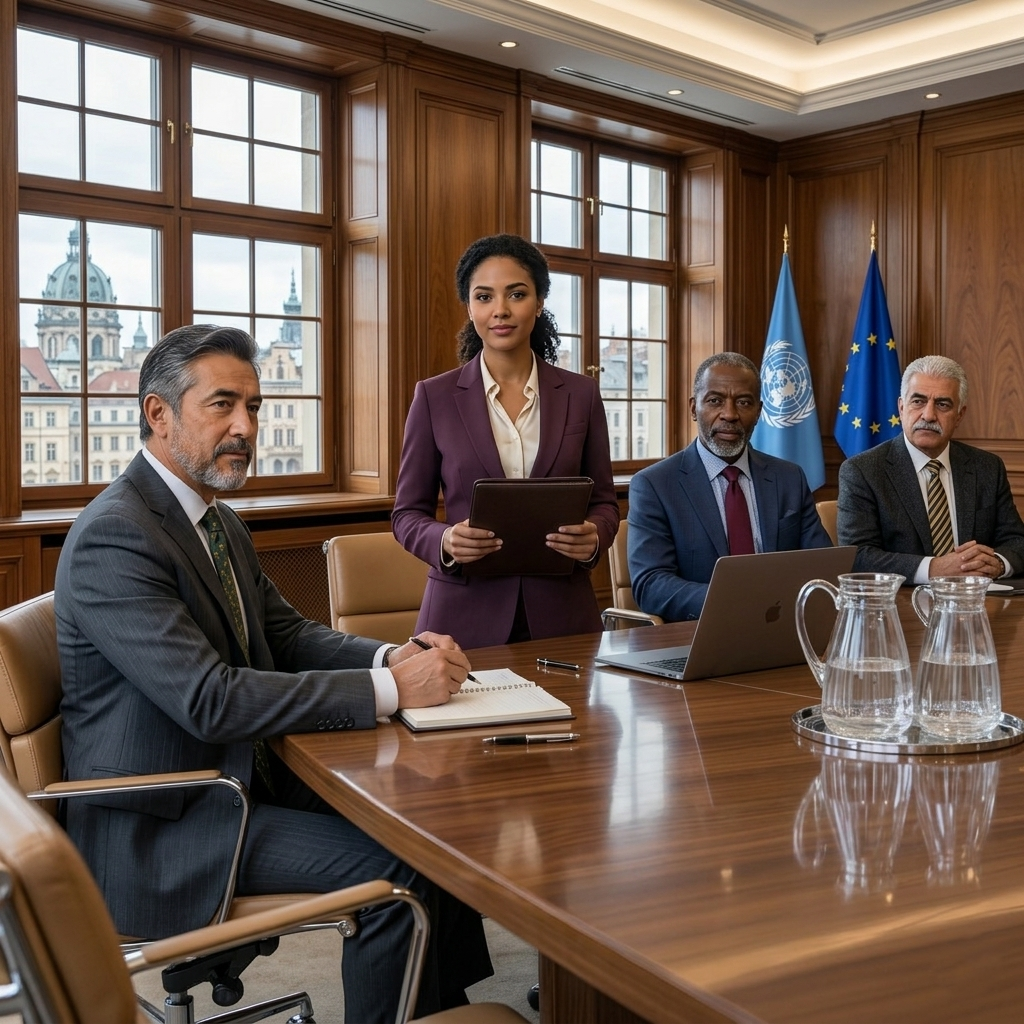
At 2:07 p.m., I walked into conference room A. Three men stood up, all in their sixties, wearing suits that were expensive but slightly outdated. Men who had been successful twenty years ago and were trying to hold on to that success.
Robert Brennan, my father, sixty-four years old, graying hair, the same sharp eyes I remembered. He looked tired. Thomas Mitchell, my father’s college roommate and co-founder of the firm, sixty-six, jovial face already sweating slightly. Michael Brennan, my father’s younger brother, sixty-one, quiet and analytical.
They looked at me with professional smiles. No recognition.
“Gentlemen,” I said, extending my hand. “Catherine Morrison, managing partner of Morrison and Whitley. Thank you for coming.”
I used my mother’s maiden name professionally. Morrison, not Brennan.
My father shook my hand, his grip firm. “Robert Brennan, senior partner of Brennan and Associates. This is Thomas Mitchell and Michael Brennan.”
Still no recognition.
I had changed since he had last seen me. Different hair, professional wardrobe, eight years older, and he wasn’t looking for his daughter. He was looking for a business opportunity.
We all sat down.
“I’ve reviewed your proposal,” I said, opening the folder in front of me. “Before we dive in, why don’t you tell me about your firm? What makes Brennan and Associates a good fit for Morrison and Whitley?”
My father launched into his pitch. Forty years of corporate law experience, solid client relationships, deep knowledge of the Chicago market, a proven track record. He was good—confident, professional, persuasive. But I could see the desperation underneath, in the way his hand tightened on his pen when he mentioned recent market challenges, in the slight pause before he gave their revenue numbers.
“Your financials show a 23% revenue decline over three years,” I said. “What’s driving that?”
Thomas shifted uncomfortably. “Market consolidation. Clients moving to larger firms with more resources.”
“That’s why we’re here,” my father interrupted smoothly. “We recognize that the legal market has evolved. Clients want global reach, specialized expertise, technological infrastructure—things that a firm our size can’t provide alone.”
“But you can provide them together with us.”
“Exactly. Brennan and Associates brings forty years of client relationships and Chicago market expertise. Morrison and Whitley brings resources, global reach, and prestige. Together, we’d be formidable.”
I made a note. “You’ve lost three major clients in eighteen months. Why should we believe the remaining clients will stay through a partnership transition?”
My father’s jaw tightened slightly. “Those clients left due to industry consolidation, not service issues.”
“One of them left for Miller and Cross,” I said, referencing my briefing materials. “A firm smaller than yours. That’s not consolidation. That’s competition.”
Silence.
“Miss Morrison,” Michael spoke up, his voice calm. “You’re right. We’ve faced challenges. But we’ve also survived for forty years in a competitive market. Our client relationships are strong. Our legal work is excellent. We’re not here because we’re failing. We’re here because we’re smart enough to evolve.”
Better answer. More honest.
“Tell me about your succession plan,” I said. “Your senior partners are all over sixty. Who’s the next generation of leadership?”
Another uncomfortable pause.
“We have several strong associates,” Thomas said. “Marcus Brennan, Robert’s son, just made partner. He’s thirty-six. Excellent trial lawyer.”
“One new partner isn’t a succession plan,” I said. “What happens when the three of you retire?”
“That’s part of why we’re seeking a partnership,” my father said. “Access to Morrison and Whitley’s resources would help us recruit and retain top talent. Young lawyers want to work for firms with global reach.”
I sat back. “Let me be direct. Your proposal asks for access to our client base, our resources, our brand. In exchange, you offer client relationships that are shrinking and expertise that we already have in-house. Why would we agree to that?”
The temperature in the room dropped ten degrees.
“Because,” my father said, his voice tight, “we’re offering you the Chicago market. Forty years of relationships with every major corporation in the region. You can’t buy that kind of institutional knowledge.”
“We can hire it,” I said. “We could recruit half your associates tomorrow and get the same knowledge for less.”
I was being harsh, harsher than I needed to be. But I wanted him to feel what I had felt for years: inadequate, not good enough.
“Ms. Morrison,” Thomas said, “perhaps we got off on the wrong foot. We have deep respect for Morrison and Whitley. We’re not here to demand anything. We’re here to explore whether there’s mutual benefit.”
“Then let me ask you this,” I said. “What happens if we say no? What’s your plan B?”
No one answered.
“Because from where I’m sitting,” I continued, “you don’t have one. You’re losing clients. Your revenue is declining. Your partners are aging out. Without this partnership, you’re looking at a slow decline into irrelevance.”
My father’s face was red. “Now, that’s a rather harsh assessment.”
“It’s an accurate assessment. Your proposal’s financial projections are overly optimistic. Your client retention assumptions are unrealistic, and your value proposition to us is minimal.”
I closed the folder. “Gentlemen, I appreciate you coming in, but I don’t see a fit here.”
“Wait,” my father said sharply. “You’re rejecting us? Just like that?”
“Unless you have something else to add.”
“We have forty years of excellence.” His voice was rising. “We’ve built one of the most respected firms in Chicago. We’ve represented Fortune 500 companies, won major cases, trained dozens of successful lawyers. You’re dismissing that because of three bad years?”
There was the ego. The inability to accept that he wasn’t the most important person in the room.
“I’m dismissing it,” I said calmly, “because it doesn’t meet our strategic needs. Morrison and Whitley partners with firms that bring unique value. I’m not seeing that here.”
My father stood up abruptly. “This is absurd. We came here in good faith.”
“And I reviewed your proposal in good faith,” I said, remaining seated. “The answer is no.”
“You’re making a mistake.”
“I rarely make mistakes, Mr. Brennan.”
He stared at me, his face flushed with anger and humiliation, and something else. Something in his eyes flickered. My mother’s maiden name was Morrison, but I had my father’s eyes. And now, in his anger, he finally saw it.
“Katie,” he said, his voice uncertain.
I stood up slowly. “Hello, Dad.”
The color drained from his face. Thomas looked between us, confused.
“You two know each other?”
“Robert is my father,” I said, “though we haven’t spoken in eight years.”
Michael sat back heavily. “Oh my God.”
“You’re Catherine Morrison,” my father said. His voice was barely a whisper. “You’ve been Catherine Morrison this whole time.”
“I use my mother’s maiden name professionally. It’s been my legal name for seven years.”
“But you’re the managing partner of Morrison and Whitley.”
“For eighteen months now. Before that, I was a senior partner at Cravath. But you wouldn’t know that. You haven’t asked about my career since I graduated from Harvard Law, which you didn’t attend, by the way.”
Thomas stood up. “Robert, you said you had two children. A son who’s a lawyer and a daughter who…” He stopped, clearly remembering what my father had told him about me.
“Who what?” I asked. “Who works in legal aid? Who handles parking tickets? Who doesn’t have what it takes to be a real lawyer?”
My father looked like he might be sick.
“Ms. Morrison,” Michael said carefully. “Perhaps we should reschedule this meeting.”
“There’s nothing to reschedule,” I said. “The answer is still no.”
“Katie, please,” my father started.
“It’s Catherine or Miss Morrison. We’re not on a first-name basis.”
“This isn’t about our personal relationship, is it?”
I looked at him directly. “You spent my entire life telling me I wasn’t good enough, that I didn’t have what it takes, that my brother was the real lawyer. You skipped my law school graduation. You haven’t called in eight years. And now you show up at my firm needing my help. And you expect what?”
“Professionalism. Objectivity.”
“I expect you to separate business from personal feelings.”
“Like you did?” My voice was sharp. “Was it business or personal when you told your partners I’d end up in legal aid? When you said I was too soft to be a real lawyer? When you skipped the biggest day of my academic career?”
Silence.
“This is exactly the problem,” I continued. “You never saw me as a lawyer. You saw me as your disappointing daughter. And now you need me professionally, and you can’t handle it.”
“I was wrong,” he said quietly.
“What?”
“I was wrong about you. About your capabilities. About everything.”
I waited.
“Katie—Catherine—you’ve built an extraordinary career. Managing partner at thirty-five, at one of the most prestigious firms in the world. I didn’t know. I should have known. I should have stayed in touch. I should have…” He stopped. “I’m sorry.”
Eight years of waiting for an apology, and now it came like this, in a conference room in front of witnesses because he needed something from me.
“Your apology is noted,” I said. “But it doesn’t change my business decision. Brennan and Associates doesn’t fit our strategic needs.”
“Please.” My father’s voice cracked. “The firm is my life’s work. Forty years. If we don’t partner with someone, we won’t survive.”
“Then maybe you should have thought about succession planning earlier. Or client retention. Or any of the other strategic issues that are now threatening your firm’s existence.”
“You’re going to let us fail just to punish me.”
“I’m going to let you fail because your proposal doesn’t make business sense. The fact that you’re my father is irrelevant.”
“Is it?” He looked at me. “Or are you enjoying this? Seeing me beg?”
That hit harder than it should have.
“This meeting is over,” I said. “Rebecca will show you out.”
I walked toward the door.
“Catherine, wait.”
I paused but didn’t turn around.
“You’re right,” my father said. “About all of it. I compared you to Marcus. I dismissed your achievements. I wasn’t there when you needed me.” His voice was heavy. “I was a terrible father. And now I’m reaping what I sowed.”
I turned around slowly. He looked older suddenly, defeated.
“I don’t expect you to forgive me,” he continued. “I don’t even expect you to help me. But I need you to know I’m proud of you. Seeing what you’ve built, what you’ve accomplished without any help from me—I’m proud. And I’m sorry it took losing everything to say it.”
Thomas and Michael were staring at the floor, clearly wishing they were anywhere else.
“I’ll review the proposal again,” I heard myself say.
My father looked up sharply. “What?”
“I’ll review it again. Give me one week. If I can find a way to make it work on terms that benefit Morrison and Whitley, I’ll consider a modified partnership.”
“Catherine—”
“Don’t thank me yet. This is business, not forgiveness. If I do this, it’s because I found a legitimate business case, not because of our relationship.”
“I understand.”
“And Dad,” I said, looking at him directly, “if we partner, you’ll be reporting to me. Your firm will operate under Morrison and Whitley’s management. You’ll follow our protocols, our standards, our decisions. If you can’t handle that, if you can’t handle your daughter being your boss, then walk away now.”
He swallowed hard. “I can handle it.”
“We’ll see.”
I walked out of the conference room and went straight to my office, closing the door behind me. My hands were shaking.
Rebecca buzzed me five minutes later. “The Brennan party has left. Are you okay?”
“I’m fine. Hold my calls for an hour.”
I sat at my desk, staring out at the Manhattan skyline, trying to process what had just happened. My father had apologized. After eight years of silence, he had apologized, and I had agreed to reconsider his proposal. Was I being weak, letting family cloud my judgment? Or was I being strong, separating the business decision from the personal hurt?
I pulled up the Brennan proposal again and started reading with fresh eyes.
Over the next week, I had my team do a deep dive into Brennan and Associates. The findings were mixed. The bad: revenue declining, client base shrinking, aging partnership, no succession plan. The good: their remaining clients were fiercely loyal, their legal work was solid, their Chicago market knowledge was genuine, and their overhead was low. They operated lean.
More importantly, I saw something my initial review had missed.
Opportunity.
If Morrison and Whitley acquired Brennan and Associates outright—not a partnership, but an acquisition—we could absorb their clients, their expertise, and their Chicago market position. We could bring in their best associates, retire the senior partners gradually, and build a true Chicago presence. The Brennan name had equity in the market. We could keep it as a subsidiary: Brennan and Associates, a Morrison and Whitley company. It would cost us less than starting from scratch, and it would eliminate a potential competitor.
I drafted a counterproposal. Not a partnership. An acquisition.
Morrison and Whitley would buy Brennan and Associates for $15 million. The three senior partners would stay on for two years in advisory roles, then transition to of counsel positions. Their associates would be offered positions at Morrison and Whitley. It was a fair offer, more than fair considering their financial situation. But it meant my father would lose control of the firm he had built.
I called him on Friday afternoon.
“Robert Brennan,” he answered.
“It’s Catherine.”
“Catherine. I’ve been hoping you’d call.”
“I’ve reviewed your proposal again. I have a counteroffer.”
“I’m listening.”
“Not on the phone. Can you come to New York tomorrow? Just you, not the other partners.”
“Tomorrow is Saturday.”
“I’m aware. Can you come or not?”
“I’ll be there.”
He arrived at my office at 10:00 a.m. Saturday morning. I was already there, having spent the night working on the final details. He looked nervous, which was a first.
“Coffee?” I offered.
“Please.”
We sat in my office, not the conference room. This conversation needed to be different.
“I have a proposal,” I said, sliding a folder across the desk. “But it’s not what you asked for.”
He opened it and started reading. I watched his face change as he processed it. Confusion. Understanding.
“You want to buy us?” he said finally.
“Yes. For fifteen million. It’s a fair price based on your current financials.”
“We’d lose the firm. Lose control.”
“You’d lose ownership. But you’d save your clients, save your associates, and save your legacy. Brennan and Associates would continue under Morrison and Whitley. Your name would remain on the door.”
He read through the details—the two-year transition, the advisory role, the of counsel position afterward.
“I’d be working for you,” he said.
“Yes.”
“My daughter would be my boss.”
“Yes.”
He set down the papers and looked at me. “Is this revenge? Making me report to you?”
“No. This is business. It’s the best option for both firms.”
“There’s no other way? No partnership structure that preserves our independence?”
“I could force a partnership on terms that would slowly strangle your firm. Give you just enough resources to survive but not thrive. Keep you dependent on us while we extract value from your client base.” I paused. “Or I can do this cleanly. You get a fair price. Your people get protected. Your name stays intact. In two years, you retire with dignity instead of watching your firm die slowly.”
“Those are my only choices.”
“Those are the only choices that make sense.”
He stood up and walked to the window, looking out at the city.
“Forty years,” he said quietly. “I built that firm from nothing. Three lawyers in a small office in 1984. We grew it to forty attorneys, handled major cases, trained dozens of lawyers. It was my legacy.”
“It still can be,” I said. “Under Morrison and Whitley, the Brennan name will reach further than it ever could independently. Your associates will have opportunities you could never give them. Your clients will get resources you can’t provide.”
“But it won’t be mine.”
“No, it won’t be yours.”
He turned around. “Why are you doing this? Really? You could have just rejected us. Let us die on our own.”
I thought about that.
“Because you were right about one thing,” I said finally. “You did build something worth preserving. Brennan and Associates is a good firm. It doesn’t deserve to die because of market forces or poor planning.” I paused. “And because those associates deserve better than to watch their careers collapse with a sinking ship. I was one of them once. I know what it’s like to work for someone who doesn’t see your value.”
The implied criticism hung in the air.
“I wasn’t talking about you,” I said. “But if the shoe fits.”
He actually smiled slightly at that. “Fair point.”
He came back to the desk and sat down. “If I agree to this, if we do this, can I ask for one thing?”
“What?”
“Can we try to rebuild our relationship? Not just business, but father and daughter.”
I looked at him for a long moment. “I don’t know,” I said honestly. “Eight years is a long time. You hurt me deeply, multiple times.”
“I know.”
“And I’m not the same person I was. I don’t need your approval anymore. I don’t need your validation. I built this career despite you, not because of you.”
“I know that, too.”
“So what exactly are you asking for?”
“A chance,” he said simply. “To know the person you’ve become. To be part of your life. To be a father, if you’ll let me.”
I felt something crack in my chest. That small part of me that had always wanted her father’s approval, no matter how much I denied it.
“We can try,” I said carefully. “But it’ll take time. And I need you to understand, I’m not looking for a father figure anymore. If we rebuild something, it’ll be different than what we had.”
“I understand.”
“And if you compare me to Marcus one more time, we’re done. Professionally and personally.”
He actually laughed at that. “Fair. Though I should tell you, Marcus has been reading about your career. He’s actually intimidated by you.”
“Good.”
We sat in silence for a moment.
“Will you take the offer?” I asked.
“Can I discuss it with Thomas and Michael?”
“Of course. You have until Monday. But, Dad?”
“Yes?”
“This is the only offer. I won’t negotiate. It’s fair, it’s generous, and it’s the best option available. If you say no, I’ll wish you luck, and we’ll move on.”
“Understood.”
He stood up, gathering the proposal documents. At the door, he paused.
“Catherine.”
“Yes?”
“I really am proud of you. I should have said it years ago. I should have been saying it all along.”
“Yes,” I said. “You should have.”
After he left, I sat in my office for a long time, thinking I had proven him wrong. I had built the career he said I couldn’t. I had become the lawyer he said I’d never be. And now he needed me. Part of me wanted to feel triumphant, vindicated. Instead, I just felt tired.
Proving people wrong was exhausting. Even when you won, you lost something in the process.
Monday morning, my phone rang at 8:47 a.m.
“Catherine Morrison.”
“It’s Robert. We’re accepting your offer.”
I let out a breath I didn’t know I was holding.
“All three partners agreed unanimously,” he said. “We know it’s the right choice.”
“Good. I’ll have our legal team draw up the formal documents. We’ll aim to close in sixty days.”
“Thank you, Catherine. For giving us this option.”
“It’s good business, Dad. Don’t make it more than it is.”
But I was smiling when I said it.
The acquisition closed on May 28, 2024. Brennan and Associates became a wholly owned subsidiary of Morrison and Whitley. The transition was smoother than I had expected. My father, Thomas, and Michael were professional throughout. They helped onboard their associates, transitioned client relationships, and accepted their new roles without complaint.
Marcus called me two weeks after the closing.
“Katie, it’s Marcus.”
“Hi, Marcus.”
“I just wanted to say thank you for what you did. A lot of firms would have just let us die. You didn’t have to help.”
“I didn’t do it for family reasons.”
“I know. But still. You gave Dad a dignified exit. That means something.”
We talked for an hour about our careers, about the acquisition, about our father.
“He talks about you constantly now,” Marcus said. “Shows everyone your articles. Tells clients you’re his daughter. It’s kind of annoying, actually.”
I laughed. “Really?”
“Really. I think he’s trying to make up for lost time. Overcompensating.”
“How do you feel about that?”
“Honestly? Relieved. I was tired of being the golden child. The pressure was exhausting.”
“You could have said something.”
“So could you.”
“Fair point.”
My father and I started having dinner once a month. Awkward at first, then gradually more natural. We talked about cases, about the firm, about the legal profession. Slowly, we talked about other things: about Mom, about my childhood, about what we had both lost in those eight years of silence.
“I was threatened by you,” he admitted one night over Italian food in Little Italy. “You were always smarter than Marcus. Quicker. More determined. And I couldn’t handle it.”
“Why not?”
“Because you reminded me of me at your age. Ambitious, hungry, unwilling to settle. And I knew if I encouraged you, you’d surpass me. Which you did anyway.”
“So you tried to hold me back.”
“I tried to convince myself you weren’t as good as you were. It’s shameful. I’m ashamed of it.”
“Good,” I said. “You should be.”
But I reached across the table and squeezed his hand.
Six months after the acquisition, I promoted three Brennan associates to partner at Morrison and Whitley. All three were exceptional lawyers who had been held back by the old firm’s financial constraints. My father attended the announcement. Afterward, he pulled me aside.
“Those three,” he said. “They would have left if you hadn’t acquired us. We’d have lost them.”
“I know.”
“You saved their careers.”
“I gave them opportunities they’d earned.”
He smiled. “You’re a better managing partner than I ever was.”
“Yeah,” I said. “I am.”
We both laughed.
A year after the acquisition, my father officially retired. We threw him a party at the office. Two hundred people, partners and associates from both firms. I gave a speech.
“Robert Brennan built Brennan and Associates from nothing forty years ago. He created opportunities for dozens of lawyers, served clients with distinction, and contributed significantly to the Chicago legal community.” I paused. “He also happens to be my father, which made this acquisition complicated in ways most mergers aren’t.”
The room laughed.
“But I want to say this publicly. Dad, you taught me more than you know. You taught me resilience by making me develop it on my own. You taught me determination by giving me something to prove. You taught me the value of success by withholding your approval until I no longer needed it.”
I looked at him directly.
“You weren’t always the father I needed, but you inadvertently gave me the skills to become the lawyer I wanted to be. So thank you for the lessons you meant to teach and the ones you didn’t.”
He was crying. So was I.
After the party, we stood on the balcony of my office, looking out at the Manhattan skyline.
“I’m sorry,” he said for the hundredth time. “I’m sorry.”
“I know.”
“Are we okay? Really?”
I thought about that. About the eight-year-old girl who wanted her father’s approval. About the twenty-seven-year-old who graduated from Harvard Law alone. About the thirty-five-year-old managing partner who had proven everyone wrong.
“We’re getting there,” I said. “It’s not perfect. It might never be perfect. But we’re getting there.”
“That’s enough for me.”
We stood in comfortable silence.
“Katie,” he said quietly, using the nickname I had forbidden.
I didn’t correct him.
“I know I don’t get to be proud now. I didn’t earn that right. But I want you to know, if I had supported you from the beginning, if I had been the father you deserved, I don’t think you’d be standing here right now.”
“What do you mean?”
“You became this successful partly because you had something to prove. Because you had to be twice as good to get half the recognition.” He paused. “If I’d been supportive, maybe you would have been comfortable. Settled. Good, but not great.”
“So you’re taking credit for my success?”
He laughed. “God, no. Your success is entirely yours. I’m just saying, sometimes the obstacles make us stronger. Even when those obstacles are our own fathers.”
I thought about that.
“Maybe,” I said. “Or maybe I’d have been just as successful with a supportive father. We’ll never know.”
“No, we won’t.”
Another pause.
“But for what it’s worth,” I said, “I forgive you.”
He looked at me sharply. “Really?”
“Really. It doesn’t undo the hurt. It doesn’t erase the years. But I forgive you because holding on to that anger is exhausting, and because you’re trying.”
Finally, he pulled me into a hug. I let him.
“Thank you,” he whispered. “Thank you.”
We stood there on that balcony, managing partner and retired senior partner, daughter and father, while the sun set over Manhattan. I had proven him wrong. I had become the lawyer he said I’d never be.
But more importantly, I had become the person I wanted to be, with or without his approval. Though I had to admit, having it now felt pretty good.