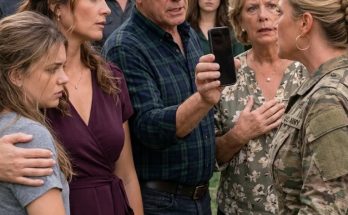
He sounded embarrassed.
He admitted that Brooke had known the rideshare destination before telling everyone Lily was missing.
He said he’d also allowed Brooke to take public credit for Lily’s lemon cake.
“I should’ve said something,” he told me.
I appreciated that he acknowledged it.
But I reminded him that the apology he most needed to make wasn’t to me.
It was to his daughter.
He was quiet.
Then said:
“I know.”
Lily later told me they’d spoken.
Travis apologized for taking credit for the cake.
Brooke acknowledged that she’d reacted more strongly to the embarrassment of Lily leaving her party than to the reasons Lily had been upset.
She also admitted she’d let relatives believe I was responsible without confirming what had happened.
It wasn’t a perfect conversation.
Brooke still struggled to accept criticism.
And Lily still had to learn how to communicate when she was angry or disappointed.
But they began having the conversations they’d avoided.
I was glad.
I didn’t want Lily to feel that choosing me meant rejecting her mother.
I wanted her to have room to love both of us.
One afternoon, Lily came to Second Shift Kitchen for her usual supervised activities.
She wore her white apron.
Flour was dusted across one sleeve.
She looked toward me.
“Aunt Cindy?”
“Yes?”
“Are you still mad about the ceremony?”
I stared.
“Mad at you?”
She nodded.
I shook my head.
“No, sweetheart.”
She looked relieved.
I continued.
“I was frightened when I learned you’d traveled without telling anyone. But I wasn’t angry that you cared about me.”
She nodded.
Then whispered:
“I didn’t want you to be alone.”
I looked at her.
“You don’t have to protect me from being disappointed, Lily.”
She frowned.
“Why not?”
I smiled sadly.
“Because that’s not your job. You’re allowed to be sixteen.”
She looked down.
For a moment, I saw the younger version of myself.
The girl who’d spent years trying to make everybody else’s life easier.
Then I told Lily something I wished somebody had told me at her age.
“Being considerate doesn’t mean making yourself responsible for everyone else’s feelings.”
She nodded slowly.
Then smiled.
“Okay.”
We returned to work.
The $10,000 grant helped us purchase new training equipment.
We replaced an aging refrigerator.
Bought additional smallwares.
And expanded our capacity for practical classes.
The grant didn’t solve every financial challenge.
But it made a meaningful difference.
Our trainees were excited.
Raina helped coordinate the changes.
And for the first time in a while, I allowed myself to enjoy the recognition we’d received.
Then Lily entered another art competition.
This time, she created a charcoal portrait of a woman sitting at a kitchen table.
The woman’s hands were folded.
Her face was tired.
But there was sunlight falling across her shoulder.
I looked at the drawing.
“Who is she?”
Lily smiled.
“Someone who keeps showing up.”
I felt my throat tighten.
I didn’t ask whether it was supposed to be me.
I didn’t need to.
The drawing was accepted into a student showcase.
There was a reception.
Lily told me about it weeks in advance.
This time, her parents arranged for her to attend.
I asked whether I could come too.
Brooke agreed.
On the evening of the reception, I arrived early.
I stood near Lily’s drawing.
Then Dad arrived.
Mom came with him.
Travis entered with Brooke and Jace.
For a moment, I felt nervous.
We’d spent months trying to change old habits.
I didn’t know whether we’d manage.
Then Lily walked into the room.
She saw us.
All of us.
Her face changed.
She smiled.
Then hurried over.
“You came.”
I hugged her.
“Of course.”
Dad told her he loved the drawing.
Mom asked about her technique.
Travis took a photograph.
Brooke stood beside Lily and told another parent that her daughter had worked hard on the piece.
For once, she didn’t take credit.
I watched Lily listening.
Her shoulders relaxed.
She looked happy.
Not because she’d won the biggest prize.
Because she’d been seen.
Later, when the reception ended, Lily walked toward me.
She hugged me again.
“Thanks, Aunt Cindy.”
I smiled.
“For what?”
She looked toward our family.
Then said:
“For showing me what it feels like when people actually come.”
I held her.
Then looked toward my parents.
Dad was helping Jace put on his jacket.
Mom was looking at Lily’s drawing one more time.
Brooke and Travis were discussing where to hang it at home.
It wasn’t perfect.
Our family wasn’t suddenly healed.
There were still difficult conversations.
Old habits.
And memories that couldn’t be erased by one good evening.
But something had changed.
We were learning that showing up wasn’t a favor reserved for the person who seemed most needy.
It was part of loving someone.
Months after my award, I returned to the Laclede Grand Hotel for a professional event.
I walked past the ballroom where I’d given my speech.
I remembered Table 6.
The two gold-lettered name cards.
The empty chairs.
And Lily sitting in one of them, looking at me as though she wanted me to know I mattered.
I stopped for a moment.
Then smiled.
For forty-two years, I’d tried to become successful enough that my parents would finally choose me.
I won awards.
Built a career.
Created a nonprofit.
Worked long hours.
And became the person everybody could depend on.
But success hadn’t changed the family pattern.
What changed it was finally refusing to pretend I wasn’t hurt.
And recognizing the same pattern in my niece before she learned to believe it was normal.
I didn’t need my parents to attend every event.
I didn’t need Brooke to become a different person overnight.
And I didn’t need Lily to risk her safety to prove she cared.
I needed honesty.
Respect.
And people who understood that being dependable didn’t mean I never needed someone beside me.
My name is Cindy Everheart.
I’m forty-two years old.
I’m an executive chef.
I built Second Shift Kitchen to help young adults who’d learned not to expect people to show up.
The Missouri Hospitality Alliance honored our work.
My parents missed the ceremony because my sister wanted them at her birthday brunch.
Halfway through my speech, my niece appeared at the hotel after leaving that brunch without permission.
My family panicked.
Then Brooke accused me of taking her daughter.
A photograph of the rideshare notification revealed that she’d had information about Lily’s destination earlier than she admitted.
The confrontation that followed was painful.
But it was also the first time my father stopped making excuses.
And the first time I stopped apologizing for being hurt.
That afternoon, I thought the most important thing I’d received was an award and a $10,000 grant.
I was wrong.
The grant helped the program.
The award recognized the work.
But Lily taught me something I’d needed to understand for decades.