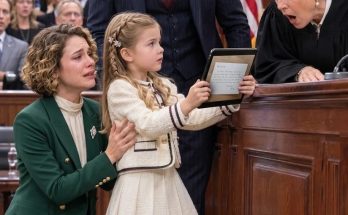
“Grandpa said to be like a scientist,” she hiccupped.
“You were,” I said. “You were exactly like a scientist.”
Above us, Judge Whitfield cleared her throat, and I realized she was working to keep her own voice steady.
“We will take a twenty-minute recess,” she said. “Mr. Calloway, you will remain in this courtroom. Bailiff, please see that he does.”
When we came back, the room had changed. Russell sat alone at the petitioner’s table. Mr. Prescott had moved to the far end of it, and I noticed he’d pulled his briefcase closer, as if preparing to leave. Constance and Brianna sat in the gallery, but not together.
Judge Whitfield took the bench.
“I have viewed the recording in its entirety, along with the forensic documentation submitted by Mrs. Calloway,” she said. “In more than twenty years on this bench, I have rarely seen a case where a child was so plainly used as a tool against her own mother.”
Russell began to speak. She held up one hand.
“Mr. Calloway, you will have the opportunity to respond through counsel in the proceedings that follow. For today, I am ruling on temporary orders.” She turned her pages. “The petitioner’s request for sole custody is denied. Temporary sole legal and physical custody of the minor child is awarded to the respondent, Mrs. Meredith Calloway. Mr. Calloway’s parenting time will be supervised, pending a full evaluation, and his mother is prohibited from any unsupervised contact with the child.”
Constance gasped. The judge ignored her.
“The marital accounts, including all accounts identified in the forensic audit, are frozen effective immediately. Any further transfers will be treated as contempt of this court. I am also ordering the respondent’s financial records and the video recording to be preserved and forwarded, along with this transcript, to the county prosecutor’s office and the state attorney general for review of possible fraud and witness coaching.”
“Your Honor,” Mr. Prescott began, his voice thin.
“Counsel, I would advise you to speak with your client about whether this firm can continue to represent him.” She looked at the bench in front of her. “And I would advise Ms. Hayes to consider whether she wishes to be found in this courtroom when the prosecutor’s investigators arrive.”
Brianna was already gone, her heels clicking down the aisle toward the exit. A deputy followed her out at a measured pace.
“Mrs. Calloway,” Judge Whitfield said, and her expression softened, “you represented yourself with extraordinary competence. But I would strongly encourage you to retain counsel for what comes next.”
“I will, Your Honor. Thank you.”
“Don’t thank me.” She nodded toward Penny, who stood pressed against my side. “Thank her.”
She struck the gavel. It was over, at least for that morning.
Outside the courtroom, the hallway was loud with the ordinary noise of other people’s problems. I sat Penny on a bench and crouched in front of her.
“Are you mad at me?” she asked.
“Mad?” I laughed, and it came out wet. “Sweetheart, no. I’m the one who’s sorry. You shouldn’t have had to carry that by yourself.”
“Daddy said you’d go away if I told.”
“I’m not going anywhere. Not ever.”
She studied my face, the way she’d studied it all those weeks, searching for the tell. Then she nodded slowly and put her small hand in mine.
“Can we get pancakes?”
“Dinosaur-shaped,” I said.
“Dinosaur-shaped,” she agreed, and she almost smiled.
The months that followed were not clean or quick. Russell hired a new attorney, who didn’t last long once the prosecutor’s office began returning subpoenas. The Nevis account was traced within weeks, with help from a banking contact I’d kept from my forensic days. It had been funded with nearly four hundred thousand dollars siphoned from Russell’s own company and from two clients who, as it turned out, were very interested in getting their money back.
Constance never apologized. In the end, she didn’t have to. The court’s supervised-contact order held through the entire evaluation, and a child psychologist wrote a report that I read only once. It said Penny had been “systematically coached by two adults whose motives were financial rather than protective.” After that, the family court stopped treating Russell as the wounded husband.
Russell took a plea eventually. Fraud, tampering with a witness, and a count of conspiracy that Brianna, ironically, provided the evidence for once she realized she could trade it for leniency. He served eleven months, with five years of probation to follow. The marital property was divided, with the court weighing his financial misconduct heavily. I kept the house, most of the savings, and full custody. Russell kept his supervised visits, and, after some time and a lot of therapy for all of us, a slow, careful chance to earn back whatever trust Penny was willing to give.
I went back to forensic accounting, this time as a partner in a small firm that handled domestic financial abuse cases. My first client was a woman who had come into a courtroom alone, in a navy dress, holding a folder she didn’t know how to open.
I taught her how.
One evening the following spring, Penny and I sat on the back porch, watching fireflies come up out of the grass. She held the silver camera in her lap, turning it over and over.
“Mom?”
“Yeah, sweetie?”
“Grandpa said a scientist keeps the evidence even when it’s sad. So I kept it. But I don’t want to watch it anymore.”
I put my arm around her. “You don’t have to. The judge and the lawyers have copies. It’s safe. You don’t have to carry it anymore.”
She thought about that for a while.
“Can I use the camera for something else?”
“Like what?”
She pointed at the yard, where one firefly had drifted higher than the rest and hung there, blinking against the dark.
“Like that.”
I smiled and handed her the camera. She held it up, carefully, the way my father had taught her, and held very still.
Somewhere in the house, my phone buzzed with a new case file. It could wait.
Tonight, my daughter was filming fireflies, and for the first time in a very long while, nobody was telling her what to say.