When it ended, the judge took off her glasses and spoke directly to Calvin.
“Mr. Hartley, I’ve sat on this bench for twenty-three years. I have rarely watched a recording that was harder to see. You told the emergency crew, three months ago, that your daughter had locked herself out by accident. You looked at a nine-year-old child lying on the ground in the rain, and you went back inside.”
“Your Honor,” Calvin began.
“I’m not finished.”
He stopped.
“Full legal and physical custody is awarded to the mother. Mr. Hartley’s parenting time is suspended indefinitely, pending completion of a court-ordered evaluation and counseling, and any future contact will be supervised. A permanent protective order will be entered as to both defendants.”
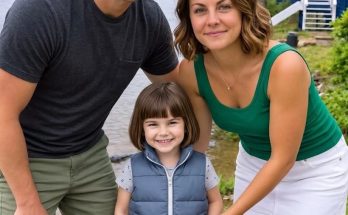
She looked at Ivy’s school photo on the evidence table, a gap-toothed smile and a crooked ponytail.
“That child wrote down the dates,” she said quietly. “She did what no adult around her was willing to do. I’d like the record to reflect that.”
Final Part
Calvin accepted a plea agreement in the spring. He was sentenced to four years in state prison, with probation to follow. Lorna received eighteen months, and a requirement to complete a parenting and anger-management program. Neither of them contested the protective order.
I didn’t go to the sentencing. I took Ivy to the zoo.
She sat on a bench near the penguin exhibit, eating a soft pretzel, swinging her legs. She had stopped flinching when it rained. She had stopped sleeping with the hallway light on, though she still liked the door open. Dr. Ames, the therapist she saw every Thursday, a gentle woman with a bowl of smooth stones on her desk, said she was doing remarkably well.
“Mommy?” she said.
“Yes, sweetie?”
“Am I allowed to still love Daddy?”
I had been preparing for that question for months, and I still wasn’t ready.
I put my arm around her.
“You’re allowed to feel whatever you feel,” I said. “You can love him. You can be angry. You can feel both at the same time. None of those feelings is wrong.”
She thought about that with the seriousness she brings to everything.
“I think I’m mostly sad,” she said. “And a little mad.”
“That sounds about right.”
“Dr. Ames says it’s okay if it takes a long time.”
“It is.”
She leaned against my side. A penguin plunged into the water, and she giggled, small and bright, and the sound went straight through me.
That evening, I found her at the kitchen table, working with a pencil on a piece of lined paper. She covered it with her arm when I came in.
“What are you writing?”
“A list.”
“Of what?”
She hesitated, then slid it across the table.
Things I want to do when I am ten:
1. Learn to ride a bike without training wheels.
2. Get a dog.
3. Have a sleepover.
4. Tell Mommy everything. Always.
I read it twice. Then I took the pencil and, beneath her list, I wrote my own.
Things Mommy promises:
1. To always listen.
2. To always believe you.
3. To always come.
I turned the page around so she could read it. She did, slowly, moving her lips. Then she took the pencil back, drew a very careful star at the bottom of the page, and slid it into the drawer by the refrigerator, where we keep the things that matter.
In June, we got the dog, a scruffy, ridiculous mutt named Biscuit, who ate one of my shoes within a week. That summer, Ivy learned to ride her bike. I ran behind her down the street, holding the seat, then letting go, and she rode forty feet on her own before she looked back and saw me standing, hands empty, and wobbled, and laughed, and kept going.
Pete, the paramedic, came to her tenth birthday party. I had written to thank him, and he had written back, a short, shy note, and I’d invited him on impulse. He arrived with a cupcake and a stuffed bear and stood at the edge of the yard, awkward in a polo shirt, until Ivy marched up to him.
“You’re the one who came in the ambulance,” she said.
“That’s right.”
“Thank you for noticing.”
Pete’s eyes went bright. He crouched to her level.
“I should have noticed sooner,” he said. “I’m sorry I didn’t.”
“You noticed on the second time,” said Ivy, with the generosity of a child. “That counts.”
He laughed, a little wetly. “I’ll take it.”
Later, when the guests had gone and the sun was slanting orange across the lawn, Ivy climbed into my lap on the porch swing. Biscuit sprawled across our feet.
“Mommy?”
“Yes?”
“It’s raining a little.”
I looked up. A soft, warm summer rain had started, speckling the porch rail, drumming gently on the roof.
“Do you want to go inside?”
She thought about it. Then she shook her head.
“No,” she said. “It’s okay. I like it when I’m out here with you.”
I held her closer. The rain fell on the grass and the garden and the yellow porch light, and I listened to it, and for the first time in a long while it was only rain.
THE END