PART 3: THE SECRET BENEATH THE ASHES
I stood between the investigator and my mother.
Nobody moved.
The building’s ventilation system hummed overhead.
Rebecca approached immediately.
“I’m Rebecca Morgan, their attorney.”
The investigator nodded.
“Detective Adrian Foster.”
He displayed his credentials again.
Two other investigators waited behind him.
One carried a document case.
The other wore a dark blue jacket.
Foster looked at Eleanor.
“Mrs. Hayes, we’d like your cooperation.”
My mother remained seated.
Her face had become very pale.
“Is she under arrest?” Rebecca asked.
“No.”
“Is she being accused?”
“Not formally.”
“Then we need to understand
the purpose of your visit.”
Foster studied her.
“We’re investigating possible evidence tampering.”
“Related to a historical death?”
“And recent financial transactions.”
Rebecca held out her hand.
“May I see the warrant?”
Foster gave it to her.
She read every page.
I watched her expression carefully.
Rebecca never rushed legal documents.
She examined the dates.
The authorized locations.
The property descriptions.
Then she looked up.
“This authorizes a limited records search.”
“Correct.”
“It does not authorize taking Mrs. Hayes.”
“Correct.”
My mother slowly exhaled.
Foster looked toward me.
“Mr. Hayes, we understand tonight
has been difficult for your family.”
I almost laughed.
Difficult.
That was an interesting word.
My wedding had collapsed.
My mother had been publicly assaulted.
A financial empire had changed hands.
And now investigators were discussing
my father’s death.
“Yes,” I answered.
“It’s been difficult.”
Foster nodded.
“We received information several hours ago.”
“From Charles Whitmore?”
He did not answer directly.
“Information relevant to an old investigation.”
I looked at Rebecca.
She gave me a subtle warning.
Don’t speculate.
Don’t accuse.
Stay controlled.
Foster continued.
“We also received an authenticated copy
of Samuel Hayes’s original death certificate.”
I frowned.
“Why is that important?”
“Because the documented injuries
do not fully match the original accident report.”
My mother made a small sound.
I turned immediately.
“Mom?”
She was gripping the chair.
Foster noticed.
“Mrs. Hayes?”
My mother stared at him.
“What injuries?”
He hesitated.
“That information isn’t appropriate
to discuss without reviewing the case.”
She shook her head.
“No.”
Her voice became stronger.
“What injuries?”
Rebecca moved closer.
“Eleanor, you don’t have to answer questions.”
My mother barely seemed to hear her.
“Tell me what happened to Samuel.”
Foster looked genuinely uncomfortable.
“Mrs. Hayes, we believe your husband
may have been injured before the fire.”
The words hung in the air.
My mother closed her eyes.
I reached for her hand.
She gripped mine tightly.
“How do you know?” I asked.
“A newly located medical record.”
“Newly located where?”
“Among documents connected to Whitmore Holdings.”
I stared at him.
Charles had kept medical records
relating to my father’s death?
For nearly thirty years?
Why?
Rebecca asked the obvious question.
“Who supplied the records?”
Foster considered his answer.
“A source with access to corporate archives.”
“Charles?”
“I can’t identify every source tonight.”
I looked toward my mother.
She was trembling again.
But this time it wasn’t cold.
It was something much deeper.
A fear that had waited decades.
Rebecca placed the warrant on the table.
“We’ll cooperate within its scope.”
Foster nodded.
“Thank you.”
The investigators began their search.
They examined designated document cabinets.
Rebecca supervised every step.
Mira joined her.
Everything was recorded.
Everything was inventoried.
I stayed beside my mother.
She had become strangely quiet.
Finally, I asked,
“What did you mean about the ledger?”
She stared at her hands.
“Danny.”
“Please.”
Her eyes filled.
“I was trying to protect you.”
I swallowed.
“From what?”
She looked toward the investigators.
Then toward Rebecca.
“I think it’s time you heard everything.”
Rebecca walked over.
She sat opposite us.
Foster approached, but Rebecca stopped him.
“My clients need a private legal consultation.”
He nodded.
“We can wait.”
We entered a smaller conference room.
Rebecca closed the door.
The room contained a round wooden table.
Three chairs.
A whiteboard.
A bookshelf filled with financial regulations.
My mother sat slowly.
Then she removed the blue quilt.
She folded it with extraordinary care.
I watched her hands.
Those hands had held me as a child.
They had prepared school lunches.
They had repaired torn clothing.
They had written birthday cards.
They had worked through illness and exhaustion.
Now those same hands trembled
above a secret older than my memories.
“Your father trusted Charles,” she began.
I sat opposite her.
“They met at university.”
“Charles studied business.”
“Samuel studied engineering.”
“They were very different.”
She smiled faintly.
“But Samuel believed friendship
could bridge almost any difference.”
I listened.
“After graduation, they started working together.”
“Samuel developed machinery.”
“Charles found investors.”
“For several years, it worked.”
“What changed?”
“Money.”
She looked down.
“More specifically, Charles’s hunger for it.”
My mother took a breath.
“The machines became successful.”
“Manufacturers wanted licenses.”
“Investors wanted ownership.”
“Samuel wanted better conditions
for the workers operating them.”
“Charles wanted expansion.”
“At any cost.”
I looked toward Rebecca.
She remained silent.
My mother continued.
“Halstead Manufacturing became their biggest customer.”
“Samuel spent months there.”
“He knew the employees by name.”
“He knew which machines needed repair.”
“He knew which managers ignored warnings.”
She paused.
“Then he discovered something terrible.”
“What?”
“Someone had been falsifying maintenance records.”
My stomach tightened.
“Charles?”
“He was involved in financing decisions.”
“Samuel believed he knew.”
“Believed?”
My mother nodded.
“He never proved Charles ordered it.”
I appreciated her precision.
Even now,
she refused to turn suspicion into fact.
“Samuel collected copies of the records.”
“He created a blue ledger.”
“What was inside?”
“Dates.”
“Payments.”
“Maintenance warnings.”
“Insurance changes.”
“And the names of people
who approved the dangerous shortcuts.”
I remembered the letter.
Charles moving money.
Missing documents.
The meeting before the fire.
“Where is the ledger?”
My mother looked away.
“I had it.”
I leaned forward.
“Had?”
She nodded.
“After the fire, Samuel’s briefcase disappeared.”
“I thought everything inside was gone.”
“But weeks later,
a coworker brought me the ledger.”
“Who?”
“An electrician named Robert Ellis.”
I stared.
“Is he still alive?”
“I don’t know.”
She wiped her eyes.
“Robert said Samuel asked him
to keep a duplicate.”
“He was terrified.”
“Of Charles?”
“Of everyone involved.”
“What happened next?”
“I took the ledger to an attorney.”
Rebecca looked up.
“Not me,” she clarified.
My mother nodded.
“No.”
“A man named Gerald Mercer.”
“He reviewed it.”
“Then he told me something frightening.”
“What?”
“The transactions might implicate several executives.”
“Possibly banks.”
“Possibly insurers.”
“And possibly people investigating the fire.”
I felt my chest tighten.
“Did you report it?”
“Yes.”
“To whom?”
“State investigators.”
“An insurance fraud division.”
“Later, federal authorities.”
She shook her head.
“But every time,
someone said the records were insufficient.”
“Or that the originals were missing.”
“Or that the case was closed.”
I looked at Rebecca.
“Do we have those reports?”
“Some.”
She opened her notebook.
“Gerald Mercer died twelve years ago.”
“His archived files were incomplete.”
My mother continued.
“Then Charles came to see me.”
Her voice changed.
I could almost picture the scene.
A young widow.
A small rented house.
A frightened little boy.
And Charles arriving in an expensive car.
“What did he say?”
“He offered money.”
“How much?”
“Enough to change our lives.”
I waited.
“He said Samuel’s death was tragic.”
“He said the investigation should end.”
“He wanted me to sign a settlement.”
“Did you?”
“No.”
My mother lifted her chin.
“I told him I wanted answers.”
“What did he do?”
“He smiled.”
She swallowed.
“Then he mentioned you.”
My blood turned cold.
“What about me?”
“He said children needed stability.”
“That accidents happened.”
“And that widows sometimes made
unwise decisions when they were grieving.”
I stared at her.
“He threatened you.”
She nodded.
“Not openly.”
“But I understood.”
“What happened to the ledger?”
She closed her eyes.
“I hid it.”
“Where?”
“In the old house.”
I frowned.
“The one on Willow Street?”
“Yes.”
“We left that house decades ago.”
“I know.”
I leaned forward.
“Mom.”
She looked at me.
“I thought it would be safer there.”
“Where exactly?”
She hesitated.
“Under the staircase.”
I stared.
“The staircase?”
“There was a loose floorboard.”
“Samuel installed it himself.”
“He used to hide birthday presents there.”
For a moment,
an old childhood memory surfaced.
My father kneeling on a wooden floor.
A screwdriver in his hand.
A narrow compartment.
His laughter.
I remembered reaching toward it.
He gently pushed my hand away.
Not yet, Danny.
I felt a chill.
“Did you ever retrieve it?”
My mother shook her head.
“No.”
“Why?”
“Because Charles started watching the house.”
I stared at her.
“What?”
“A car appeared outside.”
“Men came asking questions.”
“Then someone broke into the garage.”
She looked ashamed.
“I got frightened.”
“So I moved us away.”
I remembered moving.
A rented apartment.
A tiny kitchen.
A bedroom overlooking railroad tracks.
Mom told me our old house
had become too expensive.
I believed her.
I had never questioned it.
“Who owns the house now?”
Rebecca opened her tablet.
“I checked earlier.”
I looked at her.
“You knew?”
“Eleanor told me part of this history.”
“When?”
“Several years ago.”
I felt betrayed.
“You kept it from me?”
Rebecca met my eyes.
“Your mother was my client.”
I opened my mouth.
Then stopped.
Of course.
Attorney-client confidentiality mattered.
Even when the client was my mother.
Rebecca continued.
“The Willow Street property changed ownership
four times after your family left.”
“And now?”
“It’s owned by a Whitmore subsidiary.”
The room became silent.
I looked at my mother.
Her expression told me everything.
Charles had acquired the house.
Not because it was valuable.
Because he knew something was hidden there.
“Does he have the ledger?” I asked.
My mother whispered,
“I think he found it.”
Rebecca leaned forward.
“Not necessarily.”
“The documents supplied to investigators
may be partial or altered copies.”
I looked at her.
“Then we need the original.”
She nodded.
“Yes.”
My mother stared at the table.
“There’s something else.”
I waited.
“Samuel made two ledgers.”
I felt my pulse quicken.
“Two?”
“One for the transactions.”
“One for the technical inspections.”
“Where’s the second?”
She hesitated.
Then reached into her handbag.
From a hidden compartment,
she removed a small brass key.
It hung from a faded ribbon.
I recognized the key immediately.
My father had once worn it
on a chain around his neck.
Mom had kept it for years.
“What does it open?”
She looked at me.
“A cabinet Samuel built.”
“Where?”
She took a shaky breath.
“In the workshop behind our old house.”
I stared.
“The workshop is still standing?”
Rebecca nodded.
“According to the property records.”
My mind began racing.
If the cabinet remained untouched,
we might finally have independent evidence.
Not accusations.
Not altered photocopies.
Original technical records.
Something Charles could not easily dismiss.
I looked at Rebecca.
“Can we access it?”
“Not without lawful authorization.”
“Then get authorization.”
She nodded.
“We’ll contact the investigators.”
I stood.
“We can’t let Charles destroy it.”
Rebecca raised one hand.
“Daniel.”
I stopped.
“We need to do this correctly.”
I knew she was right.
But the thought of waiting
made my stomach twist.
My mother reached for my hand.
“Your father waited for the law.”
I looked at her.
“And it didn’t protect him.”
Tears filled her eyes.
“No.”
The single word silenced me.
She continued.
“But if we abandon it now,
we give Charles another advantage.”
I sat slowly.
She squeezed my fingers.
“Be smarter than your anger.”
For several seconds,
I could not speak.
Then I nodded.
“Okay.”
Rebecca stood.
“I’ll speak with Foster.”
When she left,
my mother looked toward the door.
“Danny?”
“Yes?”
“I’m sorry.”
I frowned.
“For what?”
“For keeping so much from you.”
I shook my head.
“You were trying to protect me.”
She nodded.
“But protecting someone with silence
can become another kind of burden.”
I stared at her.
That was exactly what I had done
during my engagement.
I concealed my doubts.
Explained away Vanessa’s behavior.
Pretended the small cruelties didn’t matter.
Silence had nearly cost me everything.
I moved beside my mother.
“You don’t have to carry this alone.”
She began crying.
Quietly at first.
Then with the exhaustion
of someone who had held back tears
for almost thirty years.
I wrapped my arms around her.
She leaned against my shoulder.
And for several minutes,
we forgot about money.
We forgot about lawyers.
We forgot about the Whitmores.
We were simply a mother and son
grieving a man we both loved.
When Rebecca returned,
she found us sitting together.
Her expression softened.
“Foster is interested.”
I looked up.
“In the cabinet?”
“Yes.”
“He’s requesting immediate authorization.”
“How long?”
“He’s coordinating with the proper authorities.”
I nodded reluctantly.
Rebecca continued.
“There’s another development.”
“What?”
“The Whitmore estate video has surfaced.”
My stomach dropped.
“Where?”
“Online.”
“Who released it?”
“We don’t know.”
I remembered Marcus.
The storage device.
His promise to preserve the footage.
“Is my mother visible?”
“Yes.”
I looked toward Eleanor.
She closed her eyes.
“Can we have it removed?”
Rebecca hesitated.
“We can request removal
of unauthorized copies where appropriate.”
“But it’s already spreading.”
I felt anger rise again.
My mother touched my arm.
“Danny.”
I looked at her.
“Don’t let them make you ashamed of me.”
The words stunned me.
“Never.”
She nodded.
“Then don’t hide the truth
because you think it makes me small.”
I swallowed.
“It doesn’t.”
“I know.”
She looked toward Rebecca.
“Perhaps other people need to know that.”
Within an hour,
the video had been viewed thousands of times.
By morning,
it had reached millions.
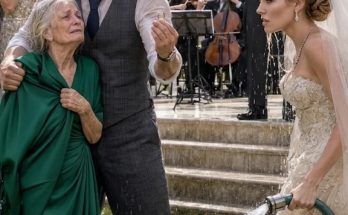
A celebrity wedding.
A wealthy bride.
A garden hose.
An elderly woman standing helplessly.
And a groom walking away.
But public outrage did not remain simple.
Charles had connections.
Vanessa had publicists.
And money could buy a complicated narrative.
At eight fifteen,
a television network aired Vanessa’s statement.
We watched from Rebecca’s office.
Vanessa sat before a neutral background.
Her makeup was flawless.
Her wedding dress was gone.
She wore a cream-colored blouse.
Her eyes appeared red.
“I deeply regret the misunderstanding.”
She paused dramatically.
“The situation was taken out of context.”
I stared at the screen.
She continued.
“Our family has always supported charity.”
“My father employs thousands of people.”
“We were celebrating a beautiful occasion.”
“Unfortunately, emotions became overwhelming.”
The interviewer asked,
“Did you deliberately spray Eleanor Hayes?”
Vanessa lowered her eyes.
“I never intended to hurt anyone.”
“That wasn’t the question,” I muttered.
The interviewer tried again.
“Did you aim the hose at her?”
Vanessa inhaled shakily.
“I believed everyone understood it was playful.”
I stood.
“Playful?”
My mother remained silent.
Then Vanessa said something worse.
“Daniel’s mother has a complicated history.”
I froze.
The interviewer leaned forward.
“What do you mean?”
Vanessa looked directly into the camera.
“Certain financial matters
have recently come to light.”
“Financial matters involving Eleanor?”
“I cannot discuss an active investigation.”
She paused.
“But perhaps people should avoid
making judgments before hearing both sides.”
Rebecca immediately turned off the television.
The room became quiet.
I stared at the black screen.
“She planned that.”
Rebecca nodded.
“It’s a deliberate insinuation.”
“She knows about the ledger.”
“Apparently.”
My mother looked sick.
“She knows what Charles told me.”
I turned toward her.
“What did he tell you?”
She hesitated.
“Years ago.”
“He said if I ever spoke publicly,
he would make me look responsible.”
“For what?”
“For the missing money.”
I felt a chill.
“What missing money?”
She looked at Rebecca.
Rebecca reached for another folder.
“Daniel, remember the false authorizations?”
I nodded.
“Some were allegedly signed by Eleanor.”
I stared at my mother.
She shook her head immediately.
“I never signed them.”
I believed her.
Without hesitation.
But belief was not enough.
Not if someone had constructed evidence
to make her appear guilty.
“What do we know?” I asked.
Rebecca opened the folder.
“The questioned documents are copies.”
“Not originals?”
“No.”
“Can we authenticate them?”
“Not conclusively from these scans.”
“Then we need the originals.”
“Yes.”
I looked at the clock.
Nine twenty-three.
The sun was already high.
Yesterday I had expected
to begin my honeymoon today.
Instead,
I was preparing to investigate
a decades-old financial conspiracy.
My phone vibrated.
A message from Vanessa.
You should have married me.
I stared at it.
Then another arrived.
My father can still fix this.
I forwarded both to Rebecca.
She looked at the screen.
“Don’t respond.”
“I wasn’t going to.”
A third message appeared.
Think about what happens to Eleanor.
I felt my jaw tighten.
Rebecca read it.
Her expression hardened.
“That’s significant.”
“Why?”
“Because it could be interpreted
as an attempt to pressure you.”
I stared at Vanessa’s name.
The woman I had loved.
The woman I had defended.
The woman I had almost married.
And now she was using my mother’s safety
as leverage.
I turned off the phone.
“I’m done speaking to her.”
Rebecca nodded.
“Good.”
But Vanessa was not finished.
At ten forty,
she arrived at Northbridge Tower.
Clara called upstairs immediately.
“Mr. Hayes?”
“Yes?”
“Miss Whitmore is in the lobby.”
I closed my eyes.
“Do not let her upstairs.”
“She insists you invited her.”
“I didn’t.”
Clara hesitated.
“She’s threatening to call the police.”
Rebecca reached for the phone.
“Transfer the call to security.”
I watched her speak calmly.
Then she hung up.
“She’s being escorted outside.”
I nodded.
Five minutes later,
my private phone rang.
Unknown number.
I answered without thinking.
“Daniel?”
Vanessa.
I nearly ended the call.
Then she said,
“Please don’t hang up.”
I remained silent.
“I need to see you.”
“No.”
“Daniel, please.”
“What do you want?”
Her voice trembled.
“I want to explain.”
“You had two years to show me
who you were.”
She inhaled sharply.
“Don’t talk like that.”
“Like what?”
“Like I’m some monster.”
I looked toward my mother.
She was reading quietly.
“You assaulted my mother.”
“It was a joke!”
There it was.
The same defense.
The same refusal.
I spoke slowly.
“Then explain what’s funny.”
Vanessa went silent.
“Explain why humiliating an elderly woman
should make people laugh.”
“Daniel—”
“Explain why her poverty,
real or imagined,
made her less deserving of respect.”
Her breathing grew louder.
“You’re twisting everything.”
“No.”
“I’m finally seeing everything clearly.”
She began crying.
Or pretending to.
I could no longer tell.
“I love you.”
I closed my eyes.
Once,
those words would have melted my anger.
Now they sounded like another demand.
“Then why did you hurt her?”
Vanessa said nothing.
I waited.
Finally, she whispered,
“I didn’t think you’d react like that.”
The honesty surprised me.
Not remorse.
Not regret for my mother’s suffering.
Regret that her behavior had consequences.
I answered quietly.
“That’s the problem.”
She began speaking rapidly.
“My father is furious.”
“He’s blaming me.”
“He says you’ve destroyed everything.”
“You need to help us.”
I stared at the window.
“No.”
“Daniel, please!”
“Vanessa.”
My voice was firm.
“Our relationship is over.”
Another pause.
Then her tone changed.
Cold.
Sharp.
Almost unrecognizable.
“You think your mother is innocent?”
My stomach tightened.
“What are you saying?”
“I’ve seen documents.”
“Which documents?”
“Documents that prove she lied.”
“About what?”
“About your father.”
I stood.
“Vanessa.”
She laughed softly.
“Ask her why Samuel was at the factory
after his shift ended.”
My heart began pounding.
“Ask her who called him there.”
“Ask her why she never told you.”
The call ended.
I stared at the phone.
Then I turned.
My mother was watching me.
She had heard enough.
“Vanessa?” she asked.
I nodded.
Mom closed her book.
“What did she say?”
I repeated the questions.
Her face changed.
But not with surprise.
With grief.
I sat beside her.
“Mom.”
She took a breath.
“I called your father that night.”
The words struck me.
“What?”
“He was supposed to come home.”
“But I called him.”
“Why?”
“Because someone had contacted me.”
She looked toward the floor.
“A woman from the factory.”
“She said the records were being destroyed.”
“She said Samuel needed to come immediately.”
I stared.
“Who was the woman?”
My mother hesitated.
“Her name was Margaret.”
“Margaret what?”
“Ellis.”
I remembered Robert Ellis.
The electrician.
His wife?
“Was she related to Robert?”
“Yes.”
“She was his sister.”
I leaned forward.
“What happened?”
“Samuel went to meet her.”
“Then the fire started.”
My mother began crying again.
“For years, I believed my call
sent him to his death.”
I took her hand.
“Mom, you didn’t start the fire.”
“I know.”
“But I sent him there.”
“No.”
I spoke firmly.
“The people responsible for unsafe conditions
are responsible for what happened.”
She looked at me.
“Samuel made his own choice.”
I continued.
“He went because he wanted the truth.”
Tears rolled down her cheeks.
She nodded slowly.
“But what if I’d waited?”
I understood.
For decades, she had tortured herself
with a question that had no answer.
What if?
Those two words had stolen her peace.
I placed my hand over hers.
“Dad loved you.”
She began to shake.
“And he knew what he was doing.”
For several minutes,
we sat without speaking.
Then Rebecca entered.
She looked unusually alert.
“We have news.”
I stood.
“The warrant?”
“Approved.”
My pulse quickened.
“The workshop?”
“Yes.”
“Can we go?”
“Investigators have authorized our presence
outside the immediate search area.”
I looked toward my mother.
She rose slowly.
“I want to come.”
Rebecca studied her.
“Eleanor, are you certain?”
My mother nodded.
“I’ve avoided that house long enough.”
We left Northbridge shortly afterward.
Paul drove.
Another security vehicle followed.
Rebecca rode beside me.
My mother sat near the window.
The city gradually gave way
to older residential neighborhoods.
Brick houses.
Narrow streets.
Small gardens.
Places where families built ordinary lives.
Willow Street appeared after twenty minutes.
I recognized it immediately.
Even after decades.
The large oak tree remained.
The porch had been repainted.
The windows were different.
But the shape of the house
was exactly as I remembered.
My chest tightened.
“That’s it.”
Mom nodded.
“Yes.”
The car stopped across the street.
Two official vehicles stood outside.
Investigators were already present.
Foster approached.
“Mr. Hayes.”
“Detective.”
He looked toward my mother.
“Mrs. Hayes.”
She nodded.
“Hello.”
He glanced at the house.
“We’ve secured the premises.”
“Has anyone been inside recently?”
“Property maintenance personnel.”
“Whitmore employees?”
“Possibly.”
I looked at Rebecca.
She gave me a warning glance.
Wait.
Foster continued.
“We’ll document everything.”
“Please remain behind the marked boundary.”
I nodded.
The investigators entered.
We waited beside the cars.
My mother stared at the house.
I wondered what she saw.
Perhaps my father carrying groceries.
Perhaps a young version of herself
standing on the porch.
Perhaps me running through the yard.
I remembered the workshop.
A small wooden building behind the house.
Its roof had once been green.
My father loved spending weekends there.
He let me hold screws.
He taught me to sand wood.
He showed me how machines worked.
I remembered the smell of sawdust.
Warm metal.
Coffee.
And the faint sweetness of pipe tobacco,
although he rarely smoked.
I closed my eyes.
For one brief moment,
I could almost hear his voice.
Careful, Danny.
Good tools deserve respect.
My mother touched my arm.
“You remember?”
I nodded.
“The little airplane.”
She smiled sadly.
“He made that on your fourth birthday.”
“I still have it.”
“I know.”
Her voice trembled.
“He would be proud of you.”
I looked toward the workshop.
“I wish I could tell him everything.”
She squeezed my arm.
“So do I.”
An hour passed.
Then another.
Investigators moved carefully between buildings.
Photographs were taken.
Equipment was carried inside.
Nobody gave us updates.
Finally, Foster emerged.
He approached slowly.
“Mrs. Hayes.”
My mother straightened.
“Yes?”
“We found the cabinet.”
Her hand flew to her mouth.
“Is it intact?”
“Mostly.”
“Was it opened?”
“Someone attempted to force the lock.”
I looked at Rebecca.
Foster continued.
“But the inner compartment remains sealed.”
My heart began pounding.
“The key,” I said.
My mother reached into her handbag.
She handed Foster the brass key.
He accepted it carefully.
Then placed it inside an evidence envelope.
“We’ll document the transfer.”
My mother nodded.
“Of course.”
Foster returned to the workshop.
We waited again.
The afternoon shadows lengthened.
A breeze moved through the oak leaves.
Somewhere nearby,
a dog began barking.
The ordinary sounds felt strangely wrong.
As if the neighborhood had no idea
what was being uncovered.
At three twelve,
Foster returned.
He carried a sealed evidence container.
Inside was a narrow blue notebook.
My mother made a small sound.
“Samuel’s.”
Foster nodded.
“We’ll need to authenticate it.”
I stepped closer.
“What’s inside?”
“We haven’t completed examination.”
“Can you tell us anything?”
He hesitated.
“Preliminary inspection shows technical diagrams.”
“Maintenance records.”
“And correspondence.”
I swallowed.
“Names?”
“Yes.”
“Charles Whitmore?”
Foster looked directly at me.
“Yes.”
My mother began crying.
Not loudly.
Not dramatically.
Just a few quiet tears.
She had waited almost thirty years
to hear that evidence had survived.
Foster continued.
“We also found a sealed envelope.”
“Addressed to whom?” I asked.
He looked at Eleanor.
“To your son.”
I went completely still.
My mother stared at him.
“Daniel?”
Foster nodded.
“The handwriting appears consistent
with your husband’s known samples.”
I could barely breathe.
My father had left something for me.
Not a vague memory.
Not a story someone repeated.
Something written by his own hand.
Something he intended me to read.
“When can I see it?”
Foster’s expression softened.
“After forensic processing.”
I nodded reluctantly.
“Of course.”
Then he added,
“There’s another complication.”
Rebecca stepped forward.
“What?”
“The cabinet contains evidence
of a financial arrangement involving Eleanor.”
My mother frowned.
“What arrangement?”
Foster looked uncomfortable.
“We need to verify the documents.”
I watched him.
“Tell us.”
He hesitated.
“There’s a transfer authorization.”
“From whom?”
“Samuel Hayes.”
“To whom?”
Foster looked toward my mother.
“To Eleanor Hayes.”
My mother stared.
“That makes no sense.”
Rebecca frowned.
“What amount?”
Foster checked his notes.
“Eighteen million dollars.”
The air seemed to disappear.
I looked at my mother.
She was shaking her head.
“No.”
Foster continued.
“The document is dated
two days before the fire.”
My mother whispered,
“Samuel never told me about that.”
Rebecca asked,
“Was the transfer completed?”
“We’re tracing it.”
I felt a cold sensation.
Eighteen million dollars.
Nearly thirty years ago.
A fortune.
Enough to explain why Charles
had spent decades watching my mother.
Enough to explain the forged documents.
Enough to connect everything.
Foster closed his notebook.
“There’s also an unidentified beneficiary.”
I stared.
“Who?”
He looked at Rebecca.
“We’re still confirming that.”
Then his phone rang.
He stepped away to answer.
I watched his face change.
He listened.
Asked several short questions.
Then returned quickly.
“Everyone needs to leave the street.”
Rebecca stiffened.
“Why?”
Foster looked toward the workshop.
“We received a credible threat
against the evidence recovery team.”
My pulse surged.
“What kind of threat?”
He didn’t answer directly.
Instead, he turned toward his colleagues.
“Clear the property.”
Investigators began moving immediately.
I took my mother’s arm.
Rebecca guided us toward the car.
Then a dark SUV appeared
at the far end of Willow Street.
It accelerated toward the intersection.
Paul stepped between us and the road.
The SUV swerved sharply.
Its tires screamed.
For one horrifying second,
I thought it would strike the investigators.
But it turned into a side street.
Then disappeared.
Foster shouted into his radio.
Two vehicles followed.
My mother gripped my arm.
“Danny.”
“I’m here.”
We hurried into the car.
Paul locked the doors.
“Everyone secure?”
“Yes,” Rebecca answered.
He started the engine.
I looked back at the workshop.
A technician was carrying
the evidence container toward a waiting vehicle.
The blue notebook was inside.
My father’s final records.
Still intact.
Still protected.
For the moment.
We returned to Northbridge under escort.
Nobody spoke much.
My mother rested her head against the window.
Rebecca exchanged messages with Foster.
I stared at my phone.
Vanessa had called again.
Seventeen times.
I did not answer.
Instead,
I opened an old photograph.
My father holding me beside the workshop.
I was smiling.
He had one hand on my shoulder.
His other hand held a wooden airplane.
The image was slightly faded.
But his eyes were bright.
I stared at those eyes
until my vision blurred.
At headquarters,
the situation had worsened.
Julian met us outside the elevator.
His expression was grave.
“Daniel, we have another problem.”
I looked at him.
“What now?”
“Whitmore’s overseas accounts.”
“What about them?”
“Someone tried to initiate transfers.”
“How much?”
“Forty-six million dollars.”
I stopped walking.
“Who authorized them?”
“Credentials associated with Vanessa.”
My jaw tightened.
“Were the transfers completed?”
“No.”
“The restrictions held.”
I exhaled.
“Good.”
Julian nodded.
“But the attempt matters.”
“Document it.”
“Already done.”
Rebecca turned toward Mira.
“Notify the appointed restructuring officer.”
Mira nodded.
“Immediately.”
My mother listened quietly.
Then she spoke.
“Vanessa is frightened.”
I looked at her.
“She should be.”
Mom shook her head.
“Fear makes careless people dangerous.”
I knew she was right.
The Whitmores were losing control.
And every failed maneuver
made them more desperate.
At six thirty,
Katherine arrived in person.
She looked exhausted.
Her coat was wrinkled.
She carried a large leather briefcase.
“I’ve spent the afternoon
speaking with the company managers.”
I gestured toward a chair.
“Sit down.”
She shook her head.
“Not yet.”
“What happened?”
“Employees are terrified.”
My stomach tightened.
“About layoffs?”
“Yes.”
“And the rumors.”
“What rumors?”
“That Northbridge intends
to liquidate the entire company.”
I rubbed my forehead.
“Charles started that.”
Katherine nodded.
“Almost certainly.”
I looked at Julian.
“How quickly can we stabilize operations?”
“We’ve secured the payroll facility.”
“Essential payments continue.”
“Vendor accounts are being reviewed.”
I turned toward Katherine.
“Then let’s tell the workers.”
She studied me.
“Public statement?”
“No.”
“Direct meetings.”
“Let them ask questions.”
Katherine nodded slowly.
“That would help.”
I looked around the room.
“We didn’t intervene to punish employees.”
“We intervened because they were endangered.”
Mira nodded.
“I’ll prepare verified figures.”
Rebecca raised one finger.
“Stay within what we can prove.”
“Always,” I replied.
The first employee meeting happened
at seven forty-five.
A video call connected us
to managers from five states.
Warehouse supervisors.
Hotel administrators.
Factory technicians.
Administrative employees.
People with tired faces.
People who had families waiting at home.
I stood before the camera.
“My name is Daniel Hayes.”
Some recognized me.
Others did not.
I continued.
“Northbridge has assumed certain oversight rights
under existing financial agreements.”
“There are serious questions
about prior financial reporting.”
“Those questions are being investigated.”
A warehouse manager raised her hand.
“Are we losing our jobs?”
I looked directly at her.
“Not because of tonight’s governance changes.”
She leaned forward.
“What does that mean?”
“It means essential operations continue.”
“Payroll funding has been secured
under independent supervision.”
“We’ll communicate promptly if circumstances change.”
Another employee spoke.
“What about our retirement accounts?”
Julian answered carefully.
“Employee benefit assets are separately administered.”
“We’re verifying all required contributions.”
A factory supervisor frowned.
“Can we trust the information?”
I paused.
It was the right question.
“You shouldn’t trust promises alone.”
The room became quiet.
“You should expect documentation.”
“Independent verification.”
“And answers when something changes.”
I looked at the faces.
“That’s what we’re committing to provide.”
The meeting lasted nearly two hours.
Some employees were angry.
Others frightened.
A few openly cried.
Nobody wanted to hear about billionaires.
They wanted to know
whether groceries would be affordable next week.
Whether medical insurance would remain active.
Whether their children could stay in school.
Those concerns mattered more
than Charles’s wounded pride.
When the meeting ended,
Katherine approached me.
“You handled that well.”
I shook my head.
“They deserved more than reassurance.”
“They’ll receive it,” she answered.
I looked toward the windows.
The city was dark again.
Twenty-four hours earlier,
I had been preparing for my wedding.
Now I felt decades older.
At ten fifteen,
Foster called Rebecca.
She listened carefully.
Then placed the call on speaker.
“Detective?”
His voice sounded tired.
“We’ve completed preliminary examination
of the recovered notebook.”
My heartbeat accelerated.
“And?”
“The technical records are significant.”
“How significant?”
“They contradict several official findings.”
My mother sat forward.
Foster continued.
“Some inspection reports were altered
before being submitted to investigators.”
I looked at Rebecca.
“Can you identify who altered them?”
“Not conclusively yet.”
He paused.
“But the notebook contains correspondence
from Samuel Hayes to Charles Whitmore.”
My mother’s eyes filled.
“What did Samuel say?”
Foster hesitated.
Then read a short passage.
He described dangerous machinery.
Missing emergency shutoff controls.
And instructions to keep operating
despite documented electrical faults.
My father had warned Charles.
Repeatedly.
The final letter contained a sentence
that made everyone fall silent.
If someone is injured,
the responsibility belongs to those
who deliberately ignored the warnings.
I closed my eyes.
My father had known the danger.
He had tried to stop it.
And he had been ignored.
Foster continued.
“There’s more.”
I opened my eyes.
“The eighteen-million-dollar transfer?”
“Yes.”
“We’ve traced the receiving account.”
My mother leaned forward.
“Where did the money go?”
Foster took a breath.
“The account was created
under a false corporate identity.”
“Who controlled it?” Rebecca asked.
“That’s the critical question.”
I stared at the phone.
“Do you know?”
“We believe so.”
“Tell me.”
Foster hesitated.
“The beneficiary information points
to an entity associated with Charles Whitmore.”
My mother gasped.
I gripped the table.
“So Charles took the money?”
“That’s a possibility.”
“We need the original bank records.”
Rebecca spoke.
“We’ll assist with lawful requests.”
Foster thanked her.
Then continued.
“One more thing.”
My heart sank.
“There was a second envelope.”
“From Samuel?” I asked.
“Yes.”
“Addressed to Daniel Hayes.”
I felt my throat close.
“Have you opened it?”
“Under controlled conditions.”
“What did it say?”
Foster’s voice softened.
“Mr. Hayes,
your father left you a message.”
I looked toward my mother.
She was crying silently.
Foster continued.
“It begins with your name.”
I could barely speak.
“Please.”
He read slowly.
My son,
if you’re old enough to understand this,
then something may have happened to me.
I hope you grow into a kind man.
Not a rich man.
Not a powerful man.
A kind man.
I closed my eyes.
The room disappeared.
For one moment,
I was five years old again.
Standing in our old kitchen.
Waiting for a father
who would never walk through the door.
Foster continued reading.
My mother began sobbing.
The letter spoke about courage.
About honesty.
About protecting people without humiliating them.
And about the danger
of believing money could replace character.
Then came the final instruction.
If anyone tells you
that kindness is weakness,
remember this:
the strongest person in any room
is often the one
who refuses to become cruel.
I couldn’t speak.
My mother reached for me.
I knelt beside her chair.
She held my face.
“He would be so proud of you.”
I shook my head.
“I almost became like Charles.”
“No.”
She touched my cheek.
“You were angry.”
“There’s a difference.”
I looked at her.
“Only if I make different choices.”
She nodded.
“Then make them.”
Foster waited respectfully.
When I could speak again,
I thanked him.
Then he delivered one final update.
“We’re arranging interviews
with surviving Halstead employees.”
I looked up.
“Surviving?”
“Yes.”
“One witness recently contacted us.”
“Who?”
“A woman named Margaret Ellis.”
My mother went completely still.
“Margaret?”
Foster answered.
“She’s alive.”
I stared at Eleanor.
Her hands flew to her mouth.
For decades,
she had believed Margaret disappeared.
Now the woman who summoned my father
on the night of the fire
had finally resurfaced.
Foster continued.
“She claims she knows
who ordered the maintenance records destroyed.”
I gripped the phone.
“Where is she?”
“She has requested protective arrangements.”
“Is she safe?”
“Currently.”
“Can we speak with her?”
“After investigators complete their interview.”
I looked at my mother.
She was shaking.
Then Foster said something unexpected.
“There’s one other name
Margaret asked us to contact.”
I frowned.
“Whose?”
“Vanessa Whitmore.”
The room went silent.
I stared at the phone.
“Why Vanessa?”
Foster hesitated.
“Apparently, Margaret has evidence
that Charles isn’t the only person
who knew about the original cover-up.”
My stomach tightened.
“Vanessa wasn’t even born then.”
“Correct.”
“Then how could she be involved?”
Foster’s answer came slowly.
“Because someone recently paid
to keep Margaret silent.”
I felt my heartbeat accelerate.
“And the payments came
from an account controlled by Vanessa.”
I looked toward Rebecca.
Her expression was grim.
Foster continued.
“We’ve issued preservation requests.”
“We’ve also asked Vanessa
to make herself available.”
I glanced at my silent phone.
The missed calls.
The threatening messages.
Her desperate insistence
that I save her family.
Suddenly, everything looked different.
She hadn’t merely been cruel.
She might have known
that my father’s death
was connected to her family’s fortune.
And she had allowed me
to prepare for marriage
without telling me anything.
At eleven forty,
the call ended.
I stood alone beside the window.
The city glittered below.
My father had left me a message.
My mother had carried his grief.
And Vanessa had possibly helped conceal evidence.
I wanted to scream.
Instead, I pressed my palms
against the cool glass.
Then my phone vibrated.
One final message from Vanessa.
This time, it contained a photograph.
A document.
A handwritten signature.
My father’s signature.
Beneath it was a second name.
Eleanor Hayes.
I stared at the date.
Three days before the factory fire.
Then I read Vanessa’s message.
You think Charles killed your father?
Ask your mother who received the money.
My hands went cold.
Another message appeared.
I have the original agreement.
And I’m bringing it to you.
Before I could respond,
the security alarm sounded.
A sharp electronic tone
echoed through Northbridge Tower.
Paul’s voice came over the intercom.
“Daniel, stay away from the elevators.”
I turned.
Rebecca rushed into the office.
“What happened?”
Paul answered through the speaker.
“Vanessa Whitmore is downstairs.”
I felt my chest tighten.
“She says she’s carrying evidence.”
Rebecca looked at me.
“Do not meet her alone.”
Then Paul’s voice changed.
“There’s someone with her.”
I moved toward the monitor.
The lobby camera showed Vanessa.
Her hair was disheveled.
Her face was streaked with tears.
She clutched a thick brown envelope.
Beside her stood an older man
wearing a dark coat.
His face was partially hidden.
But when he lifted his head,
my mother made a sound
I had never heard before.
A broken gasp.
She staggered backward.
I caught her.
“Mom?”
She pointed toward the screen.
Her lips trembled.
“That’s impossible.”
I looked at the man.
He stared directly into the camera.
Then slowly removed his glasses.
My mother whispered one name.
“Robert.”
The man raised his hand.
And Paul spoke again.
“He says he was there
the night Samuel Hayes died.”
My mother gripped my arm.
Then the stranger opened his coat.
Inside was a bloodstained photograph.
And written across its back
were five words
that made my mother collapse.
SAMUEL DID NOT DIE ALONE.