**Part 2**
Chapter Five: Amarillo by Morning
When the band went back inside, Sonny stopped at the microphone before they started the next set.
“Folks,” he said. “We just had the best brisket of our lives. Out back on our tailgate.”
Everybody laughed. Some people clapped.
“We’ve played a lot of weddings,” Sonny said. “Four, five hundred maybe. And I can count on one hand the times somebody brought us a plate.” He looked out over the crowd. “Who made that brisket?”
My mother was standing by the cake table. She’d gone to get a glass of tea. When Sonny said brisket, her head came up.
Somebody pointed at her. Aunt Rose, I think.
Sonny found her in the crowd.
“Ma’am,” he said. “Are you the lady who smoked that brisket all night in a church parking lot?”
My mother went red. She nodded.
“Then this one’s for you,” Sonny said.
Amos tucked his fiddle under his chin. He closed his eyes. And he started playing.
“Amarillo by Morning.” Again. The second time that night. Slower this time. Just the fiddle at first, all by itself. Long and sweet and sad.
I don’t know how to describe the sound. It was like the fiddle was crying. Like it was remembering something.
Then the rest of the band came in. And Sonny sang.
My daddy took my mother’s tea out of her hand. He set it on the cake table. He led her out onto the dance floor.
Everybody else stepped back. They made a circle around them.
My mother put her head on my daddy’s shoulder. She closed her eyes. And they danced. Just the two of them, in the middle of the Pawnee Creek Community Building, under the string lights, while an old man with a white beard played the fiddle for a lunch lady.
I stood by the side door with Reed’s arm around me. In my stocking feet, with brisket grease on my wedding dress.
I cried. I didn’t care who saw.
She never found out that night. About the Tahoe.
I made Aunt Patsy and Aunt Rose promise. Not tonight. Not on her one night.
Reed made the busboys promise. And the Homemakers. And the band.
We left at eleven, in Reed’s pickup with cans tied to the bumper. My mother stood on the steps of the community building and waved until we were out of sight. Her corsage was completely flat by then. She was smiling so hard.
We spent our wedding night at a Holiday Inn Express in Tulsa. That was our honeymoon. One night. We couldn’t afford more.
I lay in that hotel bed at one in the morning, with Reed asleep next to me in his undershirt, and I couldn’t stop thinking about Verlene.
About the way she didn’t jump.
About they get paid.
About the empty Tahoe with the dome light on, and the way she stood there alone in the gravel, watching all of us eat.
“Reed,” I said in the dark. “Are you awake?”
“Mm.”
“What did you mean? About your grandma? Making her put it back?”
He was quiet for a long time. I thought maybe he’d gone back to sleep.
“Aunt Vee’s always done it,” he said finally. “Since I was little. Every family thing. Funerals, reunions, Christmas at Grandma’s. She’d show up with an empty cooler and leave with it full. Pies. Casseroles. A whole turkey once.”
“Why?”
“Nobody knew. Nobody asked.” He rubbed his face. “Grandma used to stand at the back of her car and make her put it back. Not mean. Just, Verlene, honey, put the ham back. Like it was a joke. Everybody’d laugh.”
“And she did?”
“She always did,” Reed said. “For Grandma.”
He was quiet again.
“When Daddy died,” he said, “I was ten. I came out of the church after the funeral, and Aunt Vee was loading the funeral lunch in her Suburban. Everything. The chicken and the potato salad and all the pies the church ladies made. And Grandma came out and saw her and just stood there by the back of the truck. And Aunt Vee put it all back. One dish at a time. And nobody ever said a word about it.”
He turned over and looked at me in the dark.
“I always wondered,” he said, “what she’d do when Grandma wasn’t around to stop her.”
“Well,” I said. “Now we know.”
“Now we know,” Reed said.
He reached over and took my hand.
“You didn’t make a scene,” he said. “You could have. Everybody would’ve been on your side.”
“I didn’t want to.”
“I know.” He squeezed my hand. “That’s when I knew I married the right girl. When I came around the corner and saw you carrying that brisket across the gravel in your sock feet.”
Chapter Six: The Weather in the Family
My mother found out on Tuesday.
Not from me. From Doris Tapp, who came into the school kitchen at Pawnee Creek Elementary to drop off a casserole dish and couldn’t keep her mouth shut for five minutes.
Mama called me at work that afternoon. I’m a receptionist at the Farm Bureau insurance office in Pawnee Creek. I picked up the phone and she didn’t even say hello.
“Josephine Lee,” she said. “Why didn’t you tell me?”
I told her everything. Standing in the break room of the Farm Bureau office with the door shut, in a whisper, so the agents wouldn’t hear.
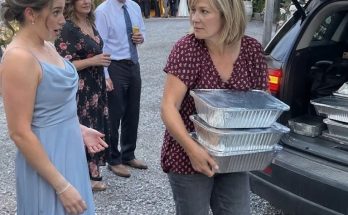
The Tahoe. The pans. They get paid. Reed. The tailgate. Mateo with his pocket full of rolls.
When I finished, she was quiet on the line for a long time.
“Mama?”
“The band ate,” she said finally. “And the boys. And Patsy and Rose and the Homemakers.”
“Yes, ma’am.”
“All of them. Off a tailgate.”
“Yes, ma’am.”
Another long silence. Then I heard a sound I didn’t expect.
My mother was laughing.
“Honey,” she said. “That’s the best thing anybody’s ever done with my food.”
“You’re not mad?”
“Mad?” She laughed again. “Josie, I’ve been feeding people for twenty-six years. You know what the worst thing is? It’s not running out. It’s when the people who need it most are standing right there with dishwater up to their elbows and nobody thinks to hand them a plate.”
She paused.
“You thought,” she said. “On your wedding night. In your wedding dress. You thought.”
Then her voice changed.
“And Verlene,” she said. “What about Verlene?”
“She left,” I said. “She drove off. Without her headlights on.”
My mother didn’t say anything for a while.
“Has anybody called her?” she asked.
“Reed tried. She didn’t answer.”
“Hm,” my mother said. And that was all.
Reed’s mother called that night.
Janine Calloway. Verlene’s younger sister. Fifty-nine, a bookkeeper at the feed store in Pawnee Creek. A widow for sixteen years, since Reed’s daddy died in a wreck on Highway 99.
She called Reed’s cell phone while we were eating supper. Hamburger Helper at our little rent house on Ash Street. Reed put it on speaker.
“What did you do to your aunt?” she said. No hello.
“Mama…”
“She called me Sunday crying. She said your wife humiliated her. In front of the whole wedding. She said Josie grabbed food right out of her hands and made a big show of it, and everybody was laughing at her.”
“Nobody was laughing at her, Mama.”
“She says they were.”
“She was loading the whole supper in her Tahoe,” Reed said. “Josie’s mama’s food. Before the band ate. Before the busboys ate. Before the church ladies ate.”
“She said she was saving it from spoiling.”
“Mama,” Reed said quietly. “You know that’s not true. You know what she does. You’ve watched her do it your whole life. You watched Grandma stop her at Daddy’s funeral.”
Janine didn’t say anything for a long time.
“She’s my sister, Reed,” she said finally. Her voice was tight.
“I know she is.”
“And now she won’t go to church. She says she can’t face anybody. She says everybody in Pawnee Creek knows.”
“Mama…”
“I hope you’re happy,” Janine said. And she hung up.
We didn’t talk much the rest of the night.
Reed washed the dishes. I dried. He kept stopping and staring out the window over the sink at nothing.
“I did the right thing,” he said finally. “Didn’t I?”
“Yes.”
“Then why does it feel like this?”
I didn’t have an answer.
Chapter Seven: Thank-You Notes
The weeks went by. July. August.
Verlene didn’t come to church. Not once. Pastor Mike went by her house twice. She didn’t come to the door.
Janine stopped calling Reed. When we saw her in town, at the IGA or the post office, she’d nod at us and keep walking.
Reed didn’t say anything about it. But I could see it bothering him. He’d come home from the pipe yard and sit on our front porch steps in his work clothes for an hour before he came in.
The thank-you notes came in August.
Not mine. I’d sent mine in July, to everybody who came, a hundred and eighty-two of them, on cards I bought at the Dollar General. Thank you so much for the slow cooker.
These were thank-you notes to me.
The first one came from Stillwater. A card with a picture of a fiddle on the front.
Dear Mrs. Calloway,
I’ve played weddings for forty-one years. I’ve played for governors and for a man who later went to prison. I’ve played in barns and country clubs and once on a boat.
You’re the first bride who ever carried me a plate.
I lost my wife Ellen four years ago. She smoked brisket on post oak, just like your mama. I haven’t tasted brisket like that since. When I took that first bite on your tailgate, I had to walk around the truck so nobody would see me cry.
Thank you. Please tell your mama her rolls are the best I’ve ever eaten. And I’ve eaten a lot of rolls.
Amos Whitlock
The Switchgrass
The second one came from Sonny. Typed, on the band’s letterhead.
Inside was the band’s invoice for my wedding. Eight hundred dollars. Paid in full. With a big red line through it.
And a check. Made out to me. For four hundred dollars.
On the memo line, he’d written: Half. For the brisket.
I called him. I told him I couldn’t take it.
“You’re not taking it,” Sonny said. “Your mama is. We want her to buy whatever she needs for the next time she cooks for a crowd. That’s all.”
The third one came in a plain white envelope, hand-addressed in pencil. No return address. Postmarked Pawnee Creek.
Inside was a piece of notebook paper, folded in quarters. Written in big careful handwriting, the kind a boy writes when he knows somebody important is going to read it.
Dear Mrs. Calloway,
Thank you for the rolls. My little sisters Camila and Rosa ate them for breakfast for three days. My mom works nights at the nursing home in Cushing and my dad is in Texas for work so sometimes there isn’t much in the morning.
Camila asked me where the rolls came from. I told her from a wedding. She wants to have a wedding now just so she can have rolls.
Also I didn’t eat anything that day until your tailgate. I was too busy. I was really hungry. I didn’t want to say.
Thank you for noticing.
Mateo Reyes
I took all three notes to my mother’s house on a Sunday afternoon.
She read them at her kitchen table. Slowly. With her reading glasses on. When she got to Mateo’s, she put it down and took off her glasses and pressed her fingers against her eyes.
“Reyes,” she said. “Camila Reyes. She’s in second grade. Mrs. Pruett’s class.” She looked at me. “She’s on my Friday backpack list.”
“I didn’t know that.”
“I know you didn’t.” She folded Mateo’s letter back up very carefully. “Nobody’s supposed to know.”
She took Sonny’s check and looked at it for a long time.
“Four hundred dollars,” she said. “For the next time I cook for a crowd.”
“That’s what he said.”
She set it down on the table. She tapped it with her finger.
“Well,” she said. “I guess I’d better find a crowd.”
Chapter Eight: The Cake Stand
In September, I found Verlene’s cake stand.
It was in a box in the back of our coat closet. A tall glass pedestal, with a domed lid, from the 1950s. The kind you see in old diners. The wedding cake had been displayed on it. Somebody had packed it up with the leftover cake boxes and the guest book, and it had ended up at our house.
I knew it was Verlene’s because Reed’s grandmother had given it to her. Everybody in the family knew that cake stand. It had held every birthday cake in the Calloway family for sixty years.
Verlene would want it back.
I didn’t tell Reed. I didn’t want him to talk me out of it.
I wrapped it in a beach towel and put it on the passenger seat of my car. On a Thursday afternoon, after work, I drove out to Verlene’s house.
She lives on the west edge of Pawnee Creek, in a yellow brick ranch house on Cedar Lane. She’d lived there forty years with her husband, Harlan. He’d been a mechanic at the Ford dealership in Cushing until he retired.
I’d only been there once. For a Christmas party, two years before, when Reed and I were dating.
I barely recognized it.
The grass was knee-high. The flower beds along the front were all weeds. There was a pile of newspapers on the porch, still in their plastic bags, maybe a dozen of them. The silver Tahoe was in the driveway with a flat tire.
I sat in my car for a long time looking at it.
Then I got out with the cake stand in my arms and went up to the door and knocked.
Nothing.
I knocked again. I heard something move inside. Footsteps. Then nothing.
“Verlene?” I called. “It’s Josie. I brought your cake stand. From the wedding.”
A long silence.
Then the lock turned. The door opened a few inches.
Verlene looked out at me.
She’d lost weight. A lot of it. Her face was thinner and her cheeks were hollow. Her auburn hair had grown out gray at the roots, two inches of it. She was wearing the pink cardigan. It hung loose on her now.
She looked at the cake stand in my arms.
“That’s Mama’s,” she said.
“I know. It got packed up with our things. I thought you’d want it back.”
She didn’t take it. She didn’t close the door either.
“Can I come in?” I asked.
She stood there for a long time. Then she stepped back.
I went in.
The house smelled stale. Like closed windows and old coffee. It was dim; all the curtains were drawn. The living room was neat but dusty. The TV was off.
I went through to the kitchen to set the cake stand down on the counter.
And I saw the refrigerator.
The door was standing open a crack. Like it didn’t quite close right.
Inside, there was almost nothing. A half-gallon of milk. A jar of mustard. A pack of bologna. A loaf of white bread with three slices left.
That was it. In the whole refrigerator.
On the kitchen table, there was a stack of mail. A big stack. Some of it unopened. On top was a letter with the logo of the Oklahoma Health Care Authority. SoonerCare. Under it, a bill from Cimarron Pointe Nursing Center in Cushing.
Balance due: $23,400.00.
PAST DUE.