**Part 3**
Part Thirteen: Standing Up
For a long moment, nobody moved.
Then, at the table nearest ours, a man stood up.
It was the man in the gray suit. The one who’d been staring at my top row of ribbons. The one whose face had gone pale.
He was standing very straight.
“Chief Halloran,” he said.
His voice was shaking.
“I’m Lieutenant Commander Mark Whitfield. Navy Reserve. I was a corpsman before I commissioned.”
He looked at Caleb.
“I knew your son,” he said. “Danny Halloran. We were at Field Medical Training Battalion together at Camp Lejeune. 2011.”
He swallowed.
“He was the best corpsman in our class,” he said. “He used to say his dad was a chief who fought a carrier fire. We all thought he was making it up.”
He looked at my ribbons.
“He wasn’t,” he said.
Then he did something else.
He picked up his chair. A white folding chair with a cushion on it. He carried it across to our table.
He set it down next to Caleb.
He sat down.
His son followed him. A little boy with red hair and freckles, carrying his own plate. He sat down on the other side of Caleb.
“Hi,” the boy said. “I’m Owen. Do you like baseball?”
Caleb looked at him. He nodded.
Then another man stood up.
An older man. Gray-haired. In a navy blazer with a Marine Corps pin on the lapel.
He picked up his chair and walked across the gymnasium. He set it down at our table.
Then another.
Then five more.
By the time the string quartet started playing again, our table in the back corner had fourteen chairs around it.
Then twenty.
Then men started dragging over whole tables. Pushing them together. Tablecloths and flower vases and coffee cups and all.
By eight-fifteen, half the gymnasium was in the back corner. By the bleachers. Around an eighty-one-year-old man in dress blues and a nine-year-old boy with syrup on his chin.
The admiral pulled up a folding chair.
He sat down next to me.
He didn’t go back to the podium.
Part Fourteen: Breakfast
We ate breakfast.
That’s all. We just ate breakfast.
Pancakes and eggs and bacon and orange juice. The admiral got up and went to the buffet himself and came back with a plate piled high.
“Navy chow,” he said. “You never pass it up.”
Caleb laughed. It was the first time I’d heard him laugh in a week.
The men around the table told stories.
Lieutenant Commander Whitfield told Caleb about Danny at field medical training. About how Danny could start an IV faster than anyone in their class. About how he’d sneak extra candy bars into his medical bag for the Marines.
An old Marine with a cane told Caleb about Hue City in 1968.
A Coast Guard pilot told him about rescuing a family from a sinking boat off Cape Hatteras.
A man who’d never served a day in his life, a lawyer in a very expensive suit, told Caleb that his own father had died when he was seven, and that his grandfather took him to every father-son event for the rest of his childhood.
“He was eighty-four at my high school graduation,” the lawyer said. “He wore his best suit. He cried the whole time.”
He looked at me.
“I didn’t know how lucky I was,” he said. “Until right now.”
The admiral and I talked about 1972.
About the ship. About the fire. About the men we knew who didn’t make it home from that war.
He told me about his career. His wife, Ellen. His son, who’s a pilot now. His grandson, Tommy, in the fifth grade, who was sitting across the table with his mouth open, staring at his grandfather like he’d never seen him before.
“I never told him that story,” the admiral said quietly. “Any of it. I never told anyone.”
“Neither did I,” I said.
He looked at me for a long time.
“I tried to find you,” he said. “After I made chief. Then again after I commissioned. I wrote to the Navy Personnel Command. They said you’d retired. They wouldn’t give me an address.”
He shook his head.
“I looked for you for thirty years, Chief,” he said.
“I was right here,” I said. “In Norfolk. The whole time.”
He laughed. It was a wet sound.
“Twenty miles,” he said. “Twenty miles away.”
Part Fifteen: The Photograph
After breakfast, there were supposed to be photographs on the front lawn. Fathers and sons. Under the big magnolia tree.
The photographer was a woman named Mrs. Ortiz. She taught art at the academy. She had a big camera on a tripod and a list of families in a certain order.
She threw away the list.
The first picture she took was of Caleb and me.
Under the magnolia tree. Me in my dress blues. Caleb in his navy blazer. My hand on his shoulder.
The admiral stood off to the side and watched.
Then Caleb did something.
He reached into his backpack. Into the inside pocket. The one with the zipper that nobody else uses.
He took out the sandwich bag.
He unzipped it. He took out the photograph. The small, square one. His father on the back steps, holding him on his knee. Both of them laughing.
He held it up.
“Can Dad be in the picture too?” he asked.
Mrs. Ortiz had to stop for a minute. She took off her glasses and wiped her eyes.
“Of course he can, sweetheart,” she said.
So Caleb held up the photograph. Right in front of his chest. Over the gold crest on his navy blazer.
I stood behind him with my hand on his shoulder.
Then the admiral stepped forward.
“Chief,” he said. “Would you mind?”
“Not at all, sir,” I said.
He stood on Caleb’s other side. He put his hand on Caleb’s other shoulder.
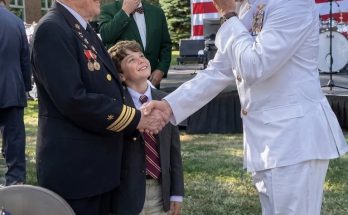
Three generations of Navy, standing under a magnolia tree. An eighty-one-year-old chief. A seventy-year-old admiral. And a nine-year-old boy holding a picture of his father.
Mrs. Ortiz took the picture.
It hangs in the front hallway of Hampton Roads Preparatory Academy now.
In a frame. Under a small brass plate.
Part Sixteen: Dr. Prentiss
Dr. Prentiss came to our house that evening.
Jess answered the door. I was in the living room in my old cardigan, with my dress blues hanging back up in the cedar closet.
He stood on the front porch in his gray suit. No bow tie. He’d taken it off.
He looked like he hadn’t slept in a week.
“Mrs. Halloran,” he said. “Mr. Halloran. May I come in?”
Jess looked at me. I nodded.
He sat on the edge of our couch. He held his hands in his lap. He didn’t say anything for a long time.
“I owe you an apology,” he said finally. “Both of you. And Caleb.”
“I’ve been thinking all day,” he said, “about why I wrote that note. About why I said a grandparent wasn’t appropriate.”
He looked down at his hands.
“My father left when I was five,” he said. “I never saw him again. Every year, my school had a father-son breakfast. And every year, I sat in the library.”
He looked up.
“With juice and muffins,” he said quietly.
Jess put her hand over her mouth.
“I told myself it didn’t matter,” Dr. Prentiss said. “I told myself it built character. That it taught me to be self-sufficient.”
He shook his head.
“When I became headmaster,” he said, “and the board asked me to restore the tradition, I thought, Well, I survived the library. Other boys can survive it too.”
He swallowed.
“I didn’t understand,” he said, “that the whole reason I wrote that note was because I was still that boy in the library. Still angry. Still waiting for somebody to come get me.”
“Nobody ever came for you,” I said.
He looked at me.
“No, sir,” he said. “Nobody ever did.”
I didn’t say anything for a long time.
Then I got up from my chair. Slowly. My knees cracked.
I walked across the living room. I sat down on the couch next to Dr. Graham Prentiss, PhD, headmaster of Hampton Roads Preparatory Academy.
I put my hand on his shoulder.
He looked at my hand.
He started to cry.
Part Seventeen: The New Tradition
The academy changed the policy two weeks later.
The board voted unanimously. Dr. Prentiss proposed it himself.
There’s no Father-Son Breakfast anymore.
There’s a breakfast called The Ones Who Show Up.
Every boy brings whoever shows up for him. Fathers. Grandfathers. Mothers. Uncles. Aunts. Older brothers. Coaches. Neighbors. Foster parents. Scout leaders.
Anybody who climbs up on the tractor.
The library is closed during the breakfast. Dr. Prentiss locks it himself.
The first year, three hundred and forty people came. They had to move it to the cafeteria because the gymnasium wasn’t big enough.
Jess came with Caleb. And me. And the admiral, who sat at our table with his grandson, Tommy.
Lieutenant Commander Whitfield came with his son, Owen. He brought a framed photograph from 2011. A group of corpsmen at Camp Lejeune, sweaty and grinning. Danny was in the middle of the front row.
He gave it to Caleb.
The guest speaker that year was Caleb.
He stood at the podium in his navy blazer. The microphone had to be lowered all the way down. He was holding a note card in both hands. His hands were shaking.
He looked out at three hundred and forty people.
He found me at our table in the back.
I nodded.
“My name is Caleb Halloran,” he said. “I’m ten. My dad was a Navy corpsman. He died in Afghanistan when I was two.”
He swallowed.
“I don’t remember him,” he said. “I only have one picture.”
He held up the sandwich bag. The photograph inside.
“But my grandpa told me something,” Caleb said. “He said courage is moving when somebody’s got their hand on your shoulder.”
He looked at the room.
“So I want to say thank you,” he said, “to everybody here who puts their hand on somebody’s shoulder.”
He looked at me.
“Especially my grandpa,” he said. “Who wore his uniform even though it didn’t fit right.”
The whole cafeteria laughed.
Then they stood up.
Part Eighteen: The Cedar Closet
The dress blues are back in the cedar closet now.
In the black garment bag. Behind Peg’s old winter coat.
But they don’t stay there all year anymore.
Every May, I take them out. I shine my shoes with a cotton ball and a little water, in small circles, until I can see my face in the toe. It takes me fifty minutes now. My hands are worse.
I pin my ribbons one-eighth of an inch above the pocket. I check it with a ruler three times.
Then Jess fastens the collar.
And every May, Caleb comes out of his bedroom in his navy blazer and stops in the hallway.
He’s eleven now. He’s almost as tall as Jess.
He still stops in the hallway. Every year.
Last year, he said something different.
He looked at me in my dress blues. At the ribbons. At the gold stripes on the sleeve. At the white cap under my arm.
“Grandpa,” he said. “Someday, when you can’t do it anymore, I’m going to wear the uniform.”
He paused.
“Not yours,” he said. “Mine. I’m going to be a corpsman. Like Dad.”
I didn’t say anything for a long time.
I knelt down in front of him. My knees cracked. Both of them. Loudly.
He laughed.
“Son,” I said. “Do you know what that means?”
“It means I’ll run into the smoke,” he said. “When somebody’s hurt.”
He looked at me.
“And I’ll climb up on the tractor,” he said. “When somebody’s scared.”
I put my hand on his shoulder.
The way I put it on a frightened nineteen-year-old in a burning hangar bay in 1972. The way the admiral put his on Caleb’s shoulder in a gymnasium full of men in expensive suits.
The way a father does.
“Then you’d better get your blazer straight,” I said. “We’ve got a breakfast to go to.”
He held my hand all the way to the car.
He’s eleven.
He still holds my hand.