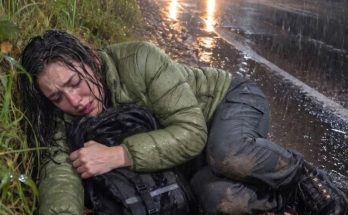
“Because it would be Tiffany.”
“Because if it was Tiffany, I’d have to admit I’d failed her. And if it was you, I could just be angry.”
It was the most honest thing my father had ever said to me.
It didn’t fix anything. But it was true, and for the first time, I could breathe a little easier.
Tiffany came on Saturday.
She stood in the hallway for a long time before knocking. When she finally stepped inside, she looked as though she hadn’t slept since Tuesday. Her hair hung limp around her pale face, and her hands shook.
“Hi,” she said.
“Hi.”
She sat in the chair beside my bed, the same chair Margo had used, and stared at the floor.
“I’m not here because the police told me to,” she said. “Although they did.”
“Okay.”
“I’m here because I couldn’t stop seeing that door.”
I waited.
“I was standing at the top of the stairs when Dad locked it,” she said. “I heard you knocking. I heard you calling my name, Josie. For almost twenty minutes.”
My throat burned.
“I just stood there,” she whispered. “I told myself you’d be fine. I told myself Dad would cool off. But I knew. I knew what I’d done, and I let you stand in the rain.”
“Why?”
She finally looked up. Her eyes were red and swollen.
“Because I was scared.”
“Of what?”
“Of Dad finding out it was me.” She pressed her hands against her face. “I started taking the pills after my back surgery two years ago. When the doctor stopped refilling them, I found other ways. A friend of mine knew a clinic that wasn’t careful. I put your name on the paperwork because they had your insurance information on file from your dentist appointments.”
I stared at her.
“You used my identity.”
“I know.” Her voice cracked. “I know how awful it sounds.”
“You hid them in my backpack.”
“I panicked. Dad was getting suspicious. I thought if he found them in my room, I’d lose everything, and I couldn’t…” She broke off, sobbing. “I thought he’d just yell at you. I thought you’d get grounded. I never imagined he’d throw you out.”
“But he did, and you let him.”
“Yes.”
She didn’t argue or make excuses. She just cried and kept her eyes on mine, and that was the hardest part to sit through.
“I’m not asking you to forgive me,” she said. “I’m telling you what happened, so nobody ever says it was your fault.”
I looked out the window at the gray November sky.
“Do you want help?” I asked quietly.
She blinked. “What?”
“The pills. Do you want to stop?”
“I…” Her face twisted. “Yes. I think I’ve wanted to for a long time.”
“Then tell Dad. Tell the police everything. Don’t make me do it for you.”
She nodded, wiping her face with the back of her hand.
“I already did,” she said. “Yesterday. I’m checking into a treatment program on Monday.”
I closed my eyes.
I wasn’t ready to forgive her. But I was glad she was still alive.
The weeks that followed were quiet and difficult.
Officer Prescott closed his investigation. The county prosecutor declined to press charges against Tiffany for the forged prescription because she’d entered treatment voluntarily and made a full statement, though she had to complete a court-supervised program. My father faced a separate review by the child welfare office. They concluded that while he hadn’t intended harm, his decision had put me in grave danger.
He was ordered to attend counseling and parenting classes as a condition of any future custody arrangement.
He didn’t argue.
Aunt Colleen drove down from Columbus the day I was released. She was my mother’s younger sister, a loud, warm woman who hugged me so hard my ribs creaked.
“You’re coming home with me,” she said. “For as long as you need.”
I looked at my father, standing awkwardly beside the hospital doors with his hands in his pockets.
“Is that okay?” I asked him.
He took a long time to answer.
“Yes,” he said at last. “It’s what you need.”
“Dad.”
“You need to be somewhere safe. I haven’t been that for you.” His voice broke. “I’m going to spend the rest of my life earning the right to be.”
I didn’t hug him that day.
But I didn’t leave without saying goodbye either.
I lived with Aunt Colleen through the winter and into spring.
Margo visited twice, bringing homemade peach cobbler and a stack of nursing textbooks she thought I might like to borrow. By April, I’d begun asking her questions about her work. By May, I’d decided what I wanted to do with my life.
“A nurse,” I told her one afternoon on Colleen’s back porch.
She smiled, but her eyes were wet.
“You’d be a good one.”
“How do you know?”
“Because you kept breathing when you had every reason not to,” she said. “And because you still asked about your sister when you woke up.”
I didn’t know what to say.
“Compassion’s not weakness, Josie,” Margo said, squeezing my hand. “It’s the whole job.”
In June, I came home for a visit.
The house on Birchwood Street looked the same, but the porch had been repainted, and a new coat rack stood just inside the door. Beside it hung my winter coat, brushed clean and waiting.
Dad stood in the kitchen, thinner than I remembered, and nervous.
“I made dinner,” he said. “It’s nothing fancy.”
On the table sat a chicken casserole and a bowl of green beans. Beside the plates, someone had placed a small framed photo of my mother.
We ate mostly in silence.
When we finished, he cleared his throat.
“Tiffany finished her first ninety days. She called this morning.”
“How is she?”
“Scared. Honest. Trying.” He rubbed his forehead. “She wants to see you. Only when you’re ready.”
I thought about the girl at the top of the stairs. I thought about the voice that wouldn’t come out on the roadside.
“Maybe in the fall,” I said.
He nodded, as if I’d given him a gift.
Before I left that evening, he followed me to the front door. His hand hovered near the deadbolt.
“I had every lock in this house replaced,” he said quietly. “But I kept this one.”
I looked at him.
“Why?”
“So I’d never forget what it sounds like.” He swallowed hard. “And so I’d remember what it means to open it.”
He turned the bolt and pulled the door wide.
Warm evening air drifted across the porch. The light was on.
“You’ll always have a way in, Josie. Always.”
I stepped onto the porch, then turned back.
“Thank you, Dad.”
It wasn’t forgiveness. Not yet. But it was a beginning.
Behind me, the light stayed on until I reached the end of the street.
THE END