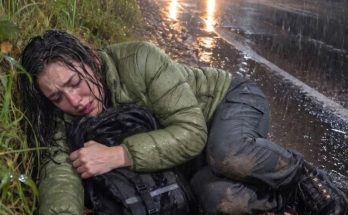
For fourteen agonizing minutes, she fought to keep me alive on the side of that road, with freezing rain pouring down around her.
When the paramedics finally arrived, my condition was already critical.
They immediately took over, removed my drenched clothing, and began carefully warming my body while providing emergency medical treatment.
Then, during the ambulance journey, my heart started beating again.
At Riverside Medical Center, doctors discovered that my core body temperature had fallen to just 82 degrees Fahrenheit.
I was suffering from severe, life-threatening hypothermia.
While medical staff fought to save my life, my father remained at home.
Later, he admitted that the first few hours after locking me outside were mostly a blur. He had persuaded himself that I had probably gone to a neighbor’s house and would eventually come back once I was willing to apologize.
Tiffany had gone upstairs to bed.
Neither of them had bothered to search for me.
Then, at exactly 12:47 a.m., the telephone in their house rang.
“Mr. Brennan? This is Officer Prescott from the County Police Department.”
My father answered with an unmistakable note of annoyance in his voice.
“What is this about?”
Part 3: The Name on the Bottle
“Mr. Brennan, your daughter was found unconscious beside County Road 9 at approximately eleven o’clock tonight,” Officer Prescott said. “She’s at Riverside Medical Center. Her core temperature was eighty-two degrees when she arrived.”
My father said nothing.
“Mr. Brennan? Did you hear me?”
“She… she’s at a friend’s house,” he finally said. “She’s fine.”
“Sir, she is not at a friend’s house. She was in a drainage ditch, and a nurse performed CPR for fourteen minutes. I need you at the hospital now.”
Later, my father told me that the phone slipped out of his hand. He said he didn’t remember driving there, only the sound of the wipers and the thought that kept repeating in his head.
I locked the door.
I woke up on the second afternoon.
The first thing I noticed was the warmth. For a moment, I thought I was dreaming, because every part of me had been so cold for so long. Heated blankets covered me, and a tube ran into my arm. The room smelled like antiseptic and weak coffee.
A woman with silver-streaked braids sat in the chair beside my bed, reading a paperback.
She looked up and smiled with her whole face.
“Well, hello there.”
My voice came out as a croak. “Who are you?”
“My name is Margo. I was driving home on Tuesday night.”
I stared at her.
“You’re the one who stopped.”
“I’m the one who almost didn’t,” she said quietly. “I thought you were trash on the side of the road, honey. I got a hundred yards before something told me to turn around.”
Tears slid down the sides of my face and into my hair.
“Thank you.”
“You don’t have to thank me.” She took my hand carefully, avoiding the IV. “You just have to keep breathing. That’s the whole job.”
Outside the room, voices rose in the hallway. One belonged to a doctor. The other belonged to my father.
I turned my face toward the window.
Margo noticed.
“He’s been here since the first night,” she said. “He hasn’t slept. He won’t eat.”
“I don’t want to see him.”
“Then you don’t have to.”
It was the first time in my entire life an adult had said that to me.
The investigation began before I could even sit up on my own.
Officer Prescott came to my room on Thursday morning with a woman in a gray cardigan who introduced herself as Ms. Hollis from the county’s child welfare office. They explained that when a minor is found in a life-threatening situation, a report is automatically opened.
“We need to understand how you ended up on that road,” Officer Prescott said gently. “Can you tell us in your own words?”
I told them everything. The kitchen table. The algebra. The orange bottle in Tiffany’s hand. The coat I wasn’t allowed to grab. The deadbolt.
Officer Prescott wrote it down without interrupting.
When I finished, he asked, “Josie, do you know what was in the bottle?”
“No. I never saw the label. Dad never looked at it either.”
He exchanged a glance with Ms. Hollis.
“We did,” he said.
My stomach tightened.
“My father gave you the bottle?”
“He brought it to the hospital when we asked. He said it was the reason he was angry.” Officer Prescott paused. “The prescription was filled at a pharmacy on Mill Avenue eleven days ago. The patient name on the label is Josephine Brennan.”
“That’s me. But I never—”
“I know.” He lifted a hand. “That’s why I went to the pharmacy yesterday.”
The room went very still.
“Pharmacies keep records of every pickup,” he continued. “A signature, an ID check, and often a camera at the counter.”
“Who picked it up?”
Prescott looked at me for a long moment.
“Your sister.”
I’d known. Somewhere deep in my chest, I had known from the moment Tiffany refused to look at me in the living room. But hearing it said out loud made something collapse inside me quietly.
“She used her own driver’s license,” he said. “She told the pharmacist she was picking it up for her younger sister, who was sick.”
“I wasn’t sick.”
“No.”
“Then why would she—”
“That’s what we’re going to find out.”
My father came to my room that evening.
I didn’t want him there. Margo had gone home to sleep, and the nurse at the desk asked me twice whether I was sure. Eventually I said yes, because there were things I needed him to hear.
He stood in the doorway for a long time, looking smaller than I had ever seen him. His shirt was wrinkled, and gray stubble covered his jaw. His hands hung at his sides as if he’d forgotten what they were for.
“Josie.”
I said nothing.
“The police told me. About the pharmacy.”
“Okay.”
“I should have read the label.”
I looked at him.
“Yes. You should have.”
His face crumpled. He walked to the foot of my bed and gripped the rail so hard his knuckles turned white.
“I was so sure. When your sister held up that bottle, all I could think of was…” He swallowed. “Last year, when she went through that bad stretch, I promised myself I’d never go through it again. I promised I’d catch it early. I’d be strict. I’d never look away.”
“So you looked at me instead.”
He flinched.
“I told you I didn’t want another sick daughter,” he whispered. “I said that out loud. To a fifteen-year-old kid. In a storm.”
“You did.”
“I don’t know how to make that right.”
“I don’t think you can.”
He nodded slowly, tears dropping onto the blanket.
“But I need you to tell me something,” I said. “On Sunday, I heard you on the phone talking about a prescription in my name. You told me it was an insurance mistake.”
His eyes closed.
“Did you already know?”
“The pharmacy called the house,” he said in a hollow voice. “Someone had questions about my insurance card. I thought it was a clerical error. But part of me…” He stopped. “Part of me wondered. And I didn’t want to find out.”