**Part 2**
At 11:23 a.m., my husband’s most important client called him.
Investigation footage and Miles Harcourt’s sworn testimony later showed me what followed.
Grant reportedly mocked me for minutes after my exit.
Miles said he called me spoiled and confused about marital ownership.
Sloane joined in.
Kent Sutter proposed changing access codes to lock me out.
Grant’s personal phone then rang.
Daniel Prescott, who chaired Prescott Development Group, was calling.
Daniel oversaw Catawba Logistics Campus, a huge private project near Charlotte.
It was Rowan Works’ largest prospective deal.
Without it, their ambitious expansion no longer added up.
Grant switched to speakerphone.
“Daniel!” he exclaimed. “Perfect timing. We’re reviewing the construction schedule right now.”
“Then stop reviewing it.”
Grant blinked.
“Excuse me?”
“The project is on hold.”
The room hushed.
Grant forced a laugh.
“Daniel, if there’s a scheduling issue, we can adjust.”
“This isn’t about scheduling.”
“Then what is it?”
“We’ve received formal notice that the financial guarantee supporting your performance obligations is being withdrawn.”
Grant’s smile faded.
“That’s a misunderstanding.”
“Our agreement requires you to maintain approved financial backing. Your current disclosures are also under review.”
“I can get another bank.”
“Then provide replacement financing and accurate financial statements within the contractual cure period.”
Grant bent toward the speakerphone.
“Daniel, we’ve already committed millions to this project.”
“I’m aware.”
“If you suspend it, you could destroy my company.”
Daniel’s reply was crushing.
“Grant, I cannot risk my entire development to protect yours.”
Grant clutched the tabletop.
“Who contacted you?”
“The Wexler family office.”
Nobody answered.
Grant frowned.
“Who?”
“Wexler.”
“I don’t know anyone named Wexler.”
Silence followed.
Then Daniel asked, “Are you serious?”
“Of course I’m serious.”
“Your wife didn’t tell you?”
Grant looked toward the doors.
“What does Leah have to do with this?”
Daniel sounded genuinely astonished.
“Leah Rowan is Leah Wexler.”
Grant gaped.
“She manages the investment interests that have been supporting your company.”
Sloane’s grin disappeared.
Daniel continued.
“I met her personally last spring. She asked us to give Rowan Works an opportunity because she believed in your leadership.”
Grant shook his head.
“No. Leah doesn’t handle our investments.”
“Grant, you need to speak with your attorneys.”
The line disconnected.
My husband stood frozen for moments.
Then he turned to Miles.
“Tell me that’s nonsense.”
Miles didn’t answer immediately.
“Tell me!”
The CFO gulped.
“I’ve been reviewing our financing documents since Leah mentioned the guarantee.”
“And?”
Miles turned his laptop.
“The primary guarantor is a private investment company managed by the Wexler family office.”
Grant stared at the display.
“Impossible.”
“The entity is listed in the original loan documents.”
“Then why didn’t you know?”
“Because the deal was structured before I joined the company. I was told you had personally arranged the financing.”
Grant eyed my abandoned chair.
Only then did he realize I hadn’t bluffed.
A second call followed.
Patrick Duvall.
Grant picked up instantly.
“Patrick, thank God. There’s been some confusion about our credit facility.”
“No confusion, Grant.”
“Just release the next advance. I’ll straighten everything out.”
“Further advances are suspended.”
Grant blanched.
“You can’t do that.”
“Our credit agreement permits suspension under the circumstances described in the notice. We also have concerns about the receivables securing the facility.”
“Patrick, we’re friends.”
“This is a bank, Grant.”
Grant spoke more quietly.
“You promised me that money.”
“I promised financing subject to the agreement’s conditions.”
Kent rose.
“What’s happening?”
Miles reviewed the firm’s cash projection.
His face grew grim.
“Grant,” he said, “we need to discuss liquidity.”
“Not now.”
“Now.”
Miles showed the board his screen.
“Our available cash will not cover the equipment deposits and supplier payments coming due this week. We’ve been relying on the revolving facility and the Prescott project mobilization funding.”
“We have receivables!”
“Some have been pledged more than once.”
Silence fell.
Grant stared at him.
“What did you say?”
Miles hesitated.
“Several invoices appear in multiple borrowing-base submissions.”
Sloane paled.
Grant saw.
“Sloane?”
She shook her head quickly.
“I don’t know anything about that.”
Miles opened another file.
“The submissions were approved through your account.”
Sloane looked at Grant.
“You told me those numbers were legitimate.”
Grant grimaced.
“Shut up.”
“I just did what you asked!”
“I said shut up!”
Director Rebecca Sloan rose.
“Grant, are you telling us the company has been borrowing against inaccurate collateral?”
“No!”
Miles answered quietly.
“We have enough discrepancies to require an immediate independent investigation.”
Kent pushed back his chair.
“You told us the business was financially secure!”
“It is secure!” Grant shouted.
His voice broke.
No one believed him.
Then Rowan Works’ general counsel, Andrew Bell, received an email from their outside legal team.
He read it.
Then reread it.
“Grant,” he said, “our prospective institutional investor has suspended the financing process.”
Grant spun toward him.
“What?”
“They’ve also requested preservation of all accounting records.”
The meeting erupted.
Directors shouted questions.
A shareholder called for an emergency vote to oust Grant as CEO.
Another phoned his lawyer.
Kent pointed at Grant.
“You convinced us to approve expansion using financial projections you knew were unreliable!”
Grant slammed both hands onto the table.
“Everybody shut up!”
Nobody obeyed.
Sloane rose from the executive seat.
The seat she had refused to relinquish.
“Grant, maybe you should call Leah.”
He faced her.
“Call her yourself!”
“I don’t have her number anymore.”
“What?”
Sloane hesitated.
“I blocked her months ago.”
Grant stared at her.
Even in that moment, he seemed more offended by her stupidity than by his own conduct.
“Get out of that chair.”
Sloane blinked.
“What?”
“Get out!”
She sprang up, banging her knee on the table.
Grant grabbed his phone and dialed me.
Voicemail answered.
He redialed.
Again.
On attempt five, he left a message.
“Leah, honey, there’s been a misunderstanding. Please call me. Whatever you want, we’ll work something out.”
Seconds later came another.
You can have the chair.
Then another.
You can keep your shares.
And finally:
Please. I need you.
At 11:41 a.m., the boardroom doors opened.
Three federal agents entered beside company counsel.
The lead agent showed identification.
“Grant Rowan?”
Grant stood slowly.
“Yes?”
“We have a federal arrest warrant for you in connection with an ongoing bank-fraud investigation.”
Everyone froze.
Grant eyed the agent’s papers.
Then the vacant chair.
Then his phone.
“Wait,” he whispered.
“Does my wife know about this?”
The agent stayed silent.
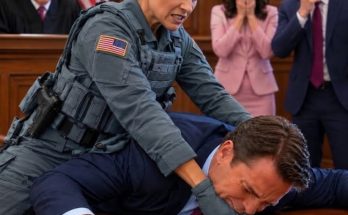
He said, “Mr. Rowan, turn around and place your hands behind your back.”
From a black sedan outside Rowan Works, I observed the first police vehicles arrive.
Naomi offered a chauffeur.
I accepted, too shaken to drive.
Her account of the collision still left my hands trembling.
Workers gathered across the plaza.
Some held coffee cups.
Some carried laptops.
Others anxiously read messages spreading through company chats.
I recognized warehouse supervisor Patricia Collins.
She’d joined Rowan Works in year three.
Her husband had undergone surgery last winter; she’d told me their health coverage saved their home.
She comforted a crying younger colleague.
Pain tightened my chest.
Grant had gambled with their livelihoods.
I meant to spare them collateral harm if possible.
My phone rang.
June Holloway.
“Leah, I’ve spoken with the restructuring specialists.”
“Tell me.”
“If Rowan Works enters a receivership or insolvency process, the Wexler investment group can propose financing to preserve essential operations. But everything must be documented, court-approved where necessary, and independent of Grant.”
“Do it.”
“We should also consider acquiring the viable operating assets through a supervised sale.”
“What happens to the employees?”
“That depends on how quickly we can stabilize the business.”
“Then move quickly.”
June hesitated.
“Leah, you’re allowed to walk away from all of this.”
“I know.”
“You don’t owe Grant anything.”
“I don’t owe him. But people like Patricia built that business too.”
June spoke gently.
“I understand.”
We reviewed emergency plans for ten more minutes.
Then came an unexpected request.
“The investigators want to speak with you before you leave.”
“About the financial case?”
“And the collision.”
My throat constricted.
“Are they certain?”
“They’ve corroborated significant portions of the driver’s account. They also recovered additional payment records.”
I observed my reflection in the window.
Seven years of marriage.
Seven years beside Grant in bed.
Now recalling our beginning frightened me.
“June,” I whispered, “what exactly did he do?”
She hesitated.
“He found out who you were before you started dating.”
I shut my eyes.
“He knew about my family?”
“Yes.”
“But he always said he didn’t care about money.”
“According to the evidence, he’d researched the Wexler family holdings for months.”
I pressed my temples.
June continued.
“Grant was deeply in debt when he met you. He’d failed at two previous businesses and had creditors pursuing him.”
I remembered his cramped basement flat.
The broken heater.
The way he’d joked that he couldn’t afford a decent dinner.
I mistook it for striving.
Apparently, he was researching me.
“He knew your regular driving route,” June said. “And he contacted a commercial driver through an intermediary.”
Nausea rose.
“The truck?”
“Yes.”
I recalled the headlights.
The wet pavement.
The enormous shape crossing the highway.
The impact.
The terrible crushing sound of metal.
And Grant’s voice screaming my name.
“He instructed the driver to force your vehicle off the road,” June explained. “The driver says Grant wanted the crash to appear accidental.”
“Did he want me dead?”
“The recording suggests he knew you could be killed and accepted that risk. The exact charges will be determined by prosecutors.”
Her words barely reached me.
I still pictured Grant hauling me from the wreckage.
His hand bleeding.
His face covered in rain.
He’d cried at the hospital.
He’d promised never to let anything happen to me again.
I’d loved him for saving me.
Who creates another person’s terror to play hero?
“There’s more,” June said.
I wanted to disconnect.
I wished I could undo entering the café where we met seven years before.
Still, I listened.
“The driver continued receiving payments through a company associated with Grant. The payments stopped recently, and he became concerned.”
“Concerned about what?”
“That Grant might arrange to silence him.”
I stared out the window.
“So he came forward.”
“Yes. His attorney contacted investigators. The case expanded from there.”
I sensed paralyzed.
My supposed rescuer kept paying the driver who endangered me.
And whenever I questioned his behavior, he’d show me the scar on his hand.
Remember what I did for you, Leah.
It was no loving reminder.
It was leverage.
Leverage I’d tolerated for seven years.
The building’s revolving doors opened across the plaza.
Two federal agents led Grant out.
His hands were handcuffed behind him.
His tie sagged.
His hair was tousled.
He scarcely resembled the confident man who expelled me less than an hour before.
Employees fell silent.
Some lifted phones.
Grant saw the black sedan.
He saw me through its open back window.
“LEAH!”
His shout crossed the plaza.
“LEAH, PLEASE!”
The agents kept moving.
Grant twisted my way.
“THAT’S MY WIFE!”
An agent restrained him.
Grant spoke urgently, more softly.
“Please. Just let me talk to her for thirty seconds.”
The lead agent glanced at me.
I checked June’s text.
You are under no obligation to engage.
I knew that.
Still, I needed Grant to understand something.
I spoke through the window.
“What do you want?”
Grant’s face transformed.
Hope lit his eyes.
“Leah, sweetheart, thank God.”
He edged nearer.
The agent restrained him.
“Please listen to me. I made a mistake.”
“A mistake?”
“I was angry. Sloane means nothing. I swear.”
I eyed him.
“You announced our divorce in front of fourteen executives.”
“I wasn’t thinking!”
“You tried to take my shares.”
“I’ll give you everything!”
His voice broke.
“The company. The house. All of it. Just call your people and fix this.”
I waited.
He began crying.
“Please, Leah. You know I love you.”
I recalled the basement apartment.
The soup I made when he was sick.
The years I’d spent protecting his pride.
Then I remembered the highway.
The headlights.
The wreck.
And the scar he used to remind me that I owed him my life.
“Grant,” I said, “I spoke with someone today.”
He swallowed.
“Who?”
“Evan Rourke.”
He froze.
His face drained of color.
“The truck driver.”
Grant stopped breathing for a moment.
Then he whispered something I could barely hear.
“He’s dead.”
I went cold.
“No, Grant.”
I leaned slightly toward the window.
“He’s alive.”
Grant stared at me.
“And he gave the investigators the recordings.”
For the first time in seven years, I saw real fear in him.