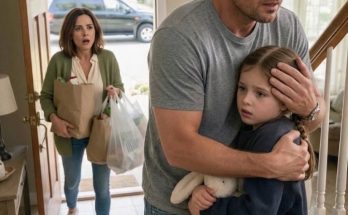
A video file appeared beneath the message. The thumbnail showed our driveway. Renee stood near the garage. Beside her was her mother. Willa was between them.
I opened the clip.
For the first few seconds, the camera showed only Dorothy’s porch rail, the edge of the lawn, and the corner of our driveway. Then Willa ran into view with her stuffed rabbit tucked under one arm. She was heading toward Dorothy’s house.
Renee followed. So did her mother.
The camera angle did not show what had happened inside our home, but it clearly showed Renee’s mother catching Willa by the wrist before she reached the street. It showed Willa twisting away. It showed Renee standing close enough to intervene and doing nothing.
Then the microphone caught Renee’s mother’s voice.
“You don’t run to neighbors,” she said. “You keep family business inside the family.”
Willa stopped breathing against my shoulder as the recording played. The nurse at the desk looked up.
Renee stood. “Give me the phone.”
I did not answer.
On the screen, Willa’s grandmother bent toward her.
“Your dad will believe whatever we tell him.”
The clip ended with Willa being led back toward our house.
The waiting area became completely still. A man near the vending machines lowered his paper cup. A woman holding a sleeping toddler looked down at the floor. The nurse’s hands rested above the keyboard without moving.
Then Willa lifted her head from my shoulder.
“Nana,” she whispered.
It was the specific name that broke through every softened explanation.
Renee’s face lost color first. Her mother’s followed a second later.
Renee reached toward my phone. I stepped back and handed it to the nurse.
The pediatric doctor returned with Willa’s chart and looked from the frozen image to the two women.
“Which one of you wants to explain why this child was told to hide an injury?” she asked.
Renee began talking immediately. She said Willa was sensitive. She said the clip looked worse than it was. She said her mother had only been trying to stop an eight-year-old from running into the street. She said I traveled too much to understand what discipline required.
Every sentence placed responsibility somewhere else. On Willa. On work. On stress. On the camera angle. On me.
Renee’s mother said almost nothing. She stared at the phone as if silence could remove her voice from the recording.
The doctor asked them to return to the waiting area while Willa was taken into an examination room. Renee objected. The nurse repeated the direction.
For the first time that night, my wife encountered a boundary she could not move by becoming louder.
Inside the room, Willa changed into a hospital gown with my help. The doctor examined her carefully and asked questions in language an eight-year-old could understand. Willa answered some. She shook her head at others. When she became tired, the doctor stopped.
Nobody accused her of lying. Nobody threatened to send her away. Nobody told her to protect an adult.
The medical record documented the location of the bruising, Willa’s description of the dresser, her statement about being grabbed, and the fear she had expressed about returning home.
A hospital social worker joined us. I gave her Dorothy’s video, the changed-flight confirmation, and the time I arrived home. I showed her the message exactly as Dorothy had sent it. I did not edit the clip. I did not summarize what another person could watch.
Facts do not become stronger when you decorate them. They become stronger when you preserve them.
When the social worker asked where Willa and I could stay that night, I looked at my daughter. She was exhausted, but her breathing had slowed.
“We are not going back there,” I said.
Renee’s ultimatum returned to me. Walk out that door with her, and don’t bother coming back.
She had meant it as a threat. By midnight, it sounded like permission.
I booked a room at a hotel close to the hospital. It was not a dramatic escape. There was no suitcase packed for Willa, no favorite pajamas, and no toothbrush with her name on it. We stopped at a twenty-four-hour store for basic clothes, toothpaste, and a phone charger. Willa chose a plain blue T-shirt and held the rabbit under one arm while I paid.
At the hotel, she stood beneath the shower for a long time. Then she came out wearing the new shirt, climbed into bed, and placed the rabbit between us.
“Are you mad at me?” she asked.
The question hurt more than Renee’s threat.
“No.”
“Are you mad at Mom?”
“Yes,” I said, because children deserve truth that does not make them responsible for managing it. “But my feelings are not your job.”
Willa rubbed the rabbit’s bent ear. “Is Nana going to hate me?”
“You told the truth,” I said. “What adults do with the truth is their responsibility.”
She thought about that. Then she asked whether doctors really could tell when children lied.
“They can tell when a child needs help,” I said. “That is what happened tonight.”
Willa fell asleep with one hand wrapped around my sleeve.
I stayed awake beside her.
Renee called seventeen times. Her messages moved from anger to apology to blame and back again. She said she had been overwhelmed. She said her mother had made things worse. She said the hospital staff did not understand our family. She said I was destroying our marriage over one accident.
I did not answer that night.
There are moments when silence is avoidance, and there are moments when silence is a locked door protecting the person behind it. Mine was the second kind.
The next morning, Dorothy met us in the hotel lobby. She carried a grocery bag with muffins, juice boxes, and the small blanket Willa often used at her house.
Dorothy apologized for not crossing the street sooner. I told her the camera had done what none of us had known to do in the moment. It had remembered without fear.
She gave me the original video file and a written note describing when she had reviewed it. Then she knelt near Willa.
“You did the right thing coming toward my house,” she said.
Willa’s eyes filled. “I didn’t make it.”
“You tried,” Dorothy answered. “That counts.”
Over the following days, I kept every record. The hospital discharge papers. The intake notes. The video file. Dorothy’s message. My flight confirmation. Renee’s texts.
Not because I wanted to turn our family into a case file, but because people who depend on confusion often become very precise once consequences appear.
Renee asked to meet without Willa. I agreed to speak by phone instead. She cried. She said she had never meant to frighten our daughter.
I asked why Willa believed doctors would punish her for telling the truth. Renee blamed her mother.
I asked why she had blocked the door when I tried to leave. She blamed panic.
I asked why the camera showed her watching while her mother pulled Willa away from a trusted neighbor.
That question brought silence.
I told Renee I would not return to the house while Willa was unsafe there. I told her every future conversation would center on Willa’s safety, not on protecting the appearance of our marriage.
She said I was choosing our daughter over her.
“Yes,” I said.
It was the easiest answer I gave all week.
Healing did not arrive as one big scene. It came in ordinary pieces. Willa sleeping through the night. Willa asking for pancakes. Willa wearing a T-shirt instead of hiding inside a sweatshirt. Willa speaking to a counselor without checking the doorway every few seconds. Willa laughing once, then looking surprised that the sound had come from her.
I learned that safety is not only removing a child from the worst moment. It is building enough quiet, honest moments afterward that fear no longer owns every room.
Months later, the stuffed rabbit still slept beside Willa. Its fur was still gray. Its ear still leaned sideways. But her fingers no longer turned white around it.
Sometimes I think about the business trip, the canceled passenger, and the Friday flight I was never supposed to take.
The clip mattered. The medical record mattered. The timestamp mattered.
But the first truth that changed everything came before any document.
My daughter told me she was hurt.
And I believed her.
THE END