The final entry was dated March 7, the Friday before his death.
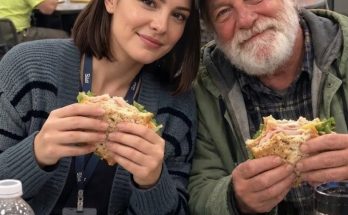
“Eleven years, and she’s still the best part of my day.”
I closed the notebook against my chest, overwhelmed by the realization that our ordinary lunches had meant as much to him as they had to me. Then I noticed a folded letter tucked inside the back cover.
My name was written across the front in Harold’s familiar handwriting. I carried the box outside and sat beneath a budding dogwood tree before carefully unfolding the pages.
The letter began by explaining that Harold had always known about the jokes. He’d heard every cruel remark, but he’d never considered our friendship something to be ashamed of.
He wrote that our coworkers believed I was a kind young woman taking pity on a lonely old janitor. According to Harold, they had misunderstood everything.
As I turned to the second page, an old photograph slipped from the letter and landed in my lap. It showed a younger Harold standing beside a smiling woman wearing a graduation gown.
I stared at her face, startled by how familiar she looked. She had my dark, wavy hair, a similarly rounded face, and almost the same crooked smile.
When I turned the photograph over, I found a short message written in faded blue ink.
“My daughter. Beth. Ohio State, Class of 1983.”
My hands began shaking as I returned to the letter. Harold explained that Beth had been his only child, a bright young woman who dreamed of becoming a social worker.
Three weeks after graduating, she was killed when a drunk driver crossed the center line of a highway. She was only twenty-two.
Harold and his wife, Edith, had never fully recovered from losing their daughter. When Edith died in 1999, he was left alone with memories of the family he’d once believed would grow old together.
For years, Harold had found comfort in the predictable routine of his custodial job. Then, one September afternoon, he noticed a frightened young woman standing in the break room with a lunch bag clutched tightly in both hands.
That woman was me.
Harold wrote that I’d reminded him of Beth immediately, not only because of our resemblance but because of the nervous smile we shared. Seeing me that day had brought warmth back into a life he’d believed would always feel empty.
He’d never told me because he didn’t want me to feel responsible for replacing his daughter. He wanted our friendship to remain genuine, without expectations or obligations.
Then I reached the final lines of his letter.
“Everyone thought I gave you a place at my table, Nell. The truth is, you gave me a place in the world again.”
I broke down crying beneath the dogwood tree, grieving not only for Harold but also for the daughter I’d never known. For eleven years, he’d quietly helped me survive my hardest days while carrying a heartbreak I hadn’t understood.
A few minutes later, Sheldon Brandt joined me on the bench. He explained that Harold had discussed me extensively while preparing his will, describing me as one of the bravest people he’d ever known.
Then Sheldon revealed that Harold had left his house to a church food pantry and his savings to a scholarship for social work students in Beth’s name. The shoebox was the only thing he’d wanted me to receive.
Before leaving, Sheldon paused and delivered one final message.
“Harold asked me to tell you something, Nell. He said you should go back to your table and never let those people take it away from you.”
I looked down at the photographs and notebooks resting in my lap. For the first time, I understood exactly what Harold had given me, and I knew what I needed to do when I returned to work on Monday.
Part 5: The Chair That Was Never Empty
I drove home from Harold’s funeral with the old shoebox resting on the passenger seat, carefully secured beneath the seat belt. That night, I spread his photographs and notebooks across my living room, reading every entry until the early morning hours.
One particular note stopped me. Harold had written about the afternoon Brad accused me of lowering myself by eating with a janitor, and how I’d defended him in front of everyone.
He remembered my exact response, although I’d forgotten the incident years earlier. Beneath it, he’d written that nobody had spoken so proudly of him since his daughter Beth was alive.
I sat there crying, realizing how deeply an ordinary act of loyalty had affected him. I’d spent eleven years believing Harold was the person who made my difficult days easier, never understanding how much our friendship had meant to him.
On Monday morning, I returned to Lindqvist & Pratt carrying the shoebox beneath my arm. At noon, I walked into the familiar break room, where Brad was entertaining his usual audience and Kristen stood talking beside the coffee machine.
Several coworkers glanced toward me as I entered. Kristen approached with the same carefully sympathetic expression she’d worn when discussing Harold’s funeral.
“Nell, how are you doing? I heard you went to the janitor’s funeral.”
For eleven years, I’d swallowed comments like that rather than cause a confrontation. This time, however, I walked directly toward the table beside the window and placed the shoebox on its familiar surface.
Then I turned to face the room.
“His name was Harold. Harold Whitaker.”
My voice carried across the break room, and several conversations stopped. I explained that Harold had worked in the building for thirty-three years, repairing equipment, helping stranded employees, and remembering people who rarely acknowledged him.
“He knew your names, your problems, and the things you needed help with. But most of you never bothered to learn anything about him.”
The room gradually fell silent as I opened the box. I arranged the photographs across our table, beginning with the picture from my first day and continuing through my promotion, divorce, and mother’s funeral.
Next, I placed the photograph of the cruel sign someone had taped to Harold’s chair. Brad stopped looking at me and lowered his eyes toward his lunch.
I added the four black notebooks, opening them to pages filled with Harold’s careful handwriting. Finally, I placed Beth’s graduation photograph beside them, directly in front of the chair where her father had sat for so many years.
I didn’t deliver another speech. The photographs, dates, and handwritten memories revealed more about Harold than anything I could have said.
Slowly, employees began approaching our table. Some read the notebook entries, while others studied the pictures, recognizing moments they’d witnessed without ever understanding their importance.
A young man from the IT department gently closed one notebook after reading several pages. His expression had changed, and he returned it to the table with unusual care.
Kristen approached last. She picked up the photograph of my promotion cupcake, then studied the picture of Beth standing beside her father.
“She looks so much like you,” she whispered.
“I know.”
Kristen carefully returned both photographs to their places. She didn’t apologize, but she didn’t make another joke either.
I wasn’t interested in embarrassing anyone or demanding an apology. I simply wanted my coworkers to understand that Harold had been a person worth knowing, not an invisible employee whose kindness could be dismissed.
When everyone returned to their seats, I sat down at our table. That morning, I’d prepared a bologna and cheese sandwich with yellow mustard, carefully wrapping it in wax paper the way Harold always had.
I ate half and placed the remaining portion in front of his empty chair. For the first time since his death, the silence beside me felt less like abandonment and more like a reminder that our friendship had truly mattered.
Over the following months, small changes appeared throughout the office. Someone installed a brass plaque above our table honoring Harold Whitaker and his thirty-three years of service.
Facilities finally repaired the troublesome east elevator, too. Rob later told me they’d discovered one of Harold’s final maintenance requests, which mentioned that the elevator remained broken and Nell kept asking about it.
I laughed when I heard that, remembering how often Harold and I had joked about the endless delays. Even during his final days, he’d still been paying attention.
That June, a young employee named Andre joined our department. He was twenty-three, recently graduated from Ohio State, and had moved to Columbus from a small town in New Mexico.
On his first day, I noticed him standing uncertainly inside the break room entrance. He held a paper lunch bag in both hands, searching the crowded tables with the same frightened expression I’d worn eleven years earlier.
I looked toward Harold’s empty chair. For three months, I hadn’t allowed anyone to sit there because it felt like the last physical connection I had to him.
Then I remembered the kindness he’d shown me when I was a nervous newcomer. I stood and called across the room.
“You can sit here, if you’d like.”
Andre looked relieved as he hurried toward the table. He introduced himself, nearly knocking over my coffee in his nervous excitement, and I couldn’t help smiling at the familiar scene.
He returned the next day and continued joining me for lunch. Unlike Harold, Andre talked constantly about his family, his grandmother’s cooking, and the video games he enjoyed.
I mostly listened, discovering that companionship didn’t always require grand conversations. Sometimes it began with nothing more complicated than offering someone a chair.
One afternoon, Brad made another joke about my newest lunch companion. This time, I didn’t hesitate before answering.
“He’s better company than you.”
Then I continued walking without giving Brad another thought.
These days, I carry a small black notebook in my bag. After lunch, I remove its rubber band and write a few lines about the moments that might otherwise disappear unnoticed.
Andre once asked what I was recording, and I told him it was a grocery list. He accepted my answer without asking anything further.
Perhaps one day, I’ll explain why I keep those notes. I’ll tell him about a quiet man named Harold Whitaker, who taught me that the smallest kindness can become the most important part of someone’s life.
Because Harold didn’t simply give me a seat at his table eleven years ago. He taught me how to make sure someone else would never have to stand alone.
THE END