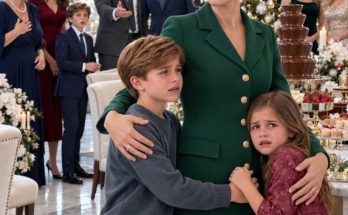
“Dad, please don’t be mad at her,” Toby said. His voice was barely above a whisper. “She didn’t ask me for anything. I offered.”
Russell set his coffee down. He had rehearsed a stern speech in the car, in the shower, at 3 a.m. staring at the ceiling. None of it came out.
“I’m not mad, buddy. I just need to understand. Who is she?”
Toby looked at his hands. “Her name is Posy Tillman. She’s in the sixth grade at Lincoln Elementary, a few blocks from our school. Her mom works nights cleaning offices, and her little brother has asthma. Posy walks him to the clinic every afternoon, and then she waits at the bench until her mom gets off.” He swallowed. “Her ankle got hurt in the fall. She stepped in a hole at the bus stop. They can’t afford the doctor.”
“And the money?”
“For her brother’s inhaler. And her ankle wrap.” He finally looked up, eyes shiny. “I took some from your jar in the garage, Dad. Only twice. I’m sorry. I was going to pay it back.”
Russell stared at his son, this small, serious boy in a school blazer, who had been quietly shouldering something that would have flattened most adults.
“Why didn’t you tell me?”
“Because you’d have handled it,” Toby said. “Like you handle everything. You’d have sent someone with a check. And Posy told me she doesn’t want charity. She wants her mom to not be tired all the time. That’s different.”
Russell felt something crack open in his chest.
He realized, with a jolt, that his twelve-year-old understood something he had spent forty-five years failing to learn.
That Saturday, Russell did not send a check.
He drove Toby to the plaza himself, parked, and walked across the grass with his hands in his pockets, trying to look less like a man who owned three companies. Posy was on the bench with a small boy asleep against her shoulder. She stiffened when she saw them.
“Posy,” Toby said quickly, “this is my dad. He’s okay. I promise.”
Russell crouched so he was eye level with her, ignoring his expensive trousers on the damp ground.
“Posy, I owe you an apology,” he said. “I followed you and Toby for a week. I thought he was in trouble. I was wrong. He’s the best thing I’ve ever done, and he told me about you.”
Her jaw tightened. “We don’t need anything.”
“I know. I’m not here to give you anything.” He paused. “I’m here to ask if I can meet your mom.”
Her mother, Marguerite Tillman, was thirty-four and looked fifty. She arrived at the bench that evening still in her janitorial uniform, and when Russell introduced himself, she folded her arms.
“My daughter says your son has been giving her money.”
“He has. And I want you to know that wasn’t his place, and it wasn’t mine either, until I understood. I’m not here to rescue anyone.” Russell chose his words carefully. “But I run a company that’s always short on reliable people. We have a daytime cleaning and facilities team with benefits, health insurance, and a pediatric clinic partnership. I’d like you to apply. Not as a favor. Through the same process as everyone else.”
Marguerite studied him for a long moment.
“Why?”
“Because my son taught me something this month,” Russell said. “And I’d like to stop being the last person in my family to learn it.”
She didn’t say yes that day. She took the application, folded it into her purse, and said she’d think about it.
Three weeks later, she turned it in.
Marguerite got the job on merit. Her manager would later say she was the most careful, most punctual employee on the team. The health plan covered her son’s asthma care and Posy’s ankle, which turned out to be a hairline fracture that had healed crooked and needed a short course of physical therapy. The therapist said another month and it might have been permanent.
Russell thought about that more than he admitted.
He put Toby on a small allowance again, and the jar in the garage stayed full. The “stolen” money was never mentioned between them, except once, when Toby tried to hand over a crumpled twenty.
“Keep it,” Russell said. “Spend it on something for yourself.”
“I don’t need anything.”
“Then save it. For the next person.”
Toby considered that, and nodded as if he’d been given an important assignment.
By spring, the bench in the plaza had a new visitor most afternoons: a tall man in a tailored coat who sat at the far end, reading, pretending not to listen while two kids argued over a chess game. Posy was winning. Toby was losing gracefully.
One afternoon, Posy looked up and said, “Mr. Hollis, you can sit closer. We don’t bite.”
Russell laughed and moved over.
“Your son’s a good guy,” she told him, moving a rook. “He never made me feel like I owed him.”
“He gets that from his mother,” Russell said. Then, after a pause: “And maybe, someday, a little from me.”
Toby grinned without taking his eyes off the board.
Years from now, Russell will remember that Tuesday in a particular way.
Not as the day he caught his son lying. His son had never really lied. Toby had hidden something, which isn’t the same thing, because he was afraid the people he loved would turn his kindness into a transaction.
Russell had followed him expecting to find a problem.
What he found instead was a mirror.
On that bench, beneath bare winter branches, his twelve-year-old had been quietly living out the values Russell had always claimed to hold and rarely practiced. He shared what he had. He asked for nothing. He told no one.
The world is full of expensive schools and polished schedules and well-meaning checks.
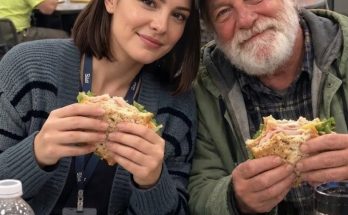
But sometimes, the best lesson a father ever receives comes from a boy with half a sandwich and a secret.
EPILOGUE
Six years later, the bench in the plaza was gone.
The city had finally torn down the worn-out little park and replaced it with a proper community center, and on the morning of the ribbon-cutting, Russell Hollis stood at the back of the crowd, hands in the pockets of his coat, feeling like a man who had arrived at the end of something he’d never planned to start.
Above the glass doors, in plain steel letters, were the words: THE HALF-SANDWICH CENTER.
Toby had picked the name. He was eighteen now, taller than his father, with a habit of rubbing the back of his neck when he was nervous. He was rubbing it now, standing at the podium in a borrowed suit, looking out at three hundred people who had come to see a project that began with a lunchbox.
“I’m going to keep this short,” he said, “because Posy told me if I go over five minutes, she’ll tell everyone about the chess tournament.”
Laughter rolled through the crowd. In the front row, Posy Tillman, now eighteen and wearing her graduation honor cord early because she couldn’t resist, rolled her eyes and grinned.
“When I was twelve, I thought helping someone meant being quiet about it,” Toby continued. “I thought if people knew, it would stop being real. It would turn into a favor, or a headline. And I was scared of that.” He glanced at Russell. “But a smart person once told me that the opposite of charity isn’t silence. It’s dignity. You don’t help people so they feel small. You help them so they can stand up.”