**PART 2**
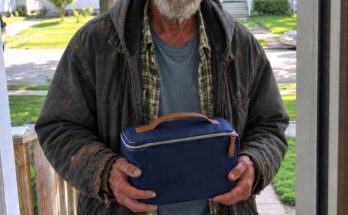
Bram stepped off the porch and sat carefully on the top step, as if he wasn’t certain whether I wanted him any closer to the house.
I stayed standing.
“Tell me what happened this morning.”
He rubbed both hands together.
“She brought me lunch like always.”
“And?”
“She told me to keep the box.”
My heart kicked.
“Why?”
“Because she said she wasn’t coming back for it.”
I looked at the blue lunchbox again.
A ridiculous, ordinary object.
Still full.
Still cold.
“What does that mean?”
Bram looked toward me.
“She said she was going to the school office after classes.”
“For what?”
Something dark crossed his face.
“To ask how to leave.”
“Leave what?”
“School,” he said.
I actually laughed because it made no sense.
“Chloe loves that school.”
Bram didn’t answer.
“Her grades are excellent.”
Still nothing.
“She worked for years to get in.”
“I know.”
“You know?”
“She told me,” he admitted.
Those three words carried a weight I wasn’t prepared for.
I didn’t even know my daughter had been discussing school with this man.
Apparently, he knew enough to hear what I hadn’t.
“Why would she leave?”
Bram looked down.
“That’s the part she doesn’t want to tell you.”
My phone was already in my hand.
I called Chloe.
Straight to voicemail.
I called again.
Voicemail.
It was school hours.
Of course.
I called Kenny instead.
He answered on the second ring.
“Hey, Fiona.”
“I need you to leave work.”
“What happened?”
I looked at Bram.
Then at the blue lunchbox.
Then at the address label that had unknowingly given this stranger the path to my front door.
“It’s Chloe.”
That was all Kenny needed.
“I’m coming.”
Bram stood.
“I should go.”
“No.”
He looked surprised.
“You came all this way because you thought I needed to know.”
“Yeah.”
“Then you’re finishing the sentence.”
He looked down.
“I promised her I wouldn’t repeat every detail.”
“She’s fifteen.”
“I know.”
“I’m her mother.”
“I know that too.”
“Then stop protecting a secret that has my daughter trying to leave school without telling us.”
Bram didn’t raise his voice.
“I’m not protecting the secret.”
He met my eyes.
“I’m protecting the difference between what she told me and what she’s ready to tell you herself.”
That stopped me.
Then he added quietly:
“But there’s one thing you need to know before you talk to her.”
I waited.
He reached into his coat pocket and pulled out a folded piece of notebook paper.
It wasn’t Chloe’s handwriting.
It was his.
On the paper were tally marks in two columns.
RED CARS.
CITY BUS.
I stared at it.
“What is this?”
“Our game.”
“What game?”
“After school.”
He pointed toward one column.
“She says red cars are more common than buses.”
“And?”
“She’s wrong.”
Despite everything, I almost smiled.
Then Bram folded the paper again.
“What is this?”
“Our game,” he repeated.
I looked at him.
He spoke more quietly this time.
“Your daughter doesn’t just stop to collect this lunchbox. Some days, she sits with me until she can make herself go home.”
I couldn’t speak.
Because suddenly, I could see every late arrival differently.
Every ten-minute delay.
Every fifteen-minute delay.
Every time she said, “Bram talks a lot.”
Every afternoon snack she devoured before dinner.
Every quick answer to:
“How was school?”
Fine.
Bram held my gaze.
“And today she said something she’s never said before.”
“What?”
He looked toward the road just as Kenny’s truck turned onto our street.
Then he looked back at me.
“She said she could survive three more years if she had to.”
Kenny pulled into the driveway before I could answer.
He got out without even properly shutting the truck door.
“What happened?”
I handed him the blue lunchbox.
“Bram says Chloe planned to ask about leaving school today.”
Kenny stared at me.
“Leaving?”
Bram nodded.
“She thinks she’s costing you too much.”
My husband went completely still.
“What?”
“She said you work overtime because of her school. She thinks if she leaves, things will be easier.”
Twenty minutes later, we were sitting in the counselor’s office.
The counselor listened carefully, then frowned.
“Chloe?”
“Yes.”
She blinked, startled.
“She’s one of our easiest students.”
“Easy enough that nobody noticed she was miserable?” I asked.
The counselor looked down.
A few minutes later, Chloe walked in.
She saw Kenny.
Then me.
Then Bram waiting near the doorway.
Her face crumpled.
“You told them.”
Bram nodded.
“I know.”
“I trusted you!” she blurted out.
“Easy enough that nobody noticed she was miserable?” I repeated.
“I know,” Bram said gently. “That’s why I couldn’t help you disappear quietly.”
Chloe started crying.
My first instinct was to ask why she hadn’t told us.
I stopped myself.
Instead, I pulled the empty chair beside me toward her.
“Sit down, honey.”
She did.
For several seconds, none of us spoke.
Then I said:
“I’m sorry.”
Chloe wiped her face.
“For what?”
“For making being strong sound like the thing I loved most about you.”
That broke her.
She covered her face.
“I’m sorry.”
“I hate it here,” she whispered.
She wiped her face again.
“Not because anyone did one huge thing. I just eat alone. I spend all day trying not to look like I don’t belong, and then I hear Dad talking about overtime and think about what the school costs.”
Kenny leaned forward.
“Chloe, baby, look at me.”
She looked at him.
“How was I supposed to tell you I was miserable somewhere you were working extra hours to keep me?”
Kenny’s eyes filled.
“You’re allowed to cost us something.”
Chloe stared at him.
“Money. Time. Sleep. Worry.”
His voice shook.
“You’re our kid. You’re supposed to.”
Chloe reached into her backpack.
She pulled out a folded note.
Then she handed it to me.
I opened it.
I read until one sentence stopped me.
*Mom, Dad… I’ll get a job and pay you back.*
I folded the paper carefully.
“You don’t owe us for being ours, sweetheart.”
Chloe cried harder.
The counselor began discussing possible choices.
A different lunch space.
Clubs.
Someone she could check in with.
A transfer, if Chloe still wanted one after they explored everything.
For once, nobody demanded that she make a decision immediately.
When we stepped outside, Chloe still looked furious with Bram.
Trust doesn’t repair itself just because someone had a good reason.
Bram gave her a crooked smile.
“You can yell at me tomorrow.”
“Maybe I will.”
“Excellent. Gives me something to look forward to.”
Eventually, Chloe’s anger softened just enough for the tension to ease.
Later, I asked Bram what he needed.
He automatically said:
“Nothing.”
Chloe gave him a look.
“Don’t.”
He sighed.
“Apparently I created a monster.”
Eventually, he admitted that he needed help receiving mail for replacement documents.
Kenny found a nearby outreach center.
We drove him there.
No miracle happened.
He came out holding a folder and a next appointment.
That was enough.
While we waited, Bram finally ate the lunch he had returned that morning.
He saved the oatmeal cookie.
Chloe opened the blue lunchbox in the parking lot.
Inside was the oatmeal cookie.
She broke it in half.
She handed Bram one piece.
He groaned.
“We’ve discussed this.”
“Eat.”
“Bossy.”
“Old.”
He looked offended.
“Teenager.”
For the first time all day, she laughed.
That afternoon, two girls from an art club were sitting outside school.
One moved her backpack from the empty spot beside her.
“Chloe?”
My daughter hesitated.
Then she sat down.
I did not tell her to go.
I let her choose.
Bram started toward the bus stop.
I rolled down the window.
“Need a ride?”
He stopped.
Looked toward Chloe.
Then back at me.
“No, I’m good.”
Then he paused.
“Actually… yeah.”
He climbed in.
Chloe’s backpack was on the floor by his feet.
I reached down, moved it to the back seat, and made room.
For months, I had believed the blue lunchbox was simply a symbol of my daughter’s kindness.
I thought Chloe was feeding a hungry man.
I didn’t realize that, in some strange way, Bram had also been helping my daughter feed something else: the part of herself that felt unseen, overwhelmed, and too afraid to come home and admit that she was struggling.
And perhaps that was why the lunchbox had always felt heavier than it should have.
It had never just carried food.
It had carried a secret.
It had carried the afternoons Chloe didn’t know how to explain.
It had carried the things she was too afraid to say.
And that morning, when Bram returned it untouched and knocked on our door, he wasn’t simply bringing back a lunch.
He was finally giving us the chance to see what our daughter had been carrying all along.