**Part 2**
At 4:58, Melissa’s fist hit my bedroom door.
“Coffee! Eggs! Toast! And make enough for everyone!”
I looked at the clock on my nightstand.
4:59.
I almost smiled.
I went downstairs.
At 5:02, Melissa appeared in the kitchen.
Wearing my robe.
My cream-colored silk robe. From a boutique in Charleston. Monogrammed on the pocket in navy thread. M.R. My business partner’s wife gave it to me the day we closed the sale. It cost eight hundred dollars.
Melissa had found it hanging on the back of the guest suite bathroom door. Where I’d left it after my last shower in that room. She’d put it on over her pajamas.
She’d tied her blonde hair into a messy bun.
She looked deeply offended.
“Where are the eggs?” she said.
I lifted my coffee.
“There aren’t any,” I said.
She blinked.
“What?”
“No breakfast here this morning,” I said.
My mother appeared behind her.
In her pale pink cardigan. Her hair flat on one side from the pillow. Holding her phone.
“Sweetheart,” she said. “What does that mean? No breakfast?”
Before I could answer, headlights swept across the living room windows.
Big ones. White. Bright.
Gravel crunched in the driveway.
A white twelve-passenger luxury shuttle pulled up in front of the house. A Mercedes Sprinter. COASTAL CONCIERGE painted in navy blue letters on the side.
A dark SUV pulled in behind it. A black Ford Explorer. With a small gold star on the door.
Melissa marched to the window.
She pressed her face to the glass.
“Who is that?”
I set down my mug.
“Your transportation,” I said.
She turned around.
She stared at me.
“My what?”
Two women got out of the shuttle.
Neat navy blazers. Khaki pants. Name tags. Clipboards. One older, maybe fifty, with gray hair in a bun. One younger, maybe twenty-five, with a ponytail.
The driver’s door of the Explorer opened.
A man got out.
Forties. Tall. Broad-shouldered. In a tan uniform. A badge on his chest. A radio on his shoulder. A folder under his arm.
CURRITUCK COUNTY SHERIFF.
My mother went completely still.
Then there was a knock on the front door.
Polite. Two taps.
I walked across the living room.
Past my father, who was sitting up on the couch now. Rubbing his eyes. Confused. The TV still on. An infomercial for a pressure cooker.
I opened the front door.
“Good morning,” the deputy said. “Ms. Reese?”
“Good morning,” I said. “Thank you for coming.”
“Deputy Marcus Hale,” he said. “Currituck County. Your attorney called.”
“I know. Thank you.”
He looked past me. Into the house. At the suitcases in the hallway. At Melissa in my robe. At my mother in her cardigan.
He nodded once.
Melissa hurried across the living room.
“What is going on?”
I stepped aside.
I let the two women from Coastal Concierge into the house.
The older one held out her hand.
“Good morning,” she said. “I’m Rhonda. This is Kayla. We’re here to help with your luggage.”
“Your new accommodations are ready,” I said to my family.
My mother frowned.
“Accommodations?”
I took a piece of paper off the entry table. Where I’d put it at 4:50. Printed. In a clear plastic sleeve.
I handed it to my mother.
“I’ve booked you two adjoining suites at Pelican Bay Family Resort,” I said. “In Kill Devil Hills. Twenty-five minutes south. Ocean view.”
My mother looked at the paper.
“They have a waterpark,” I said. “An indoor one. And an outdoor one. A lazy river. A kids’ club with activities all day. Arts and crafts. Sandcastle building. A pirate ship.”
I looked at Poppy.
She’d come out of my office. In her fox pajamas. Holding her rabbit. Standing in the hallway. Listening.
“And a breakfast buffet,” I said. “Starting at six. Pancakes. Waffles. A chocolate fountain.”
Poppy’s eyes went wide.
“Everything is paid for,” I said. “Two nights. Both suites. Breakfast included. The shuttle will take you there and bring your cars after.”
I looked at my mother.
“After that,” I said, “you’re free to extend the stay at your own expense. Or go home.”
For several seconds, nobody spoke.
The infomercial played on the TV. But wait. There’s more.
Then Melissa’s face turned bright red.
“YOU’RE KICKING US OUT?”
“I’m moving your vacation somewhere more appropriate,” I said.
“Into some tacky tourist trap?”
“You’re welcome to find something else,” I said.
My father came down the hallway.
Storming. Pulling his windbreaker over his shoulders. His face red from sleep and anger.
“What is all this commotion?”
Melissa pointed at me.
Her finger shaking.
“She’s throwing us out!”
My father stopped.
He saw the deputy standing in my front doorway.
He saw Rhonda and Kayla. In their navy blazers. Rolling Melissa’s four enormous suitcases toward the front door.
He saw the shuttle in the driveway. Its engine running. Its headlights on.
His expression hardened.
“We are not leaving,” he said.
I held his gaze.
“You are,” I said.
“I am your father!”
“And I’m the owner,” I said.
He stepped closer.
Close enough that I could smell the wine on his breath from last night. Close enough that I had to tilt my head up to look at him.
His voice rose.
“You don’t get to humiliate this family just because you have money,” he said. “We drove nine hours. We came here to spend time together. As a family. And you are going to let us stay.”
Melissa folded her arms. Triumphant.
My mother clutched the itinerary to her chest.
And for a moment, I was eight years old again.
Standing in our kitchen in Cary. In 1994. My father standing over me. Deciding what was fair.
Melissa gets the bigger bedroom because she’s younger.
Melissa gets to go to the beach with her friends because she asked first.
Melissa gets the car on Saturday because she has a date. You can take the bus.
Morgan, don’t be difficult. Your sister needs it more.
And everyone else obeyed.
My mother obeyed. I obeyed.
Except this wasn’t his kitchen.
And I wasn’t eight.
Deputy Hale stepped forward.
Calm. Unhurried. He moved to stand beside me.
“Sir,” he said. “I need you to listen carefully.”
My father drew himself up.
He’s six-two. He was a linebacker at Appalachian State in 1976. He’s used to being the biggest man in the room.
“I don’t care who you are,” he said. “I’m not leaving my own child’s house.”
Deputy Hale opened his folder.
He took out a document. Two pages. On letterhead.
OKAFOR & ASSOCIATES, PLLC — ATTORNEYS AT LAW — RALEIGH, NORTH CAROLINA
My father saw the letterhead.
He saw the name.
His face changed.
But before the deputy could say anything, Melissa shouted.
“You can’t throw us out! We don’t have anywhere else to go!”
Everybody turned and looked at her.
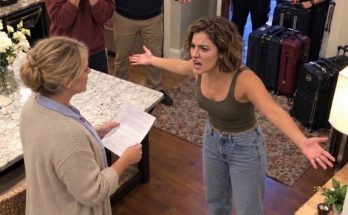
She was standing in the middle of my living room. In my eight-hundred-dollar silk robe. Her arms wrapped around herself. Her face red. Her eyes wet.
“We don’t have anywhere to go,” she said again. Her voice cracked. “Okay? Is that what you want to hear? We don’t have a house.”
The room went silent.
Ben was standing in the doorway of the guest suite. In a T-shirt and sweatpants. His glasses crooked.
He closed his eyes.
My mother put her hand over her mouth.
My father turned on Melissa.
“Melissa,” he said. “That’s enough.”
“No,” Melissa said. “No, Dad. She’s calling the police. She has a deputy here. She’s going to find out anyway.”
I looked at my sister.
“What do you mean,” I said slowly, “you don’t have a house?”
Melissa didn’t answer.
She looked at my father.
My father looked at the floor.
My mother spoke.
Very quietly.
“We sold it,” she said.
I turned and looked at her.
“Sold what?”
“The house,” my mother whispered. “In Cary. On Bridlewood Drive.”
My childhood home. Four bedrooms. A basketball hoop in the driveway. A crabapple tree in the front yard that my father planted the year I was born.
“We closed on Tuesday,” my mother said.
I stared at her.
“Why?”
My mother looked at my father.
My father didn’t look up.
“Your father,” my mother said. “He made some investments. A few years ago. With a man from church. A real estate thing. In Florida. Condos.”
She swallowed.
“It didn’t work out,” she said. “He borrowed against the house. Twice. To cover the losses. And then the payments—we couldn’t—”
She stopped.
“How much?” I said.
Nobody answered.
“Dad,” I said. “How much?”
My father lifted his head.
He looked at me.
For the first time in my entire life, my father looked at me without the head tilt. Without the pressed lips. Without the raised eyebrows.
He just looked tired.
And old.
And afraid.
“Three hundred and forty thousand,” he said.
I didn’t say anything.
“We sold the house to pay it off,” my mother said. “We got almost everything back. Almost. There’s a little left. On a credit card. Forty thousand. We’re working on it.”
“Where were you going to live?”
My mother didn’t answer.
I looked at Melissa.
“And you?” I said. “You said we. You don’t have a house either?”
Melissa’s chin trembled.
She looked at Ben.
Ben stepped out of the doorway.
“I lost my job,” Ben said quietly. “In May. The district cut the chemistry program at my school. Budget. They laid off four teachers.”
He pushed his glasses up.
“Melissa was working part-time,” he said. “At a boutique. In Alpharetta. It closed in July.”
He looked at the floor.
“We were renting,” he said. “We got behind. Three months. The landlord filed. We had to be out by the first.”
“Of October,” I said.
“Of October,” Ben said. “Five days ago.”
I looked around my living room.
At the four enormous suitcases. The two coolers. The folding crib. The beach chairs. The boxes.
Not a vacation.
Everything they owned.
“Where have you been for five days?” I asked.
Melissa wiped her eyes with the sleeve of my robe.
“At Mom and Dad’s,” she said. “Until Tuesday. Until they closed. Then at a Days Inn in Durham. For two nights.”
She laughed. A terrible, broken laugh.
“Then Mom said, Let’s go to Morgan’s.”
I turned and looked at my mother.
“Let’s go to Morgan’s,” I repeated.
My mother had her phone in her hand. Clutched against her cardigan.
The phone she’d turned face-down last night.
“Mom,” I said. “What were you going to tell me?”
My mother went pale.
“What do you mean?”
“Aunt Linda texted you,” I said. “At 4:47. Did you tell her yet about the house? Or are you waiting till she’s settled?”
My mother’s mouth opened.
“And you texted her last night,” I said. “Haven’t told her yet. Going to wait till morning. Phil says once we’re in, she won’t say no. She never does.”
The room went silent.
“You read my phone?” my mother said.
“It buzzed,” I said. “On my kitchen counter. Next to the empty bottle of wine my business partner gave me the day I sold my company. That Melissa opened without asking.”
I looked at her.
“Yes,” I said. “I read it. I’m sorry I did. I’m more sorry about what it said.”
My mother started crying.
“Once we’re in, she won’t say no,” I said quietly. “She never does.”
I looked at my father.
“That was the plan,” I said. “Wasn’t it? Not a week. Not a vacation. You were going to move in. All six of you. Into my house. And wait until I was too tired or too guilty or too polite to say no.”
My father didn’t answer.
He didn’t have to.
“She never does,” I said again.
I looked at my sister. My mother. My father.
“You’re right,” I said. “I never have.”
I turned to Deputy Hale.
He was standing beside me. Holding the folder. He hadn’t said anything. He’d just been listening.
“Deputy,” I said. “Can you give us a few minutes?”
He looked at me.
“Take as long as you need, ma’am,” he said. “I’ll be on the porch.”
Rhonda and Kayla looked at me.
“Should we keep loading?” Rhonda asked.
I looked at the suitcases.
“Yes,” I said. “Please. Everything. Into the shuttle.”
Melissa made a sound.
“Morgan—”
“I’m not changing my mind,” I said. “You’re leaving my house this morning.”
Melissa’s face crumpled.
“But first,” I said, “we’re going to sit down. All of us. At my kitchen table. And we’re going to talk. Like a family.”
My father looked at me.
“Talk,” he said. “Now you want to talk.”
“Dad,” I said. “You drove nine hours to my house. Without calling. With everything you own in the back of your car. And you were going to move in without telling me why.”
He didn’t say anything.
“That’s not talking,” I said. “That’s an ambush.”
We sat at my kitchen table.
All of us. Six adults. Well. Five adults and my father, who sat at the head of the table like he always does. Out of habit. Then looked around and realized it wasn’t his table. And moved one chair down.
Ben took the kids to the porch. To sit with Deputy Hale. Poppy wanted to see his badge.
The kitchen was still a disaster.
The empty Château Margaux on the counter. Wine glasses. Doritos.
The sun was starting to come up over the ocean. Pink and gold through the window over the sink. The pelicans were out. Skimming the waves.
“Why didn’t you call me?” I said.
Nobody answered.
“Mom,” I said. “You knew in—when? When did you know you’d lose the house?”
My mother looked at her hands.
“March,” she said quietly.
“March.”
“We thought we could fix it,” my mother said. “Your father thought he could get the money back. The man from church said the condos would sell in the spring. Then the summer.”
“Did they?”
My mother shook her head.
“He’s gone,” she said. “The man from church. He moved to Costa Rica in August. The FBI called us in September. There are forty other families.”
I closed my eyes.
“Seven months,” I said. “You knew for seven months. You knew you were going to lose the house. And you didn’t call me.”
“We didn’t want to bother you,” my mother said.
I laughed.
I didn’t mean to. It just came out.
“You didn’t want to bother me,” I said. “So instead you showed up at my door at ten-thirty at night with four suitcases and a plan to move in without asking.”
My mother started crying again.
“Dad,” I said.
He was staring at the table.
“Why didn’t you call me?”
He didn’t answer for a long time.
Then he said something I never expected him to say.
“Because I told you not to come to me for money,” he said.
I stared at him.
“Thanksgiving,” he said. “2011. When you quit IBM. When you told us about your company. I said you’ll be back in a year begging for your job. Don’t come to me for money.”
He looked up at me.
“You never came,” he said. “Not once. Twelve years. You ate ramen. You lived in that apartment in Durham with no air conditioning. You never called me. You never asked for one dollar.”
His voice broke.
“And now I need money,” he said. “And I couldn’t call you. Because I’m the one who said it. Don’t come to me.”
The kitchen was very quiet.
The pelicans skimmed the waves outside the window.
“So instead,” I said slowly, “you thought you’d just come. And not ask. And let me figure it out.”
My father put his face in his hands.
“Your mother thought,” he said through his fingers, “if we just got here. If we were already inside. If you saw the kids. You’d let us stay. And we wouldn’t have to say it.”
He lowered his hands.
“We wouldn’t have to say we failed,” he said.
I looked at my father.
Sixty-eight. A gray buzz cut. A windbreaker. Sitting at my kitchen table. At the wrong end.
The man who told me women don’t start companies. Who told me I’d be back in a year. Who never once asked how Tidewater was doing. Who said Well, good for you, I guess it worked out when I called to tell him I’d sold it.
Who lost everything to a man from church who moved to Costa Rica.
“Dad,” I said. “Do you know what I would have said? If you’d called me in March?”
He didn’t answer.
“I would have said yes,” I said.
He looked up.
“I would have helped you,” I said. “I would have called Carolyn. My attorney. I would have called a financial advisor. I would have looked at the loans. I would have figured out if we could save the house. Maybe we could have. Maybe not. But I would have tried.”
My voice was shaking now.
“You’re my father,” I said. “Of course I would have helped you. If you’d asked.”
“But you didn’t ask,” I said. “You never ask. You just take. You’ve always just taken. And you taught Melissa to take. And you taught me to give. And to never, ever say no.”
I looked at Melissa.
“She opened my wine,” I said. “A two-thousand-dollar bottle. Without asking. She took my guest suite. Without asking. She put her kids in my office with my client files. She put on my robe.”
Melissa looked down at the robe.
She went red.
“And none of you asked how long you could stay,” I said. “Because you weren’t planning to leave.”
“Once we’re in, she won’t say no,” I said. “She never does.”
I looked at my mother.
“You taught me that,” I said. “You and Dad. My whole life. Don’t be difficult. Your sister needs it more. It’s easier if you just give her what she wants.”
I shook my head.
“You trained me to never say no,” I said. “And then you counted on it.”
My mother was sobbing.
My father was staring at the table.
Melissa was crying silently. Holding the lapels of my robe.
“I’m saying no,” I said.
Nobody moved.
“You’re not moving into my house,” I said. “Not this week. Not ever. Not like this.”
I took a breath.
“But I’m not going to let you be homeless either,” I said.
My mother looked up.
“Here’s what’s going to happen,” I said.
I sat up straight. The way I used to sit in board meetings. The way I sat across from men twice my age who called me sweetheart.
“You’re going to Pelican Bay,” I said. “This morning. Two nights. Paid. The kids are going to swim in the waterpark and eat pancakes and go to the pirate ship.”
I looked at Melissa.
“And while they’re doing that,” I said, “you and Ben and Mom and Dad are going to meet with Carolyn. My attorney. On a video call. Tomorrow at ten. She’s going to look at Dad’s debts. The forty thousand on the credit card. The fraud with the man from church. The FBI case. She’s going to tell you what your options are.”
My father opened his mouth.
“I’m paying for it,” I said. “Not you.”
“And I’m going to call Dana,” I said. “My property manager. She knows every rental on the Outer Banks. Every one. The off-season starts in two weeks. Rentals drop by half. She’ll find you something.”
“We can’t afford—” my mother started.
“I’ll cover the first three months,” I said. “For both of you. Mom and Dad. And Melissa and Ben. Separate places. Close to each other. Close to me.”
I looked at Ben. Through the window. On the porch. Holding Jonah. Showing him the pelicans.
“And Ben,” I said. “There’s a high school in Manteo. Twenty minutes south. Manteo High. I happen to know they’ve had a chemistry opening since August. Nobody wants to move to the Outer Banks for a teacher’s salary.”
Melissa stared at me.
“How do you know that?”
“I’m on the school board’s education foundation,” I said. “I fund their robotics program.”
“Three months,” I said. “That’s what I’m offering. A place to live. Help with the debt. Help finding work. Three months to get on your feet.”
I looked at my father.
“After that,” I said, “you’re on your own. Like I was.”
My father didn’t say anything.
“But here’s the condition,” I said.
Everybody waited.
“You ask,” I said.
My father looked at me.
“From now on,” I said, “you ask. Every time. If you want to come to my house, you call first. You ask if it’s okay. You ask how long you can stay. You ask before you open a bottle of wine. You ask before you put your kids in my office.”
I looked at Melissa.
“You ask before you put on my robe,” I said.
Melissa looked down.
Slowly, she untied it.
She took it off. She folded it. Carefully. She set it on the table in front of me.
“And if I say no,” I said, “you accept it. You don’t argue. You don’t tell me I’m being difficult. You don’t call me sensitive. You don’t send Aunt Linda texts about how I never say no.”
I looked at my mother.
“Because I’m going to say no sometimes,” I said. “And that doesn’t mean I don’t love you. It means I’m a person. With a house. And a life. That I built myself.”
The kitchen was silent for a long time.
Then my father spoke.
“Morgan,” he said.
His voice was very quiet.
“Can I ask you something?”
I looked at him.
It was the first time in my life I’d ever heard my father say those words.
Can I ask you something.
“Yes,” I said.
He looked at the table.
At the folded silk robe. At the empty Château Margaux.
“The company,” he said. “Tidewater.”
“Yes?”
“How did you do it?”
I stared at him.
“The ramen,” he said. “The apartment with no air conditioning. The client who went bankrupt. Your mother told me about that one. 2014. She said you almost lost everything.”
He looked up at me.
“How did you not quit?” he said. “When I told you you’d be back in a year. When nobody believed you. How did you not quit?”
I thought about it.
I thought about the one-bedroom apartment in Durham. Two used laptops. Four hours of sleep. Ramen for three years.
I thought about Thanksgiving 2011. Don’t come to me for money.
“Because you told me I’d fail,” I said.
My father flinched.
“And I wanted to prove you wrong,” I said. “For about six years. That’s what kept me going. Every night. Every time I wanted to quit. I’d hear you. You’ll be back in a year.”
I looked at him.
“And then somewhere around year seven,” I said, “I stopped thinking about you. I stopped needing to prove anything. I just loved what I was building. I loved the people I was building it with.”
I looked out the window. At the ocean.
“That’s when it worked,” I said. “When I stopped waiting for you to say you were proud of me.”
My father put his hand over his eyes.
“I was,” he said.
I didn’t say anything.
“Proud,” he said. Behind his hand. “I was proud of you. The whole time. I read every article. Your mother printed them out. Triangle Business Journal. The one in Forbes about women in logistics tech.”
He lowered his hand.
“I have them in a folder,” he said. “In the car. In the Pilot. With our important papers. Birth certificates. Social Security cards. The deed to the house we don’t have anymore.”
He laughed. A broken sound.
“And your articles,” he said. “Every one.”
I couldn’t speak.
“Why didn’t you ever tell me?” I whispered.
My father looked at me.
“Because I was wrong,” he said. “At Thanksgiving. And I didn’t know how to say I was wrong. My father never said it. Not once. Not to me. Not to anybody.”
He shook his head.
“So I just never said anything,” he said. “And I let you think I didn’t care.”
He looked at Melissa.
“And I gave Melissa everything,” he said. “Every time she asked. Because she asked. Because it was easy. Because she never made me feel like I’d been wrong.”
Melissa started crying again.
“And I gave you nothing,” my father said to me. “Because you never asked. And I told myself that meant you didn’t need it.”
He looked down.
“You were the one who needed it most,” he said. “And I gave it to the one who asked loudest.”
The pelicans had gone.
The sun was fully up now. The ocean was gold.
Melissa spoke.
Very quietly.
“Morgan,” she said.
I looked at her.
“I’m sorry,” she said. “About the wine. And the robe. And the suite. And your office.”
She wiped her eyes.
“And breakfast duty,” she said. “And don’t be difficult.”
She looked at her hands.
“I’ve been saying that to you my whole life,” she said. “Because Dad said it. Because Mom said it. Because it worked. You always gave in.”
She looked up at me.
“I never once thought about what it cost you,” she said.
I looked at my sister.
Thirty-five. Blonde. In her pajamas now. Without my robe. No job. No house. Two kids on the porch with a sheriff’s deputy.
Who’d had everything handed to her. Her whole life. Because she asked.
And who’d never learned how to stand on her own.
“Mel,” I said. “Do you know why I never asked for anything?”
She shook her head.
“Because every time I did,” I said, “somebody said don’t be difficult. And gave it to you instead.”
Melissa closed her eyes.
“So I stopped asking,” I said. “And I started building. By myself. Because it was the only way to get anything.”
I looked at the house. At my kitchen. At the ocean through the window.
“This house,” I said. “Every board. Every window. Every dish in that cabinet. I built it. Alone. Without asking anybody for anything.”
I looked at her.
“So when you walked in last night and took it,” I said. “Without asking. Like it was yours. Like it was owed to you.”
Melissa put her face in her hands.
“It felt like being eight again,” I said. “Watching you get the bigger bedroom.”
My sister cried at my kitchen table for a long time.
I didn’t stop her.
I didn’t comfort her.
I let her cry.