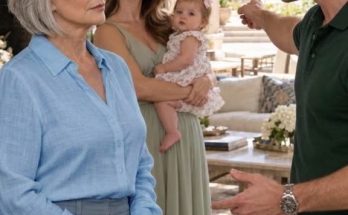
“So you’re just going to leave us?”
I looked around the dining room.
Only the previous evening, they’d asked when I would finally move out.
Now my departure sounded like abandonment.
“I’ll be leaving Saturday,” I said. “Just as we discussed.”
Daniel followed me into the hallway.
“Mom, wait.”
I stopped.
He looked shaken.
“Did we really make you feel that unwelcome?”
I could have listed every slight.
Every missed invitation.
Every time Renee called my bedroom the guest room.
Every time Daniel allowed her to speak to me like an inconvenience.
Instead, I asked one question.
“When was the last time you asked what I wanted?”
He opened his mouth.
Then closed it.
I nodded.
“That tells you something.”
Over the next few days, the atmosphere changed.
Renee offered to make dinner.
Daniel asked whether I needed help packing.
Noah carried boxes to the garage.
Lucy cried when I told her I was moving.
I hugged her tightly.
“I’ll still be your grandma.”
“Will you still make cinnamon rolls?”
“Of course.”
“Can I visit?”
“Absolutely.”
I made sure the children understood that my move wasn’t their fault.
I also made sure Daniel and Renee understood that childcare would no longer be automatic.
We could arrange visits.
We could plan time together.
But I wouldn’t be available whenever they needed someone to fill a gap in their schedules.
That was a boundary, not a punishment.
On Saturday morning, the movers arrived.
I watched them carry the last boxes out of my room.
Daniel stood beside the doorway.
“Mom, I’m sorry.”
I looked at him.
He continued.
“I got used to you doing everything. I stopped noticing how much you were giving us.”
I waited.
“And I shouldn’t have counted on your money.”
“No,” I said. “You shouldn’t have.”
He looked at me.
“Can we fix this?”
I thought about it.
“I hope so.”
He seemed relieved.
“But fixing it will take more than one conversation.”
He nodded.
I meant it.
I loved my son.
I loved my grandchildren.
But love wasn’t a reason to ignore what had happened.
I moved into my new house that afternoon.
The sunroom was brighter than I remembered.
The movers placed Harold’s old armchair beside the window.
I carried in a framed photograph of him and set it on a small table.
Then I opened the doors to the porch.
The air smelled faintly of desert rain.
For the first time in two years, I stood inside a house where nobody expected me to justify my presence.
I hadn’t told Daniel about the lottery.
I wasn’t sure when I would.
My attorney and I had discussed how to handle requests for money and how to protect my estate.
I was comfortable with those arrangements.
I didn’t owe anyone an immediate explanation of my finances.
Over the following months, Daniel began making more effort.
He invited me to dinner without asking me to cook.
He brought the children to visit and stayed to help clean up afterward.
When Renee asked whether I could collect Lucy from school, she checked whether I was free instead of assuming.
Sometimes I said yes.
Sometimes I said no.
Both answers were accepted.
I didn’t pretend everything was perfect.
Renee remained uncomfortable about the house.
Daniel sometimes struggled with my new independence.
But they were learning that my time and money belonged to me.
One evening, Lucy visited and helped me plant roses beside the front porch.
She asked whether Grandpa Harold would have liked the house.
I looked at the sunroom.
The wide windows.
The bright kitchen.
The garden waiting to grow.
“He would have loved it,” I said.
Lucy smiled.
“Then I’m glad you bought it.”
I kissed the top of her head.
“So am I.”
Later, after she’d gone home, I sat in Harold’s armchair and watched the last sunlight move across the floor.
For years, I’d believed that being needed meant being loved.
I’d given everything I could because I was afraid of being alone again.
But the day Daniel asked me to move out, I learned something important.
I didn’t need to buy anyone’s affection.
I didn’t need to earn a place at somebody else’s table.
And I didn’t need to reveal an enormous bank balance to prove I mattered.
The lottery had given me choices.
But the decision to value myself was one I had to make on my own.
I looked around the quiet sunroom.
Then I picked up my tea and smiled.
Harold would have liked that too.