Lauren would not give up her home.
There would be no security detail following her without permission.
My mother would have no contact with the boys unless they wanted it.
Educational decisions would be made jointly.
I would not demand that they change their surname, Ferris.
For the first time in my life, I understood that loving someone gave me no right to control the conditions under which that person felt safe.
When the boys were 9, Mason found some old photographs.
“Does Dad have a mom?”
Lauren and I looked at each other.
The time had come.
We explained a version suited to their age: their grandmother had made wrong decisions, believing she was protecting her family, and those decisions had kept their parents apart for years.
Mason asked:
“Is she sorry?”
Neither of us knew the answer.
My mother was granted permission for a single visit.
She arrived without gifts because I had asked her not to bring any.
Mason was direct.
“Why didn’t you let Dad get to know us?”
She took a deep breath.
“Because I thought I knew what was best for him.”
“Did you?”
“No.”
“Then why did you decide for everyone?”
The woman who had run entire boardrooms for decades couldn’t find an elegant answer.
“Because I was too used to people doing what I said.”
Henry asked something much simpler:
“Didn’t you love us?”
She began to cry.
“I didn’t know you.”
“But you knew we existed.”
She lowered her head.
Nobody comforted her right away.
At the end, Mason said:
“I still don’t know if I want to call you Grandma.”
She answered:
“That’s all right.”
It was probably the first time she had accepted a boundary without trying to negotiate it.
The relationship took years to build.
It was never perfect.
It didn’t have to be.
When the boys turned 10, Lauren said to me one afternoon:
“I think I could marry you now without feeling like I’m joining the Ashfords.”
I smiled.
“Does that mean…?”
“It means we could build something of our own.”
The proposal happened in the kitchen.
Mason had prepared a speech.
Henry drew a card.
Theo wrote a list titled “Reasonable Risks of Marriage.”
Wyatt lost the ring for 40 minutes.
It turned up inside a cereal box.
By the time I finally got down on one knee, Lauren was already crying from laughing.
“Years ago I thought loving you meant asking you to come into my world,” I said. “Then I let other people decide which world I should keep. Now I don’t want you to come into mine. I want to keep building this one with you.”
She looked at the 4 boys.
Then she looked at the ring.
“It’s quite a bit smaller than the one you bought for Blair.”
My eyes widened.
“You can’t say that now.”
Theo chimed in:
“Technically, it has a better quality-to-price ratio.”
“Theo.”
Lauren started laughing.
“Yes.”
“Yes to the ring?”
“Yes to you, you idiot.”
Years later, the 4 brothers took very different paths.
Mason studied law.
Henry turned his drawings into a career.
Theo ended up in scientific research.
Wyatt opened several restaurants and insisted it made sense because “the family really started in one.”
None of them was forced to carry the Ashford name.
Some kept Ferris. Others combined both in their own way.
I stopped measuring success by companies acquired or meetings controlled.
I started measuring it by dinners I’d arrived at on time, games I hadn’t missed, and nights when someone who was sick knew they could call me.
Many years later, when Lauren and I celebrated 30 years of marriage, Wyatt reserved a private room at the same Manhattan restaurant where it had all begun.
All 4 of our sons were there.
Their partners.
Several grandchildren.
Even my old driver, long since retired.
During dinner, a detail came out that Lauren had never shared.
“That day, I had decided to move back to Charleston with the boys,” she said.
I set my glass down on the table.
“When?”
“After lunch.”
“So the next day you wouldn’t have been in New York?”
“Probably not.”
Wyatt smiled.
“The story just got a lot better.”
Theo started doing mental math.
“Don’t even think about calculating probabilities,” I warned.
Everyone laughed.
Later, I went to the bathroom.
As I washed my hands, I looked at my reflection and remembered the 37-year-old man who had walked in there decades earlier with a ring for a woman he didn’t love, convinced he controlled every detail of his life.
Then 4 boys came in, arguing.
This time they were my grandsons.
One had Lauren’s eyes.
Another rubbed the back of his neck exactly like me.
“Grandpa, we can’t reach the soap.”
I helped them.
Nothing extraordinary.
Water.
Soap.
Four small pairs of hands.
When I came out, Lauren was waiting by the door.
Just like that first night.
“Did you take long?”
I stood there looking at her.
She understood immediately.
“Don’t start crying.”
“I’m not crying.”
“Your eyes are red.”
“Must be the soap.”
“Sure.”
The grandsons ran off.
Lauren took my hand.
For years I had thought that a delay, a restaurant, and 4 little boys had changed my destiny.
In time, I understood something different.
Chance had only opened a door.
Everything else had been a choice.
Lauren chose to let me come closer little by little.
The boys chose what kind of relationship they wanted to build with me.
I chose to stop using power to get what could only be earned with time.
Even my mother, too late, had learned to accept that loving a family didn’t mean owning it.
I never got back the first 6 years of my sons’ lives.
I didn’t see their first steps.
I didn’t hear their first words.
I wasn’t there for their first birthdays.
No fortune could buy those days back.
But I learned something that for decades no business or powerful family name had managed to teach me:
lost time can’t be recovered.
You build new time.
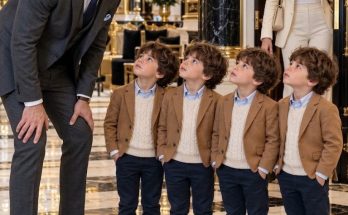
And it had all started in front of 4 sinks, when 4 boys identical to me walked out of a bathroom and one asked why that stranger looked so much like the man his mother kept hidden in an old photograph.
That night I never got to propose to Blair.
I lost an alliance between two families.
I uncovered a lie that had lasted 6 years.
And I found 4 sons I didn’t know existed.
Much later I understood that it had been the best defeat of my entire life.
Because losing the life other people had designed for me was exactly what allowed me to begin, for the first time, to build my own.