I went in expecting some formula that would let me quickly make up for the lost years.
Marlene destroyed that idea in less than 10 minutes.
“You can’t get 6 years back.”
I stayed silent.
“You can build the next ones,” she added.
The conversation with the boys took place on a Saturday.
Lauren spoke to them first. I waited in a nearby coffee shop until I got a text:
“You can come.”
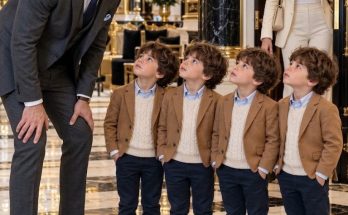
I found all 4 sitting on the couch.
Mason had his arms crossed.
Henry had been crying.
Theo was holding a notebook.
Wyatt was eating cookies.
Mason fired the first question.
“Mom says you’re our father.”
“Yes.”
“Did you know we existed?”
“No.”
“Why not?”
I had promised myself I wouldn’t burden four six-year-olds with the mistakes of adults.
“Because there were people who kept your mother and me from being able to talk. When you’re older, you’ll learn more about the details.”
“I don’t like that answer.”
“I don’t either.”
Henry asked, almost in a whisper:
“Are you going to disappear again?”
That question hurt more than any accusation.
“No.”
“Are you sure?”
I took a breath.
“I can’t promise I’ll never make a mistake. But I can promise I won’t disappear without telling you where I am.”
Theo raised his hand.
“I want a DNA test.”
Lauren sighed.
“Theo, this isn’t school.”
“I want data.”
I almost smiled.
“We’ll do it.”
Wyatt finished his cookie.
“Are you rich?”
“Wyatt…”
“You said we could ask questions, Mom.”
I answered:
“Yes.”
“A lot?”
“Quite a bit.”
“More than Batman?”
I decided that correcting certain concepts could wait.
The test confirmed paternity with virtually absolute certainty.
Theo studied the report before accepting the result.
“Okay.”
“Is that it?” I asked.
“Now we have data.”
It was the beginning.
There were no mansions handed over, no private vacations the following week.
There were two-hour afternoons.
Games in the park.
Homework.
Snacks.
Arguments over video games.
I discovered that Mason needed a small night-light to sleep. Henry drew when he was worried. Theo asked questions until he wore out any adult. Wyatt turned every room into an experiment.
One afternoon, I found Wyatt trying to put cereal inside a toaster.
“What are you doing?”
“Theo said heat transforms matter.”
“That doesn’t mean you can transform breakfast into a house fire.”
I unplugged the toaster.
He looked at me, disappointed.
“Dad ruined it.”
I froze.
Dad.
Wyatt kept talking as if nothing had happened.
I walked to the bathroom, closed the door, and cried sitting on the edge of the tub for several minutes.
I never demanded that the other 3 use that word.
Henry took months.
Theo initially saved it for when he needed something.
Mason took almost a year.
I finally understood what Lauren had meant.
Being a father didn’t begin with a genetic test.
It began with showing up on Tuesday after showing up on Monday.
Meanwhile, the Ashford structure was cracking.
My mother demanded to meet her grandchildren.
I refused.
“They’re my family.”
“Being related doesn’t give you automatic access.”
“I’m their grandmother.”
“And you’re also the person who kept their father from knowing they existed.”
She threatened to bring in lawyers.
I set copies of the fake transfer, the handwriting report, and the messages sent to Lauren on the table.
“Go ahead. But all of this stops being private.”
She understood.
Walter reacted differently.
He asked to apologize to Lauren.
She said no.
Walter accepted the refusal without pushing.
For me, that small difference ended up separating my uncle from my mother: one was beginning to understand that asking for forgiveness didn’t oblige the other person to grant access, while Constance still confused family with property.
Blair wasn’t made into an enemy either.
Three days after the canceled proposal, she visited me.
“Do you love her?”
I took too long to answer.
She smiled sadly.
“Answer enough.”
“I don’t know who Lauren is now.”
“That’s not what I asked.”
I looked down.
“I never stopped loving her in a way that could turn into something else.”
Blair nodded.
She also admitted that she had accepted the future marriage because uniting the Whitmores and the Ashfords looked perfect on paper.
“We were going to marry last names, not people.”
She left without a scene.
In time she started her own investment firm, far from her father’s decisions, and we kept a cordial relationship.
Lauren, on the other hand, did not come back to me.
Not at first.
For almost 2 years we were simply the parents of the same children.
I started therapy.
I sold my stakes in businesses I had spent years justifying simply because “that’s how it had always been done.” I shut down operations that weren’t transparent and stopped using the family name as an excuse to avoid taking responsibility for my decisions.
Lauren found out through the business press.
“Don’t change your life to impress me.”
“I’m not doing it for you.”
She frowned.
“I’m doing it for them. And for me.”
I asked for nothing in return.
That was exactly what began to convince her.
The first time we kissed again was after Mason broke his arm playing soccer.
It wasn’t serious, but Lauren spent several hours terrified.
When we got back from the hospital, the boys fell asleep and she stayed in the kitchen.
“I know he’s fine,” she said, “but for a few seconds I thought about everything that could have gone wrong.”
I put my arms around her.
She didn’t pull away.
When she raised her face, we both understood what was about to happen.
The kiss lasted only a few seconds.
She stepped back.
“We can’t pretend 6 years disappeared.”
“I don’t want to.”
“And I’m not going to step into your family again.”
“Then don’t step in.”
She looked at me, confused.
“Let’s build our own.”
We didn’t get back together right away.
There were conditions.