Valerie appeared a few minutes later, dressed all in black. Her eyes were swollen, and she clutched a cloth bag against her chest.
She stopped in front of her mother’s headstone.
“Mom, I don’t know who’s playing games with me, but someone just told me something only Dad knew.”
I slowly stepped out from my hiding place.
“Nobody’s playing games with you, sweetheart.”
When she turned and recognized me, she froze.
Then she ran to me.
She hugged me so hard we almost lost our balance. She touched my face, my hands, my chest, trying to convince herself I was really alive.
“Dad! I saw you die! I saw you lying on the floor of the ballroom!”
“I know, honey. But I’m here.”
We cried in each other’s arms in front of her mother’s grave.
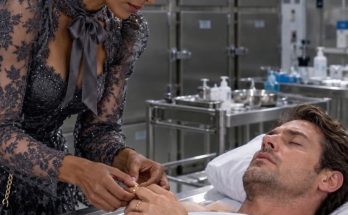
When she calmed down, I told her everything. The morgue, the cremation, the conversations I’d overheard, and the ring Leticia had taken off my finger.
My daughter began to tremble with outrage.
“That woman slept in my room after you died. She held me while I cried. She told me that now we only had each other.”
Then she opened her bag.
Inside was the crystal glass, still wrapped in a napkin from the reception.
“She wanted to take it from me,” Valerie explained. “She said I should let her keep it because it was a memento of her marriage. But I felt like it was the last thing Dad touched.”
At the bottom of the glass was a dry residue.
That changed our situation.
Adrienne went with us to hand the glass and the recordings over to the authorities, who requested specialized testing and preserved the evidence.
Hours later, we received an alarming preliminary result.
They had identified traces of a medication capable of severely disrupting heart function.
Its presence was consistent with what had happened to me.
“Arthur,” Adrienne told me, “the amount left in that glass could help explain why you lost consciousness. We need an expert to confirm everything, but this no longer looks like an accident.”
I remembered the drink spilling down my shirt.
My friend’s accidental bump had probably saved my life.
But there was another victim whose story we needed to hear.
Walter still had the phone number for Mrs. Socorro Delgado, the mother of Gerald, the man who died three years earlier.
When we called and explained what had happened, she took several seconds to respond.
“I’ve spent three years waiting for someone to tell me the truth about my son,” she whispered. “Tell me where you are.”
We went to see her.
She lived in a modest apartment near a farmers’ market. She was a small woman with white hair who kept Gerald’s photographs carefully arranged.
When she saw Walter, she recognized him immediately.
The old man took off his cap.
“Ma’am, I have to ask your forgiveness. I saw your son’s finger move before they cremated him. I tried to warn them, but nobody believed me. I never had the courage to tell you.”
Mrs. Delgado put a hand to her chest.
“I always knew something wasn’t right.”
Then she brought out a wedding album.
When she opened it, my stomach dropped.
There was Leticia.
Her hair was blonde and she was using a different name, but it was unmistakably her.
Beside her stood Octavio, also introduced as her brother.
The photographs showed a wedding just like ours: the same style of decorations, a toast in front of the guests, and personalized glasses.
But one photograph revealed something even more disturbing.
In the reflection of a mirror at the back of the hall, Leticia and Octavio were kissing passionately.
It wasn’t a family gesture.
It was the kiss of two lovers.
“My son never saw this photograph,” Mrs. Delgado said. “The photographer gave me the album after she disappeared.”
I looked at Walter.
For fourteen months I had welcomed Octavio into my home. I’d lent him vehicles, paid for his meals, and let him stay overnight whenever he said he was having money trouble.
Now I understood that the two of them had been performing a lie right in front of me.
We went back to Walter’s house with the album.
My sister Connie was waiting for us there.
When she saw me alive, she froze at first. Then she slapped me.
“Two days I’ve been mourning you, you jerk!” she yelled.
And then she hugged me.
I took the chance to ask her about that supposed deal with Leticia.
Connie lowered her eyes.
“A week before the wedding, I demanded she show me her documents. I couldn’t find anyone who knew her past. She promised to show them to me after the wedding if I kept quiet during the ceremony.”
“That was the deal?”
“Yes. And I agreed because I was afraid of losing my brother. When I found out she wanted to cremate you right away, I knew I had to stop it.”
It hurt to remember how I’d brushed off her warnings.
“I’m sorry I didn’t listen to you.”
“What matters is that you’re here. Now let’s prove what she did.”
Connie knew a family with ties to the Maricopa County Attorney’s Office. Thanks to their help, we were able to get in touch with Assistant County Attorney Mitchell, who agreed to review the case urgently.
We presented the medical records, the videos, the glass in protective custody, the photographs of Gerald, and Walter’s statement.
We also told him about the five thousand dollars Octavio had offered to recover my supposed corpse.
Mitchell listened carefully.
“There’s enough here to investigate a possible attempted murder,” he explained. “But we need to protect you and secure the evidence. I don’t want that couple finding out what we know before agents move in.”
I asked if they could be arrested at the visitation.
The prosecutor thought for a few seconds.
“We can put together an operation. You don’t have to face them alone.”
“I want everyone to see I’m alive,” I answered. “I want the people who mourned my death to know who organized that funeral.”
After weighing the risks, we agreed that I would go in accompanied and under the protection of law enforcement.
At five in the afternoon, we arrived at the funeral home.
At the entrance was a sign with my full name.
Arthur Mendoza. Rest in Peace.
Seeing it, I felt a strange mix of rage and sadness.
More than a hundred people filled the room. My employees, neighbors, relatives, and friends had gathered around a closed casket.
There were white flowers, candles, and a photograph of me standing beside a drilling rig.
Leticia was dressed in black.
Octavio stood behind her, a hand resting on her shoulder.
“Arthur was the greatest love of my life,” Leticia was telling everyone. “He taught me it’s never too late to start over. Even though our marriage lasted such a short time, I’ll carry him in my heart forever.”
Some people started to cry.
I listened from a side entrance.
Mitchell gave me a signal.
Then I walked slowly toward the center of the room.
One of my crew members saw me first.
“Mr. Mendoza!” he exclaimed, dropping his hat.
Several people turned.
A woman screamed.
The murmur became a roar of voices.
Leticia stopped speaking.
When our eyes met, the color drained completely from her face.
Her microphone fell to the floor.
I stopped in front of the casket.
“Good evening,” I said. “Looks like I made it in time for my own funeral.”
Nobody knew what to do.
Then Leticia reacted.
She started to sob and ran toward me with her arms open.
“Arthur, my love! You’re alive! It’s a miracle!”