**PART 3**
When I returned to my seat, Grandma Otie reached over and took my hand.
Her fingers seemed thinner than I remembered, but there was still strength in her grip.
She didn’t ask me to describe my career.
She didn’t question why I had stayed silent about it.
She simply held my hand for a little while and glanced toward Josephine.
Grandma had always been the one person who didn’t require a list of achievements to believe that I was headed somewhere meaningful.
When I was eighteen, she handed me twenty dollars and asked me to write postcards.
Years afterward, when I sent her that photograph from the pier at Pearl Harbor, she understood exactly why she was the only person who received it.
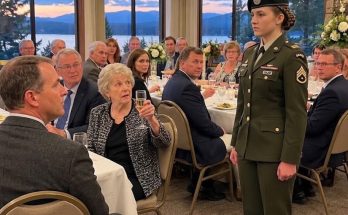
Once people began moving around the room again, Josephine approached our table.
Now that the rush of adrenaline had passed, she seemed embarrassed by what she had done.
“I’m sorry if I made everything more difficult,” she said.
“You didn’t.”
“I just couldn’t stay quiet and listen.”
“I understand.”
She paused uncertainly.
Then she began asking me questions about submarines.
Not about my mother.
Not about Barrett.
Not about the humiliating toast.
She wanted to talk about submarines.
For the first time all evening, I laughed because I had actually found something amusing.
Naturally, a nineteen-year-old Naval Academy midshipman wanted to discuss professional matters barely five minutes after blowing apart twenty years of family mythology.
So I answered the questions I was permitted to answer.
I shared the details that were mine to discuss.
I listened carefully as she described her experience in Connecticut.
And I watched the expression on her face change as she realized that the photograph hadn’t been some bizarre coincidence after all.
The aunt she barely knew had been living an entire professional life that existed completely outside the story her family had told her.
But there was something painful about that realization, too.
Not because I expected everyone to admire my accomplishments.
It hurt because Josephine and I had missed years when we could have developed an honest relationship and genuinely known each other.
That was the true damage caused by the lie.
It wasn’t humiliation.
It was the distance it created.
Mom had turned my professional life into a family joke by acting as though it didn’t exist, but I had also contributed to that separation each time I decided keeping quiet would be easier.
I could acknowledge my own part without accepting responsibility for my mother’s choices.
Both truths could exist together.
Eventually, the birthday celebration returned its attention to Grandma, exactly where that attention belonged.
Someone brought out her cake.
Relatives gathered around her for photographs.
Servers topped up the coffee cups.
Behind Table Nine, the kitchen doors continued swinging as staff carried dishes into and out of the room.
The supper club hadn’t suddenly become a courtroom, and that was never something I wanted.
No one needed to hold a vote to decide who had been telling the truth.
I didn’t need the relatives to applaud me.
My professional life already contained more than enough ceremonies.
What I hoped to receive from my family was something far less dramatic, but much more difficult to obtain.
An accurate understanding of who I was.
A willingness to be curious.
The ordinary respect of asking me about my own life before allowing somebody else to define it.
Mom and I didn’t mend twenty years of damage during a single birthday dinner.
Barrett and I didn’t suddenly become close simply because his daughter had exposed his lie.
Josephine’s salute couldn’t erase the vacant chair at my commissioning ceremony, or restore the time I had missed with relatives at weddings and funerals.
Life didn’t offer us a resolution that convenient.
Still, something important had shifted.
The old family version of Francis could no longer circulate without somebody challenging it.
Too many people had witnessed what happened.
More importantly, one of those witnesses had decided to stand for the truth without knowing what it might cost her within the family.
Josephine hadn’t saluted because she wanted to make Dolores look foolish.
She had saluted because she recognized the woman standing in front of her.
I carried that distinction with me.
Toward the end of the celebration, I noticed a server using a broom to gather a few crumbs and scraps of paper from the floor near the kitchen doors.
For an instant, I was looking at a different floor, remembering a different mess, and seeing the broom someone had placed in the hands of a young girl called Frankie after her brother broke a window.
For most of my life, I had believed that strength meant being the person who could quietly clean up every problem without making anyone uncomfortable.
But on that evening, I finally left the broom where it belonged.
I stayed beside Grandma, answered Josephine’s questions, and allowed the rest of my family to decide for themselves what they would do with the truth now that it was finally there for everyone to see.