**PART 2**
Barrett’s daughter had still been a child throughout much of my naval career.
By the time Grandma’s birthday arrived, she was nineteen and attending the Naval Academy as a midshipman.
Three months before the celebration, she had participated in submarine indoctrination in Connecticut.
During that visit, she walked past a wall covered with photographs of commanding officers.
One of those photographs showed my face.
And beneath it was my last name.
She stopped walking.
She knew me well enough to recognize the woman in the photograph, but she didn’t know enough about my life to understand why the aunt everyone called aimless was pictured among submarine commanding officers.
At Easter, she brought the photograph to Barrett’s attention.
“Dad, is that Aunt Francis?”
“No.”
“But the surname is the same.”
“Just a coincidence.”
If Josephine had grown up believing family explanations as unquestioningly as I once had, that answer might have ended the matter.
But she hadn’t.
She recognized that her father wasn’t telling the truth.
What she still didn’t understand was why he would lie about it.
When I arrived at Grandma Otie’s birthday gathering several months later, I had no idea that any of those conversations had taken place.
Aunt Loretta welcomed me with, “Well, look who managed to show up this time.”
I gave her a smile because years of experience had taught me how to handle those remarks without encouraging more of them.
Then Grandma noticed me.
Her entire expression brightened.
And that was all I needed.
I went straight to her.
I embraced her gently.
I asked how she was feeling.
Then I listened as she joked that putting ninety candles on her cake would have required a fire permit if the family had been foolish enough to attempt it.
Afterward, I settled into my chair at Table Nine, beside the kitchen doors.
Josephine kept watching me.
Not in an impolite way.
More like she was concentrating.
At first, I figured she was deciding whether she should come over and greet me.
Then I noticed her attention shifting toward my hands, the way I carried myself, and my reactions whenever she brought up her training.
She was searching for confirmation of something.
She was comparing the woman seated by the kitchen entrance with the photograph she remembered seeing in Connecticut.
At the time, I still had no understanding of what was happening.
Before Josephine could question me, Mom took possession of the microphone.
The supper club was warm from the crowded room, dinner dishes, and the kitchen doors that swung open behind my chair every few minutes.
Coffee cups stood beside plates that had held dessert.
Grandma occupied a seat where she could look around and see almost everybody.
My mother had always enjoyed having a microphone.
She understood how to speak to a crowd in a way that made her opinions sound like facts everyone had already accepted.
She started by honoring Grandma.
Then she talked about the rest of the family.
Eventually, she arrived at my name.
The laughter that followed her description of me as the “family loser” struck me differently than it would have two decades before.
At eighteen, I probably would have escaped the room.
At twenty-six, I might have tried defending myself.
But at thirty-eight, only eleven days removed from a deployment, I was simply exhausted.
I could have risen from my chair and corrected everything she said.
I could have explained that I had earned my commission.
I could have told them about serving aboard submarines.
I could have described my years as an executive officer, my early selection for commander, and the command I assumed in June 2023.
Instead, I remained silent.
I raised my glass toward Grandma.
“You look wonderful tonight.”
And I meant every word.
I intended to ignore the rest of the insult.
Just as I always had.
But Josephine was unwilling to let me do that.
Her chair scraped against the floor as she pushed it backward.
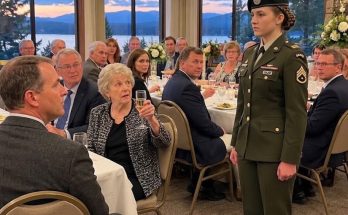
She stood in her dress whites.
She turned to face me.
Then she raised her hand.
The laughter began fading as more people noticed what she was doing.
Mom still held the live microphone when she looked toward Josephine with an irritated frown.
“Josephine, what in the world are you doing?”
My niece didn’t look at her grandmother.
She kept her eyes fixed on me.
Her chin trembled.
But her raised hand remained perfectly steady.
“Ma’am.”
A single word.
And that one word told me everything.
She recognized the photograph.
She understood the rank.
And she knew precisely what her salute represented.
Suddenly, two entirely different versions of me existed inside that supper club.
One was the Francis described by Dolores: unmarried, irresponsible, directionless, and incapable of finishing anything.
The other was the woman standing before a Naval Academy midshipman who had just saluted her in front of sixty-one witnesses.
Those two versions couldn’t comfortably exist in the same place.
I raised my hand and returned Josephine’s salute.
She lowered her hand afterward.
This time, not a single person laughed.
I noticed Aunt Loretta looking toward Mom before turning her gaze back to me.
I watched relatives who had spent years accepting convenient explanations begin piecing things together on their own.
All the holidays I had missed.
The extended periods when I disappeared.
My carefully limited descriptions of my work.
The fact that I rarely explained where I had been.
Even the unremarkable navy dress I was wearing.
None of those details, considered separately, established anything about my profession.
And Josephine didn’t have to deliver a long explanation.
The simple fact that she recognized me had already cracked open the family’s familiar narrative.
Mom was the first person to attempt to regain control.
“What is this supposed to mean, exactly?” she demanded.
Because she was still holding the microphone, her question echoed farther across the room than she probably intended.
Josephine finally turned toward her.
There was no smugness on my niece’s face.
That detail mattered to me.
She wasn’t trying to embarrass her grandmother or score points in a family disagreement.
She was a visibly nervous nineteen-year-old who simply refused to repeat a claim she knew was untrue.
She explained that while attending submarine indoctrination, she had seen a commanding officer’s photograph with my name displayed beside it.
She told everyone that she had questioned her father about the photograph.
Barrett shifted uncomfortably in his seat.
His reaction revealed more to me than anything he could have said in denial.
Josephine turned her attention back to me.
“Aunt Francis, you’re the commander of a submarine, aren’t you?”
There it was.
Not some grand declaration.
Not an attempt to get even.
Just a question whose answer my family should have bothered to discover years ago.
“Yes.”
Such a small word seemed almost ridiculous after everything that had led to that moment.
Mom stared directly at me.
“You never told any of us.”
I could have reminded her of every ignored invitation, every time she dismissed my explanations, and every occasion when she decided what my life meant before allowing me to finish speaking.
I could have brought up my commissioning ceremony back in 2009.
I could have reminded her that I had mailed five invitations.
I could have asked why Grandma had managed to receive a photograph from my change-of-command ceremony while everyone else had apparently lacked enough interest to ask what I did for a living.
But I didn’t say any of those things.
I looked directly at my mother and answered, “You quit asking years ago.”
Nothing more.
For years, brief responses had kept me imprisoned within our old family dynamic, but this answer was different because I wasn’t using it to conceal anything.
I was choosing not to put on a performance.
Barrett turned toward Josephine.
She met his eyes.
There was no need for either of them to revisit the exchange they had shared at Easter.
The fact that he had dismissed my photograph as a “coincidence” was already hanging between them.
For the first time, I made no attempt to rescue him from the awkwardness.
For the first time, I didn’t reach for the broom.
That might have been the most difficult thing I did during the entire evening.
I had spent decades taking responsibility for the discomfort other people caused.
Whenever a joke went too far, I tried to soften its impact.
Whenever a lie created an uncomfortable situation, I redirected the conversation.
Whenever a family member repeated Mom’s inaccurate version of my life, I let the statement pass because challenging it felt impolite.
But that night, I decided the discomfort should remain with the people who had created it.
And I allowed it to stay there.