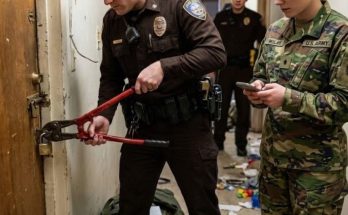
“Our financial investigators pulled his accounts this morning, with the court’s permission. In the past eleven months, he’s received twenty-two payments from a company connected to the clinic, totaling about three hundred thousand dollars. The memo lines say consulting.”
I almost laughed. For a year Carter had been telling me we couldn’t afford a new roof, and he’d gone on about being careful with money. All that time he’d been paid to deliver our daughter.
“The clinic gets insurance money for treatments that never happened,” I said slowly. “And he got paid for sending them his child.”
“Not just yours. He brought in at least two other children, we think. Cousins, children of colleagues’ friends. Spencer drove them.”
“How do I help?”
“We’d like to catch Spencer in the act. Today. Pickup is at three, correct?”
At two forty-five, I stood at the edge of the school’s parking lot, wearing sunglasses and a baseball cap. Detective Ramirez and two plainclothes officers waited in a minivan across the street. A teacher named Ms. Alvarez, who had been briefed that morning, walked Harper’s empty place in line back inside and told Spencer, when he arrived, that Harper had been picked up early by her mother.
He didn’t believe it. I watched him stand in the pickup lane with his phone pressed to his ear, then slowly turn his head toward the building.
Then he saw me.
For three full seconds, nobody moved. Spencer’s face went through a dozen expressions, confusion first, then fury, then the kind of fear I had never seen on him.
He ran. He made it about forty feet before two officers took him down on the grass beside his car. He shouted that it was a misunderstanding, that he was only a driver, that he had a right to a lawyer. In the backseat of his car, the officers found a small cooler bag. Inside were three syringes, a bottle of juice, and a child’s cartoon blanket.
I stood there with my hand over my mouth.
The juice was how they had been doing it.
The warrants reached Dr. Crane’s clinic ten minutes later. Federal agents carried out boxes of files, computers, and locked drug cabinets. Delia Crane, a polished woman in a navy blazer, was arrested at the front desk without raising her voice. In her office they found a binder of insurance forms and a spreadsheet of children, each one listed by first name only, with a column beside it labeled Referral.
Carter’s name was on eleven rows.
Part 5
Carter was arrested at his office at four fifteen.
I wasn’t there, but I heard about it later from a colleague of his, who said two agents walked past the receptionist and asked him to stand. He had been in the middle of a quarterly presentation. He asked if it could wait. They said it couldn’t.
I saw him once before the trial, in a small room at the county detention center. My lawyer had advised against it, but I needed one thing from him, and I knew I would never get it any other way.
He sat across the table in an orange jumpsuit, unshaven. When he saw me, he tried the old smile. It didn’t work.
“Melanie, thank God. You have to get me out of here. This is a terrible misunderstanding. I was doing consulting work. I didn’t know what Delia was really doing.”
“You told Spencer to make sure he didn’t leave any marks.”
He went quiet.
“I have the recording, Carter. I’ve listened to it fifty times.”
“She was never in danger,” he said, finally, and I heard something new in his voice, a kind of weary honesty. “Delia was a doctor. Harper was sedated for her own comfort. She never felt a thing. It was just blood work and IV time. It wasn’t like I was hurting her.”
I stared at him. “She woke up crying. She said everything hurt.”
“Kids exaggerate.”
“She doesn’t remember a single one of those afternoons. She trusted her uncle. She trusted you. And you sold her.”
“It was only paperwork, Melanie,” he said. “Nobody was supposed to get hurt. We were in trouble. The mortgage, the loans, my gambling…” He stopped, as if he had said too much.
“Your gambling.”
He looked down at the table. “I owed people money. A lot. Delia offered a way out.”
All those months of tight budgets, of his sudden irritability, and the nights he’d said he was working late. I had been so busy trying to be a good wife that I never asked where the money went.
“Why didn’t you tell me?”
“Because you would have left.” His eyes came up, wet and defensive. “And I couldn’t lose you.”
That was it. That was the thing I needed to hear him say, and I realized it wasn’t an apology at all. It was an excuse. He had traded our child’s safety for the comfort of not being found out.
“You didn’t lose me because I found out,” I said, standing. “You lost me the first time you laughed when I told you she was in pain.”
“Melanie—”
“Goodbye, Carter.”
I walked out of that room and didn’t look back.
Epilogue
The trial took place the following spring.
Spencer pleaded guilty in January and agreed to testify against the others. His account matched the recording, the clinic’s records, and the bank statements. Dr. Crane’s lawyers argued for months that the sedation was legitimate medical practice, but the toxicology reports, her own spreadsheets, and the testimony of a former nurse named Gwen Mercer, who had quietly resigned from the clinic and kept copies of everything, left almost nothing for them to stand on.
Dr. Delia Crane was convicted of health-care fraud, child endangerment, and unlawful administration of controlled substances. She received twenty-two years. Her medical license was permanently revoked.
Carter was convicted on all counts. The judge, a stern woman with silver hair, spoke directly to him at sentencing. “You were not a bystander, Mr. Hale. You were a father. You were the one person your daughter had every reason to trust, and you used that trust as currency.” He was sentenced to eighteen years. Spencer received nine, reduced for his cooperation.
Seven children had been identified by then. Their parents, some of whom had been deceived and some of whom had not, were contacted through the proper channels. I wrote to each of the families who wished to hear from me, because I understood what it was to wake up and realize that someone you trusted had lied to you.
The divorce was final by summer. I kept the house, because the court agreed that I should, and I sold it six months later, because I never wanted Harper to feel afraid in the kitchen where I had once poured her father’s coffee. We moved to a small town outside Austin, to a yellow house with a crooked porch and a walnut tree out back.
Harper started therapy with a gentle child psychologist named Dr. Patel, who used puppets and drawing and long afternoons of quiet. For a while, my daughter slept with the light on. She flinched whenever a car door closed outside. Some nights she woke up crying and couldn’t say why, and I would climb into her bed and hold her until morning.
She never recovered the memories, and Dr. Patel said that might be a mercy. What came back instead was her laugh. It returned slowly, like a bird landing on a fence, and the first time I heard it again, over a bowl of cereal and a terrible joke about a cow, I had to leave the room so she wouldn’t see me cry.
On the first anniversary of that morning in the emergency room, we planted a small tree in the yard. Harper chose it, a redbud, because she liked the purple flowers. She patted the soil down with both hands.
“Mommy?”
“Yes, sweetheart?”
“Dr. Patel says I did a brave thing. But I don’t remember doing anything.”
I knelt beside her and brushed the dirt from her fingers.
“You didn’t have to, baby. You told me something was wrong every single time. You just didn’t have the words. I was the one who had to listen.”
She thought about that. “But you did listen. Eventually.”
“Eventually,” I agreed. My voice shook. “I’ll always be sorry it took so long.”
“It’s okay, Mommy.” She leaned against my shoulder. “You came and got me.”
I held her tightly, in the warm Texas sun, beneath the thin branches of a tree that would someday be tall.
For a long time I blamed myself for the weeks I let Carter talk me out of my own instincts. Now I understand something I wish I had known sooner. A mother’s doubt isn’t hysteria. It’s information. When something feels wrong, and the people around you insist that nothing is, it is not disloyal to keep asking. It is the most loyal thing you can do.
Harper is ten now. She plays the cello badly and with total joy. She’s afraid of nothing except spiders and long division. And every afternoon, when the school bell rings, I’m the one standing at the gate.
The End.