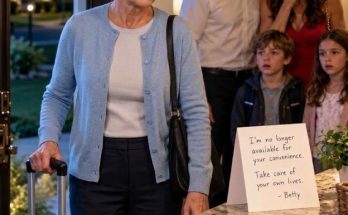
**Part 3**
Three days later,
I signed the apartment lease.
It was a one-bedroom place
above a row of small shops,
with a narrow balcony
that faced west.
The manager warned me
that the bakery downstairs
started early.
I told her
early mornings didn’t frighten me.
What frightened me,
though I didn’t say it,
was having hours
no one else had claimed.
I moved in on a Saturday.
Daniel carried the sewing machine.
Marlene brought a kettle.
Noah brought his volcano base,
carefully wrapped in newspaper.
Sophie brought a drawing
of three houses connected
by a winding purple road.
One was her house.
One was Marlene’s.
The smallest was mine.
She had filled its windows
with yellow light.
“Can I put this on the fridge?”
she asked.
“You can choose the magnet.”
She chose one shaped
like a red apple.
For the first month,
quiet surprised me everywhere.
At three in the afternoon,
I would look up from a book
and wonder which child
needed to be collected.
At six, I would measure rice
for more people
than my table could seat.
Once, I ironed a shirt
before realizing it was mine
and I had no need
to wear it crisp.
I missed the children fiercely.
I missed Daniel’s face
appearing in the kitchen
before he left for work.
Some mornings,
I even missed knowing
exactly what everyone needed.
Knowing had made me feel necessary.
Learning the difference
between necessary and loved
took longer.
The first Friday,
Noah and Sophie came
for pancakes.
Daniel dropped them off
and stood awkwardly
in my doorway.
“Do you need anything
from the old house?”
“No, thank you.”
“Emily sent strawberries.”
He held up a container.
“Those I’ll take.”
He smiled.
The children spent the morning
covering my table with flour.
Noah’s volcano remained untouched
while he told me
about a new friend at school.
Sophie drew faces
on the backs of grocery receipts.
When Daniel returned,
she asked whether she could stay.
“Grandma and I made plans
for next Friday,” he told her.
She accepted that
more easily than I had expected.
As they left,
Noah turned back.
“You seem happier here.”
“I’m learning how to be.”
He considered that.
“Okay.”
Then he ran downstairs
after his sister.
One afternoon in October,
Emily called.
I almost let it ring.
I answered instead.
“Betty,” she said.
It was the first time
she had used my name
without someone prompting her.
“I’m calling about Sophie’s birthday.”
We discussed cake,
the guest list,
and the hour I would arrive.
Then she hesitated.
“I also wanted to ask
if you’d have coffee with me.”
We met at the bakery
beneath my apartment.
Emily wore her work clothes
and looked exhausted.
She thanked me
for agreeing to see her.
Then she took a folded paper
from her bag.
I braced myself
for a school form,
a shopping list,
some new task
I hadn’t known was mine.
It was a drawing.
Sophie had made it
before the dinner.
It showed a long table
crowded with stick figures.
I was at the far end,
beside an empty chair.
“Her teacher found it
in the classroom folder,”
Emily said.
“She asked Sophie
who was missing.
Sophie said, ‘Grandma’s sitting
where she can see everyone.’”
My throat tightened.
Emily smoothed the paper.
“She had included you.
I wish I had noticed
what she already knew.”
I looked at the little figure
with gray curls
and a bright green dress.
Sophie had given me
the biggest smile at the table.
“I want her to keep it,”
I said.
Emily nodded.
“I haven’t told you everything.”
I set down my cup.
“When I got the promotion,
I was scared,” she said.
“The new job means travel.
I knew we needed childcare.
I assumed you’d cover it
because you always had.”
She met my eyes.
“At dinner, my mother asked
how we’d manage.
I said we had you.
It sounded so easy
when I said it aloud.”
“What did you feel
when you said it?”
“Ashamed.”
She looked toward the window.
“I didn’t want you there
hearing me talk about you
like part of the schedule.
So I told myself
you’d rather stay home.”
The bakery bell rang.
Someone came in
shaking rain from an umbrella.
For a moment,
I listened to water tapping
against the glass.
It was a painful truth.
It was also the first
she had given me
without asking me
to make it smaller.
“Thank you for telling me,”
I said.
“I’ve arranged care
for my travel days,” she replied.
“I should have done it years ago.”
I looked at her.
“I want you to succeed, Emily.”
“I know.”
“And I want to come
to the next family celebration
because I’m invited.”
“You are.”
“We’ll see how that feels.”
She accepted that too.
We did not leave the bakery
as close friends.
We left knowing
what each of us had said.
It was a beginning
I could trust more
than a cheerful promise.
Winter came early.
A bitter wind moved
through the streets,
and the bakery windows fogged
before sunrise.
Marlene convinced me
to return to the library
on Thursdays.
At first, I shelved books
and helped children
find stories about planets.
Then I began leading
a small reading group
on Wednesday evenings.
One night, I came home
with a stack of novels
and found a message from Daniel.
I passed your old exit today.
I almost took it automatically.
I called him.
He was making dinner.
I could hear a pan sizzling
and Sophie giving instructions
from somewhere nearby.
“I remember you taking that exit,”
I said.
“You and Dad used to stop
for ice cream there.”
“Dad always ordered vanilla.”
“And stole half my chocolate.”
Daniel laughed.
Then his voice softened.
“I’ve been thinking about him.
About how much changed
after he died.”
“I know.”
“I thought bringing you in
meant I was taking care of you.”
“At first, it helped me.”
“I stopped checking.”
“Yes.”
A cupboard closed
on his end of the call.
“I’m checking now,” he said.
I stood beside my window
and watched the bakery lights
glow on the wet pavement.
“I can tell.”
At Sophie’s birthday party,
Emily’s mother came over
while I was helping Sophie
untangle ribbon from a gift.
She asked how I liked
my “little vacation apartment.”
“It’s my home,” I said.
She blinked.
“Of course.”
Sophie held up her new kite.
“Grandma has a balcony,”
she announced.
“And on Fridays
she makes pancakes.
On Thursdays
she belongs to the library.”
Emily, standing behind her mother,
looked at me.
I smiled despite myself.
Sophie had understood
something the adults
had taken years to learn.
The party ended
with paper plates everywhere
and frosting on Noah’s sleeve.
I helped clear the table
because I wanted to.
When Emily said,
“You can leave those,”
I put down the plates.
Then I sat with Sophie
and watched her assemble
a puzzle of the night sky.
In January,
I finally hung Frank’s photograph.
Not in the bedroom.
I put it beside the balcony door,
where afternoon light
fell across the frame.
The following Friday,
Noah noticed it.
“Grandpa looks cold.”
“He was freezing.”
“Why’s he smiling?”
“A wave caught him
before he could run.”
Noah studied the picture.
“I wish I remembered him.”
“He knew you were coming.”
“Did he?”
I nodded.
“We drove past your house
when your parents first saw it.
He pointed at the maple tree
and said you’d climb it.”
Noah looked impressed.
“He was right.”
“He often was.”
I thought about
how carefully I had kept
that photograph turned away.
I had feared seeing Frank
happy without knowing
what was ahead of us.
Now I saw something else.
He had made plans
for a child he would never meet.
The love in that moment
had still been real.
In March,
the library held a Saturday fair.
I helped run a table
where children could make bookmarks.
Marlene sold donated books.
Daniel arrived with the children,
and Emily followed
carrying a box of supplies
the library had requested.
She asked where to put them.
I pointed toward the storeroom.
An hour later,
I saw her helping Sophie
thread a ribbon
through a crooked hole.
Daniel stood nearby,
reading Noah’s latest book choice.
They had come
because I had invited them.
They stayed to spend time
in a place that mattered to me.
When the fair ended,
we carried the folding tables
back into storage.
Emily reached for the heaviest one.
I took the other end.
Halfway across the room,
she said, “I’m proud of you.”
I thought of my first Thursday,
when I had felt almost foolish
introducing myself to the volunteers.
“Thank you,” I said.
“I’m proud of you too.”
We set the table down.
She understood
I meant the work she had done,
at her job and at home.
Neither of us needed
to explain it further.
That evening,
I ate dinner at Daniel’s house.
Everyone was there.
There was room for me
between Sophie and Noah,
though Sophie kept shifting closer
until her elbow touched mine.
Daniel had cooked.
Emily served the vegetables.
Her mother had brought dessert.
No one asked me
to clear the plates.
Afterward, I carried mine
to the sink anyway.
Daniel dried his hands
and took it from me.
“Go sit down, Mom.
Noah wants to show you
what he built.”
I went.
His model volcano
stood on the coffee table,
painted brown and green.
He had made a small house
at the bottom of the hill.
“Is that yours?” I asked.
“No,” he said.
“It’s Grandma’s.
See the balcony?”
There it was,
a thin strip of cardboard
with a yellow paper window.
He showed me
how he had kept it
clear of the painted lava.
Later, when I left,
I walked past the fridge.
Sophie’s old drawing
was held beneath
the same crooked magnet.
The long table was still crowded.
My green-dressed figure
sat beside its empty chair.
I paused long enough
for Daniel to notice.
“We kept it,” he said.
“I’m glad.”
Outside, the maple tree
was beginning to bud.
The night air smelled
of damp earth.
I drove home
with a container of cake
Emily had asked
whether I wanted.
Upstairs, I put it
in my own refrigerator.
Then I opened the balcony door
and stood looking west.
The street below was quiet.
Behind me were my books,
Sophie’s drawing,
and Frank smiling
in the light from the kitchen.
Friday would bring pancakes.
Thursday belonged to the library.
Tomorrow morning,
I could sleep late
or wake with the bakery.
I stayed outside
until the air turned cold,
then went in
and closed the door
to my home.