**Part 3**
We didn’t talk about it in the truck on the way home.
Mason fell asleep against the window before we even got to the edge of town. Kaylee rode with her friends to the team’s pizza party at Casey’s.
Travis drove with both hands on the wheel. The rose lay on the dashboard, rolling a little on the curves.
He didn’t say a word for eleven miles.
Neither did I.
When we got home, I carried Mason up to bed and came back down.
Travis was sitting at the kitchen table. In the same chair he’d been sitting in on Tuesday.
The rose was lying in front of him on the oilcloth.
I put on a pot of decaf.
I didn’t ask him anything.
I sat down across from him, and I waited. The same way I’d waited all week.
Only this time, it didn’t feel like a test.
“I’m sorry I didn’t tell you Dad was coming,” I finally said. “I should have. I wanted you to decide on your own. But that wasn’t fair to you.”
He shook his head.
“You were right not to,” he said. “If you’d told me, I’d have done it for you. I needed to do it for her.”
And then he told me something he’d never told me in nine years of marriage.
And it explained the whole thing.
I had to set my coffee cup down.
When Travis was twelve years old, his mother remarried.
The man’s name was Dale.
He wasn’t a bad man, Travis said. He worked hard. Paid the bills. Never raised a hand to anybody.
That spring, Travis played Little League.
At the end of the season, there was a banquet at the American Legion. The boys’ fathers were supposed to stand up behind them when they got their trophies.
Travis asked Dale to come.
And Dale said, right there in front of Travis’s mother, at their own kitchen table:
“You’re not mine to raise. That’s your dad’s job. I’m not going to stand up there and pretend.”
“My dad wasn’t coming either,” Travis said. “So I walked up there alone. I got my trophy. I walked back to my seat. And I never asked Dale for anything ever again.”
He turned the rose a quarter turn on the oilcloth.
“I swore I’d never do that to a kid. I’d never make a kid feel like that.”
He looked up at me.
“And Tuesday night, I sat right here in this chair and I said almost the exact same words.”
“Why?” I asked him.
Not mean. I just needed to understand.
“Because I’ve been scared for nine years that I was overstepping,” Travis said.
“Every time I wanted to call her mine, I’d think about her real dad. What if he shows up someday. What if she resents me for it. What if I take something that was never mine to take.”
He rubbed his face with both hands.
“When I said real dads, Jodi, I wasn’t talking about her. I was talking about me. I didn’t think I counted. I didn’t think I was allowed to count.”
He was quiet for a long time.
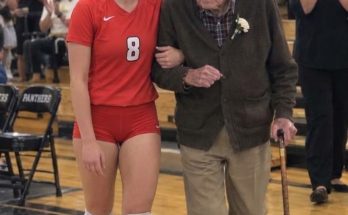
“Then I watched your dad walk her out on that cane,” he said. “A seventy-nine-year-old man. Walking the whole length of that gym. And I thought, what in the world am I doing up here?”
He looked down at the rose.
“He showed up. That’s all a real dad is. The one who shows up. And I’ve been showing up for nine years, and telling myself it didn’t count.”
I reached across the table and put my hand over his.
His hands are rough. From the shed. From loading seed bags and fixing augers.
He turned his hand over. And he held on.
We sat there like that until Kaylee came home at eleven.
She came in through the back door in her warmup jacket. Her braid half undone. Smelling like pepperoni and the gym.
She stopped when she saw us at the table.
She looked at the rose.
Then she walked over and did something she hadn’t done since she was ten years old.
She sat down on Travis’s knee.
Like a little girl.
She’s five foot ten. She’s a middle hitter. She didn’t fit on his knee at all.
It didn’t matter even a little bit.
“I put my phone away during the party,” she said. “Everybody kept showing me the video. Somebody already put it on Facebook. Grandpa has four hundred likes.”
Travis laughed. It came out wet.
“Your grandpa doesn’t even know what Facebook is.”
“I know,” she said. “That’s the best part.”
Then she was quiet for a minute.
And she said, to the side of his head, “I wasn’t mad that you said no, Travis. I was mad because I thought you didn’t want to.”
“I always wanted to,” he said. “Every single day. I was just scared.”
“Scared of what?”
He thought about it.
“Of you telling me I wasn’t your dad.”
Kaylee pulled back and looked at him. Like he’d just said something in a foreign language.
“Travis,” she said. “Who do you think taught me how to braid my own hair?”
That’s when I had to get up and go stand at the kitchen sink for a while.
The next morning was Friday.
My father called at 6:15. Which, for him, is sleeping in.
He wanted to know if the rose was in water.
He said a rose that good ought to last a week, if you cut the stem at an angle.
Travis cut the stem at an angle. He put it in a canning jar on the windowsill over the kitchen sink.
It lasted nine days.
My father said that was a record for a flower shop rose in October.
Travis never made a speech about any of it again. He’s not that kind of man.
But a few things changed in our house after that night. And I want to tell you about them. Because they’re the real ending.
He started coming to parent-teacher conferences with me.
For years he’d always waited out in the truck. He said the teachers only needed one of us.
Now he comes inside. He sits in those tiny plastic chairs. And he asks Kaylee’s chemistry teacher about her grades.
The Saturday after senior night, he drove out to my father’s place and spent the whole afternoon fixing the latch on the machine shed door.
It had been sticking since August.
Dad hadn’t asked him to. He just went.
Dad told me later they didn’t talk much.
They fixed the latch. They sat on the tailgate of Travis’s pickup and drank coffee out of Dad’s old green thermos.
And Dad said, “She’s a good girl.”
And Travis said, “She is.”
That was about the whole conversation.
With men like my father and my husband, that’s a long talk.
As for Ryan, Kaylee’s father, he never knew any of it happened.
I thought about sending him the video.
I decided it wasn’t mine to send. Kaylee never mentioned it. So it stayed where it was.
Kaylee’s volleyball season ended in November. A five-set loss in the section semifinals.
She cried about it for two days. Then she never mentioned it again.
And in April, she sat down at the kitchen table with her laptop to fill out her graduation announcement.
The company the school uses has an online form. Lines for the graduate’s name. The date. The time of the open house.
And the parents’ names.
I was at the stove cooking supper.
Tater tot hotdish, as it happens.
I didn’t plan it that way.
Travis was sitting across the table from her, working out his spring seed deliveries on his own laptop.
Kaylee typed for a while.
Then she turned her screen around so we could both see it.
And she didn’t say a word.
She just waited. The way I’d waited at that table in October. The way her grandpa had waited, holding out that rose.
Travis looked at the screen.
He took off his reading glasses.
And he didn’t say anything for a long time.
Under her name, on the line that said Parents, there were three names.
Jodi Brandt.
Travis Brandt.
Duane Ostrem.
Travis reached across the table and touched the edge of that laptop screen. Just the edge. Like it might break.
“You spelled Ostrem right,” he finally said. His voice was rough. “Your grandpa will want to know you spelled it right.”
“I know how to spell my own grandpa’s name, Travis.”
“I know you do, Kay.”
She turned the laptop back around and hit submit.
Then she looked over at the stove.
“Is that hotdish?”
“It is,” I said.
“Good,” she said. “I’m starving.”
And the four of us ate supper together at that kitchen table. Same as always.
Except nobody was waiting for anybody to fix anything.
And nobody had to ask.