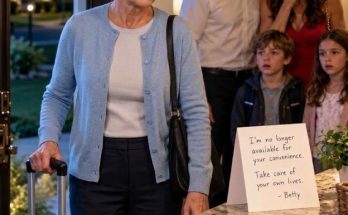
Now my son was telling me something very different.
I called the tablet immediately.
No answer.
I tried again.
This time it went straight to voicemail.
Then one last message appeared.
“Mom, whatever happens, don’t give Dad the card.”
I stared at the screen.
My son hadn’t simply chosen his rich father over me. He had walked into Grant’s world carrying a secret, and somehow he had made me the only person he trusted to protect it.
Part 2: My Son Left Me $3.8 Million, but His Grandfather Had Hidden Something More Valuable
I was still standing outside Dulles International Airport when my eight-year-old son’s last message came through.
Mom, whatever happens, don’t give Dad the card.
Seven days earlier, Owen had told a judge he wanted to live with his wealthy father because I couldn’t give him the future he deserved. Now he was warning me about that same man while secretly handing me access to $3.8 million.
I didn’t know whether to feel hopeful or terrified.
Instead of driving home, I checked into a hotel near the airport. I locked the door, set the black card on the desk, and replayed Owen’s messages until I knew every word.
At 11:40 that night, a new voice message arrived. It was shorter than the others, and I could hear a door closing somewhere behind Owen’s whisper.
“Mom, I’m okay. I’m in the bathroom. Dad thinks I’m brushing my teeth. Grandpa Walter made me a video. It’s on the tablet. The password is the name of the dinosaur you gave me. I can’t send it, but I can tell you where he said the paper is.”
I pressed the phone against my ear.
“Grandpa said to tell you the paper is in the lighthouse. You’ll know.”
The line went dead.
I sat on the edge of the hotel bed, and my mind went back four years to Walter Whitaker’s study at the estate. He had been a hard, formal man who rarely smiled, but he had always been gentle with Owen. He kept a small brass lighthouse on his desk, and Owen was the only person allowed to touch it. The last time I saw it, Owen was four, and Walter had pressed it into his hands and said, “This is yours when you’re big enough to keep a secret.”
Everyone had assumed Walter was being sentimental. I lay awake until dawn working out how a dying man might have planned for a four-year-old to carry something dangerous across the years without knowing it.
In the morning I called the only person I trusted, an attorney named Priya Natarajan who had handled a small lease dispute for me years earlier. I told her everything: the court statement, the airport, the card, the messages.
She was silent for a long moment.
“Rachel, do not use that card,” she said. “Not once. Don’t even check the balance. If that money is what I think it might be, every transaction will leave a trail, and the wrong person could follow it straight to you. Can you come to my office today?”
“What do you think it is?”
“I think your father-in-law may have been protecting something,” she said carefully. “And I think your son may be the only person he trusted with it.”
Part 3
Priya’s office was on the ninth floor of a plain building in Tysons Corner. She had cleared her schedule, and a second person was already waiting at the conference table, a thin, tired-looking man in his fifties with a gray folder in front of him.
“This is Tomas Beck,” Priya said. “He’s a special agent with the FBI’s financial crimes unit. I called him last night, after we spoke.”
I felt my pulse in my throat.
“You asked me not to use the card,” I said to Priya. “I didn’t. But how did he…”
“Because the agent has been waiting four years for someone to call him,” she said.
Beck opened the folder.
“Walter Whitaker contacted our office a few months before he died,” he said. “He told us he’d discovered that someone inside his own company was using the family’s hotels to launder money for a group of men who weren’t the type you say no to. He was a careful man. He said he needed more time to gather evidence, and he didn’t want to name anyone until he could prove it. Then he died of a heart attack, and the paper trail went cold.”
“Who was he protecting?” I asked, though I already felt the answer sinking through me.
“His son,” Beck said quietly. “Walter wasn’t sure how deeply Grant was involved. He hoped Grant was being pressured rather than complicit. That’s why he never gave us a name.”
I stared at the table.
“The men Grant works with are real,” Beck continued. “One of them is Victor Lang. He moves money through shell companies, and he doesn’t forgive mistakes. About six months ago we began to suspect that Grant had lost control of something. Walter’s records are missing, and Grant has been searching for them ever since.”
“The custody case,” I whispered.
“Probably not about Owen at all,” Priya said gently. “Or not only about him. Grant needed a legitimate reason to move your son into the estate. If Walter hid something, and Owen found it…”
“Then Grant would want Owen close,” I said. “To find out what he knows.”
I thought of my son’s rehearsed little voice in the judge’s chambers. Mom can’t give me the future I need.
“He wasn’t lying,” I said slowly. “He was acting. He agreed to go so he could keep the secret safe.”
Priya nodded. “Eight-year-olds are better at pretending than we give them credit for. Especially when someone they love has taught them how.”
“The lighthouse,” I said suddenly. “Owen said the paper is in the lighthouse.”
Beck leaned forward.
“Where is it now?”
“The study at the estate. On Walter’s desk, last I saw it.”
“We can’t walk into Grant Whitaker’s house without a warrant,” Beck said. “And we can’t get a warrant without evidence, and our evidence is in that house.”
Nobody spoke for a moment.
Then my phone buzzed. It was a voice message from the tablet, sent at 9:12 a.m., and I knew from the first second that something was wrong. Owen wasn’t whispering.
“Mom, Dad found the video,” he said, his voice tight and small. “He took the tablet. I told him it was just cartoons. He knows I’m lying. We’re going to see Mr. Lang this afternoon. Please, Mom, please hurry.”
The message ended.
I stood up so fast my chair hit the wall.
“Where are they?”
“Sit down, Rachel,” Beck said, already dialing. “Please. Where did they fly?”
“They didn’t,” I said. A cold clarity came over me. “They never left the country. They took a flight to New York, or that’s what Grant said, but…” I remembered something Owen had said in the car the week before, in the narrow honesty children have when they think no one is listening. “Owen told me Dad had a house in Middleburg. He said it had horses. He said Dad doesn’t tell Grandma about it.”
Beck lowered the phone.
“Middleburg,” he said. “A house in Middleburg is tied to one of Lang’s shell companies. We’ve had eyes on it for two weeks.”
He was already moving toward the door.
“Priya, call the local sheriff and the Bureau’s field office. Rachel, you stay here.”
“No,” I said.
“Mrs. Mercer…”
“That is my son,” I said, and my voice came out calmer than I felt. “If he sees a stranger, he’ll be afraid. If he sees me, he’ll know it’s safe.”
Beck studied my face for a long moment.
“You stay in the car,” he said finally. “Whatever happens. You stay in the car.”
The drive to Middleburg took an hour and ten minutes, and I counted every one of them.