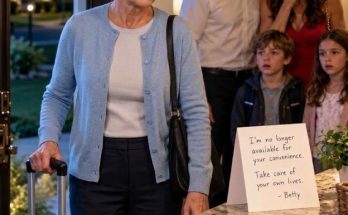
**PART 3**
Newport’s early days were peaceful in a way I initially found unfamiliar. Nora took me to a farmers market, where we lingered over tomatoes, fresh basil, and a small container of honey. Choosing ordinary groceries without coordinating somebody else’s schedule felt unexpectedly delightful.
One afternoon on her porch, I switched my phone on again. Messages and missed-call notifications flooded the screen, followed almost immediately by Theo’s call. “Mom, I went to the house,” he said. “There are strangers living there. What happened?”
“I sold it,” I said. “I’ve moved to Newport.”
He couldn’t believe I’d acted without consulting him. Then he made an admission that stopped me cold. “I always thought that house would belong to me someday.”
I reminded him that Sebastian and I had purchased it ourselves and had never committed it to anyone else. “I’m still alive, Theo,” I said. “I need to pay for my own care and plan for my future.”
Khloe took over the call. She described the property as a family asset and demanded to know why I wasn’t considering Theo’s future. I reminded her of the roof replacement, dance tuition, telephone charges, and years of other support. Then I asked why neither of them seemed concerned about what lay ahead for me.
When I described postponing physiotherapy and spending my medical savings, Theo sounded sincerely distressed. “Mom, why didn’t you tell me?”
“Because I didn’t want to be another problem,” I admitted. “But you’ve spent this conversation asking about the house and the payments. You didn’t ask whether I got here safely.”
Neither responded immediately. Theo urged me to return and discuss the financial situation. I explained that I planned to remain in Newport and prioritize my treatment. I wasn’t rejecting my grandchildren or ceasing to love the family. I was allowing their parents to shoulder their own responsibilities. We could resume the discussion when everyone was prepared to speak respectfully.
In the weeks afterward, I attended my medical appointments consistently and rested whenever my body called for it. Nora suggested a watercolor course. My first attempt resembled a landscape being swallowed by a puddle, and I laughed more freely than I had in a very long time.
We went to exhibitions and reading groups. Many of the women I encountered had devoted decades to employment, teaching, or looking after loved ones. They too were discovering the possibility of enjoying their days without offering apologies. I continued to mourn Sebastian, but I stopped burying that grief beneath endless chores.
Pamela, Theo’s cousin, occasionally telephoned with updates from home. Without my daily assistance, mornings had become challenging. Theo now had to get the children to school before starting work, while Khloe rearranged extracurricular commitments and took responsibility for collections and meals. Arguments about household work and finances followed, and they began reviewing expenses I’d previously paid without discussion.
Their difficulties didn’t make me happy. Hugo and Cheyenne needed a stable, peaceful home. Gradually, however, Pamela reported constructive changes: Theo adjusted his working hours, Khloe reorganized the children’s activities, and the couple began sharing the domestic workload more fairly.
Once Pamela described finding Khloe sitting outside, overwhelmed by how difficult it was to organize a single afternoon. I remembered countless afternoons I’d managed for them without mentioning my own medical appointments. Still, I felt relieved that their struggle was producing real adjustments instead of another expectation that I’d return and solve everything.
Life remained demanding for them, but they were learning to cope. They needed that experience without my constant intervention. Over almost six months, I was learning something equally important: loving them didn’t require surrendering the peaceful routine that was allowing me to recover.
Almost six months after my arrival, Theo rang one afternoon while Nora and I were drinking tea. At first he hesitated. Then he asked, “Mom, how are you?” Such a simple question nearly brought me to tears.
“I know that comes too late,” he said. “I’m sorry I let you walk out that night. I shouldn’t have made you choose between apologizing to Khloe and being part of our family.”
I explained that neither the financial support nor the exhausting chores had wounded me most deeply. What hurt was believing my son could discard me when I needed him to recognize that I was a person with needs of my own. Theo listened without defending himself. Having to manage meals, school mornings, and household bills had finally made him recognize just how much he’d taken for granted.
“I didn’t know about your pain,” he said. “But I should have been paying attention.”
I made it clear that I wouldn’t move back and resume our former arrangement. He assured me he wasn’t asking for that. He wanted to apologize and hoped I might eventually forgive him. We talked at length about Hugo and Cheyenne, who continued asking after me. I said I loved all of them, including Khloe, but wanted a relationship based on freely chosen affection rather than compulsory service. I ended the call feeling cautiously optimistic, aware that years of established behavior couldn’t be repaired by one conversation.
Later that summer, Theo sent details of a family trip to Newport. He’d booked their accommodation independently and made no request for me to pay or host them. It wasn’t simply the money that mattered. He was approaching the trip as a son visiting his mother, not as someone assigning her another responsibility.
I stood outside their inn waiting for them. Hugo and Cheyenne recognized me and rushed into my arms. They eagerly shared news about school and dancing, and I hugged them until my knees told me to straighten up carefully. Theo embraced me too, whispering how grateful he was that I’d agreed to see them.
We strolled along the beach, ate together, and spent an afternoon on Nora’s porch. Hugo excitedly described his recent reading. Cheyenne wanted us to bake, so we did. Her parents helped clean afterward without being prompted. During another meal, Theo laid the table while Khloe put the food away. These weren’t dramatic acts of repentance, only everyday consideration I’d once learned not to expect.
While the children played outdoors one afternoon, Khloe joined me. She apologized for behaving as though my energy and time were unlimited and for failing to recognize my pain. I acknowledged that I should have explained my limitations sooner, while insisting that those boundaries needed to be respected even when inconvenient.
“I don’t want you to feel useful only when we’re asking something from you,” she said. I believed she was sincere. But I also understood that genuine change would have to show itself in everyday behavior, not merely in emotional promises.
Before returning home, Theo said they hoped to visit every few months and would organize those journeys themselves. I told him I’d be pleased to see them whenever my health permitted, and promised to say plainly when I needed to rest. He accepted that without bargaining.
After their departure, Nora and I sat together watching the marsh. I still longed for my family when they were far away. Yet the quiet around me no longer resembled rejection. At sixty-eight, I finally understood that loving my children didn’t require dedicating the remainder of my life to proving I deserved their love in return.