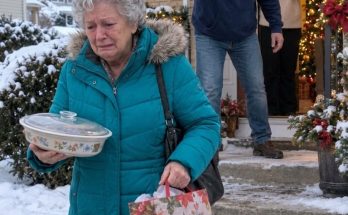
It took him a minute to get his breath.
“The Sunday before Dad died,” he said. “I rode with him out to the Millers’ place to look at that boat. You remember. He was going to buy that boat.”
“I remember.”
“He drifted over the center line twice, Mom. Twice in four miles. The second time, there was a milk truck coming. And I reached over and grabbed the wheel. And he laughed at me. He said the road had moved.”
He wiped his face with the flat of his hand.
“I was going to say something. I was going to talk to you about it. His eyes. I had it all worked out, how I’d bring it up. I thought I’d wait until after Thanksgiving. So I wouldn’t spoil it.”
Walter died on the nineteenth of November.
On County N. At twenty minutes to seven in the morning. On his way to open up the cheese plant, where he ran maintenance for thirty-four years.
He went off the curve by the Miller farm.
“The deputy called me,” Brian said. “Not you. You were at the church setting up for the bazaar and nobody could get ahold of you. So he called me. And I drove out there.”
He looked up at me.
“I saw the car, Mom. I saw the car before they had him out of it.”
I hadn’t known that.
In eleven years, he’d never once told me that.
“Oh, Brian.”
“I said nothing. And he died.”
His voice broke clean in half.
“And then you called me about that mailbox. So cheerful about it. Laughing. And all I could see was that curve. I haven’t slept right since. I’d lie there and think, I said nothing once. I’m not going to say nothing twice.”
He shook his head.
“But I couldn’t do the talking part. I knew if I talked to you first, you’d talk me out of it. And then you’d be out on some road somewhere. And I’d get another call.”
He looked at me with his face all wet.
“So I just did it. I did it all at once. So it would be over.”
I pulled the other chair around and sat down close to him. Close enough that our knees almost touched.
“Listen to me,” I said. “I’m going to tell you two things. And I need you to hear both of them.”
He nodded.
“The first one is this. It was ice.”
He started to shake his head.
“It was ice, Brian. I read that deputy’s report. Which is more than you ever did. There was black ice on that curve, from the creek. A boy of twenty-six went off that exact same curve forty minutes before your father did. He only walked away because he was in a big pickup. The deputy told me to my face that a man of thirty would’ve gone off that road.”
I took his hand.
“Your father’s eyes did not kill him. You did not kill him. November did.”
He was crying too hard to say anything.
“Maybe he should’ve had his eyes looked at. I’ll grant you that. Maybe you should’ve said something. Maybe I should’ve noticed. I was the one sleeping right next to him.”
I squeezed his hand.
“If that silence belongs to anybody, we carry it together. You do not get to carry it all by yourself for eleven years. And then set it down on me.”
He made a sound I won’t try to describe.
“And here’s the second thing.”
I waited until he looked at me.
“Fear is not a reason to take away a person’s legs, Brian. I don’t care how much you love her. That car was my legs. You were afraid. So you made me smaller, so you could sleep.”
I looked at him.
“And you didn’t sleep anyway. Did you?”
“No,” he whispered.
“No. Because that’s not how fear works. You feed it, and it just wants more. Next it would’ve been the stove. Then the stairs. Then the whole house.”
He sat with that for a long time.
Out front, I could hear Mandy answering the phone in a voice that was a little too bright.
“I’m sorry,” he said finally. “Mom. I’m so sorry. I’ll get it back. I’ll get the Buick back. I’ll call that man right now.”
“You don’t have to do that.”
“I do, though.”
He found the number on a slip of paper in his desk drawer. He dialed it with the speaker on, so I could hear it for myself.
A man answered on the fourth ring.
He was very nice about it. He’d bought the LeSabre for his granddaughter. She was starting at the college in Platteville in the fall. He’d already put four new tires on it.
And she’d named it.
“She calls it Walter,” the man said.
I went very still.
“There was a roll of mints in the console,” the man said. “With a little note rubber-banded around it. It said Walter’s. Do not throw out. She thought that was the sweetest thing she ever saw. She left them right where they were.”
I’d forgotten I ever wrote that note.
Brian opened his mouth. I could see him getting ready to offer the man more money.
I put my hand on his arm and shook my head.
“You tell her,” I said toward the telephone, “that it likes to be warmed up a full two minutes in the winter. And the mints stay.”
“Yes ma’am,” the man said. “I surely will.”
So the Buick was gone. And that was that.
And I found I could stand it. A girl of eighteen was going to drive it off to college with my husband’s name on it. There are a lot worse ends for a car.
Brian hung up the phone. He sat there looking at his hands.
“Then I’m buying you another one,” he said. “And it’s not a discussion.”
“I have the forty-two hundred. Less a tricycle.”
“You keep that.” He swallowed hard. “This one’s mine to do. Let me do it all the way through, Mom.”
I thought about Eli. And the bell.
“All right,” I said.
He found it that same week at the Toyota dealer in the county seat. A silver Corolla. 2015. Eighty-two thousand miles and a clean little back seat.
He wanted me to have something newer. I told him a woman my age doesn’t need a car that’s going to outlive her by thirty years.
He paid ninety-six hundred dollars for it.
At the title desk, the girl asked how the names should read on the title.
And Brian said, before I could open my mouth, “One name. Dorothy M. Hale. Just hers.”
Then he wrote the insurance policy on it himself. And he gave me the safe-driver rate.
Because I had the paperwork to prove it.
I let him believe that was the end of it.
It wasn’t the end of it.
I’m his mother. And I wasn’t about to let him all the way off the hook.
“There’s one more thing,” I told him in the dealer’s parking lot, with the new keys in my hand. “Wednesday. Ten o’clock. My carport.”
“What’s Wednesday?”
“You said I could’ve been killed. I want you to see exactly what you were so afraid of. You’re going to ride the route.”
“Mom, I’ve got appointments.”
“Mandy already moved them. I called her this morning.”
He came straight from the office.
Which is how he ended up in a white dress shirt and a striped tie, sitting on Wilma’s blue spare. The tall one. With his knees still coming up way too high.
Wilma looked him up and down.
“Don’t lean,” she told him.
“I know how to ride a bike, Wilma.”
“That’s exactly what’s going to tip you over,” she said.
And she rang her bell. And we went.
Five of us. Down Cedar Street in a line. At four miles an hour.
Brian leaned on the very first corner. His inside wheel came right up off the pavement.
Shirley is eighty-one years old. She didn’t even turn her head.
“Grocery cart, dear!” she called out.
He sat up.
We went to the library, where he carried in everybody’s books. We went to the Piggly Wiggly, where the store manager came out to shake his hand. Brian turned the exact color of my trike.
People waved from their porches.
Then a grain truck came up behind us on Depot Street.
I watched my son’s back go stiff as a board.
The truck slowed down to a crawl. It followed us a full block. Patient as a cow. And when we turned off, the driver gave two little taps on his horn.
Donna rang her bell back at him twice.
“He’s my nephew,” Donna said. “They all know us now. They watch for the little orange flags.”
Brian didn’t say anything.
But his shoulders came down.