**Part 2: Saturday Morning**
I didn’t need it. I was awake at four-thirty, lying in my old twin bed, staring at the ceiling.
When I came downstairs, Dad was already in the kitchen. He’d made a big pot of coffee. Not his usual little four-cup pot. The big one. The thirty-cup urn that my mother used to bring to church potlucks. It was sitting on the counter, perking and gurgling.
“What’s that for?” I asked.
“People,” he said.
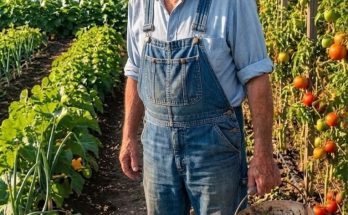
He was wearing his old blue work shirt. The faded one with the tear in the pocket.
He picked up his bucket and walked out the back door into the garden.
Saturday morning was foggy.
The kind of thick, soft fog that rolls up out of the river valley in late summer and sits on everything like a blanket. You could barely see the end of the garden. The corn disappeared into it. The fence disappeared into it. The world was gray and white and quiet.
I stood on the back porch with a cup of coffee.
At five to six, headlights came slowly up Ridge Road through the fog. A little white car. The county seal on the door.
Tyler Ostrowski parked on the side of the road, at the end of Dad’s driveway. He got out. He was wearing a county jacket over a sweatshirt. He had his clipboard. He looked half asleep. He looked a little nervous too.
He walked up the driveway toward me.
“Morning,” he said. “I’m here. Like he asked.”
“Want some coffee?”
This time, he said yes.
I poured him a cup from the big urn. He held it with both hands.
“Where’s your father?”
I pointed. Out in the fog, in the bean rows, you could just barely make out a shape. A thin old man in a faded blue shirt, bent over with his bucket. Picking beans. Like any other day.
“What’s he want me to see?” Tyler asked.
“I honestly have no idea,” I said.
Then I looked up at the gray house.
Brent was already on his deck.
He was standing at the railing in a dark blue bathrobe, holding his coffee mug, staring down at us. At the county car. At Tyler. At me.
He’d seen the car pull up. He’d come out to watch.
Of course he had. He wanted to see the inspector write it up. He wanted to see my father lose.
Tyler followed my eyes. He saw Brent too. Brent lifted his mug a little. Like a toast.
Tyler didn’t toast back.
At six o’clock exactly, headlights came down the road through the fog.
One pickup. An old red Ford with rust on the wheel wells. It slowed down, pulled off onto the shoulder, and parked along the ditch at the bottom of Dad’s property.
Then two more pickups. A white Chevy and a blue Dodge with a cracked windshield. They parked behind the red Ford.
Then a car. A little brown Corolla with a dented bumper.
Then four more. A station wagon. A sedan with a donut spare tire. A rusty old Buick. A minivan with a handicap tag hanging from the mirror.
They kept coming. One after another, their headlights cutting through the fog, pulling off onto the shoulder and parking along the ditch in a long, neat line.
Tyler set his coffee cup down on the porch railing very slowly.
I counted. I couldn’t help it.
Eleven cars. Fourteen. Seventeen.
People got out.
An old man in a feed store cap and suspenders. A young woman with a baby strapped to her chest in a carrier, holding a toddler by the hand. A heavyset man in a Walmart vest, like he was coming straight from a night shift. Two teenage boys, brothers maybe, carrying a laundry basket between them. A woman in scrubs. An old lady with a cane and a canvas tote bag. A man with a prosthetic leg. A family of five, the kids still in pajamas with jackets thrown over them.
They were all carrying something.
Empty boxes. Empty buckets. Empty grocery bags. Empty laundry baskets. A little red wagon.
Nobody said much. A few people nodded to each other. Somebody said, “Morning, Earl.” Somebody said, “How’s your hip, Doris?”
And then they walked up the driveway, past the porch, past me and Tyler, and into the garden.
Everybody knew where to go.
The old man in the feed store cap went straight to the potatoes. He knelt down with a little hand fork and started digging. The young mother with the baby went to the strawberries along the edge, the ones my mother planted, and she sat the toddler down in the grass and let him pick, and he ate more than he put in the bag, and she laughed.
The two teenage boys went to the corn. They worked together, one pulling the ears down and the other one twisting them off. They’d clearly done it before.
The woman in scrubs went to the tomatoes.
The old lady with the cane walked very slowly down to the end of the bean rows, where my father was. She stopped next to him. She put her hand on his arm. He straightened up and said something to her that I couldn’t hear. She laughed. He handed her his bucket. It was already full of beans. He’d been picking them for her.
Everywhere I looked, there were people. Moving through the fog in my father’s garden. Quiet. Careful. Filling their boxes and buckets and bags.
Taking only what they needed. I could see that. Nobody was grabbing. Nobody was greedy. They’d pick a bag of beans and a few tomatoes and some potatoes, and then they’d stop. They’d leave plenty for the next person.
Tyler stood next to me on the porch.
He’d stopped writing. His pen was still in his hand, hovering over the clipboard. But he wasn’t writing anything.
“What is this?” he whispered.
I couldn’t answer.
My eyes were full of tears. I didn’t even know why yet. I just knew.
Who are all those beans for?
People.
I looked up at the deck.
Brent was still standing there. But he wasn’t holding his mug up anymore. He’d lowered it. He was gripping the railing with his other hand.
He was staring down at the garden. At all of those people. At the line of cars along the ditch, disappearing into the fog.
His face had gone very still.
The last car was a silver minivan.
It came slowly down the road, the way people drive when they’re not sure they’re in the right place. Or when they’re sure, but they wish they weren’t.
It parked at the very end of the line. Way down at the bottom of the hill, behind all the others.
For a moment, nobody got out.
Then the driver’s door opened.
A woman stepped out into the fog. She was older. Maybe seventy. Small and thin, wearing a tan raincoat that was too big for her and a pair of white sneakers. Her gray hair was pulled back in a clip. She had two empty grocery bags folded under her arm. The cloth kind. Faded.
She closed the car door very quietly. Like she didn’t want to wake anybody.
Then she started walking up the driveway.
She walked slowly. Her eyes were on the ground. Her shoulders were hunched up inside the raincoat. She walked like someone who’d made this walk many times before and still hadn’t gotten used to it.
Halfway up the driveway, she lifted her head.
She looked toward the garden.
And then her eyes went past the garden. Past the fence. Up.
To the deck of the big gray house.
To the man in the dark blue bathrobe.
She stopped walking.
She stopped so suddenly that one of her grocery bags slipped out from under her arm and fell onto the gravel.
She didn’t pick it up.
She just stood there in the middle of my father’s driveway, in the fog, staring up at Brent Hollis.
And up on his deck, Brent set his coffee cup down on the railing.
Very slowly. Very carefully.
Like his hands had stopped working.
For a long moment, nobody moved.
The people in the garden kept picking. They hadn’t noticed. The teenage boys were still twisting off ears of corn. The toddler was still eating strawberries.
But I noticed. And Tyler noticed. And down at the end of the bean rows, my father straightened up and looked toward the driveway.
He noticed too.
The woman in the tan raincoat bent down slowly and picked up her fallen grocery bag. She held both bags against her chest. She didn’t take her eyes off the deck.
Then Brent moved.
He left his coffee cup on the railing. He disappeared through the glass door. I heard it slide open and slam shut.
A minute later, he came around the side of his house. Fast. Barefoot. Still in his bathrobe. Down his perfect lawn, across the grass, wet with dew, to the fence that divided his property from my father’s.
There was no gate in that fence. There had never been a gate. Old Mr. Swenson and my father used to just step over the low part in the corner, where the post had leaned for thirty years.
Brent stepped over it.
He walked through the edge of the corn, pushing the stalks aside, until he came out on the driveway.
He stopped about ten feet from the woman in the tan raincoat.
They looked at each other.
“Mom?” he said.
The woman’s face crumpled.
She didn’t cry. Not right away. Her face just folded in on itself, like a paper bag when you crush it. She pressed the empty grocery bags harder against her chest.
“Brent,” she said. Her voice was very small. “What are you doing here?”
“I live here,” he said. He pointed back toward the gray house. His hand was shaking. “That’s my house. That’s… Mom, that’s my house.”
She turned and looked at it. The big gray house. The black windows. The three-car garage. The deck.
“I didn’t know,” she whispered. “I didn’t know which one was yours. You never… I’ve never been out here. You never invited me.”
Brent opened his mouth. Then he closed it.
“What are you doing here?” he said again. Quieter this time.
His mother looked down at the grocery bags in her arms. At the white sneakers on her feet. At the gravel.
She didn’t answer.
She didn’t have to.
Brent looked past her. At the garden. At all those people with their boxes and buckets and bags, moving through the fog, quietly picking vegetables. At the old man in the feed store cap. At the young mother with the baby. At the man in the Walmart vest.
He looked back at his mother.
At the two empty grocery bags.
I watched it happen. I watched him understand. It moved across his face like a shadow across a field.
“No,” he said. “No. Mom. No.”
“Brent—”
“You’re here for… you’re here to get food?”
His mother lifted her chin. Her lip was trembling.
“Every Saturday,” she said. “For a year and a half.”
Brent took a step backward. Like she’d pushed him.
“Why?” he said. “Why would you… Mom, I send you money. I send you money every month.”
“You send me two hundred dollars,” his mother said quietly. “Every month. And I’m grateful for it. I am, honey. I’m so grateful.”
“Then why—”
“Because my pension is eleven hundred dollars a month,” she said. “And my rent is eight hundred. And my heart medicine is three hundred and forty after the insurance. And the electric. And the phone. And the car insurance.” She shook her head. “It doesn’t add up, Brent. It hasn’t added up since your father died. I can’t make it add up.”
“You never told me.”
“How could I tell you?” Her voice broke. “You worked so hard to get out of that house. You worked so hard. You went to college on loans and worked two jobs and built your company from nothing. You were so proud. I was so proud.” She was crying now. “And every time you called, you were so happy. Telling me about your clients. Your new car. Your new house. I didn’t want to be the thing that dragged you back.”
“You’re not dragging me anywhere. You’re my mother.”
“I know,” she whispered. “I know. But I didn’t want you to look at me and see the old house. The old kitchen. The cupboards with nothing in them. I didn’t want you to remember.”
Brent stood there in his bathrobe in the middle of the driveway, barefoot on the gravel.
“Remember what?” Tyler asked quietly beside me. He didn’t mean to. It just slipped out.
But I knew. Somehow I knew already.
My father had walked up from the bean rows. He was standing a little way off, near the edge of the garden, holding his bucket. He hadn’t said anything. He was just watching.
Brent’s mother turned and saw him.
“Arne,” she said. “I’m sorry. I’m so sorry. I didn’t know he was your neighbor. I swear, I didn’t know.”
“Morning, June,” my father said gently. “No need to be sorry.”
Brent stared at my father.
“You know her?”
“Every Saturday for a year and a half,” Dad said. “June likes the yellow squash. And the little red potatoes. Not the big ones. Says the little ones taste like the ones her mother grew.”
June let out a sound. Half sob, half laugh.
Brent looked from my father to his mother and back.
“I called the county,” he said. His voice was hollow. “I called the county on this. I told them it was an eyesore. I told them to make you tear it out.”
“I know,” Dad said.
“You knew? You knew she came here?”
“No,” Dad said. “I didn’t know she was your mother. I knew she was June. I knew she was a widow who lived in the apartments by the Dollar General and liked yellow squash. That’s all. People don’t have to tell me who they are to get a bag of beans.” He set his bucket down in the gravel. “But I knew you’d see it. If you just watched long enough. I figured if you saw who was eating out of this garden, you might feel different about looking at it.”
Brent sat down.
Right there on the gravel driveway. In his expensive blue bathrobe. He just sat down, hard, like his knees gave out. He put his elbows on his knees and his face in his hands.
June stood over him. She reached down. Hesitated. Then she put her hand on his head, on his good haircut, the way you’d touch a little boy’s head.
“Honey,” she said. “It’s okay.”
“It’s not okay,” Brent said into his hands. “It’s not okay at all.”
The people in the garden had noticed now. They’d stopped picking. They were standing in the rows in the fog, holding their buckets, watching.
Nobody said anything.
Brent lifted his head. His eyes were red.
“When I was a kid,” he said. He wasn’t talking to anybody in particular. Maybe he was talking to all of us. “We lived out on County Road 9. In a trailer. My dad drove a delivery truck until he hurt his back, and then he didn’t drive anything. And my mom grew a garden. Not because she wanted to. Because we had to. Because otherwise, we didn’t eat.”
June closed her eyes.
“Every summer, I’d come home from school and she’d have me out there picking beans,” Brent said. “Hours. In the heat. And I’d go to school with dirt under my fingernails that wouldn’t come out no matter how hard I scrubbed. And the kids called me Bean Boy. Every day. For six years. Bean Boy. Because that’s all we ever had in our lunches. Beans. Green beans. Bean sandwiches. Beans and rice.” He laughed, but it wasn’t a laugh. “I swore I’d never pick another bean as long as I lived. I swore I’d never be poor again. I swore I’d never let anybody look at me and see dirt.”
He looked up at the gray house. At the perfect lawn. At the deck.
“So I built that,” he said. “And every morning, I’d go out on that deck with my coffee. And I’d look down at your garden.” He looked at my father. “And all I could see was County Road 9. The trailer. My mom on her knees in the dirt. The empty cupboards. I couldn’t stand it. I couldn’t stand looking at it. It was like the whole thing was following me. Like I couldn’t get away from it, no matter how much money I made.”
He put his face back in his hands.
“And she was here,” he said. “The whole time. She was right here. Every Saturday. Eating out of the garden I wanted to tear out.”
It was quiet for a long time.
The fog was starting to lift. You could see the sun now, a pale white circle behind the gray.
Then my father walked over and sat down on the gravel next to Brent. He did it slowly. It took him a long time. His knees cracked so loud I heard it from the porch.
He sat there next to Brent for a while without saying anything.
“In nineteen eighty-two,” my father said, “the paper mill laid off two hundred men. I was one of them.”
Brent lifted his head.
“I had a wife and a five-year-old daughter.” Dad nodded toward me on the porch. “That one, there. Kristin. And a mortgage. And no job. And no prospects, because every other mill in the valley was laying off too.” He looked out at the garden. “We had a garden then. A little one. Maybe a quarter of what it is now. Marta grew it. My wife. She grew it because she liked flowers, mostly. Some tomatoes. A few beans.”
He rubbed his hands together. They were stained brown with soil that would never come out.
“That winter was bad,” he said. “Real bad. There was a week in February when we had nothing in the house but a box of crackers and a jar of peanut butter. Marta was giving Kristin her share. I watched her do it. Pretending she wasn’t hungry. Pretending she’d already eaten.”
I didn’t remember that. I was five. I didn’t remember any of it.
“And one morning,” Dad said, “I opened the front door to go look for work. And there was a box on the porch.”
He stopped. He looked down at his hands.
“Potatoes. Onions. Canned beans and canned tomatoes and a big bag of flour. A ham. A whole ham. And a note. No name. Just a note that said, From the neighbors. Pass it on.”
Brent was staring at him.
“Every week,” Dad said. “Every Friday, until I found work again in May. A box on the porch. Never saw who left it. Never found out. Marta always thought it was the Swensons. That was your lot, there, Brent. Where your house is. The Swensons lived there for forty years. Little white farmhouse.”
Brent turned and looked at his gray house.
“I don’t know if it was them,” Dad said. “Never asked. Old man Swenson wouldn’t have told me anyway. Stubborn as a mule. But Marta believed it was. And she made me promise. That spring, when I got the job at the school bus garage, she sat me down at the kitchen table and made me promise. ‘Arne,’ she said. ‘We are going to pass it on. As long as we live. We are never going to let anybody on this road open their cupboards and find nothing.’”
He looked out at the garden. At all those people standing in the rows.
“So she made the garden bigger,” he said. “Every year. A little bigger. And every Saturday, she’d open it up. To anybody. Didn’t matter who. Didn’t matter why. No questions. No sign-up sheet. You just came and you took what you needed. And on Fridays, before sunrise, she’d load up the truck and drive boxes to the people who couldn’t come. The shut-ins. The old folks. The ones who were too proud to come up a driveway in daylight.” He glanced at June. “No offense, June.”
“None taken,” June whispered.
“She did that for forty years,” Dad said. “Forty years. Every Saturday. Every Friday. And then she got sick.” His voice went rough. “And the last thing she said to me, in the hospital, the very last thing she ever said to me, she grabbed my hand and she said, ‘Arne. The Fridays. Don’t you dare stop the Fridays.’”
He was quiet for a moment.
“So I didn’t,” he said.
I was crying on the porch.
I hadn’t known. I hadn’t known any of it. I knew my mother grew a garden. I knew people came by sometimes on Saturdays. I’d thought they were friends from church. I’d thought it was a hobby. I’d moved away to college at eighteen and never really come back except for holidays, and I’d never asked. Not once.
Forty years. And I’d never asked who the beans were for.
Tyler was standing beside me. He’d put his clipboard down on the porch railing. He hadn’t touched it in a long time.
“How many people?” he asked my father. His voice was rough. “How many people does this feed?”
Dad thought about it.
“Saturdays, about forty families. Sometimes more. Depends on the week.” He shrugged. “Fridays, I do eleven houses. And I drop off whatever’s left at the food pantry at St. Luke’s. Sister Rosemary says it’s the only fresh vegetables they get all summer.”
Tyler looked out at the garden. At the old man with the potatoes. At the young mother with the baby. At the teenage boys with the corn.
“Forty families,” he said.
“Give or take.”
Tyler picked up his clipboard.
He looked at it for a long moment. Then he took the top sheet, the one with the notice of violation already half filled out, and he tore it off.
He folded it in half. Then in half again. Then he put it in his jacket pocket.
“Mr. Lindqvist,” he said, “the ordinance says unmaintained agricultural use.”
“That’s what the letter said,” Dad agreed.
“In my professional opinion,” Tyler said, “this is the most maintained property I’ve ever inspected. In my life.” He cleared his throat. “I don’t see any violation here, sir. I’ll write it up as unfounded.”
Dad looked up at him from the gravel.
“Thank you, son.”
“Don’t thank me.” Tyler shook his head. “My grandmother used to get vegetables from somebody like you. When I was a kid. Down in Iowa. I never knew who. I just knew some weeks there was a bag of tomatoes on our back step.” He blinked hard. “I’m going to look into getting you that special permit. Fast-tracked. Community garden exemption. There’s a category for it. I’ll find it. I’ll walk the paperwork through myself.”
“You don’t have to do that.”
“Yes,” Tyler said. “I do.”
Brent was still sitting on the gravel.
He looked at Tyler. He looked at my father. He looked at his mother, standing over him with her two empty grocery bags.
Then he stood up.
He brushed the gravel off his bathrobe. He wiped his face with his sleeve.
He turned to Tyler.
“I want to withdraw my complaint,” he said. “Officially. Today. Whatever I have to sign. I want it gone.”
“I’ll bring you the form Monday,” Tyler said.
Brent nodded.
Then he turned to my father.
“Mr. Lindqvist,” he said. His voice cracked. “I’m sorry. I’m so sorry. I don’t know what else to say.”
Dad looked up at him from the ground.
“Help me up,” Dad said. “My knees don’t work like they used to.”
Brent reached down and took my father’s hand and pulled him up off the gravel. Slowly. Carefully. Dad was wobbly. Brent held his elbow until he was steady.
“Thank you,” Dad said.
They stood there, the two of them. My seventy-nine-year-old father in his faded blue work shirt with dirt on his knees. And the man in the expensive bathrobe who’d tried to make him tear out his garden.
“Mr. Lindqvist,” Brent said again.
“Arne.”
“Arne. Is there anything… is there anything I can do? Anything at all?”
My father looked at him for a long moment.
Then he bent down, very slowly, and picked up his bucket from the gravel. The old dented metal bucket he’d been carrying since I was a little girl.
He held it out to Brent.
“Beans are on the left,” he said. “Nine rows. Your mother likes the yellow squash, but she’ll need beans too. Pick from the bottom up. The ones near the ground are ready first.”
Brent stared at the bucket.
He didn’t take it right away. I watched his face. I watched him think about County Road 9. About the trailer. About the dirt under his fingernails that wouldn’t come out. About six years of being called Bean Boy.
His mother was watching him too. Her face was so full of something it was hard to look at.
Brent reached out.
He took the bucket.
“Bottom up,” he said quietly.
“Bottom up,” Dad agreed.
And Brent Hollis walked out into my father’s garden in his bare feet and his blue bathrobe and knelt down in the dirt at the end of the first row of green beans.
He started to pick.
June stood at the edge of the garden with her hands pressed over her mouth and watched her son pick beans for the first time in thirty years.
Nobody said anything.
But one by one, the people in the garden went back to work. The old man went back to his potatoes. The teenage boys went back to the corn. The toddler went back to the strawberries.
And the fog lifted all the way, and the sun came out over the valley, and lit up the whole garden gold.