**Part 3: Passing It On**
I came down off the porch.
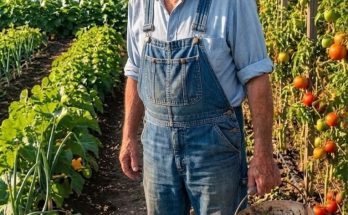
I walked over to my father. He was standing at the edge of the garden, watching Brent pick beans. His hands were in his overall pockets.
I put my arm around him. He felt so thin. So light.
“You could have told me,” I said. “About Mom. About the Fridays. About all of it.”
“You never asked,” he said.
“I asked once. Who the beans were for. You said ‘people.’”
He looked at me sideways.
“Well,” he said. “That was the answer.”
I laughed. I couldn’t help it. Then I cried a little more. Then I laughed again.
“I had a lawyer,” I said. “I had a lawyer’s name written on the back of the envelope. Doug Pratt. I was going to call him Monday. I was going to fight the county. I was going to go after Brent with everything we had.”
“I know.”
“Why didn’t you let me?”
My father was quiet for a while.
“You could’ve won,” he said finally. “Maybe. Lawyer might’ve found a loophole. Grandfather clause. Something. And Brent would’ve stood up on that deck every morning for the rest of his life hating this garden. Hating me. Hating whatever it made him remember.” He shook his head. “Lawyer can make a man stop complaining. Can’t make him stop hurting.”
He nodded toward the bean rows. Toward Brent, on his knees in the dirt.
“Only way to fix a thing like that,” he said, “is to let him see it. All of it. Who eats out of this garden. Why it’s here. Then he gets to decide for himself who he wants to be.”
“What if he’d seen it and still wanted it torn out?”
Dad shrugged.
“Then I’d have called your lawyer,” he said. “But I figured it was worth a try first. Your mother always said most people aren’t mean. Most people are just scared of something they haven’t looked at yet.”
That Friday, I rode along.
I set my alarm for three-forty-five. When I came downstairs, Dad was already in the kitchen packing banana boxes. Eleven of them.
“You coming?” he asked. Like it was the most normal thing in the world. Like I’d been coming every Friday for forty years.
“I’m coming.”
We loaded the boxes together in the dark. He showed me how to pack them so the tomatoes didn’t bruise. Potatoes on the bottom. Then squash. Then beans. Then tomatoes on top, wrapped in newspaper.
We drove down Ridge Road with the headlights off until we got to the main road. “Don’t want to wake the neighbors,” Dad said.
We stopped at a little blue house on Elm Street first. An old man named Walt lived there. He was ninety-one and couldn’t drive anymore and couldn’t walk more than a few steps without his walker. Dad carried the box up the porch steps and set it by the door. He didn’t knock. He just tapped the window twice, and through the glass, I saw a light come on, and an old hand waved.
“Walt’s been getting boxes for nine years,” Dad said, climbing back into the truck. “Since his wife died. Marta brought him a pie the week of the funeral, and he cried so hard she just kept coming back.”
We stopped at a trailer park on the edge of town. A young woman named Dee with three kids and a husband in the hospital. We stopped at an apartment building where four different elderly people lived on the same floor, and Dad carried a box up three flights of stairs, wheezing, and I made him let me carry the next one.
We stopped at a little house with a ramp out front, where a man named Curtis lived. He’d lost both his legs in Afghanistan. He was waiting on the porch in his wheelchair at four-thirty in the morning with a thermos of coffee.
“Arne,” he said. “Who’s this?”
“My daughter. Kristin.”
Curtis looked at me for a long moment.
“Your mother,” he said, “used to bring me peach pie. Every August. When the peaches were good.” He took the box from Dad and set it in his lap. “I miss her.”
“So do I,” I said.
We stopped at seven more houses. Then we stopped at St. Luke’s, and Dad carried the last two boxes into the back of the church kitchen, where Sister Rosemary hugged him and called him a saint and he told her to hush.
The sun was coming up by then. Pink and gold over the hills.
On the way home, Dad took a turn I didn’t expect. He pulled into the cemetery on the hill behind the church.
He parked by the big oak tree. He got out. He reached into the cab and pulled out a small paper bag I hadn’t noticed.
I followed him across the wet grass to my mother’s grave.
MARTA ELISE LINDQVIST. 1949 – 2023. SHE PASSED IT ON.
I’d never noticed that last part before. I’d been to her grave a dozen times. I’d never noticed.
Dad opened the paper bag. He took out a single tomato. Big and red and perfect. The best one from the whole garden. I’d seen him pick it on Thursday, holding it up to the light, turning it around and around in his hands.
He set it on top of her headstone.
“Eleven houses this week, Marta,” he said. “And St. Luke’s. And forty-two families on Saturday. That’s a record.”
He stood there for a moment.
“And the neighbor’s going to be all right,” he said. “June’s boy. He’s coming around. You’d like him, I think. Once he lets you.”
He put his hand flat on top of the stone, next to the tomato.
“I haven’t missed a Friday,” he said quietly. “Not one.”
Then he turned around and walked back to the truck.
I stood at my mother’s grave for a long time.
Then I touched the tomato. Just once. And I followed my father home.
That was a year ago.
A lot has changed since then.
Tyler Ostrowski got Dad the special permit in six weeks instead of six months. He walked the paperwork through the county office himself, desk to desk. The garden is officially registered now as the Marta Lindqvist Community Garden. There’s a little wooden sign at the end of the driveway. Tyler made it in his garage. He comes most Saturdays now with his girlfriend. They pick tomatoes for her grandmother.
Brent withdrew his complaint on that Monday. And then he did something none of us expected.
In October, a construction crew showed up at the big gray house. I was scared at first. I thought maybe he was building a higher fence. A wall.
They tore out half of his perfect painted lawn.
Brent stood on his deck in a sweatshirt and watched them do it. Then he walked over and knocked on my father’s back door.
“I want to make the garden bigger,” he said. “On my side. If that’s okay with you. My mother says if we put in pole beans along the property line, we can double the yield. And she’s got opinions about squash.”
My father looked out the window at the torn-up lawn.
“Your mother’s right about the squash,” he said.
They put a gate in the fence that fall. A real one. Wooden, with an iron latch. Brent built it himself. He’s terrible with tools. It took him three weekends and he hit his thumb with a hammer so many times it turned purple. But he built it.
It hangs a little crooked. Dad says that’s how you know it’s handmade.
June moved in with Brent in November.
She didn’t want to. She fought him on it for weeks. She said she didn’t want to be a burden. She said she had her own life. She said she liked her little apartment by the Dollar General.
“Mom,” Brent finally said. “I’ve got four empty bedrooms. And a garden that needs somebody who knows what they’re doing. Please.”
She moved in the week before Thanksgiving. She has the bedroom with the window that looks out over the garden.
Every morning now, there are two people on that deck. Brent with his coffee. June with her tea. Looking down at the garden. Not frowning anymore. Pointing at things. Arguing about where to put the tomatoes next year.
Brent comes on Fridays now.
Not every week. He’s got his company, and sometimes he has to travel. But most Fridays, at a quarter to four in the morning, there’s a knock on my father’s back door, and Brent is standing there in a hooded sweatshirt and jeans with dirt on the knees.
He drives now. Dad sits in the passenger seat and gives directions. Brent carries the boxes up the stairs. All three flights. Dad lets him.
They talk the whole way, Dad says. About gardens, mostly. About the mill. About County Road 9. About Brent’s father, who was angry and sad and never got over hurting his back. About Marta.
“He’s a good boy,” Dad told me once. “Just took him a while to stop running.”
My father turned eighty in May.
He had a little health scare in March. His heart. They put a stent in. He was in the hospital for four days, and he spent all four of them complaining that nobody was planting his peas.
Brent planted his peas.
Brent and June and Tyler and the two teenage brothers, Marcus and Devon, who turned out to be the old man in the feed store cap’s grandsons. And the young mother with the baby, whose name is Ashley, and whose baby is walking now. And Curtis, from his wheelchair, giving instructions from the end of the row.
They planted all of it. Every row. Peas and beans and onions and potatoes. They put the tomato cages up. They tied the strings for the green beans.
When I brought Dad home from the hospital, he stood on the back porch for a long time looking out at the garden. At all those neat rows. All that dark, turned earth, already sprouting green.
“Well,” he said. His voice was shaking. “Would you look at that.”
“You’ve got help now, Dad.”
“I see that.”
He sat down in his old metal lawn chair. I sat down on the steps next to him.
“Your mother used to worry about this,” he said. “Toward the end. Who’d keep it going. After.”
“I know.”
“I told her I’d figure something out.” He laughed a little. “Didn’t figure on the guy who tried to get it torn out.”
This morning was a Saturday.
I drove out at five-thirty. I come every Saturday now. Every single one. I bring an extra coffee urn. Mom’s old church urn isn’t big enough anymore.
It was foggy again. That thick, soft late-summer fog that rolls up out of the river valley.
At six o’clock, the headlights started coming down the road.
I counted them.
Twenty-three cars. A record.
People got out carrying their boxes and buckets and bags. Nobody said much. Everybody knew where to go.
I saw June at the squash, of course. Yellow squash. And the little red potatoes, not the big ones.
I saw Tyler at the tomatoes with his girlfriend.
I saw Ashley at the strawberries with her little girl, who ate more than she put in the bag.
And I saw my father, eighty years old, down at the end of the bean rows with his old dented bucket. Moving slower than he used to. Stopping to rest more often. But still there. Still picking. Still on his knees in the dirt.
And next to him, in the next row over, I saw Brent.
On his knees. In jeans with holes in them now. With dirt under his fingernails that won’t come out no matter how hard he scrubs.
He doesn’t try anymore.
A new family came this morning. I’d never seen them before. A young couple with a little boy, maybe seven, in a car with a cracked windshield and Texas plates. They stood at the end of the driveway for a long time before they came up. The way June used to. The way people do when they’ve never done this before and they wish they didn’t have to.
The little boy was holding his mother’s hand. He was looking at the garden with big eyes.
Brent saw them.
He stood up. He brushed the dirt off his knees. He walked down the driveway to meet them.
“Morning,” he said. “First time?”
The father nodded. He looked embarrassed. He looked like he hadn’t slept in a week.
“Somebody at the gas station told us,” the father said. “Said there was a place up here. Where you could… where people could…”
“There is,” Brent said. “Come on up.”
He led them up the driveway. He handed them a bucket from the stack by the shed.
The little boy looked up at Brent.
“Mister,” he said. “Whose garden is this?”
Brent thought about it.
He looked out over the rows. At June, at the squash. At Tyler, at the tomatoes. At Ashley’s little girl, with strawberry juice all over her face. At my father, down at the end of the bean rows, slowly straightening up to see who’d come.
“It’s Mr. Lindqvist’s garden,” Brent said. “And his wife’s. She started it a long time ago.”
“Who are all the beans for?”
Brent smiled.
I’d never seen him smile like that before. Not on his deck. Not with his coffee. Not at his perfect painted lawn.
He knelt down so he was eye level with the little boy.
“People,” he said.
The little boy considered that.
“Like us?”
“Exactly like you,” Brent said. “Beans are on the left. Nine rows. Pick from the bottom up. The ones near the ground are ready first.”
He handed the little boy the bucket.
And the little boy walked out into my father’s garden, in the fog, and knelt down in the dirt at the end of the first row, and started to pick.
Down at the end of the rows, my father was watching.
He caught my eye across the garden.
He didn’t say anything. He didn’t have to.
He just lifted his hand, very slightly, the way you’d wave to someone across a crowded room. Then he bent back down to his beans.
I stood on the porch with my coffee and watched them. All of them. Twenty-three cars’ worth of people moving quietly through the fog. Taking only what they needed. Leaving plenty for the next person.
Somewhere up on the hill behind St. Luke’s, there’s a headstone with a tomato on top of it.
SHE PASSED IT ON.
And she did.
And he did.
And now, so do we.