“Marcus,” I said, stepping back, pulling my hands out of his grip. “What aren’t you telling me?”
He took a deep breath, clutching his coat against his chest.
“The social worker came in twenty minutes before you got here,” he whispered. “Because Clara was unmarried, had no designated next of kin on her intake forms, and passed away before filling out birth certificate records… state child protective services was called.”
My pulse began to roar in my ears.
“They’re going to place her in emergency foster care tomorrow morning,” Marcus continued, his words coming faster now, tumbling over each other in a desperate rush. “Unless a blood relative steps forward to claim custody immediately.”
I stood frozen, looking from my husband’s bloodshot eyes to the window of the room.
“Marcus…”
He took two steps forward, falling to his knees right there on the linoleum floor of the hospital corridor, grabbing both of my hands in his.
“Sarah,” he begged, his voice breaking into raw, jagged pieces. “What he asked me in that hallway… I still can’t repeat it out loud without feeling like my heart is going to burst.”
He squeezed my hands until my fingers went numb.
“He looked up at me from the floor, his face wet with tears, and said: ‘Please, Sarah. Help me bring our daughter home.’“
PART 3
The word hung in the sterile air between us like a physical object—heavy, terrifying, and immutable.
Our daughter.
“Marcus, get up,” I whispered frantically, looking around the hallway, terrified someone would see him like this. “Get up, please.”
“No,” he sobbed, his head pressed against my knuckles. “Not until you look at her. Just look at her once, Sarah.”
“Marcus, we have three boys!” my voice cracked, tears finally bursting from my eyes. “Nine, seven, and four! Our house is chaotic, our finances are tight, and I just spent two years coming to peace with the fact that my body cannot handle another child! We closed that door!”
“Your body didn’t have to carry her,” he whispered, standing up slowly, his hands still holding mine. “She’s here, Sarah. She’s blood. She’s Brenda’s granddaughter. She’s Clara’s baby. If we don’t take her, she goes into the system. She becomes a ward of the state. How do we live in our house, with our boys, knowing Clara’s daughter is out there in a stranger’s house?”
“It’s not that simple!” I cried, pulling my hands away and pacing the narrow hallway. “Adoption—fostering—taking in a newborn who just lost her mother—that is a trauma! It’s a legal nightmare! It’s emotional chaos! We aren’t prepared for a infant! We don’t have a crib, we don’t have formula, we don’t have—”
I stopped mid-sentence.
My voice died in my throat.
The garage.
The box on the shelf above his tools.
The swaddles. The two sleepers. The hat the size of an orange.
Four years. For four years, he had refused to give it away. Every time I asked, he said, “Next month.” I had thought it was grief for the daughter I couldn’t carry. I had thought it was a quiet, stubborn refusal to accept the doctor’s final verdict.
I looked at Marcus, my jaw trembling. “You kept that box…”
“I kept it because I couldn’t let go of the dream,” Marcus whispered, tears pouring down his face. “I kept it because I loved you too much to ever ask you to risk your life again, but my heart couldn’t throw away the thought of a little girl in our home. And now… now she’s sitting in that room, thirty feet away from us, with no mother, no name, and no one in the world except us.”
He walked over to the heavy wooden door of the maternity room, pushed it open a few inches, and held it for me.
“Just look at her,” he pleaded softly. “If you look at her and tell me no, I will sign the state release papers. I will let the social worker take her. I will never bring it up again. I promise you, Sarah. But please… just look at her.”
My legs felt like lead. My heart was pounding so hard against my ribs it felt painful. Every logical, practical bone in my body was screaming at me to turn around, get back in my car, and drive home to my loud, safe, predictable life with my three boys.
Instead, I walked toward the door.
I pushed it open and stepped inside.
The room was dim, lit only by a small yellow lamp in the corner. The plastic bassinet sat beside the empty hospital bed.
I walked over to the edge of the bassinet and looked down.
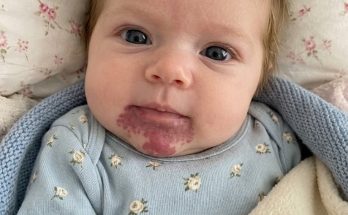
She was tiny. Impossibly small. Swaddled tightly in a white hospital blanket with pink and blue stripes, a tiny knitted cap covering her head. Her skin was soft and pink, her tiny chest rising and falling in rapid, delicate breaths. As I leaned over, her tiny fist broke free from the swaddle, her microscopic fingers opening and closing against the cool air.
She opened her eyes—dark, slate-gray eyes, identical to Marcus’s. Identical to Clara’s. Identical to the eyes of my three boys sleeping in their beds at home.
A wave of something overwhelming, terrifying, and breathtaking crashed over me. It wasn’t the chemical rush of childbirth, nor was it the quiet fulfillment of an old dream. It was something far fiercer, far colder, and infinitely stronger:
It was the sudden, undeniable instinct of protection.
This baby was an orphan. Her mother had died three floors above us. She had no one.
I reached down with a trembling finger, touching her tiny palm. Her miniature hand instantly snapped shut around my finger, holding on with a desperate, surprising strength.
I let out a shaky, sob-choked laugh.
Marcus stepped into the room behind me, standing so close I could feel the heat radiating from his chest, his breath ragged in the quiet room.
“Sarah?” he whispered, his voice trembling with an agonizing suspense.