### PART 3
*(Original Parts 8–10)*
**PART 8 — THE PRIVATE SCHOOL FINALLY LEARNED SOMETHING**
Hawthorne’s relationship with Maya did not end there.
A year after she declined the assembly invitation, the school created a community tutoring partnership with Northside Youth Bridge.
Not because I ordered it.
In fact, I stayed out of the planning.
The idea came from Hawthorne’s math department.
Several teachers had watched Sophie change.
Not just her grades.
Her confidence.
Her willingness to ask questions.
They wanted students from different educational backgrounds learning together.
Maya was skeptical.
Understandably.
“What’s the point?”
Mr. Chen, who had been invited into the planning group, answered:
“The point is that wealthy kids should sometimes learn from people they weren’t taught to expect anything from.”
Maya smiled.
“I like that point.”
The program began small.
Saturday math lab.
Hawthorne provided classrooms.
Northside provided tutors and program supervision.
College students earned wages.
No charity spectacle.
No children photographed beside “less fortunate” teenagers.
Just learning.
Maya agreed to tutor twice a month.
The first Saturday she returned to Hawthorne, I drove Sophie.
We stopped at the curb where they had first met.
Sophie pointed.
“That’s the spot.”
“I know.”
Maya arrived by train.
No oversized coat.
No duct-taped backpack.
But she still carried the old bag.
Repaired again.
I stared.
“You still have that thing?”
“It survived.”
“Barely.”
“It has character.”
Sophie said:
“Dad hates things he can’t replace.”
“That is not true.”
Both girls looked at me.
“Fine.”
Inside, twenty students waited.
Some from Hawthorne.
Some from neighborhood schools.
Maya stood at a whiteboard.
For a moment, she looked nervous.
Then she drew a simple equation.
“What do you see?”
Hands went up.
She shook her head.
“No answers yet. Patterns first.”
Sophie smiled.
The room changed.
Two hours later, parents arrived.
One woman approached me.
I recognized her.
She had been among the people who complained about Maya years earlier.
She seemed to recognize me too.
“Daniel.”
“Hello.”
She glanced toward Maya.
“She’s remarkable.”
I said nothing.
The woman continued.
“I think we were unfair before.”
“We?”
She looked uncomfortable.
“I was.”
Better.
“I worried about safety.”
“I remember.”
“I didn’t know her circumstances.”
“You didn’t need to.”
She looked at me.
I continued.
“You knew she was an eighteen-year-old sitting on a public sidewalk helping a child with homework.”
The woman nodded slowly.
“You’re right.”
Then:
“I’m sorry.”
Maya happened to walk past.
The woman stopped her.
“I owe you an apology.”
Maya looked surprised.
“For what?”
“I complained about you being near the school years ago.”
Maya studied her.
Then said:
“Okay.”
The woman seemed confused.
“Okay?”
“Thank you for telling me.”
No instant forgiveness ceremony.
No emotional performance.
Just acknowledgment.
Maya walked away.
The woman looked at me.
“She’s direct.”
I almost laughed.
“You have no idea.”
That same year, Sophie turned eleven.
Three years since Rebecca’s death.
On her birthday, she asked for something unexpected.
“No party.”
“What do you want?”
“Dinner.”
“With who?”
“You. Maya. Tasha. Mr. Chen.”
“That’s an odd birthday group.”
“I’m an odd child.”
Rebecca’s daughter.
We ate pizza at our house.
After dinner, Sophie brought out an old shoebox.
Inside were things she had saved from her mother.
A scarf.
Photographs.
A note Rebecca once put in her lunchbox.
A grocery list.
One earring.
Then Sophie placed something new inside.
A short broken twig.
Maya recognized it.
“No way.”
“I kept it.”
“That is disgusting sidewalk garbage.”
“It taught me algebra.”
Maya laughed.
Sophie placed it beside Rebecca’s note.
I understood what she was doing.
The box was not only for things from her mother anymore.
It was for things that changed her.
Loss.
Love.
People.
Moments.
Patterns.
Sophie looked at me.
“Dad?”
“Yes?”
“You should put something in.”
I thought.
Then I removed my watch.
The expensive one I had stared at constantly during the first year after Rebecca died.
Pickup time.
Therapy time.
Dinner time.
Bedtime.
Control disguised as responsibility.
I placed it in the box.
Sophie stared.
“You’re giving me your watch?”
“No.”
I immediately took it back.
Everyone laughed.
Then I found something better.
An old printed schedule from two years earlier.
SATURDAY:
9:00 Gymnastics
10:30 Tutoring
12:00 Lunch
1:00 Piano
2:30 Museum
4:00 Reading
5:00 Family Walk
Sophie stared.
“You scheduled walking?”
“I was unwell.”
Maya laughed so hard she had to put down her pizza.
I folded the schedule.
Placed it in the box.
“Keep that.”
Sophie smiled.
“Why?”
“To remind you your father eventually got slightly less ridiculous.”
**PART 9 — THE DAY SOPHIE STOOD ONSTAGE**
When Sophie was twelve, Hawthorne held an annual student presentation night.
She had always hated public speaking.
Rebecca loved it.
I hated that Sophie hated anything Rebecca loved because grief makes people irrational that way.
But that year Sophie signed up voluntarily.
Her project title:
PATTERNS WE MISS.
I did not help.
That was difficult.
The night of the presentation, I sat in the third row.
Maya sat beside me.
She was twenty-two now.
A junior at Illinois Tech.
Applied mathematics major.
Computer science minor.
Research assistant.
Still tutoring.
Still carrying the terrible backpack, although she had finally transferred it into ceremonial use only.
Sophie walked onto the small stage.
She looked terrified.
Then she saw us.
She began.
“When I was eight, I thought being smart meant getting answers right.”
A slide appeared.
A photograph of numbers written in chalk.
“I was wrong.”
Another slide.
A paper bridge.
“Being smart can mean trying again after you’re wrong.”
Then a photograph of Rebecca.
My breath caught.
Sophie continued.
“My mom died when I was six.”
The room became quiet.
“For a long time, I thought grief was a problem I was supposed to solve.”
I stared.
Those were my words.
Not things I had said.
Things I had taught through behavior.
Sophie continued.
“My dad thought that too.”
A few parents smiled.
I deserved it.
“He got me tutors and schedules and activities.”
She looked toward me.
“He was trying.”
My eyes filled.
“Then I met someone who taught me math on a sidewalk.”
Maya looked down.
“She told me to stop looking for the answer and look for the pattern.”
Sophie changed slides.
A series of photographs.
Her mother cooking.
Maya at graduation.
Tasha at the youth center.
Mr. Chen.
Me making terrible pancakes.
The audience laughed at that one.
Sophie continued.
“I started noticing that people can be gone and still change what happens next.”
My throat closed.
“Mom is gone.”
She paused.
“But she taught my dad how to make pancakes badly.”
Laughter.
“She taught me to ask questions.”
Another pause.
“And Maya’s mom is gone, but she taught Maya not to quit when things are hard.”
Maya covered her mouth.
Sophie looked at her.
“And Maya taught me that.”
Then she finished.
“Patterns aren’t about everything staying the same.”
Her voice shook slightly.
“They’re about understanding how one thing changes another.”
Silence.
Then applause.
I couldn’t stand immediately.
Maya was crying.
I was crying.
Half the room probably was.
Afterward, Sophie ran toward us.
“How was it?”
I hugged her.
“Terrible.”
She pulled back.
“What?”
“I’m emotionally destroyed.”
She laughed.
“Good.”
Maya hugged her next.
“You stole my line.”
“I improved it.”
“Absolutely not.”
Then Mr. Chen appeared.
He had come too.
He handed Maya an envelope.
“What now?”
“Open it.”
She did.
Inside was an offer.
A paid summer research position with a university mathematics lab studying optimization problems in urban transportation systems.
Maya stared.
“Me?”
Mr. Chen smiled.
“You keep asking that question.”
She looked at the letter again.
No billionaire miracle.
No secret connection.
She had earned it.
Grades.
Professors.
Work.
Recommendations.
I felt something I could not quite name.
Pride without ownership.
That was new for me.
Later that night, after Sophie went to bed, Maya and I sat in the kitchen.
She said:
“You know you look disappointed.”
“I’m not.”
“You are.”
“I’m thinking.”
“Dangerous.”
I smiled.
Then:
“I used to believe the best thing I could give people was access.”
“To what?”
“Money. Schools. Jobs. Connections.”
“Those things help.”
“I know.”
“But?”
“I think sometimes the best thing is not standing in the way while they build something themselves.”
Maya nodded.
“Look at you.”
“What?”
“Almost emotionally healthy.”
“Let’s not exaggerate.”
She laughed.
Then became serious.
“Daniel?”
“Yes?”
“Thank you.”
“For what?”
“The first day.”
I shook my head.
“Tasha said I was one door.”
“She’s right.”
Maya looked toward the window.
“But you opened.”
That was enough.
**PART 10 — FIVE YEARS AFTER THE SIDEWALK**
Five years have passed since I saw my daughter sitting on a Chicago sidewalk beside a homeless teenager with a broken stick.
Sophie is thirteen now.
Maya is twenty-three.
And I am still learning things far slower than both of them.
Maya graduated from Illinois Tech last spring.
Applied mathematics.
High honors.
She did not become a billionaire.
She did not invent a revolutionary equation at nineteen.
Real life is slower than that.
She accepted a job with a transportation-analytics company in Chicago, where she works on routing systems for public transit and logistics networks.
The kind of math most people never notice until it fails.
She loves it.
More importantly, it is hers.
She also tutors Saturday mornings at the same community math program Hawthorne and Northside built together.
She says she’ll stop when she becomes too busy.
Nobody believes her.
Her old duct-taped backpack finally died during her senior year.
The zipper broke.
The bottom split.
Even Maya admitted the end had come.
Sophie held a funeral.
I wish I were joking.
She placed the backpack on our kitchen table and said:
“We gather here today to honor a bag that carried calculus through hardship.”
Maya nearly fell out of her chair laughing.
Tasha said:
“This family needs supervision.”
I bought Maya a new backpack.
Then immediately worried I had violated some boundary.
Maya looked at it.
Then at me.
“It’s a backpack, Daniel.”
“I know.”
“You can buy me a backpack.”
“Good.”
She smiled.
“You’ve become exhausting in a completely different way.”
Progress.
Sophie is still at Hawthorne.
By choice.
I asked once whether she wanted to transfer.
She looked offended.
“Why?”
“I don’t know.”
“You think every emotional event requires a school decision.”
Fair.
She loves science.
Math.
Drawing.
Hates piano.
Still.
She wants to become either an architect, an astronomer, or “someone who designs rides at amusement parks.”
I told her those are three different careers.
She told me:
“Patterns.”
I lost the argument.
Our house sounds different now.
Rebecca is still missing from it.
That never changed.
There is no lesson that makes her absence good.
No inspiring stranger erased the worst thing that happened to us.
What changed was how we carried it.
For two years after Rebecca died, I tried to build walls around Sophie’s grief.
Now we leave doors in it.
We talk about Rebecca.
Sometimes we laugh.
Sometimes Sophie cries because she can no longer remember what perfume her mother wore.
Sometimes I remember and tell her.
Sometimes neither of us knows.
That is allowed.
We keep videos.
Photographs.
Stories.
But we no longer treat memory like a test we can fail.
I changed too.
I am still an investor.
Still demanding.
Still impatient.
My employees would laugh if I claimed otherwise.
But Harrison Capital runs differently.
I hired people who tell me no.
Real people.
Not executives who learn to phrase agreement as advice.
Every major investment review now includes one question at the top of the page:
WHAT ARE WE MISSING?
My team jokes that an eighteen-year-old with a stick changed our governance process.
They aren’t entirely wrong.
The Harrison Foundation still supports Northside Youth Bridge.
Through normal grants.
Independent review.
No photographs of Maya.
No “saved from the streets” stories.
No buildings with my name.
The first time someone suggested calling the new education lab the Harrison Center, I said no.
Tasha almost fainted.
“You’re evolving.”
“Don’t make it weird.”
They named it the Pattern Room.
Maya hated the name.
Sophie loved it.
Sophie won.
Of course.
One cold afternoon last November, I arrived early to pick Sophie up again.
Same school.
Same iron gates.
Same Chicago wind.
Martin still drives me sometimes, although now he complains that I make him stop for coffee too often.
As we approached Hawthorne, I looked toward the curb.
For a second, the past appeared so clearly I could almost see it.
An eight-year-old girl in a blue coat.
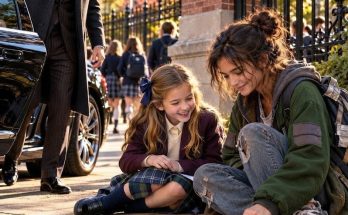
An eighteen-year-old teenager wearing shoes too big for her.
Numbers scratched onto concrete.
Then the real scene came into focus.
Sophie was thirteen now.
She stood beside three younger students.
Maya was there too.
She had stopped by after work.
A little boy was struggling with a math worksheet.
Maya crouched.
She picked up a piece of sidewalk chalk.
“If you only look for the answer, you’re going to miss it.”
Sophie finished the sentence.
“Look for the pattern.”
The boy frowned.
Then tried again.
I told Martin:
“Stop here.”
He smiled at me through the mirror.
“You say that a lot at this corner.”
“I know.”
I got out.
Maya looked up.
“Mr. Harrison.”
She only calls me that when she wants to annoy me.
“Ms. Ortiz.”
Sophie rolled her eyes.
The little boy solved the problem.
His face lit up.
“There!”
Maya smiled.
“Exactly.”
His mother arrived a moment later and thanked them.
They walked away.
Then Sophie looked at me.
“Dad?”
“Yes?”
“Do you remember the first day?”
“Of course.”
“You looked terrified.”
“I was.”
“Of Maya?”
I looked at Maya.
“No.”
That answer surprised even me.
I thought about it.
“I was terrified because something was happening to you that I hadn’t planned.”
Sophie nodded.
“That sounds like you.”
Maya laughed.
I continued.
“And because for the first time in two years, something I didn’t control made you happy.”
Sophie became quiet.
Then she took my hand.
Thirteen-year-olds do that less often.
I noticed.
Maya looked away politely.
We started walking.
At the corner, Sophie said:
“Do you think Mom somehow made us meet Maya?”
I used to hate questions like that.
I wanted evidence.
Cause.
Effect.
Now I knew some questions deserved room.
“I don’t know.”
Sophie nodded.
“Me neither.”
Then Maya said:
“Personally, I think I dropped your homework.”
Sophie laughed.
“Very spiritual.”
“Thank you.”
We reached the car.
Maya was taking the train home.
I offered her a ride.
She said no.
Five years earlier, that might have offended me.
Now I simply said:
“See you Saturday.”
“Yep.”
Then she walked toward the station.
Sophie and I got into the car.
As Martin pulled away, I looked back.
Maya stood at the corner waiting for the light.
No oversized coat.
No broken shoes.
No uncertainty about where she would sleep.
But that is not why I am proud of her.
I am proud because five years earlier, Maya had every reason to believe the world was something that happened to her.
Instead, when one door opened, she walked through it.
Then another.
Then another.
She did the walking.
Sophie leaned against the seat.
“Dad?”
“Yes?”
“What would you have done if you hadn’t seen me with Maya that day?”
The question unsettled me.
I thought about the schedules.
The specialists.
The silence in our enormous house.
“I don’t know.”
“Would we be okay?”
I looked at her.
“Eventually, I hope.”
She nodded.
Then:
“But different.”
“Yes.”
Very different.
That is the strange thing about life.
We remember dramatic moments as if they were the whole story.
The car stopping.
The homeless girl.
The broken stick.
The first laugh.
But lives rarely change in one moment.
They change in what happens afterward.
A teenager agrees to enter a shelter.
A father learns to ask instead of order.
A child quits piano.
A teacher keeps an old student’s records.
A caseworker refuses a rich man’s shortcuts.
A young woman takes one class.
Then another.
A family says a dead mother’s name out loud.
Someone apologizes.
Someone refuses help.
Someone accepts different help.
A door opens.
A person walks through.
Five years ago, I thought I was stopping the car because I had found my daughter sitting with someone who might be dangerous.
I was wrong.
The dangerous thing was the life I had built around Sophie after Rebecca died.
Perfectly scheduled.
Perfectly protected.
So carefully controlled that almost nothing unexpected could reach her.
Including joy.
Maya never saved my daughter.
Sophie never saved Maya.
I didn’t save either of them.
That is the version of the story people always want because it is clean.
The truth is better.
They met.
They noticed something in each other.
Then a lot of people did their jobs.
Tasha.
Mr. Chen.
Counselors.
Teachers.
Case managers.
Professors.
Maya herself.
Sophie herself.
Even me, eventually.
That afternoon long ago, Maya drew numbers on the sidewalk with a broken stick and told my daughter:
“You don’t have to know the answer yet. Just find the pattern.”
I thought she was talking about math.
I know better now.
Sometimes the answer comes much later.
Sometimes all you can do is notice what keeps repeating.
Control wasn’t healing Sophie.
Money wasn’t replacing Rebecca.
Silence wasn’t protecting us.
And homelessness had never meant Maya lacked ability.
We had all been looking at the wrong things.
The expensive school.
The battered backpack.
The black sedan.
The oversized sneakers.
Then one eight-year-old girl laughed.
And for the first time, I stopped looking at what everything cost.
I started paying attention to what it meant.
**THE END**