**Part 3**
I stayed in Ohio for four days that trip. Dad and I talked more, honestly, in those four days than we had in the previous ten years combined. The conversations weren’t especially dramatic — there was no single, perfect explanation that made sense of everything he and Mom had done. Slowly, over quiet mornings with coffee and long afternoons while he napped in his recliner, I came to understand that they had favored Vanessa for years simply because she was louder, more emotionally demanding, more willing to punish them with tears and silence and accusations whenever they refused her something. I had always been quieter by comparison. They had mistaken that quiet for strength, and had used it, without ever quite admitting it to themselves, as an excuse to give me less.
On my last night there, Mom came into the guest room carrying a small cardboard box. Inside were old photographs, elementary school certificates, birthday cards going back decades, and a silver bracelet my grandmother had given me for my sixteenth birthday, one I’d assumed was lost forever.
“I kept these,” she said, setting the box on the bed beside me.
“I thought you’d thrown all of this away, honestly. Along with everything else.”
“I couldn’t do it. I tried, once, and I couldn’t.”
I ran my thumb slowly over the bracelet’s worn silver links.
Mom sat down across from me, her hands folded in her lap. “I should have stopped you that night. When you packed those suitcases.”
“Yes,” I said. “You should have.”
She winced visibly at my answer, but I didn’t soften it for her, and some part of me noted, almost with surprise, that I no longer felt the old reflexive need to make her feel better about her own failures.
“I kept telling myself, for years, that you would eventually call,” she said quietly.
“I kept telling myself the same thing about you.”
That was the closest either of us came to fully understanding ten years of silence in a single exchange.
Before I flew back to Seattle, I laid out clear conditions for any future financial help, conditions my attorney had helped me formalize into an actual written agreement. Their house could never be transferred to Vanessa, under any circumstance. No one could borrow against it, ever, for any reason.
I would pay approved medical or property expenses directly to the provider or the county, never through a family member’s hands. And if Vanessa ever moved back in with them, she would be required to contribute toward groceries and utilities once she was employed again.
Mom agreed to every condition. Dad agreed too, his signature shaky but legible on the paperwork.
Vanessa didn’t speak to me at all for the next seven months. During that stretch of silence, she filed for bankruptcy. She sold the BMW. She moved into a small one-bedroom apartment in Dayton and took a job managing the front office of a dental practice, a position she was apparently quite good at, according to Mom’s occasional updates. It wasn’t the life Vanessa had always assumed she deserved, growing up as the daughter our parents chose without hesitation. But it was the first life she’d built in years that nobody else was financing on her behalf.
My parents began calling me every Sunday evening after that trip. At first the calls were painfully awkward — Mom over-explaining everything, apologizing for small, insignificant things in a way that felt like she was trying to make up for the one large thing all at once. Dad apologized too often as well, until I finally told him, gently but firmly, that if we were going to have any kind of real relationship going forward, it couldn’t consist of him apologizing on a loop while I performed comfort in response.
So instead we talked about ordinary things. His physical therapy progress. My company’s newest contract. The Seattle Mariners’ latest disappointing season. The neighbor two doors down who kept parking his truck too close to their mailbox.
A year after Vanessa first walked into my office, Dad was able to walk short distances around the house without his cane.
That Thanksgiving, I flew back to Ohio again. Vanessa was there too, having driven up from Dayton, carrying a grocery-store pumpkin pie in a plastic clamshell container that she set on the counter without quite meeting anyone’s eyes.
For the better part of the first hour, we barely looked at each other across the table.
After dinner, I stepped outside for air, needing a moment away from the noise and the careful, deliberate normalcy everyone was working so hard to maintain. The backyard looked smaller than it had when we were children, the way childhood spaces always do once you’re grown, the fence lower than memory insisted it should be.
Vanessa followed me out a few minutes later. She stood beside the old wooden fence, hands shoved deep into her coat pockets, her breath visible in the cold November air.
“I hated you,” she said, without any preamble at all.
I looked over at her. “When?”
“When you came back here. Six months ago. With the lawyers and the accountant and the folders.”
“That’s not what I expected you to say.”
She gave a short, humorless laugh. “I thought I’d won, back when we were younger. Ten years ago, I mean.”
The word hung there in the cold air between us.
“Won what, exactly?” I asked.
“Everything. Mom and Dad always gave in to whatever I wanted. You left, and I got the wedding, and the duplex, and help every single time I asked for it. I genuinely thought that meant I mattered more to them than you did.”
I said nothing, letting her keep going.
“And then everything just fell apart,” she continued, staring out at the dark yard. “Ryan left. The properties were both gone within a year of each other. I owed money to people I’d never even met in person. And you — you had this whole life I didn’t even know existed. A company. Employees. All of it.”
“So you came to me.”
“I thought you’d still be the same person you were back then.”
“The one who left with sixty dollars in her pocket?”
“The one who would do absolutely anything to be let back into this family again.”
That answer hurt more than anything else she’d said all evening, precisely because it had been true, at least for the first few years after I left, before I’d learned to stop wanting something that clearly wasn’t coming.
Vanessa looked down at her boots. “When you said no to me, in your office, I hated you because you weren’t where I’d left you ten years ago. You’d actually moved on without any of us.”
I let out a slow breath, watching it cloud in the cold air. “Do you regret what you did? Back then, I mean. That night.”
She took a long time to answer, long enough that I wondered if she would answer at all.
“I regret that I thought love was something you could force people to prove by making them choose sides,” she finally said.
It wasn’t the apology I’d imagined during all those years of imagining. But it was honest, and honesty from Vanessa had always been in short supply.
Then she added, quieter, “And I’m sorry I got you thrown out of your own home.”
I nodded once, slowly. “I believe that you’re sorry. Now, at least.”
She looked at me carefully, studying my face in the porch light spilling out from the kitchen window. “That’s not the same as forgiveness.”
“No,” I agreed. “It isn’t.”
“Maybe someday, though?”
“Maybe,” I said, and I didn’t promise her anything more than that single word.
We went back inside together, the cold finally driving us in. Nothing became perfect after that Thanksgiving — I want to be clear about that, because real families rarely transform completely because of one honest conversation beside an old fence. Vanessa and I didn’t become best friends overnight, or ever, really. We exchanged birthday texts. We talked about our parents’ health from time to time.
Once, when my company needed to hire an administrative coordinator for a small satellite office we were opening in Columbus, I actually asked Vanessa’s opinion, because I knew, whatever else was true about her, that she was genuinely good at office management. She gave me a thoughtful, useful answer and didn’t ask for anything at all in return, which felt, quietly, like its own small kind of progress.
Two years after that Thanksgiving, Mom called to tell me Vanessa had been promoted at the dental practice, moving into a full office manager role. I congratulated her sincerely when she texted me the news herself a few days later.
Three years after Dad’s stroke, my parents sold the Columbus house voluntarily, on their own timeline, and moved into a smaller condo near his physical therapy clinic. They split the remaining proceeds into retirement accounts, guided by a financial adviser I’d recommended but had no direct control over.
No daughter owned their home outright. No daughter controlled their money. That mattered to me more than almost anything else that came out of those years, more than any apology, more than any single conversation.
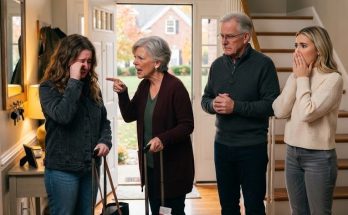
Ten years earlier, my sister had stood in our parents’ kitchen and forced them to choose between us in a single ultimatum, delivered with her arms crossed and her jaw set. They had chosen her, without a second’s real hesitation, and handed me sixty dollars on my way out the door.
For a long time afterward, I believed that night was the moment I lost my family for good.
I understand it differently now, looking back across a decade that reshaped nearly everything about who I turned out to be. That night, I didn’t lose my family at all. I lost only the version of it that required me to accept less, year after year, so that Vanessa could go on receiving more without ever having to ask what it cost anyone else.
The sixty dollars lasted three days, folded flat in my coat pocket, spent carefully on gas and grocery-store sandwiches.
The lesson underneath it lasted a great deal longer. I learned to read every contract twice before signing anything. I learned to build an emergency fund and never let it drop below a number that could carry me through six real months, no matter what.
I learned to build friendships that didn’t depend on shared blood to hold their weight, the way Denise’s couch and six unasked-for weeks of kindness had taught me long before I understood what I was actually learning. And I learned, slowly, painfully, to stop confusing being needed with being loved, which turned out to be the hardest lesson of all the ones that decade handed me.
Most importantly, when Vanessa walked into my office that rainy Tuesday morning, ten years after our parents chose her over me in a kitchen in Columbus, I finally had something in my life that she couldn’t demand from me, couldn’t borrow against, couldn’t inherit, and couldn’t talk our parents into handing over on her behalf.
A life that was entirely, unmistakably my own.