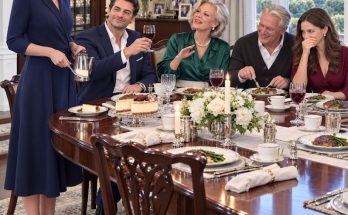
Cornered, Vanessa finally snapped.
“Then ask him about the six million he lost! Ask him who told me to create the company so we could move the money! Your son was the one who said Claire was in the way!”
The entire ballroom fell silent.
Mark stared at Vanessa as if he could make her disappear.
“Shut up.”
“No! You told me the insurance money would cover the debts and then we’d start over.”
That sentence ended everything.
I felt no victory.
Only exhaustion.
Fourteen years of marriage had just been reduced to a confession born from panic.
The ballroom doors opened.
Investigators entered with representatives from the prosecutor’s office.
The case was already active because of Olivia’s evidence, the financial reports, and everything my attorney had submitted.
The gala had simply forced Mark and Vanessa to reveal themselves publicly.
An investigator approached Mark.
“Mark Reynolds, we have an order requiring you to appear in connection with allegations involving fraud, document forgery, fraudulent financial activity, and an investigation into attempted murder.”
Mark looked at me.
For the first time, I didn’t see the charming husband.
The polished executive.
The man who always knew exactly what to say to make me doubt myself.
I saw someone terrified.
“Claire, you did this.”
“No,” I said. “You did. I just stopped protecting you from the consequences.”
When he tried to step toward me, the investigators stopped him.
Vanessa started crying.
Diane screamed that it was my fault, then Vanessa’s, then the creditors’, then “bad luck.”
But no one could undo the decision she had made when she blindly placed her house at risk for her son.
Before they took Mark away, he turned toward me.
“What about Ethan? What are you going to tell him about his father?”
Pain hit my chest.
“The truth. The truth you never had the courage to tell him.”
The months that followed were exhausting.
Forensic examinations.
Interviews.
Hearings.
Financial audits.
My Georgetown house, inherited from my father, remained mine.
The forged contracts involving my firm were voided.
Mark’s company lost its investors.
With the life insurance policies, the sedative, the nighttime break-in, the fabricated mental-health narrative, and the financial records, prosecutors built their case.
Mark was eventually sentenced to prison for the offenses proven against him, including attempted murder and fraud connected to the forged documents.
Vanessa was also convicted for her involvement in the financial scheme.
Diane did not go to prison because investigators could not prove she knew about the plan to kill me.
But she lost the home she had used as collateral.
One day, she called.
“Claire… I have nowhere to go.”
I stayed silent.
For years, that woman had told me that what belonged to me also belonged to Mark.
That a good wife obeyed.
That protecting my father’s inheritance was selfish.
“I can give you the contact information for a social worker and an attorney who can review your options,” I told her. “But I’m not going to pay for decisions you made while helping someone hurt me.”
She hung up crying.
I felt no satisfaction.
Only a boundary.
Six months later, I drove to Virginia to pick up Ethan.
When he came out of school and saw me beside the car, he dropped his backpack and ran toward me.
I hugged him so tightly that for a moment I felt the fear of that night all over again.
“Mom,” he said against my shoulder, “is it over?”
I looked at my son.
He had grown up far too quickly during those months.
No teenager should ever have to know that his father tried to turn his mother’s death into a financial transaction.
“That part is over,” I told him. “Now ours begins.”
We drove back to Washington together.
For a while, I couldn’t bring myself to live in the Georgetown house.
Every creak in the wooden floors reminded me of Mark’s footsteps climbing the stairs.
But I refused to sell it.
It had belonged to my father.
It belonged to me.
And more importantly, it was no longer a trap.
I replaced the locks.
Updated the electrical system.
Changed the windows.
I opened the hidden room and removed every document I had stored there for years.
Then I converted my father’s old study into a workspace for Ethan and me.
My design firm changed too.
I removed everyone who had knowingly participated in the falsifications.
I protected the employees who had provided evidence in good faith.
And I created internal safeguards I once would have considered excessive.
A business needs procedures.
A family needs love.
Neither survives blind obedience.
A year later, I received a national design award for transforming an abandoned industrial building into a cultural center.
During an interview, a journalist asked me how I could ever trust anyone again after such a betrayal.
I thought about Mark.
Diane.
Vanessa.
But I also thought about Ethan.
David.
Olivia.
And everyone who had chosen to tell the truth when telling it cost them something.
“I still believe in trust,” I said. “What I no longer believe is that loving someone means handing them the keys to your judgment. Love without boundaries can turn into permission. And boundaries don’t destroy families. Sometimes they’re the only thing that can save you from one.”
That night, Ethan was building a robot for a school competition.
“Did you win?” he asked.
I showed him the award.
“Now it’s your turn.”
I opened the garden doors.
The night air moved the curtains.
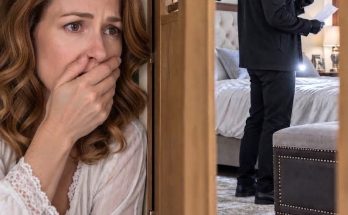
I looked toward the staircase Mark had climbed that night carrying a syringe and a lie already prepared to explain my death.
I felt no fear.
Justice cannot give back the years taken from you.
But it can return something essential.
The right to decide what happens with your life after the damage.
Ethan looked up from his robot.
“Mom, are you okay?”
I looked at him and smiled.
“Yes. I am now.”
Because that night, my son saved my life with a phone call.
But later, I realized that survival was not hiding inside a secret room.
Survival was stopping myself from making excuses for the man who wanted to destroy me.
Protecting what belonged to me.
And learning that no promise of love is worth more than your own dignity.
And ever since then, whenever I lock my front door at night, I no longer wonder who might come inside.
I think about something far simpler:
at last, no one inside the house wants me gone.
THE END