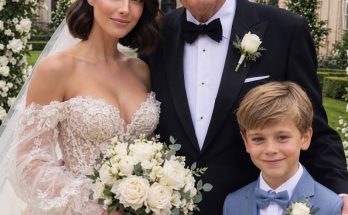
“Yes, Caleb,” I whispered, watching the firelight dance across the room. “He was the best kind of guardian angel there is.”
Epilogue: The Garden at Sunset
Two years after Arthur Pendelton’s passing, the evening sun dipped low over the cliffs of the coastal estate, painting the sky in deep shades of gold, amber, and violet.
The waves broke steadily against the rocks below, carrying a cool, salty breeze that rustled through the hydrangeas along the stone terrace. In the center of the garden stood a simple, elegant bench carved from white marble, inscribed with a single line:
Arthur Pendelton (1943–2024) “Love is not something you buy or inherit. It is something you protect.”
I sat on the marble bench holding a warm cup of herbal tea, watching the golden light dance across the lawn. Beside me sat an iPad displaying the quarterly audit report for the Pendelton Children’s Medical Foundation.
Two years ago, when Arthur handed me the keys to his empire, I was terrified. I was a woman who had spent a decade juggling nursing shifts, counting pennies for groceries, and lying awake at night praying my son’s body wouldn’t give out before I could find a way to save him. The thought of managing a three-hundred-million-dollar charitable trust felt like being asked to pilot a ship through a hurricane without a map.
But Arthur’s legal and financial team had honored their late chairman’s wishes with absolute loyalty. And more importantly, I soon discovered that running a medical foundation didn’t require an MBA from Harvard. It required empathy, grit, and the unyielding memory of what it felt like to sit in a cold hospital hallway staring at an estimate you couldn’t pay.
In twenty-four months, the foundation had funded over four hundred life-saving pediatric heart surgeries across the country. Every month, I personally reviewed the grant applications. Every month, four dozen mothers received a phone call telling them that their child’s surgery was paid for in full—no strings attached, no debts owed, no nightmare estimates left on the kitchen table.
A sudden burst of laughter pulled me from my thoughts.
Down on the lower lawn, eleven-year-old Caleb was sprinting toward a soccer net, a black-and-white ball rolling ahead of his sneakers. His golden retriever, Barnaby, bounded beside him, barking happily.
Caleb paused, looked back over his shoulder, and called out, “Watch this, Mom!”
He planted his left foot and kicked the ball straight into the top right corner of the net. He threw his hands into the air, doing a dramatic victory dance on the grass before dropping down to hug Barnaby.
My chest swelled with a warmth so deep it brought sweet, quiet tears to my eyes.
Looking at him now—tall, strong, cheeks flushed with dark, healthy color, his lungs drawing deep, easy breaths—it was almost impossible to remember the pale, frail eight-year-old boy who couldn’t walk up a flight of stairs without gasping for air. His surgical scar had faded to a thin, silver line across his chest—a quiet badge of honor, a reminder of the miracle that an old man’s final act of defiance had given us.
“You’re getting better at that bend!” a voice called out from the terrace steps.
I turned to see Sarah, our lead foundation director and Arthur’s former chief of staff, walking down the stone path holding a leather folder.
“He gets faster every week, Clara,” Sarah smiled, taking a seat beside me on the bench. “I checked the physical therapy reports from his last routine checkup. The cardiologist says his heart function is completely normal. He’s officially cleared for competitive youth soccer next season.”
“He’s been begging me to sign him up for two months,” I laughed, wiping a speck of dust from my eye. “I guess I don’t have any excuses left.”
Sarah opened her folder, sliding a printed executive summary onto my lap. “The board approved the new regional hospital initiative this morning. We’re opening the third Pendelton Pediatric Wing in Chicago next spring. The facility will house sixty dedicated beds for low-income families needing specialized pediatric cardiology.”
I looked down at the renderings of the new wing—bright, sunlit rooms, private family suites, playground courtyard gardens—and felt Arthur’s presence as clearly as if he were sitting beside us on the marble bench.
“He would be so proud of this, Sarah,” I whispered.
“He knew what he was doing, Clara,” Sarah said softly, looking out over the ocean. “For forty years, Arthur watched people use his name and his money for status, power, and greed. His own children saw him as nothing more than a bank account waiting to be divided. When he brought you into this house, everyone thought he had lost his mind. But he didn’t lose his mind. He found his legacy.”
She paused, offering a gentle smile. “Julian and Victoria tried to appeal the trust terms again last month, by the way.”
I didn’t even feel a flicker of anxiety. “And?”
“The judge dismissed the petition with prejudice in less than ten minutes,” Sarah replied smoothly. “The toxicology records and financial trail are permanently sealed in the court archive, but the waiver they signed remains ironclad. They receive their mother’s small legacy allowance, and not a penny more. They will never touch this foundation.”
“Good,” I said quietly. I held no hatred for Arthur’s children anymore. Anger takes energy, and my energy belonged to my son and to the hundreds of children whose lives were waiting to be saved.
As the sun began to dip beneath the horizon, casting long, crimson shadows across the lawn, Sarah excused herself to finish the evening filings.
I stayed on the bench as the stars began to blink awake in the twilight sky.
Caleb ran up the terrace steps, breathing heavily, Barnaby trotting faithfully at his heels. He sat down beside me, leaning his head against my shoulder, his small, warm hand sliding into mine.
“What are you looking at, Mom?” he asked softly, looking out at the ocean.
“Just thinking about Arthur, sweetie,” I said, putting my arm around his shoulders and pulling him close.
Caleb looked at the marble inscription on the bench, then down at his own chest, where his heart beat strong, steady, and vibrant beneath his shirt.
“Do you think he knows?” Caleb asked quietly. “Do you think he knows how happy we are?”
I looked up at the evening sky, feeling the cool ocean breeze blow gently through my hair, carrying the soft, eternal peace of a house that had finally learned what it meant to be a home.
“I know he does, Caleb,” I whispered, kissing the top of his head. “He’s watching every single step you take.”
Caleb smiled, squeezed my hand, and rested his head against my arm as the stars shone brightly above us—a mother and her son, safe, whole, and finally, beautifully home.
THE END