**Part 4**
Chapter 13
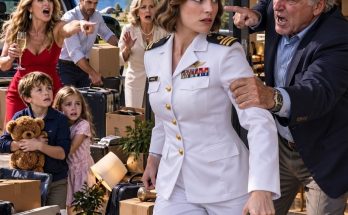
“You pinky-promised,” she reminded me.
“I did.”
“Mr. Buttons says goodbye.”
I held the rabbit out to her. She shook her head firmly.
“No. You keep him. Until I come back. Then I’ll know you’ll let me come back.”
I looked down at the worn little rabbit with its dangling button eye.
“Deal,” I said.
Susan was the last one to leave. She paused at the bottom of the porch steps.
“Katherine.”
“Yes?”
“I made extra pancakes. They’re in the fridge. I know that’s a silly thing to say.”
“It’s not silly.”
She hesitated. Then she climbed back up the steps and gave me a quick, awkward hug. The first hug we had shared in twenty-three years.
“I’m proud of you,” she whispered. “Your mother would be too.”
Then she hurried down to the car before I could see her face.
Dad stood by the driver’s door. He didn’t come up to the porch. He just looked at me for a long moment across the snowy driveway.
Then he lifted his right hand to his forehead.
A salute.
It was crooked. Clumsy. The fingers were in the wrong position, the elbow too low. It was the salute of a man who had never served a day in uniform and had only ever seen it on television.
It was the most beautiful salute I had ever received.
I returned it, crisp and correct.
Then he got into the car, and they drove away down the mountain.
Ethan and I sat on the dock that afternoon, legs hanging over the edge, wrapped in wool blankets. The water was so clear I could see smooth stones twenty feet below.
“You could have made this so much worse for them,” he said after a while. “You know that, right? Michael would have gone to war for you.”
“I know.”
“So why didn’t you?”
I thought about it for a long time.
“Because winning isn’t the same as ending it,” I said. “If I’d had them hauled out in front of those kids, Dad would have spent the rest of his life telling everyone how cruel I was. Olivia would have believed him. Mason and Lily would have grown up thinking their Aunt Kate was the monster in the ceiling who threw them out into the snow.”
I pulled the blanket tighter around my shoulders.
“This way, the truth came out. Not because I forced it out. Because they finally had to look at it.”
Ethan nodded slowly.
“James would’ve liked you, you know,” I said. “He always said the best officers are the ones who know which fights to win and which ones to end.”
“I think I would’ve liked him too.”
We sat in the quiet. A heron flew low across the water, its wings nearly brushing the surface.
“So,” Ethan said eventually. “A retreat for Gold Star families. That’s going to need a lot of work. Accessibility. Wi-Fi. A smart home system that doesn’t accidentally startle six-year-olds.”
“She wasn’t startled. She waved.”
Chapter 14
“She waved,” he agreed, grinning. “I’m putting that in my report as a successful operation.”
“Are you volunteering?”
He shrugged, looking out at the lake instead of at me.
“I’m getting out of the contract world next spring. I’ve been looking for something that actually means something. Figured I might stick around Tahoe for a while.”
I didn’t say anything. But I didn’t look away either.
The next six months were the hardest and best months I had lived through since James died.
I went back to San Diego and finished my last tour. Every weekend I could get away, I drove north. Michael handled the nonprofit filings. Ethan rewired half the house and installed ramps for wheelchairs, grab bars in every bathroom, and, at Lily’s written request, delivered by mail in purple crayon, “a night light that looks like a lighthouse.”
Dad’s first payment arrived on the first of December. Five hundred dollars exactly, with a note attached.
Payment 1 of 100. I’m sorry. —Dad
The second arrived January first. Payment 2 of 100. Still sorry.
By March, the notes had changed.
Payment 4 of 100. Susan and I drove out to see the kids in Carson City. Mason scored two goals. Lily lost her front tooth and looks like a jack-o’-lantern. She asked if Mr. Buttons is behaving. I told her he’s a Navy rabbit now and follows orders.
I read that one three times. Then I put it in my desk drawer, beside James’s watch.
Olivia called every Sunday night. Not because I asked her to. Because she wanted to.
The first few calls were stiff and careful, like two people learning to dance again after a long time apart. Then, somewhere around January, she started telling me real things. That she’d gotten a job as a front-office manager at a dental practice. That David was working ten-hour days for Ethan’s friend and coming home exhausted but proud. That they were seeing a marriage counselor through their church.
“He cried in the second session,” she told me. “David. Actual tears. I’ve been married to that man for eleven years, and I’d never seen him cry.”
“How did it feel?”
She was quiet for a moment.
“Like meeting him for the first time,” she said. “The real him. Not the guy who was always pretending.”
One night in February, she called late. Much later than usual.
“Kate. Can I ask you something?”
“Of course.”
“Were you lonely? After James? All those years?”
I was sitting on the floor of my apartment, surrounded by moving boxes. My retirement date was set for May.
“Yes,” I said. “Every single day.”
“I’m sorry I wasn’t there.”
“You’re here now.”
“I am,” she said firmly. “And I’m not going anywhere.”
On the last Saturday in June, the James Mercer Harbor House officially opened its doors.
I stood on the front porch of the villa in my dress whites for what I knew would be one of the last times. My retirement ceremony had been two weeks earlier. Twenty-two years, three ships, and one small, worn stuffed rabbit riding in my pocket during the ceremony.
Chapter 15
Nobody knew about the rabbit except Ethan. He had spotted one ear sticking out and grinned at me across the room the entire time.
The driveway was full of cars. Friends from the fleet. Michael and his wife. Sergeant Diane Holloway, off duty, holding a plate of homemade brownies. “I don’t usually attend openings,” she told me. “But I’ve never had a call end with a hug before. I wanted to see how the story turned out.”
And the families. Four of them, for the first week. A young Marine widow from Camp Pendleton with twin toddlers. A retired Army colonel who had lost his son overseas and hadn’t taken a vacation in eleven years. A Coast Guard spouse and her teenage daughter, both of them quiet and watchful and wary, the way I had once been.
And a Navy family from Norfolk: a mother and her three kids who had lost their father in the same kind of training accident that had taken James.
The mother found me on the dock during the reception. She was about thirty-five, with tired eyes and a small, careful smile.
“They told me you lost your husband too,” she said.
“I did. Almost seven years ago.”
“Does it get easier?”
I looked out across the water. Her children were on the shore skipping stones with Mason and Lily, who had appointed themselves official Harbor House greeters and were taking the job very seriously.
“It doesn’t get easier,” I said. “But it gets different. One day you realize you’ve been laughing for five whole minutes before you remember to feel guilty about it. And then one day, you stop feeling guilty at all.”
She nodded slowly, blinking hard.
“Thank you,” she said. “For this. For all of this.”
“Thank James,” I said. “It was his idea.”
At four o’clock, we gathered in front of the house for the ribbon cutting.
Michael gave a short speech. Ethan gave an even shorter one, most of which was about Wi-Fi passwords. Everyone laughed.
Then it was my turn.
I stood in front of that cedar-sided house with its big windows full of sunlight and looked out at all the faces watching me.
“Nine months ago,” I began, “I came home to this house after three weeks at sea and found out it wasn’t mine anymore.”
I saw Dad at the back of the crowd, standing beside Susan. He dropped his eyes to the ground.
“I was angry. I was hurt. I had every legal right to make the people who took it pay for what they did.” I paused. “And I made sure they understood that. I made sure the truth came out. But then I had to decide what to do with that truth. And I realized the most powerful thing I could do wasn’t to take something away from them. It was to give something back.”
I looked at my father.
“My family and I have a long way to go. We’re not perfect. We probably never will be. But we’re trying. Every Sunday on the phone. Every first of the month when a check arrives. Every time my niece sends me a drawing in purple crayon.”
Chapter 16
The crowd laughed softly.
“This house was always meant to be a home. Not just for me. For anyone who has lost the person they built their home around. So to every family walking through these doors, today and every day after: welcome home.”
Lily stepped forward holding the enormous ceremonial scissors with both hands. According to Olivia, she had rehearsed this moment for three weeks. She approached it with the gravity of a four-star admiral.
“Ready, Aunt Kate?”
“Ready.”
She cut the ribbon. It took three tries. Everybody cheered anyway.
The celebration went on long after the sun began sliding toward the western peaks.
Burgers on the grill. Kids running barefoot across the lawn. The retired Army colonel, who had barely spoken all day, sat on the porch with Dad for over an hour, the two older men talking quietly about fathers and sons and everything they wished they’d done differently.
Near sunset, Dad found me alone at the end of the dock.
He stood beside me for a while without saying anything. We both watched the light turn the water gold.
“Payment ten of a hundred goes out next week,” he said finally.
“I know.”
“I’ve been thinking.” He cleared his throat. “When I’m done paying you back, I’d like to keep going. Five hundred a month. For Harbor House. For as long as I can.”
I turned to look at him.
“You don’t have to do that, Dad.”
“I know I don’t have to.” His voice was thick. “That’s why I want to.”
He reached into his jacket pocket and pulled out something small. A folded card. The same birthday card he had handed Sergeant Holloway nine months earlier.
Dad, whatever happens, you’ll always have a place with me.
“I shouldn’t have used this,” he said. “Not the way I did. It wasn’t a deed. It wasn’t permission. It was my daughter telling me she loved me, and I was too proud and too blind to read it right.” He pressed the card into my hand. “I’d like to earn it this time. If you’ll let me.”
I looked at the card. At my own handwriting, four years younger. At the faded ink.
Then I folded it carefully and handed it back to him.
“Keep it,” I said. “It was always true, Dad. You just had to come to the right door.”
He made a sound I had never heard him make before. Half laugh, half sob.
Then my father, Walter Hale, who hadn’t hugged me since the day my mother died, pulled me into his arms and held on tight.
We stood there together at the end of the dock as the sun slipped behind the mountains.
Later, much later, after the families had settled into their rooms and soft light glowed in every window, I sat alone on the porch steps with a cup of tea.
Ethan came out and sat down beside me. He handed me a wool blanket without a word.
“Every light in the house is on,” he said.
Chapter 17
“I noticed.”
“Nine months ago, you turned them all off.”
“Nine months ago, the wrong people were inside for the wrong reasons.”
He smiled.
“And now?”
I looked up at the windows. A child’s silhouette moved behind one of the curtains. Somewhere inside, a mother was laughing. The lighthouse night light glowed in the room with the painted sailboat on the wall, where the Navy widow’s youngest son was falling asleep in the bed I had once bought for children I never got to have.
“Now,” I said, “it’s exactly the way James imagined it.”
Ethan was quiet for a moment. Then he reached over and, very gently, took my hand.
I didn’t pull away.
Down on the shore, the lake lay perfectly still under the first stars. Like glass. Like the whole world was holding its breath.
My father had once told me to go back to my base.
In the end, he was right.
I just hadn’t understood, until that night, that home was never a building. It was the place where you finally stopped defending yourself and let the people you love come back inside.
And for the first time in a very long time, I was home.
THE END