**Part 2**
The next morning, I received a phone call from the lawyer.
“Can you meet me at Eleanor’s house?”
Something in her voice made me sit upright.
“What happened?”
“We found discrepancies.”
I drove over immediately.
Tom came too.
Macaroni rode in his carrier beside me, wrapped in one of Grandma’s old knitted blankets.
The Victorian house looked different when I pulled into the driveway.
Quieter.
Almost hollow.
Police weren’t there.
But two representatives from the estate were standing inside with tablets and printed photographs.
The lawyer led me upstairs.
Grandma’s bedroom still smelled faintly like lavender powder.
Her reading glasses sat beside the bed.
A half-finished book rested on the nightstand.
For a moment, grief hit me so hard I had to grip the doorframe.
Macaroni began crying from his carrier.
I opened it.
He stepped out.
Then something happened that shattered me.
He ran straight to Grandma’s bed.
Jumped onto it.
Walked to her pillow.
Circled twice.
And lay down.
He waited.
I sat beside him and cried silently.
The lawyer gave me a minute.
Then she showed me what was missing.
A jewelry case.
Two antique watches.
Several envelopes of emergency cash.
A small collection of gold coins.
And one emerald brooch that had belonged to my great-grandmother.
Estimated total value?
Nearly ninety thousand dollars.
All had been photographed by the estate attorney one month earlier.
All were gone.
There was only one person who had been alone in the house after Eleanor died.
Brenda.
“She took them,” I whispered.
The lawyer didn’t answer.
She didn’t need to.
But Grandma had one final surprise.
The old house had cameras.
Not obvious ones.
She had installed them after the unauthorized developer visits.
The system recorded motion in the entry hall, study and upstairs corridor.
At 2:14 p.m., only ninety minutes after Grandma died, Brenda appeared on camera carrying an empty tote bag upstairs.
At 2:27, she came back down.
The bag was full.
Three separate trips followed.
Then, at 3:06, she carried Macaroni downstairs by the scruff of his neck.
He twisted desperately in her hand.
My stomach turned.
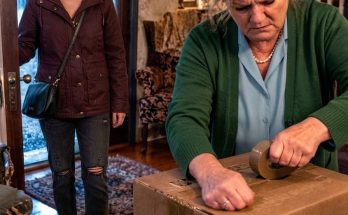
She dropped him into the cardboard box.
The camera had no audio in that room.
It didn’t need any.
We watched Brenda fold the top closed.
Tape it.
Pick it up.
Walk out.
That afternoon, the lawyer contacted Brenda.
Within two hours, every missing item was returned.
Brenda claimed she had merely taken them “for safekeeping.”
Nobody believed her.
The estate chose not to pursue criminal charges after all items were recovered, partly because Grandma’s instructions strongly favored protecting the charitable assets rather than spending years destroying the family in court.
But Brenda received written notice that any further interference with the estate would trigger immediate legal action.
She disappeared from town three days later.
The developers disappeared with her.
And then the strangest part of Grandma’s plan began.
The trust did not sell the house.
Instead, using part of Grandma’s liquid assets, the trust converted the property.
The formal dining room became an adoption meeting space.
The old sunroom became a kitten nursery.
A detached carriage house was renovated into a veterinary treatment room.
The six acres behind the home became secure outdoor rehabilitation areas.
Grandma’s enormous kitchen became storage for food donations and medicine.
And the room Brenda had already measured for demolition became the volunteer office.
Tom cried the first time he saw the architectural plans.
“You know what she told me once?” he said.
We were standing beneath the huge oak tree behind the house.
“What?”
“She said this place was too big for one old woman.”
I smiled.
“That sounds like her.”
Tom shook his head.
“No. She said something else.”
He looked toward the house.
“She said, ‘Someday I’ll figure out how to fill every room again.’”
Six months later, she did.
The Eleanor Whitmore Rescue House opened on a Saturday morning.
No expensive gala.
No champagne.
Grandma would have hated that.
We had folding chairs.
Coffee.
Homemade cookies.
Volunteers.
Veterinarians.
Families looking to adopt.
And approximately thirty-seven animals making enough noise to wake the dead.
I liked to think Grandma appreciated that.
Above the entrance hung a small bronze plaque.
Not a giant portrait.
Not a list of donations.
Just one sentence.
CHARACTER IS WHAT REMAINS WHEN KINDNESS BECOMES INCONVENIENT.
Tom had suggested it.
I approved it immediately.
Macaroni became the unofficial king of the place.
The seventy-five-thousand-dollar trust turned out to be comically excessive for one healthy orange cat, but Grandma had known exactly what she was doing.
Every reimbursement I didn’t use remained invested.
Every dollar left after his lifetime would eventually help other animals.
So I bought him good food.
Took him for regular checkups.
And refused to purchase the ridiculous diamond-studded cat collar Tom once jokingly sent me a link to.
Macaroni preferred a three-dollar cardboard scratching pad anyway.
Naturally.
Almost a year passed before I saw Brenda again.
She came to the rescue house alone.
No designer suit.
No clipboard.
No real estate developer.
She stood outside the front gate for nearly five minutes before entering.
I watched from the porch.
Macaroni was asleep in a patch of sunlight beside my chair.
Brenda noticed him.
She stopped.
He noticed her too.
His body immediately stiffened.
That tiny reaction told me animals remembered more than people liked to believe.
Brenda stayed several feet away.
“I’m not here to cause trouble,” she said.
I didn’t answer.
She looked at the house.
Children were laughing inside.
A volunteer carried a basket of clean towels through the hallway.
Somewhere in the back, a dog barked.
Then another answered.
Brenda swallowed.
“I drove past three times before coming in.”
“Why?”
She looked embarrassed.
“I don’t know.”
I did.
But I let her find the words herself.
Finally, she said, “I hated that cat.”
Macaroni opened one eye.
Brenda almost laughed.
“I hated him because Mother loved him.”
That surprised me.
She stared toward the gardens.
“I used to visit her and she’d barely talk to me. Then she’d spend twenty minutes telling me Macaroni climbed a curtain.”
“She talked about you too.”
Brenda looked at me.
“She did?”
“All the time.”
That seemed to hurt worse.
She sat carefully on the far end of the porch.
“She and I fought for years.”
“I know.”
“I kept thinking the house was the proof.”
“Proof of what?”
“That she finally valued me.”
There it was.
Not greed exactly.
Something older.
Uglier.
A wound that had turned into greed because Brenda had fed it for too long.
“She left you eight hundred thousand dollars,” I said.
Brenda closed her eyes.
“I know.”
“She did value you.”
“I know that now.”
Macaroni stood.
Brenda immediately tensed.
He walked toward me instead and climbed into my lap.
I stroked his back.
“I could have killed him,” Brenda whispered.
“Yes.”
No softening.
No pretending.
She needed the truth.
“Tom said ten more minutes.”
Her eyes filled.
“I know.”
“You sealed the box.”
“I know.”
“And then you lied about it.”
“I know.”
For several seconds, she cried quietly.
I didn’t hug her.
Some things aren’t healed by pretending accountability is cruelty.
Then she reached into her purse.
My body tightened.
But she only removed an envelope.
“I sold my condo.”
I frowned.
“What?”
“I bought something smaller.”
She placed the envelope on the table.
Inside was a cashier’s check.
One hundred thousand dollars.
Payable to the Eleanor Whitmore Animal Protection Trust.
I stared at it.
“I don’t want this if you’re trying to buy forgiveness.”
“I’m not.”
“Then why?”
Brenda looked at Macaroni.
“Because I spent almost a year being furious that Mother gave my money to animals.”
She wiped her face.
“Then I realized it was never my money.”
That sounded like Eleanor.
Maybe some lessons just took longer.
I took the check.
Not for me.
For the rescue.
“I still don’t trust you,” I said.
“I know.”
“And this doesn’t erase anything.”
“I know.”
“But Grandma would want it used.”
Brenda nodded.
“I know.”
Then she stood.
She hesitated at the steps.
“Can I ask you something?”
“What?”
“What was in the cardboard box she left me?”
I stared at her.
“You never opened it?”
She shook her head.
“I couldn’t.”
I almost smiled.
“Open it.”
Brenda left without another word.
Three days later, I received a photograph from an unknown number.
A cardboard box was sitting on a kitchen table.
Inside was one object.
Grandma’s old red umbrella.
Beneath it was another note.
Brenda had photographed that too.
It said:
FOR THE NEXT TIME YOU SEE SOMETHING HELPLESS IN THE RAIN.
I laughed so hard I cried.
That was Eleanor.
Even dead, she refused to waste a perfectly good lesson.