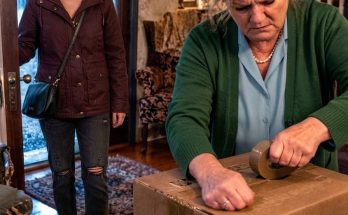
She handed me the paper.
My hands shook so violently the paper rattled like dry leaves in the wind. There, at the bottom of the lab report, printed in bold black ink, were the results: Probability of Paternity: 99.98%. Father: Julian Vance.
“For five years, he paid every cent of child support through a third-party attorney,” Chloe choked out. “He never missed a payment. But he never came to see her. He was too afraid to love her, because loving someone meant he could lose them.”
“Until she got sick,” I breathed, my tears finally breaking through, hot and stinging against my cold skin.
“Until six months ago,” Chloe agreed, her voice breaking completely. “When Nora’s kidneys began failing, I reached out to his lawyer in absolute desperation. None of my family matched. The public registry had a three-year waitlist, and the doctors told me Nora wouldn’t survive eight months. Two days later, Julian showed up at my apartment. He didn’t say a word about the past. He just looked at Nora, sat on the floor, and played blocks with her for three hours.”
Chloe looked toward the porch swing, where the little girl was gently swaying back and forth, hugging her rabbit.
“He called me that night,” Chloe whispered. “He told me, ‘I failed her for five years because I was a coward. I am not going to let my fear kill my daughter.’ He went to the clinic the next morning under an alias to get tested. When he found out he was an exact match, he wept on my living room sofa. He told me it was the first time in his life he felt like his existence actually mattered.”
I sank down onto the wooden porch bench, clutching the paper to my chest.
The pieces of the last few months began falling into place with devastating, terrifying clarity. The way Julian had suddenly started coming over to my house every Sunday, sitting at the kitchen table, staring at old childhood photo albums of his deceased brother. The way he had held my hand in the hospital corridor before his surgery, his voice trembling as he said, “Mom, if anything happens to me, I need you to know that I finally fixed the biggest mistake I ever made.”
I had thought he was talking about an old career choice. I had thought he was talking about leaving his high-paying job to work for a non-profit.
He was talking about his daughter.
“He made me promise never to tell you unless the surgery went wrong,” Chloe said, kneeling on the cold floorboards in front of me, taking my shaking hands in hers. “He didn’t want you to carry the weight of his secret if he lived. He wanted to earn the right to tell you himself. He was planning to bring Nora to your house next Sunday for dinner to introduce her as your granddaughter.”
I covered my face with my hands and wept—raw, agonizing, ragged sobs that tore through my throat. My son was gone. My sweet, terrified boy, who had carried the silent trauma of his brother’s death for a decade, had stepped into the very nightmare he feared most to save his child.
And in doing so, he had left me with the piece of him I thought I had lost forever.
PART 3: THE LIVING LEGACY
The house felt different that evening.
The suffocating, heavy stillness that usually accompanies a funeral had shifted into something else—a delicate, trembling quiet.
I sat at the kitchen table with a cup of tea that had long gone cold. Beside my mug lay the DNA report, a stack of Julian’s old baby photos, and a small wooden box he had left in his bedroom closet.
I had opened that box an hour after Chloe left. Inside were dozens of printed photographs he had quietly saved over the last five years—photos Chloe’s lawyer had forwarded to him every month. Photos of a baby girl taking her first steps, a toddler wearing a yellow raincoat, a young girl smiling with a gap in her front teeth.
Beneath the photos was a handwritten letter addressed to me, sealed in a white envelope bearing my name in his familiar, hasty cursive.
My fingers trembled as I broke the wax seal.
Mom,
If you’re reading this, it means my luck finally ran out, and the thing I’ve been running from my entire life caught up with me.
I am so sorry. I know the pain of losing a child—I watched you survive it when we lost Thomas, and it broke something inside me that I never knew how to fix. For years, I believed that love was just a setup for unbearable grief. When Chloe told me she was pregnant six years ago, I panicked. I let my fear make a coward out of me. I thought that if I kept my distance, if I stayed a stranger, I could protect myself from ever feeling that crushing loss again.
I was wrong. Staying away didn’t protect me; it just made me empty.
When I saw Nora six months ago, I saw Thomas in her eyes. I saw you in her smile. I realized that fear isn’t a reason to run away—it’s the tax we pay for loving someone deeply. She needed me, Mom. For the first time in my life, my fear didn’t matter.
If I don’t make it off that operating table, please don’t let my mistake define her life. She doesn’t know what a father is, but she deserves to know what a grandmother’s love feels like. Show her the garden. Teach her how to bake those cinnamon rolls Thomas and I used to fight over. Tell her about her dad, but don’t tell her I was a hero.
Tell her I was just a man who finally found his way home.
I love you, Mom.
Julian.
I pressed the letter to my lips, my tears soaking into the paper.
He hadn’t died in vain. He hadn’t died as a tragic victim of a cruel fate. He had died in an act of absolute, triumphant redemption. He had faced his darkest, most suffocating terror, walked straight into the hospital operating room that had haunted his nightmares for fifteen years, and traded his life so his daughter could have hers.
The doorbell rang softly.
I stood up, wiped my face with the back of my hand, and walked to the front door.
Chloe stood on the porch under the warm yellow light, holding a small overnight bag. Beside her, little Nora was yawning, rubbing her eyes with her small fist, still clutching her stuffed rabbit.
“I know it’s late,” Chloe said nervously, her voice hesitant. “We were staying at a hotel near the clinic, but… I didn’t know where else to go. I can leave if you need space—”