**Part 3**
By afternoon, Chloe was awake enough to eat half a banana.
I sat beside her bed.
“Grandma?”
“Yes, sweetheart?”
“Am I in trouble?”
My heart cracked.
“No.”
“Daddy said everybody would lose the house if I was bad.”
“You were never bad.”
She stared at the blanket.
“Mommy cried.”
I swallowed.
“I know.”
“She said I had to help.”
“You’re six years old, Chloe. Grown-ups are supposed to help you. You are never supposed to save grown-ups from their own choices.”
She thought about that.
Then looked at me.
“Is Daddy mad?”
“I don’t know.”
“Are you mad?”
I wanted to lie.
Instead I said, “Yes.”
“At me?”
“Never at you.”
She reached for my hand.
I gave it to her.
She fell asleep holding two of my fingers.
That was when Julian called.
Not me directly.
His attorney contacted Detective Chen and said Julian wanted to speak to his mother.
I refused.
For twenty minutes.
Then I changed my mind.
Not because I wanted answers.
Because there was one question I needed him to hear.
The call was recorded.
Julian’s voice came through a phone in a small consultation room at the hospital.
“Mom?”
I said nothing.
“I know what you think.”
“No, Julian. You don’t.”
“We weren’t going to hurt her.”
“You drugged your daughter.”
“I was going to wake her.”
“You locked her inside a casket.”
“For a few hours.”
“She thought she was dead.”
“No. No, we explained—”
“She thought if she woke up she would destroy the family.”
His breathing changed.
“That was Victoria.”
“There it is.”
“What?”
“The thing you’ve done your entire life.”
“What are you talking about?”
“Whenever you break something, you find someone standing nearby and point at them.”
“That’s not fair.”
“You’re forty years old.”
“Mom—”
“You told your six-year-old daughter she had to pretend to be dead because you were afraid of losing your house.”
“It wasn’t only the house.”
“I don’t care.”
“You don’t understand what was happening.”
“You’re right. I don’t understand.”
My voice started shaking.
“I don’t understand how the son I raised could watch his little girl stop moving and decide the next step was to close the lid.”
Silence.
Then Julian cried.
A broken sound.
The kind of crying that would once have destroyed me.
It didn’t.
“I panicked.”
“No.”
“What?”
“You planned.”
He stopped.
“Panic is running a red light because your child can’t breathe. Panic is forgetting your wallet at the hospital. Panic is making one terrible decision in one terrible second.”
I stared through the glass wall at Chloe sleeping down the corridor.
“You bought a casket.”
Julian said nothing.
“You forged documents.”
Silence.
“You created another identity.”
Still nothing.
“You purchased a cabin.”
His breathing grew heavier.
“You insured your daughter.”
“Mom—”
“You didn’t panic, Julian.”
My voice became steady.
“You built this.”
And I hung up.
The investigation lasted eleven months.
By the time it ended, the story had become national news.
Reporters camped outside the courthouse.
Commentators argued about motive.
Strangers online invented theories.
But the truth was uglier than any conspiracy.
It was greed mixed with fear.
Debt mixed with entitlement.
Two parents who kept crossing lines until the lines disappeared.
Julian pleaded guilty after prosecutors recovered messages between him and Victoria.
The worst one had been sent six weeks before Chloe’s fake death.
Victoria:
What happens if she wakes up during the viewing?
Julian:
She won’t.
Victoria:
You can’t guarantee that.
Julian:
Then we make sure nobody opens it.
Another message came later.
Victoria:
Your mother will want to see her.
Julian:
I’ll handle Mom.
He had known.
He knew exactly what I would want.
And he built the plan around manipulating me.
Victoria eventually accepted a plea too.
Neither of them could convincingly claim the other had acted alone.
There were too many messages.
Too many purchases.
Too many shared decisions.
The fake doctor.
The medication.
The cabin.
The insurance.
The forged documents.
The false death announcement.
The casket.
The sedation.
The threats that made Chloe believe her family’s survival depended on her silence.
They went to prison.
Not forever.
No sentence could ever feel long enough to me.
But long enough for Chloe to grow up without them controlling every room she entered.
I became her temporary guardian first.
Then permanent.
The first few months were difficult.
She slept with the hallway light on.
She refused to close her bedroom door.
If she woke and couldn’t see me, she screamed.
She hated flowers.
Especially white lilies.
She couldn’t watch cartoons with sleeping princesses.
And for almost a year, she panicked anytime someone whispered around her because she believed whispering meant adults were planning something.
We found a therapist she trusted.
A pediatrician who explained every medicine before giving it to her.
A school counselor who never forced her to talk.
Slowly, Chloe came back.
Not the exact child she had been before.
Trauma doesn’t return what it takes in perfect condition.
But something else appeared.
Strength.
At seven, she joined an art class.
At eight, she learned to swim.
At nine, she stood on a school stage and forgot half her lines in a play, then laughed so hard the audience laughed with her.
That night, after the performance, she ran into my arms.
“Grandma!”
“You were wonderful.”
“I forgot everything!”
“You remembered enough.”
She smiled.
Then she asked me something I never expected.
“Do you still have the key?”
I knew immediately which key.
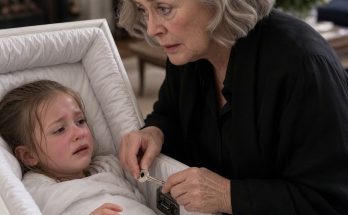
The tiny metal key I had pulled from beneath the casket lining.
The one that opened the restraint.
Police had kept it as evidence.
After the case ended, it had been returned to me inside a sealed property envelope.
“Yes.”
“Can I see it?”
I hesitated.
Then I brought it to her.
Chloe held it in her palm.
It looked impossibly small.
A cheap piece of metal.
Nothing special.
Yet once, it had been the difference between a child being trapped and a child being carried into the light.
“What should we do with it?” I asked.
She stared at it for a long time.
Then she closed her hand.
“Keep it.”
“Why?”
“So we remember.”
My throat tightened.
“Remember what?”
She looked at me.
Her face was older now.
Not old.
Just no longer six.
“That somebody opened it.”
I couldn’t speak.
So I hugged her.
And for years, that little key stayed in a wooden box in my bedroom.
Not as a reminder of Julian.
Not of Victoria.
Not of the insurance policy.
Not even of that terrible casket surrounded by white lilies.
It reminded me of one moment.
A sound so faint I almost dismissed it.
A tiny scrape.
A whisper from a place where nobody expected life.
Because sometimes evil does not announce itself with screaming.
Sometimes it sits inside a beautiful house.
It wears expensive clothes.
It signs funeral cards.
It tells relatives not to ask questions.
It says everything is under control.
And sometimes the difference between tragedy and rescue is one person refusing to walk away when something feels wrong.
Twelve years after that night, Chloe graduated from high school.
I sat in the front row.
She was eighteen.
Healthy.
Tall.
Nervous.
Alive.
When her name was called, she crossed the stage in a blue graduation gown and accepted her diploma.
I cried harder than I had at any graduation in my life.
Afterward, families crowded the football field with balloons and flowers.
Chloe found me near the bleachers.
She hugged me.
Then she slipped something into my hand.
Metal.
Cold.
Small.
I opened my fingers.
The key.
I stared at her.
“I thought this was in my bedroom.”
“It was.”
“You took it?”
“Borrowed it.”
She smiled.
Then she turned the key over.
Something had been engraved on one side.
Three tiny words.
I OPENED MY EYES.
I looked at her.
“Chloe…”
She hugged me again.
For a moment, I couldn’t see anything through the tears.
Then she whispered beside my ear.
“Daddy said waking up would ruin everything.”
I held her tighter.
Around us, hundreds of people were laughing.
Taking photographs.
Calling names.
Celebrating children stepping into their futures.
Chloe pulled back and smiled at me.
“He was wrong.”
I closed my fingers around the key.
“Yes,” I said.
“He was.”
Because the night Chloe opened her eyes did ruin something.
It ruined Julian’s lies.
It ruined Victoria’s plan.
It ruined the future they had built on fear, money, and the belief that a six-year-old child could be controlled forever.
But it did not ruin Chloe.
It saved her.
And every birthday after that, every school picture, every scraped knee, every laugh from the kitchen, every ordinary Tuesday morning when I heard her running down the stairs was proof of the same thing.
The casket had never been the end of her story.
It was the place where the truth finally woke up.