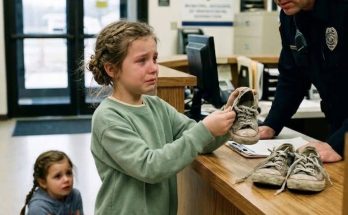
The father had officially claimed the children ran off because they refused their medicine, yet Charlotte had just stated that her sister was given the liquid without knowing what it was. The narrative had split cleanly down the middle, and Terrence knew from decades of police work that the truth usually lay with the person who held the least power.
He printed out the digital pharmacy receipt, placed it right beside the sealed syringe, and typed a new entry into the official station logbook: Two juvenile females present at front desk requesting immediate protection prior to parental arrival.
Just as he saved the file, the sound of wet tires slipping on the asphalt echoed from the parking lot outside. Terrence glanced through the glass doors, expecting to see the flashing red lights of the incoming ambulance.
Instead, a sleek black SUV pulled into the lot at high speed, parking diagonally across two designated spaces. The driver’s side door flew open, and a well-dressed man stepped out into the pouring rain while holding a cell phone to his ear.
“He’s here,” Charlotte whispered in terror, her small body freezing completely as she spotted the vehicle.
Delilah made a low, panicked whimpering noise, burying her face into her sister’s gray hoodie. The man outside was wearing an expensive dark overcoat and carrying a bright pink children’s backpack tucked under his arm.
Terrence looked at the sealed evidence bag, then at the printed pharmacy record, and finally at the two terrified girls huddled near his desk. He did not hesitate for a single second.
He walked quickly to the front entrance, turned the heavy brass deadbolt, and dropped the secondary security latch into place with a loud click. He then guided the two girls behind the solid wooden counter where they could not be seen from the parking lot.
“Stay down here and keep quiet,” Terrence instructed them gently. “Nobody is coming through that door without my permission.”
Locking the public doors of a police station against a citizen was a highly unusual action that could lead to administrative scrutiny, but Terrence did not care. He knew that explaining a locked door to a police chief was far better than handing two endangered children back to an abuser.
PART 4: THE CONFRONTATION AT THE GLASS
The metallic door handle rattled loudly from the outside as Dr. Douglas Sinclair tried to push his way into the station lobby. When the door refused to budge, he knocked heavily on the reinforced glass pane.
“Officer, open this door right now!” Douglas called out, his voice sounding polished and authoritative through the glass. “My daughters are inside there with you! They are sick and confused, and they need their father!”
Behind the counter, Charlotte quickly placed both of her hands over Delilah’s ears to block out their father’s voice. Terrence ignored the man at the door, stepping back to his desk to pick up the internal phone line.
“Dispatch, this is Officer Callahan at the front desk,” Terrence said calmly. “The reporting party from the missing children call, Dr. Douglas Sinclair, is currently outside my locked front door. I have both juveniles inside requesting emergency protective custody.”
“Understood, Officer Callahan, secondary units are two minutes away,” the dispatcher replied over the receiver.
Outside, Douglas held his professional identification card up against the glass pane, his face showing a mixture of annoyance and stern authority. “I am Dr. Douglas Sinclair!” he shouted clearly. “I am a licensed physician, and I prescribed the exact medication my daughter requires! You are unlawfully interfering with a medical situation!”
Terrence walked over to the glass door, standing a few inches away from the locked pane without making any move to open it. “Your report to dispatch claimed the girls ran away because they refused their medicine,” Terrence said through the frame. “Your daughter inside tells a very different story about what happened in your kitchen.”
For a fraction of a second, the doctor’s composed expression flickered, revealing a sharp flash of genuine shock. It vanished almost instantly, replaced by a warm, sympathetic smile that looked completely practiced.
“Officer, my children are seven years old and easily confused,” Douglas explained smoothly, maintaining a calm tone. “Delilah has a mild stomach bug, and Charlotte got frightened when her sister became upset. Please, let’s settle this reasonable misunderstanding inside where it’s dry.”
Terrence watched the man’s face closely through the glass pane. During his thirty years on the force, he had seen many frantic parents whose children were missing or sick, and they were always visibly distressed, emotional, and unraveled.
Dr. Sinclair, however, was entirely controlled, adjusting his posture and tone like an actor fine-tuning a performance for an audience. He was not worried about his daughter’s health; he was calculating how to regain control of the narrative.
“We are going to wait right here until the paramedics and additional officers arrive,” Terrence stated plainly, refusing to argue.
“You are making a massive professional mistake, Officer Callahan,” Douglas warned softly, reading the name tag on the policeman’s uniform. “I know the chief of your department personally, and this bizarre behavior will be reported immediately.”
Before Douglas could say anything further, the siren-less lights of an emergency ambulance flashed across the wet pavement as the vehicle pulled into the precinct parking lot. A second police cruiser arrived right behind it, blocking the doctor’s black SUV from leaving the premises.
Two paramedics hopped out of the ambulance carrying medical kits, while Officer Marcus Bennett stepped out of the secondary patrol car. Terrence quickly unlocked the side entrance to let the medical personnel into the precinct.
“Where are the patients?” paramedic Sarah Jenkins asked as she rushed inside with her partner, an experienced medic named Todd.
“Right behind the main desk,” Terrence directed them. “The seven-year-old named Delilah is experiencing severe abdominal distress and lethargy. The twin sister is uninjured but traumatized.”
Todd immediately dropped to one knee beside Delilah, speaking in a low, soothing voice to keep her calm while he checked her vital signs. Sarah focused on Charlotte, asking careful questions about what the girls had eaten or drunk earlier in the afternoon.
“Did your sister swallow anything from a bottle or a cup?” Sarah asked Charlotte gently.
“Daddy gave her liquid from a plastic tube,” Charlotte answered clearly. “He told her it was fruit juice, but it tasted bad, and then her stomach started hurting real bad.”
Outside on the sidewalk, Officer Bennett approached Dr. Sinclair to inquire about the situation. Charlotte looked through the lower glass window and suddenly pointed at the pink backpack held firmly under her father’s arm.
“Look!” Charlotte called out, her voice rising in panic. “There is another plastic tube in the front pocket of that pink bag! I saw him hide it in there before we ran away!”
PART 5: THE SECOND SYRINGE
Hearing Charlotte’s warning, Terrence immediately stepped out the side door onto the wet pavement alongside Officer Bennett. “Dr. Sinclair, I need you to set that children’s backpack down on the hood of the patrol car right now,” Terrence commanded.
Douglas offered a condescending laugh, stepping back toward the open door of his SUV. “This is completely absurd,” Douglas said smoothly, holding the bag tighter against his chest. “This is my daughter’s school bag containing her personal items. I am taking it inside my vehicle out of the rain.”
“Set the bag down immediately, sir!” Officer Bennett ordered, taking a step forward and placing his hand firmly on his duty belt.
Recognizing that he was outnumbered in full view of the station’s security cameras, Douglas slowly set the pink backpack onto the wet hood of the cruiser. Officer Bennett immediately secured the item while Terrence unzipped the small front compartment.
Inside the front pocket lay a second plastic oral syringe, identical to the one Charlotte had hidden in her sneaker. It was wrapped tightly in a soggy white paper towel alongside a torn piece of printed paper.
“What do we have here?” Officer Bennett asked, holding the plastic bag open as Terrence extracted the paper fragment with gloved fingers.
The paper fragment was half of a printed pharmacy prescription label, showing a partial patient name and dosage instructions. Terrence held the torn piece up against the receipt he had printed earlier inside the station.
The serial numbers matched perfectly, but the patient name on the label was not Delilah or Charlotte Sinclair. The prescription had been officially issued to Dr. Douglas Sinclair for a potent, adult-strength sedative compound that was strictly forbidden for pediatric use.
“This medication was prescribed directly to you, Dr. Sinclair,” Terrence said, looking up from the paper with a cold glare. “It contains explicit black-box warnings against administering it to children under any circumstances.”
Douglas did not flinch, maintaining his composed, professional posture despite the damning discovery. “As a physician, I am fully aware of what that label says,” Douglas replied smoothly, directing his speech toward Officer Bennett. “I was preparing my own medication at the kitchen counter while simultaneously trying to manage my daughter’s illness. I accidentally mixed up the dispensers during a chaotic moment.”
“You mixed up identical syringes and then checked your children’s pockets before they left the house?” Terrence challenged him directly.
“I am an overworked parent dealing with two difficult seven-year-olds,” Douglas argued calmly. “The moment I realized my terrible oversight, I called emergency services to report them missing so they could be located and treated. I acted responsibly.”
“You reported to dispatch that they ran away after refusing their medicine,” Officer Bennett noted, reading the dispatch log on his pocket computer. “You made no mention of an accidental overdose of a prescription sedative.”
“I was panicked and stressed!” Douglas countered, his tone hardening slightly. “Now step aside so I can check on my daughter’s condition!”
“Dr. Douglas Sinclair, you are under arrest for felony child endangerment and domestic abuse,” Terrence stated clearly, pulling his handcuffs from his belt. “Turn around and place your hands behind your back.”
For the first time, a flash of genuine anger broke through the doctor’s polished exterior. “Do not touch me!” Douglas snapped, pulling his arms back. “I demand to speak with my legal counsel immediately! You are making a catastrophic mistake that will cost you your law enforcement career!”
Officer Bennett quickly grabbed the doctor’s left arm, forcing it behind his back while Terrence clicked the steel cuff around his wrist. “You have the right to remain silent,” Terrence read the Miranda rights aloud as they escorted the handcuffed doctor toward the rear seat of the patrol car. “Anything you say can and will be used against you in a court of law.”